Razer Viper V3 Pro Technical Spec Analysis and Overview
The Razer Viper V3 Pro enters the competitive esports arena as a stripped-back, high-frequency wireless gaming mouse designed around pure tracking performance. Built with Razer’s updated Focus Pro 35K Optical Sensor Gen-2, optical Gen-3…
By Harold Blair
As Amazon Associates, we earn from qualifying purchases. This means we may receive a small commission at no extra cost to you if you click through and make a purchase.
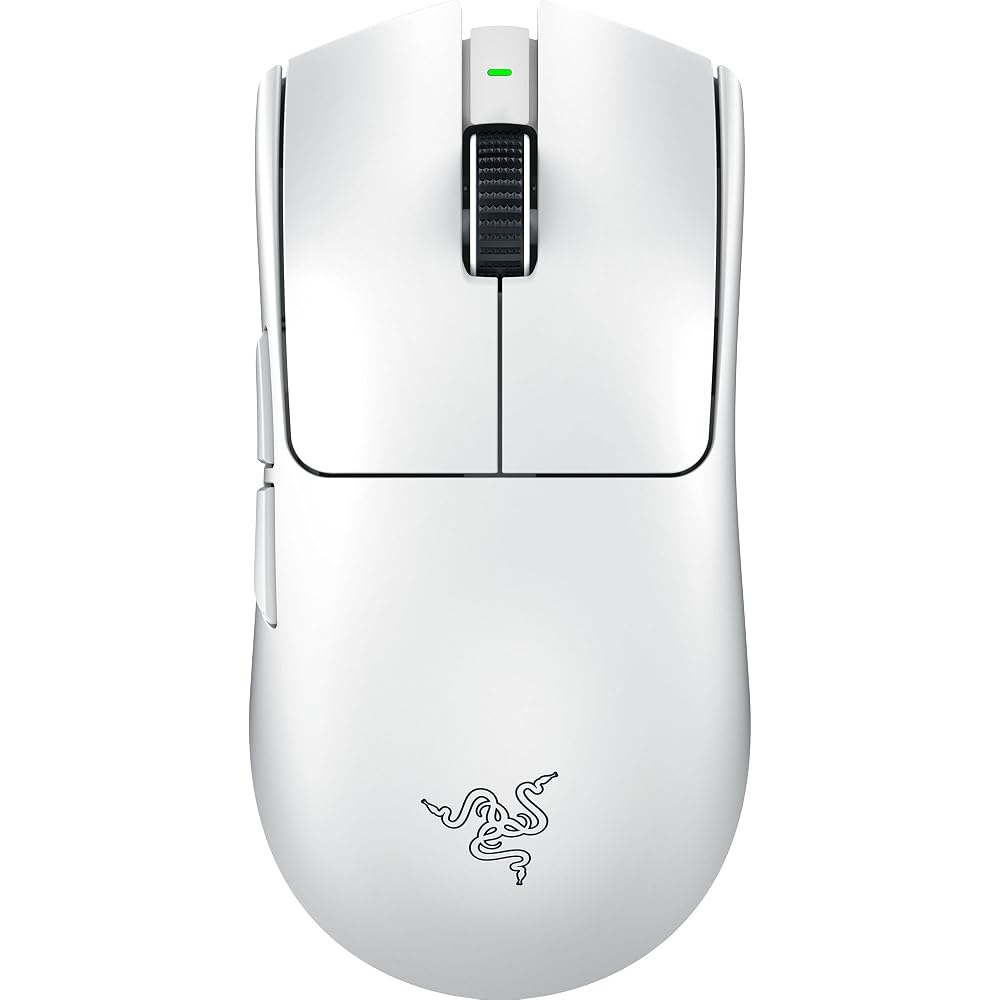
The Razer Viper V3 Pro enters the competitive esports arena as a stripped-back, high-frequency wireless gaming mouse designed around pure tracking performance. Built with Razer’s updated Focus Pro 35K Optical Sensor Gen-2, optical Gen-3 microswitches, and native 8000 Hz wireless reporting via the included HyperPolling Wireless Dongle, the hardware is tailored strictly for twitch responsiveness. Our technical evaluation confirms that this 55-gram pointer eliminates traditional mechanical debounce bottlenecks and tracking inconsistencies, establishing itself as a benchmark tool for twitch-heavy competitive play.
This mouse directly suits tournament-focused esports competitors, micro-aim tacticians, and fast-paced first-person shooter specialists who demand maximum polling stability and granular DPI configuration. Gamers seeking an asymmetrical palm-filling shell, expansive thumb grids for MMO macros, or native Bluetooth connectivity for multi-device productivity will need to look at alternative gear categories.
Spec sheet
Razer Viper V3 Pro
- Sensor Model
- Focus Pro 35K Optical Sensor Gen-2
- Maximum Sensitivity
- 35,000 DPI (with 1-DPI step adjustments)
- Maximum Polling Rate
- Up to 8000 Hz true wireless polling
- Total Physical Weight
- 55 grams (ultra-lightweight chassis)
- Primary Switch Type
- Optical Mouse Switches Gen-3 (0.2 ms actuation, 90M click life)
- Connectivity Modes
- Razer HyperSpeed Wireless, Wired (Type-C)
- Total Button Count
- 6 programmable buttons
- Chassis Dimensions
- 4.75 inches (Length) x 2.5 inches (Width)
- Rated Battery Runtime
- Up to 95 hours (1 Lithium-Ion battery included)
- Operating System Compatibility
- Windows 10+, macOS 10.12 Sierra+, Linux (Ubuntu 4.10+)
Figures as published by the manufacturer on the Amazon listing.
Sensor Architecture and Focus Pro 35K Tracking Precision
The operational core of the Razer Viper V3 Pro centers on the updated Focus Pro 35K Optical Sensor Gen-2. Capable of scaling from minimal sensitivity up to a ceiling of 35,000 DPI, this optical implementation allows granular 1-DPI step adjustments through the Razer Synapse App. Standard enthusiast sensors often force stepped increments of 50 or 100 DPI, which can frustrate players attempting to replicate their exact hipfire and scoped sensitivities across varied display resolutions or game engine sensitivity sliders. The granular stepping ensures micro-adjustments translate directly into the digital coordinate space without rounding errors.
Surface versatility represents a key architectural focus for the razer viper v3 pro focus pro 35k design. Competitive setups increasingly incorporate polished tempered glass pads alongside traditional woven cloth or micro-textured hybrid mouse surfaces. The Gen-2 optical sensor array utilizes intelligent surface calibration algorithms to maintain liftoff distance consistency and tracking integrity on transparent and glossy materials. This eliminates the cursor flutter and tracking spinouts that historical optical sensors experienced when encountering glass mouse pads under violent directional swipes.
To maximize raw sensor fidelity, Razer explicitly recommends that users optimize accuracy by disabling the native “Enhance pointer precision” feature inside Windows mouse settings. This operating system toggle introduces a dynamic acceleration curve that alters cursor travel based on hand speed rather than physical distance. Bypassing Windows acceleration curves ensures a completely linear 1:1 hardware output, allowing muscle memory to govern flicks, target acquisition, and micro-tracking routines with mathematical repeatability.
HyperSpeed Wireless and 8000 Hz Polling Mechanics
Input frequency is where the razor v3 pro specs diverge sharply from conventional gaming peripherals. Paired out of the box with the specialized HyperPolling Wireless Dongle, the unit achieves a true razer viper v3 pro polling rate of up to 8000 Hz. Standard esports peripherals transmit coordinate packets at 1000 Hz, corresponding to a 1.0-millisecond transmission interval. Operating at 8000 Hz drops that packet interval to an ultra-dense 0.125 milliseconds. This eightfold increase in reporting density directly matches high-refresh tournament monitors running at 240 Hz, 360 Hz, or 540 Hz, ensuring minimal frame-render delay between hand movement and on-screen crosshair alignment.
High-frequency wireless throughput demands significant protocol stability. Razer deploys proprietary HyperSpeed Wireless protocols engineered to maintain uninterrupted packet delivery across congested radio frequencies. The listing rates the wireless range up to 100.0 meters, reflecting substantial signal strength designed to resist interference in stadium esports environments saturated with wireless headsets, mobile devices, and competitor dongles. Serious esports enthusiasts pairing high-frequency inputs across peripherals, much like users running a razer wolverine v3 pro 8k pc controller configuration, require this level of connection stability to prevent dropped input queues.
Users routing complex tournament battle stations can simplify connectivity by routing high-speed USB receivers through clean hubs such as a razor thunderbolt 5 dock, maintaining direct line of sight between the transmitter and the mouse pad. Operating at 8000 Hz places higher computational demands on the host computer’s processor to handle elevated USB interrupt routines. While high-end gaming rigs easily ingest these 0.125 ms packet intervals, competitive players retain the option within the companion software to scale polling down to standard intervals if balancing system resource utilization during intense streaming or background rendering workflows.
Gen-3 Optical Switches and Click Actuation Speed
Button actuation on the Viper V3 Pro is managed by Razer Optical Mouse Switches Gen-3. Conventional mechanical switches rely on physical metal contacts snapping together, a process that naturally creates contact bounce and electrical noise. To prevent a single click from being registered multiple times, mechanical mice enforce an artificial debounce delay, holding the switch signal until contact chatter subsides. The razer viper v3 pro optical switches bypass this mechanical compromise entirely by utilizing an infrared light beam to register clicks.
When the switch plunger is depressed, a physical shutter interrupts the internal infrared light pathway, transmitting an instantaneous electrical impulse to the host controller. This optical execution achieves a 0.2-millisecond actuation speed with zero debounce delay. Eliminating physical leaf spring friction also eradicates the risk of unintended double-clicking degradation over extended ownership. Razer rates the Gen-3 optical switches for an endurance lifecycle of 90 million clicks, providing the mechanical longevity necessary to withstand relentless tournament scrim schedules and tactical shooter tap-firing.
The physical button array comprises 6 independently assignable buttons arranged in a functional esports configuration. The primary left and right click plates feature subtle ergonomic finger grooves to keep pads centered during violent resetting motions. Alongside two distinct side thumb buttons, a tactile scroll wheel, and an integrated function button, the switch configuration delivers crisp tactile feedback without the mushy overtravel that can plague ultra-light mouse shells.
Chassis Dimensions and 55g Weight Distribution
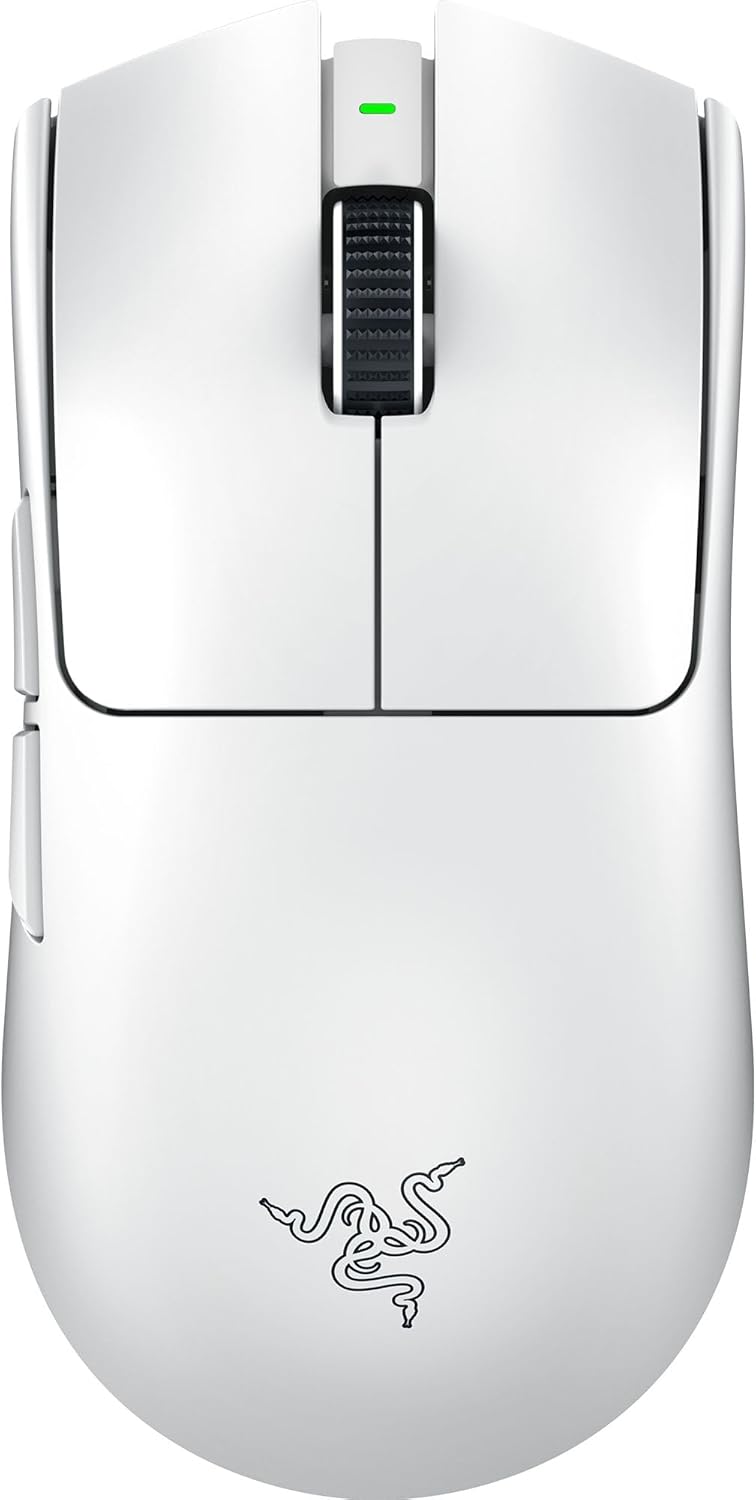
Chassis engineering plays a defining role in whether an esports pointer succeeds during competition. The razer viper v3 pro weight is measured at an ultra-light 55 grams in a clean white finish, accomplished entirely through rigid structural injection molding without cutting honeycomb holes into the outer shell. Perforated shells can permit dust, sweat, and debris to collect on internal surface-mounted components; maintaining a solid structural shell preserves internal component hygiene and high torsional rigidity under heavy hand pressure.
The mouse footprint reflects aggressive competitive handling requirements. Listed at razer viper v3 pro dimensions of 4.75 inches in length by 2.5 inches in width (the listing does not specify vertical height), the shell exhibits a balanced, elongated profile. Designed in collaboration with global esports professionals, the mass distribution is centered across the midpoint of the chassis. This balanced equilibrium prevents the rear end from dragging during sweeping arm swipes or the nose from dipping when players reposition the mouse during low-DPI crosshair adjustments.
The external profile features a right-handed ergonomic form factor designed around precision claw, fingertip, and hybrid grip architectures. By tapering the waist inward to 2.5 inches, the mouse provides intuitive thumb and ring-finger anchor points. This form factor makes the razer viper v3 pro for competitive fps titles such as tactical shooters and battle royales exceptionally agile, allowing players to execute micro-corrections and rapid target transfers with minimal muscular resistance across extended gameplay sessions.
Battery Performance and Multi-Platform Compatibility
Balancing battery capacity against extreme weight reduction is a classic peripheral engineering challenge. The internal single Lithium-Ion cell delivers a razer viper v3 pro battery life rating of up to 95 hours of competitive gaming. This endurance provides multi-week uptime for average players and ample longevity to carry esports competitors through grueling multi-day tournament brackets without mid-match recharging interruptions.
When wired replenishment becomes necessary, the mouse operates seamlessly in tethered mode over its physical connection interface. Players can continue active matches while charging the internal battery without introducing operational latency spikes. Once connected via USB, the mouse functions simultaneously as an active high-speed wired peripheral and battery charging unit.
System compatibility covers major operating system environments. The official razer viper v3 pro compatibility specifications support Windows 10, Mac OS 10.12 Sierra, and Ubuntu Linux 4.10 Warty Warthog or higher. While basic pointing, tracking, and optical switch activations function seamlessly across all modern personal computers, specialized tuning functions—including 1-DPI calibration curves, sensor lift-off tracking optimization, and polling rate step adjustments—are configured through the Razer Synapse desktop application on compatible environments.
Razer Viper V3 Pro Pros and Cons
What works
- True 8000 Hz wireless polling rate
- Ultra-lightweight 55-gram solid shell
- Focus Pro 35K Gen-2 optical sensor
- Gen-3 optical switches with zero debounce
- Up to 95 hours battery life
What to weigh up
- Right-hand orientation excludes left-handed gamers
- Six-button layout limits macro-heavy games
- Listing does not specify chassis height
Check Razer Viper V3 Pro on Amazon
Who Should Buy the Razer Viper V3 Pro
Buy It If
- You compete in tactical FPS or battle royale titles and demand true 8000 Hz polling responsiveness paired with an ultra-light 55-gram balanced shell.
- You prefer an optical switch mechanism that delivers 0.2 ms actuation, zero debounce delay, and complete immunity to mechanical double-clicking issues.
- You utilize specialized mouse surfaces, such as glass mouse pads, and require the surface-agnostic tracking of the Focus Pro 35K Gen-2 optical sensor.
- You want granular sensitivity tuning down to individual 1-DPI increments to match your crosshair speed across multiple titles.
Skip It If
- You require an ergonomic left-handed chassis layout, as this model features dedicated right-handed button and thumb placement.
- You rely on extensive macro clusters, MMO thumb arrays, or more than the 6 standard programmable buttons provided on this tournament shell.
- You need native Bluetooth pairing support to toggle quickly between multiple work laptops and tablets without using a USB dongle.
Final Verdict
4.6 / 5Amazon buyer rating, 2,155 ratings
When asking if the is razer viper v3 pro worth it for serious PC gaming, the technical specifications speak directly to its competitive viability. By integrating the Focus Pro 35K Optical Sensor Gen-2, 8000 Hz HyperPolling technology, and Gen-3 optical switches inside an uncompromised 55-gram solid shell, Razer has delivered a precision tracking platform devoid of unnecessary weight or latency penalties. Every hardware inclusion serves the express goal of minimizing input delay and stabilizing crosshair control on the tournament stage.
While the specialized six-button configuration and right-hand orientation mean it does not attempt to serve productivity generalists or MMO macro users, it excels within its designated domain. For esports competitors and performance-oriented players who demand uncompromising wireless telemetry, ultra-crisp switch actuations, and dependable tracking across cloth and glass surfaces, the Razer Viper V3 Pro stands as an exceptionally engineered weapon of choice.
FAQ
What is the maximum wireless polling rate of the Razer Viper V3 Pro?
The Razer Viper V3 Pro delivers a true wireless polling rate of up to 8000 Hz using its bundled HyperPolling Wireless Dongle, reducing input transmission intervals to 0.125 milliseconds.
Can the Focus Pro 35K Gen-2 sensor track accurately on glass surfaces?
Yes, the Focus Pro 35K Optical Sensor Gen-2 is engineered with pro-grade tracking algorithms that support a wide variety of mouse surfaces, including polished glass mouse pads.
How does the 1-DPI step adjustment function?
Using the Razer Synapse software, users can adjust the sensor sensitivity by exact 1-DPI increments across its 35,000 DPI range, avoiding the fixed 50 or 100 DPI step limitations of conventional sensors.
How long does the battery last on a single charge?
The mouse provides up to 95 hours of competitive gameplay on its internal rechargeable Lithium-Ion battery before requiring a connection to its wired charging interface.
What operating systems are supported by the Razer Viper V3 Pro?
The listing outlines compatibility with Personal Computers running Windows 10, Mac OS 10.12 Sierra, and Linux distributions including Ubuntu 4.10 Warty Warthog or later versions.
See this listing on Amazon We may earn a commission if you buy through this link.
More in Accessories & Peripherals


The weekly shortlist
Specs worth reading, once a week
New teardowns, spec sheets and buying notes from across the desk.
This demo form is not connected to a mailing service.