DWARFLAB Dwarf Mini Specs Breakdown & Optical Performance
The DWARFLAB Dwarf Mini is an ultra-compact, dual-axis smart imaging system engineered to automate deep-space astrophotography within an 840-gram enclosure. Built around a 30 mm objective lens, an integrated Sony IMX662 imaging sensor, and…

As Amazon Associates, we earn from qualifying purchases. This means we may receive a small commission at no extra cost to you if you click through and make a purchase.
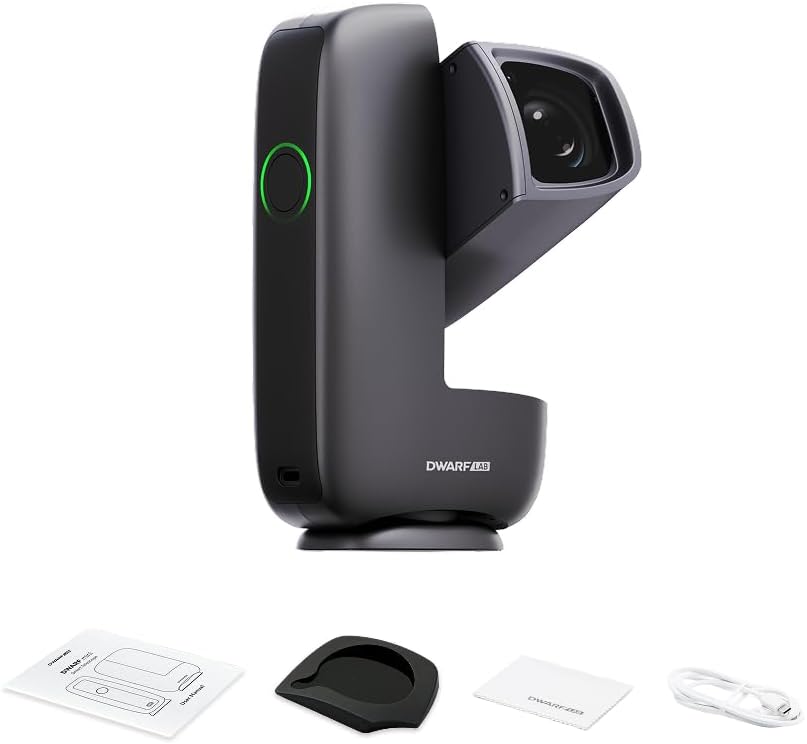
The DWARFLAB Dwarf Mini is an ultra-compact, dual-axis smart imaging system engineered to automate deep-space astrophotography within an 840-gram enclosure. Built around a 30 mm objective lens, an integrated Sony IMX662 imaging sensor, and an automated dual-mode Altazimuth and Equatorial mount, the unit functions as a self-contained digital rig controlled entirely through mobile hardware. As a motorized optical platform, this dwarf mini smart telescope eliminates the steep learning curve associated with manual polar alignment, physical star hopping, and manual dark calibration by packaging plate-solving automation, motorized GOTO navigation, and cloud stacking into a single portable instrument. In this comprehensive dwarf lab mini review, technical analysis reveals an imaging system specifically optimized for wide-field night-sky targets, balancing optical light grasp against remarkable travel portability.
This automated optical setup suits traveling astrophotographers, backpackers, and urban stargazers who require an operational rig that deploys in minutes without requiring heavy counterweights, external guiding scopes, or standalone power stations. Mobile observers seeking multi-minute integrated captures of sweeping nebulae and expansive open clusters will find its automated tracking and onboard filtration highly capable. Conversely, astronomers focused strictly on high-resolution lunar surface features or detailed planetary disks will find the fixed 150 mm focal length and 30 mm aperture constrained, and users wanting an interchangeable optical train must look to modular imaging rigs instead. Precision engineering in ultra-compact tech shares much in common with platforms like the bambu a1- mini, where streamlined mechanical miniaturization redefines how accessible complex fabrication or observation workflows can become.
Spec sheet
DWARFLAB Dwarf Mini
- Aperture (Objective Lens Diameter)
- 30 mm
- Focal Length
- 150 mm
- Focal Ratio
- f/5
- Field of View
- 2.45°
- Image Sensor
- Sony IMX662 (1/2.8-inch format)
- Image Output
- 2 MP RAW Output
- Mount Mechanics
- Dual-Mode Altazimuth (AZ) & Equatorial (EQ)
- Rotation Freedom
- 360° Motorized Pivot Freedom
- Maximum Single Exposure
- Up to 90 seconds
- Internal Filters
- Dark Filter, Astro Filter, Duo-Band Filter
- Physical Dimensions
- 2.39" D x 3.95" W x 7.23" H
- Unit Weight
- 1.85 lbs (1.9 lbs shipping spec / 840g)
Figures as published by the manufacturer on the Amazon listing.
Optical Assembly and Sony IMX662 Sensor Architecture
The optical system of the Dwarf Mini centers on a 30 mm objective lens paired with a 150 mm focal length, resulting in a fast f/5 optical configuration. To maximize photon transmission across the optical elements, the manufacturer applies a basic anti-reflection coating to the glass. This 150 mm focal length delivers an expansive 2.45-degree field of view, making the telescope fundamentally suited for extended deep-sky objects such as the Andromeda Galaxy (M31), the Orion Nebula (M42), and the Rosette Nebula, rather than pinpoint high-magnification planetary targets. The 30 mm exit pupil diameter matches the optical aperture, maintaining direct optical alignment across the compact chassis.
At the core of the imaging train lies the dwarf lab mini sony imx662 sensor. Built on an industry-standard 1/2.8-inch format, the IMX662 silicon utilizes back-illuminated pixel architecture with 2.9μm pixel pitch (specified alongside a 2μm metric in listing notes), producing uncompressed 2 MP RAW output. The listing specifications emphasize high sensitivity and exceptionally low read noise, which are critical parameters for pulling faint emission structures from light-polluted skies. For astrophotographers who prefer manual calibration over automated pipelines, having direct access to 2 MP RAW frames ensures compatibility with dedicated external stacking utilities like Siril, Astro Pixel Processor, or DeepSkyStacker.
When analyzing optical glass, sensor integration, and high light-gathering efficiency, parallels appear in premium camera lenses such as the tamron 28-75mm f/2.8 di iii vxd g2, where anti-reflective surfaces and modern digital sensors work together to suppress internal reflections and aberrations. Within the Dwarf Mini, the Sony silicon is tuned to work in harmony with the manual-and-auto focus motor, enabling users to lock critical star focus without touching the optical tube and introducing micro-vibrations.
Mount Mechanics, Motorized Tracking, and EQ Mode Capabilities
Operating a robotic telescope requires precise mechanical tracking to counteract the rotational velocity of the Earth. The Dwarf Mini integrates a dual-mode mount supporting both Altazimuth (AZ) and Equatorial (EQ) tracking configurations. Mechanically, the chassis boasts full 360-degree pivot freedom, allowing unobstructed slewing across the entire celestial sphere. In standard Altazimuth orientation, the mount tracks celestial targets by simultaneously adjusting altitude and azimuth axes, an operational mode suited for casual visual inspection and short integration runs.
The true technical differentiator for mobile astrophotography is the dwarflab dwarf mini eq mode. In conventional Altazimuth tracking, exposures exceeding 15 to 30 seconds suffer from field rotation, where stars at the edge of the sensor frame begin to streak in circular arcs around the center point. By activating EQ mode, the mount tracks along the right ascension axis parallel to Earth’s celestial equator. This mechanical orientation neutralizes field rotation, enabling a single-frame dwarf lab mini exposure time of up to 90 seconds. Clean 90-second sub-exposures permit the sensor to accumulate significantly more signal from faint emission nebulae before stacking, dramatically elevating overall signal-to-noise ratios.
The automated dwarf lab mini tracking system relies on internal motor drivers coupled with automated plate solving. By cross-referencing wide-field sky images against an integrated database, the mount verifies target positioning automatically. The physical housing measures just 2.39 inches deep, 3.95 inches wide, and 7.23 inches high, with a net weight of 1.85 pounds (840 grams). This diminutive form factor keeps rotational inertia low, ensuring the small internal drive motors maintain tracking precision without dropping steps or introducing tracking jitter during long single-frame exposures.
Integrated Filtration and Urban Astrophotography Performance
Urban light pollution presents a major challenge for wide-field astrophotography rigs. To counter stray light without requiring users to purchase third-party filter holders or thread adapters, the platform provides specialized dwarf lab mini filters built directly into the system. The integrated filter array includes three operational selections designed for distinct imaging scenarios:
- Dark Filter: Mechanically blocks incoming optical light to perform automated dark frame calibration, measuring and subtracting thermal sensor noise, amp glow, and hot pixels from the final image stack.
- Astro Filter: Boosts contrast across astronomical targets while enhancing infrared spectrum sensitivity, pulling out deeper hydrogen emission signals from active star-forming regions.
- Duo-Band Filter: A dual-bandpass filter optimized strictly for Hydrogen-Alpha (H-alpha) and Oxygen-III (OIII) emission wavelengths, cutting through artificial city glow, street lighting, and moonlight interference.
The Duo-Band filter transforms the dwarf lab mini specs from a basic travel telescope into a viable suburban light-bucket. By selectively isolating the 656.3 nm H-alpha and 500.7 nm OIII emission lines, the Dwarf Mini allows astrophotographers living in high Bortle class zones to image target nebulae that would otherwise be washed out by city luminescence. In addition to the internal filtration array, the physical product package includes one external physical filter, providing additional versatility out of the box.
Translating faint celestial signals into clear, dynamic, high-contrast images requires sophisticated processing workflows, not unlike modern display panels evaluated in the sony bravia 9 ii 2026 review that demand precise dynamic range tone mapping. In astrophotography, isolating faint emission wavelengths from the background sky glow is the essential first step before any digital stretching or noise reduction can take place.
Software Ecosystem, Sky Atlas Navigation, and Field Workflow
A smart telescope relies fundamentally on its software architecture, and the Dwarf Mini interfaces directly via the dedicated DWARFLAB App for mobile smartphones. The application houses an interactive star map and built-in sky atlas, mapping thousands of celestial coordinates into a visual catalog. Stargazers can simply tap an object on the digital sky chart to initiate the Auto GOTO sequence. According to the manufacturer data, an observer can progress from unboxing the unit to initiating their first live capture in approximately 3 minutes.
Focusing is handled through a hybrid manual-and-auto focus control system within the mobile interface. The software calculates point-source sharpness using onboard autofocus algorithms, automatically driving the internal focusing motor to minimize star star-fwhm (Full Width at Half Maximum) values. Users retain the option to fine-tune focus manually through virtual stepper controls on their smartphone screen, ensuring pinpoint stars across the entire 2.45-degree field of view.
Once raw frames are captured, the platform offers smart cloud processing alongside local device storage. Cloud processing offloads computational heavy lifting, applying automated dark frame subtraction, alignment, frame rejection, and background neutralization on remote servers. For mobile users operating out of field locations without high-bandwidth internet, the system also supports local processing and direct export of uncompressed 2 MP RAW frames via the included USB-C cable or local wireless connection, keeping users in total control of their data.
DWARFLAB Dwarf Mini Pros and Cons
What works
- Ultra-lightweight 1.85 lb grab-and-go chassis
- Sony IMX662 sensor with 2MP RAW output
- Dual-mode Altazimuth and Equatorial tracking
- Up to 90-second single-frame exposure capability
- Built-in Duo-Band, Astro, and Dark calibration filters
- Fast 3-minute setup with interactive sky atlas
What to weigh up
- Modest 30 mm objective lens aperture
- Fixed optical assembly without interchangeable lenses
- Limited magnification for planetary and lunar observation
- Internal nonstandard battery requires USB-C power source
Check DWARFLAB Dwarf Mini on Amazon
Who Should Buy the DWARFLAB Dwarf Mini
Buy It If
- You prioritize field portability and require a fully motorized astrophotography rig weighing under 2 pounds for hiking and dark-sky travel.
- You capture wide-field deep-sky targets like large emission nebulae and open star clusters that benefit from a 2.45-degree field of view.
- You shoot in light-polluted suburban environments and want built-in Duo-Band and Astro filtration to isolate H-alpha and OIII spectrums.
- You want 90-second single-frame sub-exposures enabled by a motorized dual Altazimuth and Equatorial tracking mount.
Skip It If
- Your primary astronomical interest is resolving fine details on Jupiter, Saturn’s ring system, or small lunar craters requiring long focal lengths and large apertures.
- You require interchangeable camera sensors, dedicated guide scopes, or standard threaded optical tube accessories.
- You plan extended off-grid expeditions where you cannot recharge the internal nonstandard battery via a USB-C power bank.
Final Verdict
8.8/10Our score
When considering whether the Dwarf Mini is worth it, buyers must weigh its physical footprint against optical physics. The engineering team at Tinyphoton Technology has integrated an impressive array of hardware features into this 1.85-pound device. Combining an automated Altazimuth/Equatorial dual mount, a high-sensitivity Sony IMX662 back-illuminated sensor, and an internal multi-filter array featuring Duo-Band and automated dark-frame calibration creates a truly capable grab-and-go deep-sky platform. Its 30 mm aperture and 150 mm focal length clearly prioritize broad celestial vistas over high-magnification planetary targets, delivering crisp 2.45-degree wide-field framing.
For mobile observers, outdoor adventurers, and suburban backyard stargazers who refuse to haul massive equatorial wedges and heavy battery packs into the field, the Dwarf Mini offers a frictionless entry point into automated deep-sky astrophotography. By streamlining alignment, motorized tracking, filtration, and raw data export into a unified mobile app workflow, the DWARFLAB Dwarf Mini delivers exceptional functional value for astrophotographers seeking extreme travel capability without sacrificing long-exposure equatorial tracking.
FAQ
What is the optical aperture and focal length of the DWARFLAB Dwarf Mini?
The telescope features an objective lens diameter of 30 millimeters and an optical focal length of 150 millimeters. This configuration yields a fast focal ratio of f/5 and provides an expansive 2.45-degree field of view, tailored for framing extensive nebulae, large galaxies, and open star clusters.
How does the equatorial mode prevent field rotation during long exposures?
In standard Altazimuth mode, stars appear to slowly rotate around the center of the frame during multi-second captures due to the Earth’s axial rotation. When set to Equatorial (EQ) mode, the motorized mount tilts its tracking axis to match the celestial pole, rotating at a single sidereal rate. This mechanical alignment eliminates rotational streaking and unlocks single-frame exposures of up to 90 seconds.
Which filters are integrated into the Dwarf Mini imaging system?
The telescope features a built-in filter mechanism consisting of three dedicated options: a Dark Filter for automated dark frame thermal noise calibration, an Astro Filter designed to optimize contrast and infrared sensitivity on faint nebulae, and a Duo-Band Filter specifically tuned to isolate Hydrogen-Alpha and Oxygen-III light wavelengths while cutting through urban light pollution. The retail package also includes an additional physical filter.
Can I export uncompressed raw images from the DWARFLAB Dwarf Mini?
Yes. In addition to onboard live image stacking and automated cloud processing, the Dwarf Mini supports 2 MP RAW file output. These uncompressed frames can be exported directly to your computer or mobile storage, allowing advanced astrophotographers to manually align, stack, stretch, and post-process their celestial data using dedicated third-party astrophotography software.
What accessories are included in the box with the telescope?
The standard product box includes the DWARF Mini Smart Telescope unit, one filter, a USB-C to USB-C charging cable, and an optical cleaning cloth. Power is supplied by an internal nonstandard rechargeable battery that charges directly through the USB-C port.
See this listing on Amazon We may earn a commission if you buy through this link.
More in Optics & Outdoors


The weekly shortlist
Specs worth reading, once a week
New teardowns, spec sheets and buying notes from across the desk.
This demo form is not connected to a mailing service.