Tamron 28-75mm F/2.8 Di III VXD G2: Technical Specs and Performance Breakdown
The Tamron 28-75mm F/2.8 Di III VXD G2 (Model A063) represents an extensive optical and mechanical overhaul of one of the most widely adopted standard zoom lenses produced for the Sony mirrorless ecosystem. Engineered…

As Amazon Associates, we earn from qualifying purchases. This means we may receive a small commission at no extra cost to you if you click through and make a purchase.
The Tamron 28-75mm F/2.8 Di III VXD G2 (Model A063) represents an extensive optical and mechanical overhaul of one of the most widely adopted standard zoom lenses produced for the Sony mirrorless ecosystem. Engineered to deliver exceptional resolution and refined edge-to-edge definition across its entire focal range, this fast-aperture standard zoom combines a constant f/2.8 maximum aperture with an agile, travel-ready chassis. As a definitive daily workhorse for photography and video capture, the lens balances high optical rendering, high-speed linear autofocus, and specialized close-focusing capabilities in a lightweight footprint that aligns with modern mirrorless camera ergonomics.
This lens is engineered primarily for full-frame Sony mirrorless photographers who require a versatile, high-throughput daily lens for events, portraits, street photography, and documentary video production without hauling cumbersome glass. Its compact physical footprint and fast f/2.8 light-gathering capability offer an ideal solution for creators moving between handheld tracking and stationary shooting environments. However, photographers who frequently shoot expansive architecture, tight interior layouts, or sweeping landscapes requiring an ultra-wide 24mm starting focal length, or those who depend on integrated in-barrel optical image stabilization for unstabilized camera bodies, will need to evaluate whether this specific focal range and stabilization profile fits their operational workflow.
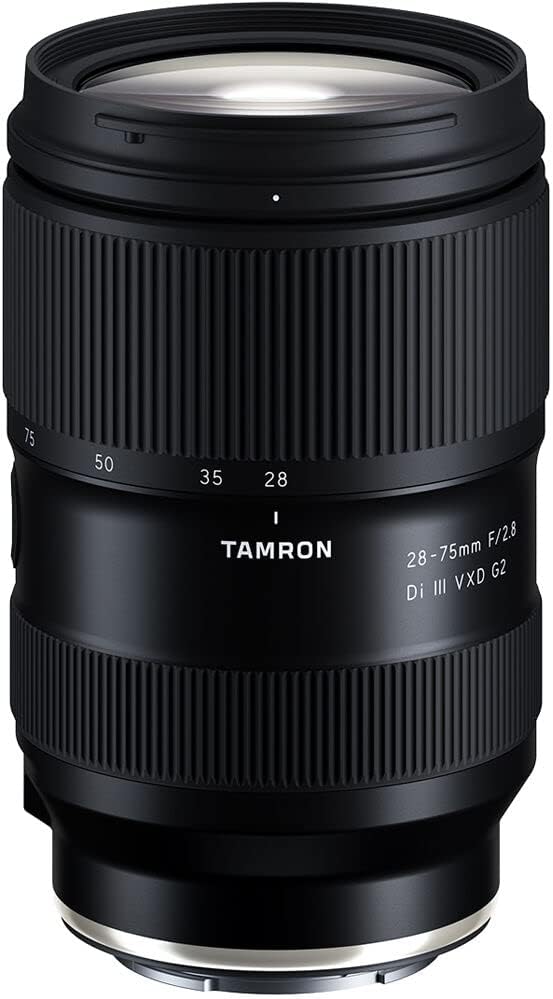
Spec sheet
Tamron 28-75mm F/2.8 Di III VXD G2
- Model Designation
- Model A063
- Focal Length Range
- 28-75mm
- Maximum Aperture
- f/2.8
- Minimum Aperture
- f/22
- Lens Mount Compatibility
- Sony E-mount (Full-Frame and APS-C)
- Autofocus Motor System
- VXD (Voice-coil eXtreme-torque Drive) Linear Motor
- Minimum Object Distance (MOD)
- 7.1 inches (wide end)
- Maximum Magnification Ratio
- 1:2.7 (wide end)
- Diaphragm Blade Count
- 9 circular blades
- Filter Thread Diameter
- 67mm (6.7 cm)
- Physical Dimensions and Weight
- 4.6 inches length, 19 oz weight
- Optical Image Stabilization
- No (relies on camera in-body image stabilization)
Figures as published by the manufacturer on the Amazon listing.
Optical Resolution and Frame Sharpness Performance
The technical foundation behind the Tamron 28-75mm F/2.8 Di III VXD G2 lies in its completely redesigned optical assembly. With contemporary high-resolution mirrorless sensors demanding intense resolving power, the updated Tamron A063 optical performance delivers crisp fine-detail separation, strong micro-contrast, and uniform edge-to-edge sharpness from f/2.8 through moderate aperture settings. The optical formula corrects common chromatic aberrations across the 28mm to 75mm range, rendering complex textures, fabric weaves, and architectural details with clinical precision. Even when shooting wide open at f/2.8, the central portion of the frame displays stellar contrast, making it an excellent platform for studio portraiture and environmental captures where critical subject definition is paramount.
Evaluating the Tamron 28-75mm f/2.8 G2 sharpness toward the outer borders of the frame highlights significant optical improvements over standard budget zooms. Where legacy standard zooms often suffer from peripheral astigmatism or corner softening at wide apertures, this G2 optic retains clear detail into the extreme corners when stopped down moderately to f/4 or f/5.6. The 9 diaphragm blades produce a smooth, circular aperture opening that translates to soft, pleasing background blur and smooth out-of-focus highlights without distracting polygonal artifacts. For portrait photographers who occasionally evaluate dedicated short-telephoto primes like the ttartisan 75mm f2, the Tamron G2 provides a versatile constant f/2.8 zoom alternative that delivers comparable compositional isolation at the 75mm telephoto boundary.
Flare suppression and surface protection are reinforced through specialized optical treatments, including Tamron’s front-element Fluorine Coating. This protective layer repels water, environmental condensation, and oily fingerprints, ensuring clear image transmission even when operating under challenging backlighting or humid outdoor mist. The 28-75mm focal length spread, offering a 2.68:1 zoom ratio and an 18.43-degree real angle of view at the telephoto extremity, provides a practical working span for commercial scenarios where changing prime lenses would result in missed operational opportunities.
Autofocus Speed and Tracking Precision with the VXD Motor
One of the primary technical upgrades integrated into the Tamron 28-75mm F/2.8 Di III VXD G2 is the adoption of Tamron’s VXD (Voice-coil eXtreme-torque Drive) linear motor mechanism. Autofocus velocity and responsiveness are fundamentally critical for contemporary hybrid shooters working across fast-moving commercial sets, sports events, and candid portraiture. The Tamron 28-75mm f2.8 VXD G2 autofocus drive operates with near-silent precision, executing rapid focal plane shifts in fractions of a second. Because linear voice-coil motors eliminate the mechanical gears and friction points common in traditional stepper motor systems, focus transitions remain fluid, instantaneous, and highly repeatable.
In continuous tracking scenarios, the VXD mechanism leverages the advanced phase-detection autofocus algorithms native to Sony E-mount mirrorless cameras. Real-time Eye AF and subject-tracking protocols maintain continuous lock on moving subjects, even during high-burst sequential stills or dynamic gimbal sweeps. Video creators benefit considerably from this implementation, as the quiet linear drive suppresses operational motor noise from bleeding into on-camera audio capture. The electronic focus ring operates with fine positional resolution, ensuring that manual focus adjustments can be executed smoothly without abrupt focal jumps.
For creators who configure multi-lens zoom setups, the autofocus reliability of this standard zoom aligns seamlessly alongside extended focal options like the tamron 70-180 f2.8 sony e mount, creating a cohesive shooting workflow across focal lengths. Whether locking focus instantaneously on erratic subjects at 28mm or maintaining tack-sharp tracking on eye pupils at 75mm, the VXD system eliminates the hunting and latency that occasionally constrained first-generation third-party mirrorless zooms.
Generational Evolution: G2 Versus G1 Design Upgrades
Comparing the Tamron 28-75mm G2 vs G1 reveals an extensive list of deliberate design enhancements that directly address real-world operational feedback from the original release. While the original Model A036 established Tamron as a serious contender in the mirrorless standard zoom category, the G2 (Model A063) elevates operational refinement, tactile feel, and optical precision across the board. The exterior finish has been reworked with a new exterior surface texture that offers superior grip and resistance to surface scuffs, abandoning the smoother matte plastic finish of the predecessor. The zoom and focus rings have been ergonomically reprofiled with refined ribbing patterns to ensure positive finger engagement during critical handheld maneuvers.
Optically, the generational gap is distinct across high-megapixel sensors. While the G1 was praised for strong center resolution, its extreme corner performance and chromatic control wide open at 28mm left room for improvement. The G2 incorporates a re-engineered optical formula that visibly tightens peripheral sharpness, enhances resolving power for dense sensor architectures, and softens transition zones in out-of-focus background rendering. Furthermore, the autofocus architecture represents a major generational jump: moving from the RXD stepping motor in the original version to the high-velocity VXD linear motor in the G2 translates to roughly double the focusing speed and noticeably improved response when tracking subjects moving directly toward or away from the camera.
Close-focus capabilities have also been refined between the generations. The minimum object distance has been drawn down to 7.1 inches at the wide end, giving the G2 a higher maximum reproduction ratio of 1:2.7 compared to the 1:2.9 magnification of the original. These mechanical, optical, and operational refinements make the G2 not merely an incremental refresh, but a comprehensive redesign intended to meet demanding production standards on high-resolution Sony camera bodies.
Close-Focusing Capabilities and Macro Magnification
Beyond standard portraiture and general documentary work, the Tamron 28-75mm F/2.8 Di III VXD G2 excels as a dynamic close-up optic. The Tamron 28-75mm G2 minimum object distance measures just 7.1 inches (approximately 18 centimeters) from the camera sensor plane at the 28mm wide focal length. When shooting at this minimum distance, the lens achieves an impressive maximum magnification ratio of 1:2.7, allowing photographers to capture intimate macro-style perspectives that standard 24-70mm zooms typically cannot match without auxiliary extension tubes.
This close-focus flexibility allows for creative framing where foreground details—such as product textures, culinary arrangements, flora, or mechanical components—are rendered with sharp, granular clarity while the background dissolves into soft f/2.8 bokeh. Because the front element approaches close to the subject at 7.1 inches, careful lighting management is required to avoid casting shadows from the lens barrel onto the scene. While the listing does not specify the exact minimum object distance at the 75mm telephoto setting, the optical architecture maintains balanced close-range rendering across the mid-range focal lengths.
Photographers seeking a single-lens kit for travel or commercial product assignments will appreciate this extended capability. Rather than carrying a specialized macro lens alongside a primary walkaround zoom, shooters can capture establishing wide shots, medium portraits, and intricate detail captures with the same optical barrel. The wide-angle magnification ratio of 1:2.7 provides an expressive, exaggerated sense of perspective that separates close-up subjects cleanly from expansive backgrounds.
Chassis Design, Weather Resistance, and Portability
Weighing in at just 19 ounces (approximately 539 grams) and measuring 4.6 inches in overall length, the Tamron 28-75mm f/2.8 G2 weight and compact physical footprint make it one of the most portable f/2.8 standard zooms available for full-frame systems. When paired with compact Sony mirrorless camera bodies, the overall system balance remains neutral, minimizing wrist fatigue during extended handheld wedding coverage, documentary travel, or run-and-gun video shoots. Even on APS-C crop-sensor bodies—where shooters might alternatively evaluate dedicated crop zooms like the tamron 17 70—the Tamron 28-75 G2 Sony E mount compatibility functions seamlessly with an effective focal range equivalent to roughly 42-112.5mm.
Environmental durability is reinforced through Tamron’s Moisture-Resistant Construction. Rubberized seals positioned at critical barrel seams and the lens mount interface help prevent moisture, mist, and fine dust from intruding into the internal optical chambers during inclement outdoor shoots. Complementing the internal weather sealing, the front glass element features a protective Fluorine Coating that actively resists water droplets, fingerprints, and oil accumulation, allowing for easy cleaning with a microfiber cloth in field environments.
Filter integration is another practical strength of the Tamron ecosystem. The Tamron 28-75mm f/2.8 G2 filter size is standardized at 6.7 centimeters (67mm), matching the filter thread diameter across multiple Tamron mirrorless lenses. This standardized thread allows creators to share neutral density, circular polarizing, and mist filters across several lenses in their bag, eliminating the need to invest in redundant filter sets or cumbersome step-up rings. The mechanical zoom ring rotates smoothly with consistent damping, preventing barrel creep during downward carrying positions.
Tamron 28-75mm F/2.8 Di III VXD G2 Pros and Cons
What works
- High-speed, silent VXD linear autofocus motor
- Constant fast f/2.8 maximum aperture throughout zoom
- Close 7.1-inch minimum object distance with 1:2.7 magnification
- Lightweight 19-ounce chassis for handheld shooting
- Moisture-resistant construction with front fluorine coating
- Standardized 67mm front filter thread diameter
What to weigh up
- No built-in optical image stabilization mechanism
- Wide focal length starts at 28mm rather than 24mm
- No physical aperture control ring on barrel
Check Tamron 28-75mm F/2.8 Di III VXD G2 on Amazon
Who Should Buy the Tamron 28-75mm F/2.8 Di III VXD G2
Buy It If
- You need high optical performance in a lightweight rig: Photographers who prioritize mobility will appreciate the 19 oz weight and 4.6-inch form factor paired with edge-to-edge f/2.8 resolution.
- You shoot hybrid stills and video on Sony E-mount bodies: The quiet, rapid VXD linear autofocus motor delivers smooth tracking without audible acoustic interference during video recording.
- You require creative close-up magnification: A 7.1-inch minimum focus distance and 1:2.7 maximum reproduction ratio at 28mm enable expressive macro-style perspectives without dedicated macro glass.
- You value a unified 67mm filter system: The 67mm front filter thread allows seamless sharing of expensive polarizing and ND filters across Tamron’s mirrorless lens lineup.
Skip It If
- You depend heavily on an ultra-wide 24mm perspective: The 28mm wide end restricts the field of view compared to traditional 24-70mm zooms, which can be limiting for tight interior architecture or sweeping landscapes.
- You shoot on older camera bodies without in-body image stabilization: The lens features no internal optical stabilization mechanism, relying entirely on sensor-shift stabilization inside the camera body.
- You demand built-in mechanical aperture control rings: The lens design emphasizes streamlined exterior controls and does not feature a physical, clickable aperture ring on the barrel.
Final Verdict
4.6 / 5Amazon buyer rating, 652 ratings
The Tamron 28-75mm F/2.8 Di III VXD G2 establishes itself as an exceptionally well-engineered standard zoom that successfully answers whether the Tamron 28-75mm f/2.8 G2 is worth it for modern mirrorless creators. By addressing the operational and optical limitations of its predecessor through the implementation of a high-torque VXD linear autofocus motor, a redesigned optical architecture with superior edge-to-edge sharpness, and a tactile, weather-sealed barrel, Tamron has crafted a lens that punches well above its lightweight class. The inclusion of a 7.1-inch close-focus distance and standardized 67mm filter threading further underscores its practical utility for working professionals and passionate enthusiasts alike.
While the 28mm wide-angle boundary requires a slight compositional compromise compared to heavier 24-70mm alternatives, and the absence of internal optical stabilization leaves stabilization duties to the camera sensor, the optical gains and weight savings far outweigh these constraints for the vast majority of shooting scenarios. For Sony E-mount photographers seeking a dependable, razor-sharp, and featherweight standard zoom capable of handling everything from high-speed action to intimate portraiture, the Model A063 represents an outstanding, spec-driven investment.
FAQ
Does the Tamron 28-75mm F/2.8 Di III VXD G2 have built-in optical image stabilization?
No, the lens specifications confirm that it does not include internal optical image stabilization. Instead, it relies on the in-body image stabilization (IBIS) systems integrated into modern Sony full-frame mirrorless camera bodies to compensate for camera shake during low-light photography or handheld video capture.
What is the filter thread diameter for this lens?
The Tamron 28-75mm F/2.8 Di III VXD G2 uses a 67mm (6.7 centimeters) front photo filter size. This allows users to share circular polarizers, ND filters, and protective UV filters across several other Tamron mirrorless lenses that share this exact thread dimension.
How does the VXD autofocus motor improve upon the original G1 motor?
The G2 features Tamron’s Voice-coil eXtreme-torque Drive (VXD) linear motor, which replaces the RXD stepping motor found in the original G1 lens. The VXD linear motor provides substantially faster drive speed, greater positional accuracy, near-silent operation, and significantly improved tracking reliability for fast-moving subjects and Eye AF tracking.
What is the minimum object distance and magnification ratio of this lens?
At the 28mm wide-angle focal length, the lens achieves a minimum object distance of 7.1 inches (approximately 18 centimeters) from the sensor plane. At this distance, it delivers a maximum image magnification ratio of 1:2.7, enabling expressive wide-angle macro-style close-up photography.
Is the Tamron 28-75mm G2 compatible with both full-frame and APS-C Sony cameras?
Yes, the lens is built with a Sony E-mount compatible with both full-frame and APS-C mirrorless camera bodies. When mounted on an APS-C camera, the field of view undergoes a 1.5x crop factor, offering an effective standard-to-telephoto focal length range equivalent to approximately 42mm to 112.5mm.
What type of weather protection does the lens offer?
The lens features Tamron’s Moisture-Resistant Construction, incorporating protective seals throughout the barrel joints and lens mount to guard against moisture ingress during outdoor shooting. Additionally, the exterior surface of the front element is treated with a protective Fluorine Coating that repels water droplets, oils, and environmental dirt.
See this listing on Amazon We may earn a commission if you buy through this link.
More in Cameras & Drones


The weekly shortlist
Specs worth reading, once a week
New teardowns, spec sheets and buying notes from across the desk.
This demo form is not connected to a mailing service.