WD Red Plus 2TB (WD20EFPX): Technical Analysis & Compatibility
The WD Red Plus 2TB (model WD20EFPX) is an internal 3.5-inch SATA hard drive designed for network attached storage systems operating 24/7 in home offices and small to medium business environments. Built with Conventional…

As Amazon Associates, we earn from qualifying purchases. This means we may receive a small commission at no extra cost to you if you click through and make a purchase.
The WD Red Plus 2TB (model WD20EFPX) is an internal 3.5-inch SATA hard drive designed for network attached storage systems operating 24/7 in home offices and small to medium business environments. Built with Conventional Magnetic Recording (CMR) technology, a 5400 RPM rotational speed, a 64 MB cache, and Western Digital’s NASware firmware, this drive is engineered to maintain data integrity across multi-bay configurations supporting up to 8 bays. For storage users seeking predictable write performance and lower operating temperatures without the RAID rebuild risks of shingled media, this drive provides a dependable, balanced storage platform.
This model suits home lab administrators and small businesses deploying 2-bay to 8-bay RAID enclosures for shared file storage, media serving, and scheduled system backups where silent operation and energy efficiency matter most. However, users managing virtualized multi-tenant environments or demanding databases with continuous I/O queues should look beyond its 5400 RPM speed and 64 MB buffer; such intensive use cases, or systems needing higher per-bay capacity, are better served by larger mechanical drives like the wd red plus 6tb.
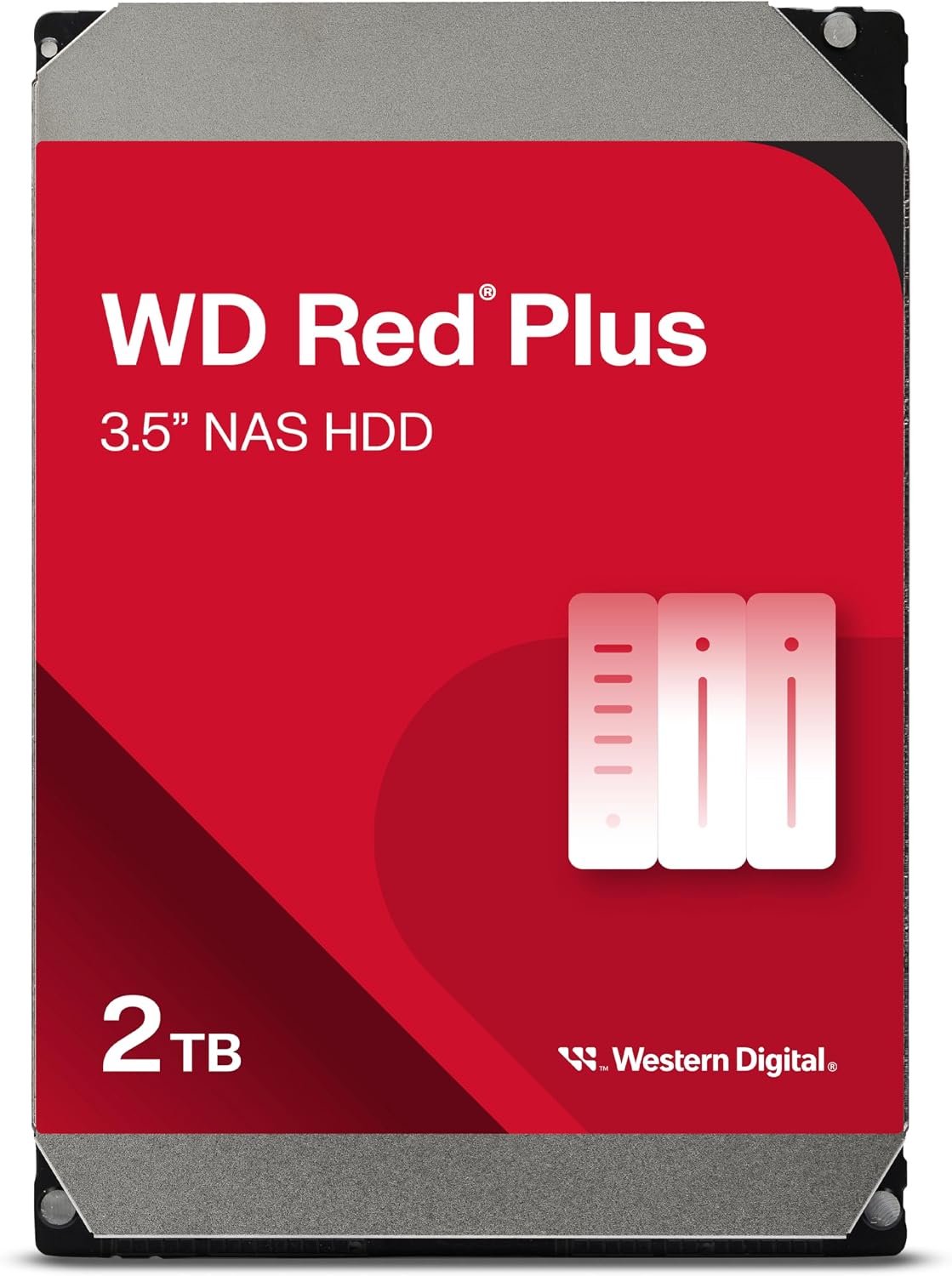
Spec sheet
WD Red Plus 2TB
- Model Number
- WD20EFPX
- Storage Capacity
- 2000 GB (2 TB)
- Form Factor
- 3.5-inch internal hard drive
- Interface
- SATA 6.0 Gb/s (Serial ATA-600)
- Recording Technology
- Conventional Magnetic Recording (CMR)
- Rotational Speed
- 5400 RPM
- Cache Memory Size
- 64 MB
- Enclosure Bay Support
- Up to 8 bays
- Workload Rate Limit
- Up to 180 TB/year
- Warranty Coverage
- 3-year limited warranty
Figures as published by the manufacturer on the Amazon listing.
CMR Architecture and Multi-Bay RAID Stability
The primary technical attribute of the WD Red Plus 2TB is its Conventional Magnetic Recording (CMR) architecture. Unlike Shingled Magnetic Recording (SMR), which overlays adjacent data tracks to boost storage density at the cost of rewrite latency, CMR writes data tracks side by side without overlapping. This architectural foundation ensures that inbound write operations never trigger cascading updates of neighboring tracks, preventing severe latency spikes during heavy random write workloads.
This layout is vital when planning a wd red plus 2tb raid setup. When a drive fails in a RAID 1, RAID 5, or RAID 6 array, the controller rebuilds the volume by recalculating parity and streaming data continuously across the replacement disk. SMR drives subjected to sustained writes often experience internal command timeouts, prompting controllers to drop the drive and degrade the array. Because the wd red plus 2tb cmr architecture handles continuous write streams deterministically, it executes rebuild passes reliably. Avoiding non-Plus SMR alternatives, such as older versions of the standard wd red 6tb, remains essential for multi-disk RAID health.
Furthermore, modern storage environments running ZFS or Btrfs file systems depend on consistent drive responsiveness for periodic pool scrubs and parity verification. The WD20EFPX avoids the unpredictable internal garbage collection routines found in shingled disks, maintaining steady I/O queue times across multi-drive configurations. This steady response profile guarantees that routine background scrubs complete without introducing disruptive system latency.
Rotational Speed, NASware Firmware, and Thermal Dynamics
Spinning at 5400 RPM, the WD Red Plus 2TB prioritizes acoustic dampening and thermal efficiency. In multi-bay desktop NAS enclosures where several mechanical drives operate closely together, heat buildup and vibration can shorten drive longevity. The wd red plus 2tb 5400 rpm motor produces far less thermal energy than 7200 RPM enterprise alternatives, keeping chassis temperatures moderate even in enclosures that utilize low-speed, quiet cooling fans.
To maximize multi-drive reliability, Western Digital includes its proprietary NASware firmware. Standard desktop drives often feature extended error recovery cycles; if a minor read error occurs, a desktop drive may attempt recovery for several minutes, causing a RAID controller to drop the disk from the pool. NASware implements Intelligent Error Recovery Controls that limit drive-level recovery times, returning control to the RAID manager so parity can resolve the error without dropping the drive.
In addition, the drive is engineered to manage rotational vibration across enclosures housing up to 8 bays. Spinning platters create harmonic vibrations that travel through drive caddies and can disrupt the head tracking of neighboring disks. The internal balance controls and firmware algorithms in the WD Red Plus 2TB minimize these harmonic vibrations, allowing adjacent drives to sustain accurate track alignment during simultaneous read and write operations.
Workload Limits and Cache Buffer Architecture
Western Digital rates the drive for an annualized wd red plus 2tb workload rate of up to 180 TB/year. According to the product data, this rating measures total user data transferred to and from the drive, annualized by multiplying transferred terabytes by 8,760 hours divided by recorded power-on hours. In a 24/7 operating profile, this provides roughly 15 TB of data movement per month, offering ample margin for small business backups, multi-user document sharing, and local streaming.
The drive pairs its SATA 6.0 Gb/s interface with a 64 MB cache memory buffer. While high-performance flash storage such as the 990 evo plus 2tb delivers instantaneous random throughput across gigabytes of cache, the wd red plus 2tb cache provides an essential staging buffer for mechanical operations. The 64 MB memory pool smooths inbound write bursts, optimizes actuator arm movements, and retains frequently requested metadata to reduce physical head seeks.
Buyers should evaluate their daily data transfers against these specifications. For standard network tasks like central file sharing, client backups, and media libraries, the 180 TB/year limit and 64 MB cache function reliably within design targets. However, workloads such as heavy multi-tenant virtual machines or high-frequency transactional databases will quickly saturate both the 64 MB buffer and the annual workload ceiling.
Multi-Bay NAS Enclosure and File Server Compatibility
Compatibility is a central strength of the WD Red Plus 2TB, which is specifically designed for NAS enclosures supporting up to 8 bays. Built in the standard 3.5-inch form factor, measuring 8 inches long, 3 inches wide, and 6 inches thick, with a weight of 15.84 ounces, the drive fits standard drive trays and tool-less caddies. It interfaces through Serial ATA-600, supporting interface transfer speeds up to 600 megabytes per second.
Integration with leading network storage hardware is direct and fully supported. For users configuring a wd red plus 2tb synology setup, the drive communicates seamlessly with Synology DSM, reporting SMART attributes, thermal metrics, and drive health indicators. Identical compatibility applies to QNAP, Asustor, and TerraMaster systems, as well as DIY servers operating TrueNAS CORE, Unraid, or OpenMediaVault, where native CMR formatting ensures zero translation layer complications.
When designing a multi-bay storage array, bay efficiency is a key long-term consideration. While four or six 2TB drives in RAID 5 deliver fast rebuilds and reliable fault tolerance, enclosures with limited physical drive bays may eventually reach capacity limits. In 2-bay or 4-bay systems, stepping up to larger capacity drives like the wd 6tb red nas may provide a more practical path for long-term expansion by maximizing storage density per bay.
WD Red Plus 2TB Pros and Cons
What works
- Conventional Magnetic Recording architecture prevents RAID rebuild timeouts
- Low 5400 RPM operating temperature and acoustic profile
- Dedicated NASware firmware for up to 8-bay multi-drive arrays
- Solid 180 TB/year workload rating for 24/7 operation
- Backed by a 3-year limited warranty
What to weigh up
- Modest 64 MB cache memory buffer
- 5400 RPM spindle limits sustained sequential transfer rates
- 2TB capacity limits storage density in small enclosures
Check WD Red Plus 2TB on Amazon
Who Should Buy the WD Red Plus 2TB
Buy It If
- You are populating a 1-to-8 bay NAS enclosure and require CMR architecture to prevent RAID rebuild failures.
- You want a quiet, low-power 5400 RPM drive that keeps multi-bay enclosure temperatures low.
- Your annual network storage traffic stays within an annualized 180 TB/year workload rating.
- You want dedicated NASware firmware tuned for error recovery and multi-drive vibration mitigation.
Skip It If
- You have a 2-bay enclosure and need higher per-slot capacity to accommodate large media archives.
- Your workload requires 7200 RPM enterprise drives for multi-tenant virtualization or heavy database tasks.
- Your data transfers consistently surpass the 180 TB/year annualized workload threshold.
Final Verdict
8.4/10Our score
This wd20efpx review illustrates that the WD Red Plus 2TB is a dependable, well-engineered hard drive for home office and small business network storage systems. By combining Conventional Magnetic Recording architecture with a 5400 RPM spindle speed and Western Digital’s NASware firmware, this drive avoids the performance drops and rebuild failures associated with SMR media. It provides steady, predictable throughput across multi-bay configurations, ensuring arrays stay online and responsive.
Deciding whether the WD Red Plus 2TB is worth it comes down to enclosure capacity and performance requirements. For users assembling a cool, quiet 24/7 network storage array of up to 8 bays for file sharing and backups, this drive delivers proven stability backed by a 3-year limited warranty. While heavy virtualization hosts will require faster enterprise drives, the WD Red Plus 2TB remains a rock-solid, trustworthy choice for everyday network storage.
FAQ
Is the WD Red Plus 2TB a CMR or SMR drive?
The WD Red Plus 2TB uses Conventional Magnetic Recording (CMR) technology. Unlike SMR drives that overlap tracks, CMR writes tracks side by side, preventing write speed slowdowns and avoiding command timeouts during intensive RAID rebuilds.
What is the workload rate rating on the WD Red Plus 2TB?
The WD Red Plus 2TB supports an annualized workload rate of up to 180 TB/year. Western Digital defines this as total data transferred to or from the drive annualized by multiplying transferred terabytes by 8,760 hours divided by recorded power-on hours.
How many drive bays can the WD Red Plus 2TB support in a single NAS?
The listing specifications state that the WD Red Plus series is designed to support systems with up to 8 bays. Its NASware firmware is specifically tuned to mitigate vibration and manage thermal output in multi-drive enclosures.
Does the WD Red Plus 2TB run at 5400 RPM or 7200 RPM?
The WD Red Plus 2TB operates at 5400 RPM. This spindle speed reduces power consumption, dampens acoustics, and minimizes heat generation, which helps multi-bay desktop enclosures run quietly and stay cool.
What warranty coverage comes with the WD Red Plus 2TB?
Western Digital provides a 3-year limited warranty for the WD Red Plus 2TB. Complete regional warranty terms and support details can be verified directly on Western Digital’s official website.
See this listing on Amazon We may earn a commission if you buy through this link.
More in PC Components & Storage


The weekly shortlist
Specs worth reading, once a week
New teardowns, spec sheets and buying notes from across the desk.
This demo form is not connected to a mailing service.