WD 6TB Red NAS Drive: Technical Analysis of WD60EFRX
The WD Red Plus 6TB (model WD60EFRX) is a 3.5-inch internal mechanical hard drive purpose-built for network-attached storage environments. Designed specifically to balance electrical efficiency, thermal output, and steady data throughput, this unit establishes…

As Amazon Associates, we earn from qualifying purchases. This means we may receive a small commission at no extra cost to you if you click through and make a purchase.
The WD Red Plus 6TB (model WD60EFRX) is a 3.5-inch internal mechanical hard drive purpose-built for network-attached storage environments. Designed specifically to balance electrical efficiency, thermal output, and steady data throughput, this unit establishes a reliable mechanical foundation for small to medium-sized business servers and personal media arrays. Based on the technical specifications and manufacturer architecture data, this model delivers rock-solid data integrity thanks to its native Conventional Magnetic Recording (CMR) layout, which avoids the write-stall issues common to residential desktop hard drives.
This drive suits storage administrators, homelab builders, and creative professionals who need dependable 24×7 storage across multi-bay network appliances. It is particularly well matched for setups running storage appliances with up to eight drives where consistent write handling and RAID parity calculations are required. Users managing enterprise server racks with more than eight bays or high-concurrency production databases requiring 7200 RPM access speeds should look elsewhere in Western Digital’s enterprise lineup.
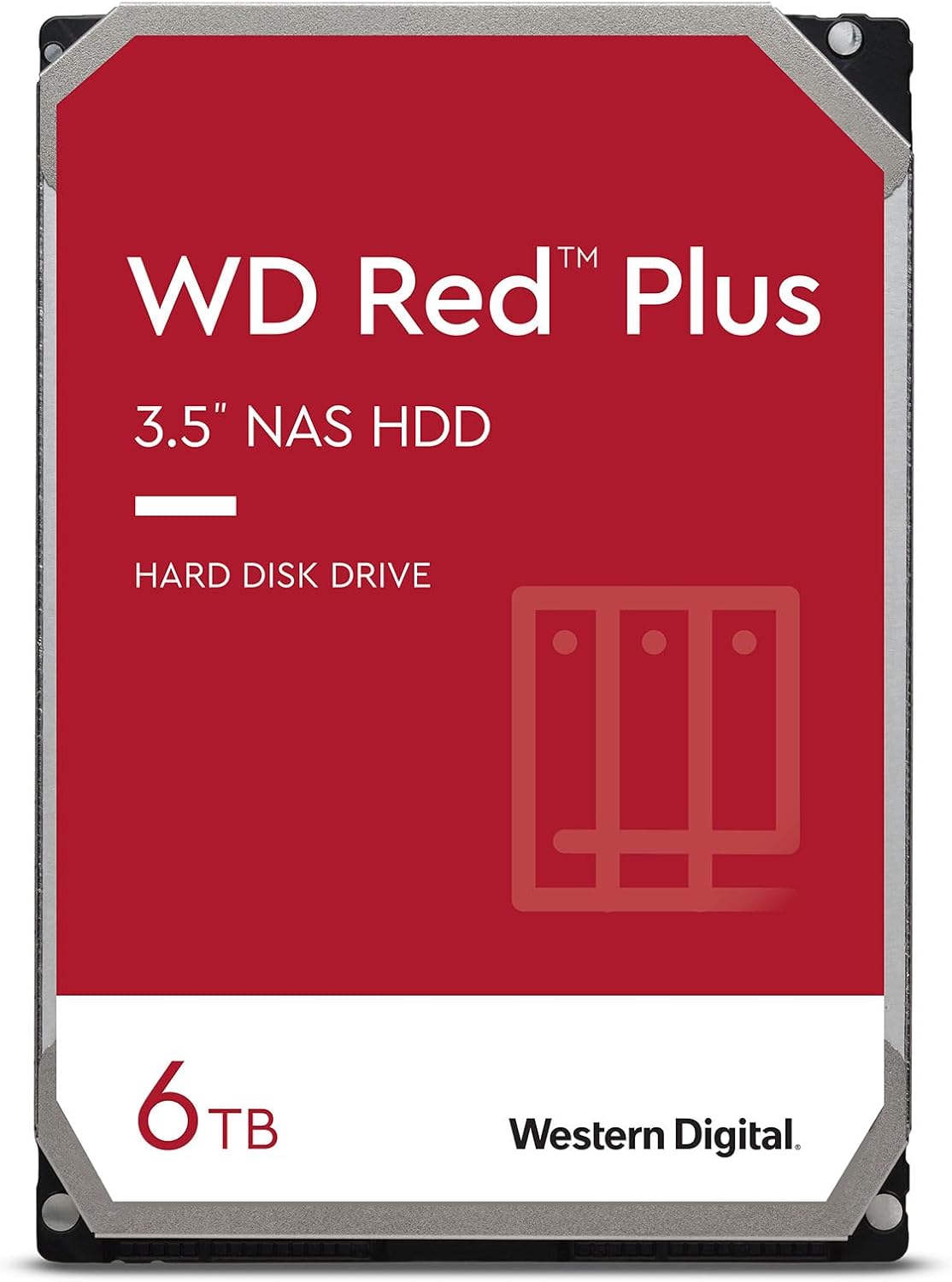
Spec sheet
WD Red Plus 6TB
- Model Number
- WD60EFRX
- Digital Storage Capacity
- 6 TB
- Recording Technology
- Conventional Magnetic Recording (CMR)
- Rotational Speed
- 5400 RPM performance class
- Cache Memory Size
- 64 MB
- Interface
- SATA 6.0 Gb/s (Serial ATA-600)
- Workload Rate Limit
- 180 TB/year
- Enclosure Scalability
- 1 to 8 bays
- Hardware Technologies
- NASware, 3D Active Balance Plus, IntelliPower, NCQ
- Warranty Coverage
- 3-year limited warranty
Figures as published by the manufacturer on the Amazon listing.
Recording Architecture: CMR Verification and WD60EFRX Identity
For any storage administrator configuring an array, determining whether a drive is wd red 6tb CMR or SMR is a critical step. The WD Red Plus 6TB model WD60EFRX is manufactured exclusively with Conventional Magnetic Recording (CMR) technology. In a CMR drive, physical data tracks are laid side-by-side in parallel without overlapping. This architectural foundation allows individual data sectors to be modified, overwritten, or updated on the fly without disturbing adjacent sectors, ensuring constant, predictable write timing across random and sequential file transfers.
During Western Digital’s product restructuring, the manufacturer renamed its CMR-based network drives to “WD Red Plus” to deliberately separate them from standard “WD Red” models that adopted Shingled Magnetic Recording (SMR). The official listing confirms that during the packaging transition period, some WD Red Plus units may arrive marked with a legacy “WD Red” front sticker. Regardless of the label printed on the outer casing, verifying the hardware part number as WD60EFRX confirms the physical drive inside contains genuine CMR platter geometry and the full suite of NASware firmware instructions.
Understanding track architecture matters directly for array longevity. SMR technology overlaps physical tracks like shingles on a roof to increase platter density, requiring entire bands to be cached, cleared, and rewritten whenever an internal block changes. While acceptable for basic desktop archiving, SMR introduces heavy latency spikes under continuous write workloads. The native CMR track implementation on the WD60EFRX eliminates this risk entirely, preventing drive dropped-offline states and keeping response times stable under sustained client transfers.
Rotational Speed, Cache Allocation, and Core Specifications
Reviewing the published wd 6tb red nas specs reveals an intentional engineering focus on thermal moderation and acoustic control. The WD Red Plus 6TB operates on a 5400 RPM rotational speed class. By spinning platters at 5400 RPM rather than higher enterprise speeds, the drive minimizes kinetic motor drag, dampens motor humming, and reduces steady-state operational heat. In multi-disk desktop chassis sitting close to workstations or living areas, this lower rotational velocity keeps ambient operating noise low while preserving the operating lifespan of delicate spindle bearings.
The drive pairs its 5400 RPM spindle with an onboard 64 MB cache memory buffer. This wd red 6tb 5400rpm cache allocation is optimized through Western Digital’s NASware firmware to handle command queuing, metadata updates, and burst data buffering. Operating in tandem with Native Command Queuing (NCQ) and Advanced Format technology, the 64 MB DRAM footprint provides ample headroom to order incoming reads and writes before committing raw data blocks to physical sectors across the SATA 6.0 Gb/s bus.
Power delivery and motor management are coordinated through Western Digital’s IntelliPower algorithms. This platform balances rotational velocity, transfer rates, and internal caching mechanisms to deliver reliable performance without consuming unnecessary wattage. For systems running 24 hours a day, 7 days a week, this architectural tuning curbs continuous electrical draw and reduces internal heat buildup inside compact drive trays.
Multi-Drive Enclosure Dynamics and 8-Bay Scalability
Deploying drives inside multi-bay appliances creates severe rotational vibration challenges that standalone desktop hard drives cannot survive. The wd red plus 6tb incorporates 3D Active Balance Plus technology, an active dual-plane balance control mechanism that stabilizes the entire internal head assembly and spindle motor. Maintaining strict physical balance prevents harmonic resonance from traveling across the chassis metalwork, which would otherwise induce head-drift errors and degrade data throughput across neighboring drive bays.
The mechanical build of the WD60EFRX is officially certified for network-attached storage enclosures scaling from 1 to 8 drive bays. Across an 8-bay chassis, vibrations from multiple spinning platters can easily disrupt track-following accuracy if drives lack specialized damping. The 3D Active Balance Plus engineering counters these rotational forces, allowing the drive to sustain track registration and avoid unnecessary sector re-reads during concurrent multi-user access.
Western Digital rates this drive for an annualized workload rate of up to 180 TB per year. The manufacturer calculates this figure based on total user data transferred to or from the hard drive annualized over recorded power-on hours. For personal clouds, office file shares, and offsite backup targets, a 180 TB/year ceiling offers broad operational headroom. However, enterprise data centers deploying racks exceeding eight drive bays require drives like the wd red pro 20tb, which feature hardware sensors designed specifically for large chassis environments.
ZFS Resilience and RAID Rebuild Dynamics
One of the strongest technical arguments for the WD60EFRX emerges when evaluating wd 6tb red nas raid compatibility in traditional hardware and software arrays. In standard RAID configurations such as RAID 1, RAID 5, or RAID 6, the system expects each drive to respond to read and write requests within a narrow latency threshold. If an individual disk encounters a marginal sector and spends several minutes attempting internal error recovery without communicating with the host bus adapter, the RAID controller marks the disk as dead and drops it from the array.
The integrated NASware firmware provides precise Error Recovery Control (ERC) timing to prevent this catastrophic drop-out behavior. Rather than getting locked in endless read-recovery loops, the drive reports the sector status to the controller, allowing the array parity to reconstruct the missing block without kicking the drive offline. When a failed disk must be replaced, the CMR track architecture ensures that parity rebuild operations proceed at linear, sustained write speeds instead of stalling out on track overwrites.
For systems leveraging advanced copy-on-write filesystems, wd red plus 6tb zfs performance remains stable across intense resilvering cycles. Because ZFS distributes parity across the entire storage pool, rebuild operations trigger heavy concurrent random read and write requests. CMR platters write updated blocks directly to target sectors without the massive background data reorganizations inherent to SMR technology. This architectural design ensures that ZFS resilvering completes reliably within standard operational timeframes, preserving pool health and avoiding data loss during multi-terabyte rebuilds.
Synology Integration and Benchmark Expectations
When selecting a wd 6tb red nas for synology systems, administrators look for deep compatibility across the DiskStation Manager (DSM) operating system. The WD60EFRX is widely recognized across Synology DiskStation hardware platforms, from dual-bay enclosures up through eight-bay desktop towers. Integrated support for SMART attribute reporting, thermal telemetry, and idle spin-down states enables DSM to monitor disk health precisely, schedule scrubbing routines safely, and run Synology Hybrid RAID (SHR) without driver conflicts.
In real-world operational environments, any wd red plus 6tb benchmark evaluation must be considered in the context of network interface boundaries. The SATA 6.0 Gb/s hardware interface supports a theoretical burst data transfer rate of up to 600 megabytes per second. In practice, sustained mechanical read and write transfers easily saturate a standard 1 Gigabit Ethernet (1GbE) network connection, which peaks near 115 to 125 megabytes per second. The physical drive easily delivers enough sequential throughput to keep gigabit and multi-gigabit connections fully saturated during sequential file backups and media streaming.
When evaluating whether the drive is worth deploying in a modern homelab, the balance of thermal moderation, acoustics, and data safety provides an affirmative answer. By combining quiet 5400 RPM spindle operation with native CMR reliability and a 3-year limited warranty, the WD60EFRX avoids the noise, excessive heat, and power demands of 7200 RPM enterprise disks while delivering superior structural data stability compared to entry-level desktop drives.
WD Red Plus 6TB Pros and Cons
What works
- Native Conventional Magnetic Recording technology
- Tailored NASware firmware for RAID environments
- Quiet and energy-efficient 5400 RPM spindle
- Engineered for 24×7 multi-bay enclosures
- Integrated 3D Active Balance Plus stabilization
What to weigh up
- Spindle speed capped at 5400 RPM
- Restricted to 8-bay maximum enclosure configurations
- Limited to 64 MB onboard cache
- Annual workload rating capped at 180 TB
Check WD Red Plus 6TB on Amazon
Who Should Buy the WD Red Plus 6TB
Buy It If
- You manage a 1-bay to 8-bay network storage enclosure requiring 24×7 operational reliability.
- You utilize ZFS storage pools, unRAID, TrueNAS, or Synology Hybrid RAID where CMR track architecture is mandatory to prevent rebuild failures.
- You need low acoustic noise and moderate thermal output inside an office or living space where high-RPM drives would be distracting.
- Your data workload stays within the 180 TB/year rating for regular office file sharing, virtualization storage, or multimedia streaming.
Skip It If
- Your network storage infrastructure requires enclosures containing more than eight drive bays.
- Your workloads demand 7200 RPM rotational spindle speeds for ultra-low seek times and maximum mechanical IOPS.
- You operate high-volume enterprise data pipelines exceeding the 180 TB/year workload rating.
Final Verdict
The WD Red Plus 6TB (WD60EFRX) remains one of the most reliable mechanical storage investments available for small-to-medium business servers and domestic storage enclosures. Western Digital’s integration of native CMR recording technology, 3D Active Balance Plus dual-plane balancing, and custom NASware firmware solves the foundational operational challenges that plague conventional desktop hard drives in multi-disk environments. The drive provides predictable write behavior, maintains stable ZFS rebuild integrity, and runs quiet and cool across sustained operation.
While power users demanding maximum enterprise speeds or multi-bay rack configurations beyond eight bays will need to look at faster 7200 RPM platforms, the WD60EFRX hits the ideal mechanical sweet spot for up to 8-bay NAS units. Its balanced 5400 RPM acoustic profile, SATA 6.0 Gb/s interface, 64 MB cache, and robust array recovery protocols make it an outstanding storage component for any data-conscious administrator building a dependable redundant array.
FAQ
Is the WD60EFRX model CMR or SMR?
The WD60EFRX is exclusively a Conventional Magnetic Recording (CMR) hard drive. Western Digital uses this model number specifically to designate CMR platter technology, distinguishing it from SMR drives that suffer severe write degradation in multi-drive storage arrays.
Can the WD Red Plus 6TB be used in an 8-bay Synology NAS?
Yes, the drive is engineered and tested for continuous operation in network enclosures containing up to eight drive bays. It fully supports Synology DSM, Synology Hybrid RAID (SHR), and standard RAID levels 1, 5, 6, and 10.
Why does the label say WD Red instead of WD Red Plus on some drives?
During the transition period when Western Digital separated its lineup into standard Red (SMR), Red Plus (CMR), and Red Pro tiers, some CMR units were shipped with existing “WD Red” label stock. You can confirm the drive is a CMR unit by checking the model number WD60EFRX on the drive label.
What does the 180 TB/year workload rating mean?
The workload rate represents the total volume of user data transferred to and from the hard drive annualized over the operating hours of the unit. The 180 TB/year rating ensures reliable 24×7 service for typical personal, home office, and small business storage environments.
Does the 64 MB cache affect ZFS or RAID rebuild times?
The 64 MB cache functions as a temporary DRAM buffer for metadata, read-ahead caching, and command reordering through NCQ. Because the drive uses CMR rather than SMR, rebuild and resilver times remain fast and linear regardless of the 64 MB buffer size, as the drive does not have to pause to rewrite overlapping data tracks.
See this listing on Amazon We may earn a commission if you buy through this link.
More in PC Components & Storage


The weekly shortlist
Specs worth reading, once a week
New teardowns, spec sheets and buying notes from across the desk.
This demo form is not connected to a mailing service.