Steelcase Leap Chair: Mechanical and Ergonomic Specification Analysis
The Steelcase Leap is an advanced task chair engineered for extensive ergonomic adjustability and active musculoskeletal support in professional office environments. Designed around responsive mechanical linkages rather than static structural framing, the chair serves…
By Harold Blair

As Amazon Associates, we earn from qualifying purchases. This means we may receive a small commission at no extra cost to you if you click through and make a purchase.
The Steelcase Leap is an advanced task chair engineered for extensive ergonomic adjustability and active musculoskeletal support in professional office environments. Designed around responsive mechanical linkages rather than static structural framing, the chair serves as an industry reference for continuous spinal tracking and task-oriented recline geometry. It delivers precise, multi-point postural control through dedicated adjustments that target lumbar curvature, seat depth, and multi-axis arm positioning, providing a reliable ergonomic foundation for long computational shifts.
This seating platform is ideally tailored for computational analysts, software developers, and knowledge workers who demand exact ergonomic tailoring to maintain neutral posture during eight-plus hours of focused screen work, making it an essential reference when comparing dynamic task chairs against platforms like the herman miller logitech embody. Conversely, users seeking a heavily padded lounge chair for passive relaxation, such as the la-z-boy arcadian ergonomic bonded leather swivel executive chair, should look elsewhere, as the Leap prioritizes active corrective alignment over soft, pillowed compression.
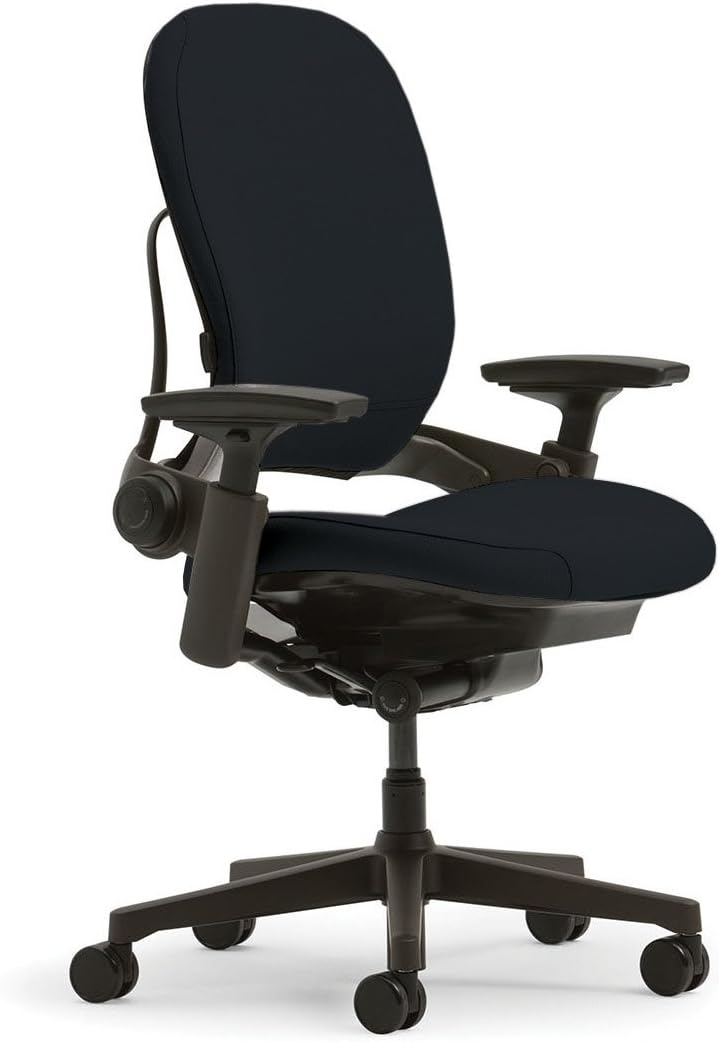
Spec sheet
Steelcase Leap
- Brand and Manufacturer
- Steelcase
- Model Designation
- Leap (Onyx)
- Backrest Technology
- 3D LiveBack Dynamic Spinal Tracking
- Recline Kinematics
- Patented Natural Glide System
- Lumbar Adjustments
- Height-Adjustable Lumbar Support with Lower Back Firmness Dial
- Armrest Articulation
- 4D (Height, Width, Depth, and Pivot Adjustable)
- Seat Cushion Architecture
- Internal Air Pockets with Flexible Seat Edge
- Mechanical Controls
- Seat Depth, Seat Height, and Recline Tension Adjustments
- Surface Recommendation
- Carpet Caster Wheels
- Manufacturer Warranty
- Standard Steelcase Factory 12-Year Warranty
Figures as published by the manufacturer on the Amazon listing.
Dynamic Spine Tracking and the 3D LiveBack System
The primary structural feature of the Steelcase Leap is its 3D LiveBack technology, an articulating backrest assembly engineered to mirror the dynamic kinematics of the human spine. Static chair backrests force the lumbar and thoracic regions into a single rigid profile, which causes muscular fatigue when the occupant shifts postures throughout the workday. The Leap avoids this biomechanical pitfall by flexing and re-contouring in real time, actively mapping to the spine as the user moves from an upright task orientation to an engaged recline. This continuous conformity ensures that the spine maintains its natural, healthy S-shape across various seated angles.
Lumbar support on the Leap operates through two independent adjustment mechanisms rather than a single static block. First, a height-adjustable lumbar assembly slides vertically along the inner frame, allowing users to calibrate the exact height where the support contacts their lordotic curve. Second, Steelcase integrates a dedicated lower back firmness dial on the side of the chair. This dial alters the mechanical tension across the lower section of the backrest, giving occupants precise control over whether the lower spine receives firm, rigid stabilization or a more compliant, softer contour. This dual-action approach makes the steelcase leap chair for back pain a thoroughly researched intervention, as users can resolve specific localized pressure points without sacrificing broader spinal support.
From an ergonomic analysis perspective, the integration of 3D LiveBack mechanics directly addresses the primary vector of seated spinal compression. When a seated worker leans forward or relaxes backward, the sacral base angle shifts, typically causing the lower lumbar discs to flatten out against flat backrests. Because the steelcase leap 3d liveback mechanism couples flexible ribs with dynamic lateral curvature, it supports the pelvic rim while stabilizing the upper thoracic area. The resulting steelcase leap lumbar support performance delivers a stable, corrective seating profile that sustains spinal integrity during long research and analytical sessions.
Natural Glide Recline Kinematics and Task Proximity
Traditional chair tilt assemblies utilize simple center-pivot or knee-tilt mechanisms that swing the occupant’s upper body backward and away from the desk during recline. This conventional arc creates a severe ergonomic disconnect: as the distance between the user and their desk increases, the worker must stretch their arms forward to reach the keyboard and crane their neck to view monitors, introducing secondary strain along the trapezius and cervical spine. The steelcase leap natural glide system resolves this mechanical flaw by uncoupling the seat pan motion from a simple angular tilt, translating recline energy into a coordinated forward slide.
When the user reclines on the Leap, the backrest pivots backward while the seat pan smoothly glides forward on integrated guide rails. This synchronized forward translation ensures that the occupant’s eyes, hands, and upper torso remain within their optimal vision and reach envelope relative to their desk surface. By keeping workers close to their work tools during full recline, the natural glide system encourages frequent postural transitions without requiring manual repositioning of the chair base or desktop peripherals. Users can transition between deep analytical contemplation in recline and focused data input in upright mode while maintaining constant visual focal length to their displays.
Controlling this dynamic movement is a calibrated recline tension adjustment system, which allows the occupant to tailor the recline resistance to their specific upper body mass. Increasing the tension provides steady resistance that arrests free-falling sensations, while lowering the tension permits effortless reclining with minimal abdominal or thigh exertion. This balance of forward pan translation and dial-regulated resistance ensures that the recline cycle works as an active ergonomic tool rather than a passive lounge mechanism, maintaining steady ocular and manual alignment with computational gear.
Seat Pan Architecture, Pressure Mapping, and Air Pockets
The seat pan design of the Steelcase Leap prioritizes pressure distribution and vascular circulation over sheer foam thickness. Conventional thick foam seats often trap body heat and collapse unevenly under the ischial tuberosities (the pelvic sit bones), eventually leading to bottoming-out against the hard structural sub-pan. Steelcase solves this structural degradation by utilizing a proprietary seat cushion fitted with internal air pockets. These miniature cavities compress selectively under load, displacing air internally to conform precisely to the unique contours of the user’s pelvic anatomy while preserving uniform weight dispersion.
Beneath the front edge of the seat pan lies another critical mechanical refinement: a flexible seat perimeter. Static, rigid front plastic edges can press into the soft tissue of the posterior thighs, compressing the femoral arteries and sciatic nerve pathways during prolonged desk work. The Leap’s seat frame is engineered to flex downward along its front border whenever pressure is applied by the legs, actively eliminating localized pinch points under the hamstrings regardless of how the user angles their lower limbs.
To accommodate various anthropometric dimensions, the chair features an integrated seat depth adjustment mechanism. Occupants can slide the seat pan forward or backward to achieve proper clearance between the front edge of the cushion and the popliteal fossa (the back of the knees). Maintaining a gap of approximately two to three finger widths prevents contact pressure against posterior knee tendons while ensuring the thighs receive full horizontal support. Although the listing does not specify the exact linear stroke of this slide adjustment, the inclusion of seat depth variability ensures proper alignment across a broad spectrum of user leg lengths.
Multi-Axis 4D Armrest Articulation and Upper Body Ergonomics
Sustained computational efficiency depends heavily on offloading the dead weight of the arms from the shoulder girdle. The Steelcase Leap is equipped with fully articulated 4D armrests, providing four independent axes of mechanical adjustment: height, width, depth, and horizontal pivot. These comprehensive steelcase leap adjustments allow users to position the arm caps in exact alignment with their specific elbow height and forearm orientation, directly relieving tension across the neck, levator scapulae, and upper trapezius musculature.
The operational mechanics of the arm assemblies are designed for immediate, tool-free adaptation:
- Height Adjustment: Moves the armrests vertically to match working desk surface elevation, allowing elbows to rest at a neutral 90-degree angle without shrugging the shoulders.
- Width Adjustment: Translates the arm uprights inward or outward relative to the seat pan, accommodating both narrow and broad shoulder breadths to prevent awkward elbow flare.
- Depth Adjustment: Slides the arm pads fore and aft, enabling the chair to pull up closely to desk perimeters without the armrests colliding with desktop edges.
- Pivot Adjustment: Rotates the arm caps inward or outward, matching natural forearm convergence when typing on compact keyboards or manipulating input devices.
By locking in this degree of multi-axis positional freedom, the armrest assemblies eliminate gaps between the user’s resting arm posture and task inputs. The firm yet supportive padding on the arm caps prevents ulnar nerve compression at the elbow, establishing a solid ergonomic platform for sustained data entry, CAD work, or detailed document editing.
Build Durability, Materials, and Factory Warranty Coverage
When evaluating whether the investment is justified, build quality and operational longevity are central considerations. The steelcase leap chair warranty reflects commercial contract-grade standards, backed by a standard 12-year factory warranty. This extensive coverage protects against structural and mechanical failures, demonstrating confidence in the integrity of the chair’s internal gas cylinder, recline linkage springs, 3D LiveBack frame ribs, and manual adjustment dials. For enterprise IT departments and individual professionals evaluating long-term equipment amortization, this multi-year warranty significantly lowers lifecycle ownership costs compared to standard retail task seating.
The main listing model is upholstered in durable Onyx fabric, delivering a neutral aesthetic that integrates smoothly into commercial or residential office configurations. The tactile response of the adjustment controls—from the lower back firmness dial to the seat depth release lever—exhibits tight mechanical tolerances with minimal play or chassis wobble. The structural core utilizes high-strength composite polymers and metal structural components, ensuring that repeated adjustments over multiple work shifts do not cause loosening or mechanical slippage.
These carpet casters provide balanced rolling resistance across low-to-medium pile carpeting, preventing the chair from sliding uncontrollably when the user reaches for items. However, buyers planning to deploy the Leap on hardwood, tile, or laminate surfaces should note this carpet-specific wheel profile, as harder floors may require an aftermarket mat or alternative caster set to prevent surface marring. While the listing does not specify precise maximum weight capacities or overall physical frame dimensions, the chair’s industrial-grade components reflect Steelcase’s seven decades of seating research and commercial manufacturing standards.
Steelcase Leap Pros and Cons
What works
- Dynamic 3D LiveBack spinal tracking
- Natural Glide system maintains desk reach
- Dual-action lumbar height and firmness controls
- Four-dimensional armrest positional articulation
- Standard twelve-year factory manufacturer warranty
What to weigh up
- Included wheels recommended specifically for carpet
- Headrest assembly not included in package
- Overall chair dimensions not specified in listing
Check Steelcase Leap on Amazon
Who Should Buy the Steelcase Leap
Buy It If
- You spend extended eight-hour computational shifts at a desk and require active 3D LiveBack spinal contouring that adapts to ongoing posture shifts.
- You suffer from targeted lower back strain and need discrete mechanical control over both lumbar height placement and lower back firmness tension.
- You rely on extensive forearm support for typing and mouse work and need 4D armrests with full height, width, depth, and pivot articulation.
- You want high long-term investment security supported by a standard Steelcase factory 12-year warranty on mechanical components.
Skip It If
- You plan to use the chair directly on polished hardwood or tile flooring without a protective mat, as the supplied wheels are specifically designated for carpet.
- You prefer thick, pillowed, executive-style recliners with plush padding over an active, corrective ergonomic frame.
- You require a factory-integrated headrest for neck resting during high-angle recline, as the included components list only the core office chair assembly.
Final Verdict
8.4/10Our score
The Steelcase Leap remains a technical benchmark in ergonomic seating because it approaches desk-bound posture as a continuous mechanical problem rather than a static positioning exercise. By synchronizing the dynamic spine tracking of 3D LiveBack with the smooth forward translation of the Natural Glide system, the chair eliminates the reach disconnects and spinal flattening common to standard task chairs. Its dual-action lumbar adjustments and 4D armrests provide the granular control required by users who need precise mechanical alignment to mitigate musculoskeletal fatigue.
When asking if the steelcase leap is worth it, the answer depends on how deeply you value individual adjustability and long-term durability. While its carpet-oriented wheel configuration and firm, active seat profile may not appeal to those seeking plush executive loungers, its engineering pedigree, comprehensive adjustment range, and 12-year factory warranty establish it as an outstanding long-term asset. For professionals committed to preserving posture and spinal health through demanding computational workloads, the Steelcase Leap delivers uncompromising ergonomic performance.
FAQ
What makes the Steelcase Leap Natural Glide System mechanically unique?
Unlike conventional tilt mechanisms that pivot the backrest backward while leaving the seat stationary or tilting it upward, the Natural Glide System translates the seat pan forward as you recline. This forward glide keeps your eyes, hands, and upper torso within your optimal work reach and sightline zone, allowing you to recline without overreaching for your keyboard or straining to see monitors.
How does the Steelcase Leap lumbar support adjust for lower back curvature?
The Leap utilizes a two-part lumbar adjustment system. It features a sliding lumbar support handle that adjusts vertically to match the exact height of your lumbar curve, alongside an independent lower back firmness dial. Turning this dial alters the mechanical tension in the lower backrest area, allowing you to increase or decrease lower spinal resistance to suit your comfort.
What is covered under the Steelcase Leap chair warranty?
The chair includes the standard Steelcase factory 12-year warranty, which covers the primary mechanical components, framework, and operating mechanisms against manufacturing defects and structural failures under normal commercial office usage.
Are the included casters safe for all types of flooring?
The product listing explicitly specifies that the included wheels are carpet casters designed for rolling on carpeted surfaces. While they roll smoothly on rugs and office carpet, using them directly on delicate hard flooring such as hardwood or vinyl may cause scratching or excessive slipping, making a protective floor mat advisable.
How does the seat cushion prevent bottoming out during long workdays?
The Leap seat cushion integrates internal air pockets that actively displace air and conform to the user’s specific pelvic anatomy without prematurely crushing the foam. Combined with a flexible front edge that relieves pressure beneath the thighs, the seat pan architecture maintains balanced weight dispersion across the ischial tuberosities without requiring overly thick, heat-retaining foam blocks.
See this listing on Amazon We may earn a commission if you buy through this link.
More in Office & Furniture



The weekly shortlist
Specs worth reading, once a week
New teardowns, spec sheets and buying notes from across the desk.
This demo form is not connected to a mailing service.