Herman Miller Logitech Embody Spec Analysis: Ergonomics, Build, and Performance
The Herman Miller Logitech Embody represents a technical high-water mark in ergonomic seating design, engineered collaboratively by industrial innovators Bill Stumpf and Jeff Weber alongside more than 20 medical researchers to optimize long-duration sedentary…
By Harold Blair

As Amazon Associates, we earn from qualifying purchases. This means we may receive a small commission at no extra cost to you if you click through and make a purchase.
The Herman Miller Logitech Embody represents a technical high-water mark in ergonomic seating design, engineered collaboratively by industrial innovators Bill Stumpf and Jeff Weber alongside more than 20 medical researchers to optimize long-duration sedentary physiological health. Constructed specifically for intense computer tasking, the platform provides active biomechanical support that facilitates vascular circulation and maintains natural musculoskeletal alignment. Our analytical assessment confirms that the Embody functions as a superior postural investment for operators requiring reactive, continuous back support through exhaustive daily work or gaming sessions.
This chair directly accommodates software engineers, technical analysts, and dedicated workstation users who sit for eight or more continuous hours and need dynamic pressure redistribution. Its narrow back structure and reactive matrix actively invite upper-body thoracic movement and reaching without requiring continuous manual recalibration. Conversely, individuals desiring thick, pillowed executive padding, or those who favor the rigid suspension mesh tensioning found on the herman miller aeron, should look elsewhere, as the Embody focuses strictly on active anatomical posture rather than plush lounge seating.
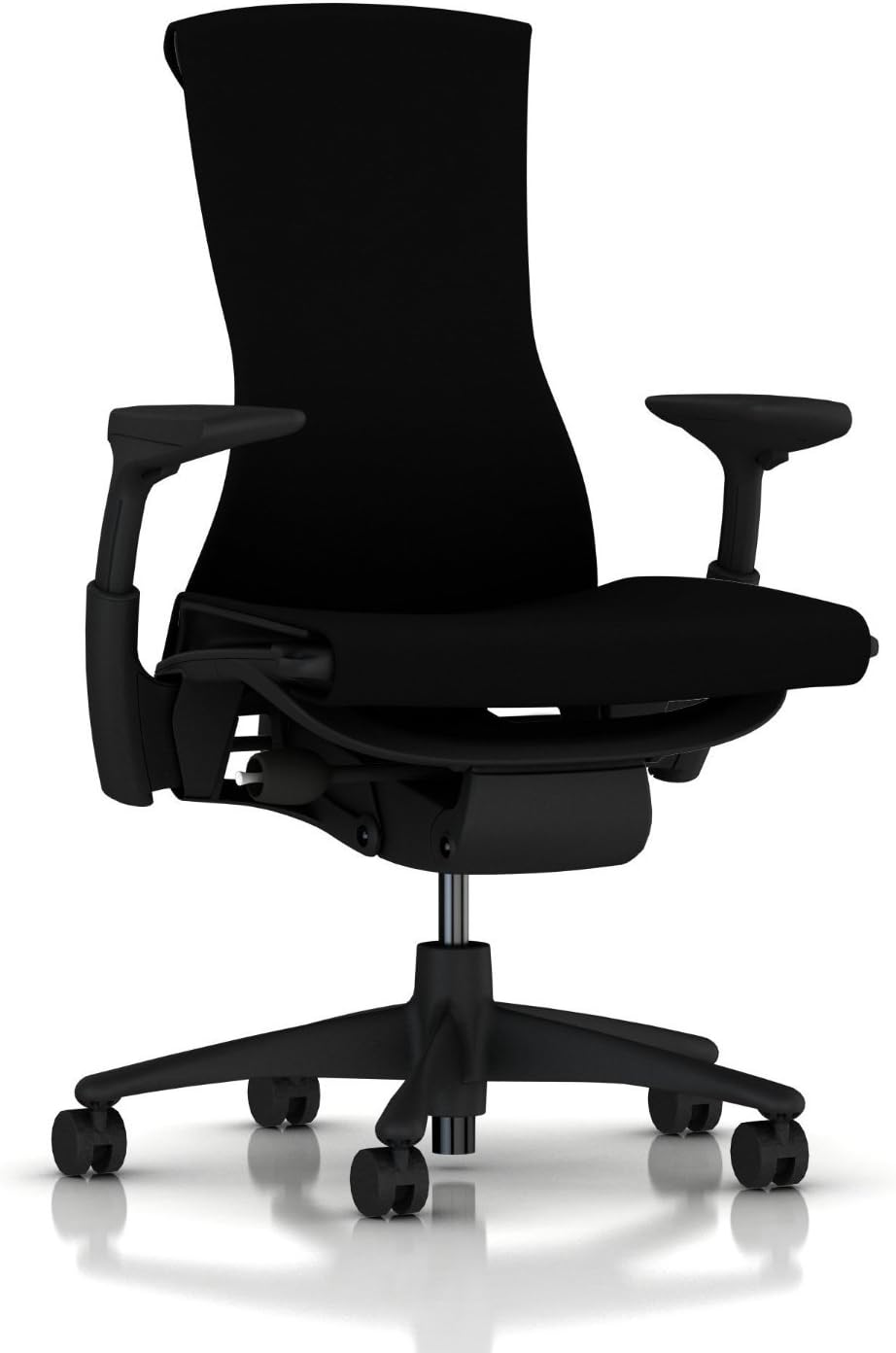
Spec sheet
Herman Miller Logitech Embody
- Model Number
- CN122AWAAG1G1BB3014
- Global Trade Identification Number
- 04250396429596
- Designers and Year
- Bill Stumpf and Jeff Weber (Introduced 2008)
- Upholstery Specification
- Black Rhythm fabric (tight weave, smooth touch, heat dissipating)
- Seat Pan Construction
- Four-layer intelligent support system with dynamic pixel matrix
- Spinal Support Architecture
- Backfit adjustment with central dynamic spine and flexible ribs
- Tilt Mechanics
- Tilt limiter mechanism with 3 reclining positions
- Armrest Adjustability
- Fully adjustable arms with black arm pads
- Base Structure and Movement
- Graphite base and frame with 360-degree swivel
- Mobility Casters
- Carpet casters rated for indoor carpeted flooring
Figures as published by the manufacturer on the Amazon listing.
Biomechanical Engineering and Pixelated Support Dynamics
The core structural design of the Herman Miller Logitech Embody ergonomics departs sharply from traditional office chair engineering. Guided by empirical research from more than 20 physicians and PhDs specializing in biomechanics, physical therapy, ergonomics, and vision, the chair establishes a new standard for universal pressure distribution. Conventional task chairs rely primarily on molded polyurethane foam cushions that inevitably compress over time, generating focal pressure spikes beneath the pelvic bones. The Embody circumvents this fatigue mechanism through an engineered structural foundation that continuously adapts to user micro-movements, preserving unrestricted capillary blood flow throughout grueling work days.
Central to this kinetic performance is the Herman Miller Embody Pixelated Support system deployed across both the seat pan and the backrest. The architecture incorporates a dynamic matrix of individual structural pixels that articulate independently under localized load. When you sit, these flexible pixels immediately distribute gravitational weight across the entire contact surface, yielding a sensation of floating while maintaining balanced stability. By distributing downward loads evenly, the matrix prevents hot spots, encourages natural involuntary posture shifts, and improves blood circulation to send more oxygen to the brain during mentally strenuous work blocks.
Directly beneath the primary upholstery lies a structural stack known as the layers of intelligence. The Embody seat incorporates four distinct support tiers, with each tier engineered from a unique material property and manufactured through specialized processes. These interactive layers flex simultaneously to match the specific contours of the user’s thighs and pelvis with exceptional fidelity. Unlike the airy tensioned suspension of a herman miller sayl chair, the Embody layered seat pan offers a grounded, highly responsive platform that mitigates sacral compression without deadening the tactile feedback necessary for proper spinal orientation.
Backfit Adjustment Mechanism and Spine Kinematics
The backrest of the chair mimics biological anatomy through an external kinetic spine paired with a network of lateral flexible ribs. Controlled by the Herman Miller Embody Backfit adjustment, this mechanical structure allows the user to contour the backrest to match the natural curvature of their lumbar and thoracic spine. Instead of forcing the spine into an artificial posture, the Backfit adjustment aligns the backrest directly with the user’s neutral pelvic tilt. Once tuned to the body’s proportions, the flexible ribs automatically track subtle kinetic shifts, ensuring full contact whether the user leans forward to inspect dense code or sits upright.
A notable functional feature of the Embody backrest is its slender, tapering vertical footprint. Standard high-back task chairs routinely bracket the shoulder blades, immobilizing the upper torso and discouraging natural scapular retraction. The Embody narrow profile intentionally frees the shoulders, permitting unconstrained rotational twisting, stretching, and reaching across expansive multi-monitor desk setups. Crucially, as the user moves laterally or reclines, the integrated lumbar mechanism remains active, maintaining positive physical engagement against the lower back across all angles.
For individuals evaluating the Herman Miller Logitech Embody for gaming and digital sports performance, this unrestricted range of movement provides measurable ergonomic advantages. Gamers frequently oscillate between forward-leaning competitive postures and relaxed observation stances during long sessions. Because the dynamic spine and flexible ribs accommodate micro-adjustments without requiring manual lever manipulation, mechanical shear forces against the lower back are greatly minimized. By sustaining continuous sacropelvic support through every shift in focus, the chair actively combats muscular fatigue across extended gaming campaigns.
Kinematic Adjustments, Tilt Limiter, and Seat Depth Mechanics
Kinematic personalization on the Embody is accomplished through clean mechanical adjustment controls integrated directly into the chair’s structural skeleton. The Herman Miller Embody tilt limiter provides users with calibrated resistance control across three dedicated reclining positions. This three-stage limiter allows operators to anchor the backrest in a concentrated upright tasking stance, an intermediate reclined position suitable for keyboard entry, or a full recline intended for reading and tactical reflection. The underlying harmonic pivot ensures that throughout the reclining sweep, the front edge of the seat pan remains level to keep the user’s feet grounded.
Lower extremity ergonomics are refined via the Herman Miller Logitech Embody seat depth adjustment mechanism. Modifying seat depth is vital to ensure adequate clearance behind the popliteal region behind the knees, preventing venous restriction and numbness. The Embody allows the front edge of the seat pan to expand or retract smoothly, accommodating diverse leg lengths while preserving the structural continuity of the Pixelated Support matrix. Paired with fully adjustable arms that move smoothly through height and width vectors, users can establish precise 90-degree elbow support to eliminate forearm straining against the desktop.
When analyzing the technical Herman Miller Logitech Embody specs, users must account for physical boundaries defined within the listing data. The unit is supplied with a 360-degree swivel graphite base, black arm pads, and factory carpet casters designed specifically for indoor fibrous flooring. However, concerning exact Herman Miller Logitech Embody chair dimensions, such as overall frame width, total vertical height boundaries, and maximum seat height clearance, the listing does not specify exact numerical values. Workstation planners should ensure adequate space clearance for a full-sized commercial office chair footprint.
Material Properties, Rhythm Fabric, and Structural Durability
The external contact layer of this configuration features Herman Miller Embody Rhythm fabric in a black aesthetic. Rhythm fabric is a tightly constructed textile engineered for a smooth, soft-touch hand feel that prevents the abrasive friction common in coarse commercial polyesters. Functionally, its breathable weave operates in tandem with the four underlying seat layers to prevent heat buildup throughout prolonged seating periods. Traditional foam-padded chairs inevitably trap body heat and moisture against the user; Rhythm fabric promotes passive thermal dissipation, keeping the contact surface cool during intensive operational stretches.
Herman Miller conceptualized the chair around functional technology, ensuring that its internal mechanical systems serve as its visible aesthetic. Rather than hiding structural linkages, flex ribs, and mounting brackets beneath bulky plastic housings, the chair showcases its external exoskeleton. The graphite frame and matching base place the central spine, flexing ribs, and pixel matrix on full display. Every visible joint and pivot point performs an active ergonomic role, producing an industrial design that celebrates functional transparency while simplifying maintenance inspection over the life of the chair.
Structural reliability is underscored by heavy-duty commercial components engineered to handle continuous adult usage in rigorous office environments. The graphite frame offers exceptional torsional rigidity, while the flexible ribs and pixel matrix endure repetitive cyclic flexing without taking a permanent set. Investing in an original factory unit guarantees proper factory tolerances, avoiding the mechanical slack and unknown structural history occasionally encountered when buying a herman miller embody refurbished from secondary market channels. From its resilient carpet casters to its precision arm adjustments, the chair delivers uncompromising mechanical execution.
Herman Miller Logitech Embody Pros and Cons
What works
- Pixelated Support matrix distributes micro-movement pressure
- Backfit adjustment matches natural spinal curvature
- Four-layer intelligent seat platform construction
- Breathable Rhythm fabric prevents body heat buildup
- Narrow backrest encourages natural shoulder movement
What to weigh up
- Factory casters strictly intended for carpeted floors
- Tilt limiter restricted to three recline positions
- Listing does not specify precise exterior dimensions
Check Herman Miller Logitech Embody on Amazon
Who Should Buy the Herman Miller Logitech Embody
Choosing an advanced ergonomic seating platform requires balancing your working habits, posture tendencies, and anatomical support needs. The Embody delivers exceptional biomechanical stabilization for demanding workstation environments, but its active engineering is tailored to specific sitting profiles.
Buy It If
- You log eight or more hours daily at a desk and require active posture correction that reduces spinal fatigue and improves circulation.
- You value upper-body mobility and need a narrow backrest that permits free shoulder articulation, reaching, and torso twisting.
- You prefer an advanced, responsive pixel matrix and four-layer seat rather than traditional thick foam cushions that trap metabolic heat.
- Your desk area is fitted with carpeted flooring where the factory-installed carpet casters provide smooth, controlled mobility.
Skip It If
- You desire an ultra-plush, pillowed executive recliner designed for lounging, slumping, or curling your legs beneath you on the seat pan.
- Your office setup features bare hardwood, tile, or laminate flooring, which requires specialized non-marking hard-floor casters.
- You demand infinite, micro-stepped recline angle lockouts rather than the three positive reclining positions provided by the tilt limiter.
Final Verdict
7.8/10Our score
Evaluating whether the Herman Miller Logitech Embody is worth it depends on whether you view seating as a passive cushion or an active piece of ergonomic workstation machinery. By partnering with more than 20 medical authorities alongside designers Bill Stumpf and Jeff Weber, Herman Miller engineered a platform that directly addresses the biomechanical stressors of the modern digital workspace. The combination of the Backfit adjustment, the four-layer intelligent seat platform, and the reactive Pixelated Support matrix distributes body weight with mathematical precision, mitigating chronic fatigue across long working hours.
Although the listing does not specify precise exterior dimensions, and the included carpet casters limit its immediate use on bare hard floors without a protective mat, the chair’s functional engineering remains world-class. For software developers, digital creators, and competitive gamers seeking uncompromising anatomical posture and dynamic spinal articulation, the Herman Miller Logitech Embody represents an outstanding long-term investment in physical health and operational endurance.
FAQ
What are the primary technical specifications of this Herman Miller Embody?
This model features manufacturer part number CN122AWAAG1G1BB3014, a Global Trade Identification Number of 04250396429596, a graphite frame and base, black arm pads, Black Rhythm fabric, fully adjustable arms, adjustable seat depth, a 3-position tilt limiter, and carpet casters fitted onto a 360-degree swivel base.
How does the Herman Miller Embody Pixelated Support system function?
Pixelated Support relies on an integrated dynamic matrix of individual structural pixels across the seat pan and backrest. These pixels conform automatically to your body’s micro-movements, equalizing weight distribution to eliminate pressure concentration points and provide a balanced floating sensation.
What does the Herman Miller Embody Backfit adjustment do?
The Backfit adjustment allows you to physically tune the curve of the chair’s central spine and flexible rib matrix to match the unique curvature of your back. This establishes a balanced, neutral posture that naturally maintains lumbar support whether you sit upright or recline.
Can the seat depth on this Embody chair be adjusted?
Yes, this model features an adjustable seat depth control. You can expand or retract the front edge of the seat pan to match your thigh length, ensuring full leg support while leaving proper clearance behind your knees to promote healthy blood circulation.
Can I use the included casters on hardwood or tile flooring?
The product listing explicitly specifies that this model comes equipped with carpet casters designed for carpeted surfaces. Using these hard casters directly on hardwood, vinyl, or tile surfaces may result in slipping or surface abrasion unless paired with a suitable floor mat.
How does Rhythm fabric prevent heat buildup during long sessions?
Rhythm fabric is a tightly woven, smooth-touch technical textile designed to be breathable. Working in synergy with the four open support tiers of the seat, it permits continuous air circulation to dissipate metabolic body heat during extended desk sessions.
See this listing on Amazon We may earn a commission if you buy through this link.
More in Office & Furniture


The weekly shortlist
Specs worth reading, once a week
New teardowns, spec sheets and buying notes from across the desk.
This demo form is not connected to a mailing service.