Herman Miller Embody Refurbished: Complete Mechanical and Ergonomic Breakdown
The Herman Miller Embody represents one of the most mechanically sophisticated ergonomic task chairs engineered for intensive computer use. Co-designed by Bill Stumpf and Jeff Weber, this seating platform intentionally discards conventional high-density foam…
By Harold Blair

As Amazon Associates, we earn from qualifying purchases. This means we may receive a small commission at no extra cost to you if you click through and make a purchase.
The Herman Miller Embody represents one of the most mechanically sophisticated ergonomic task chairs engineered for intensive computer use. Co-designed by Bill Stumpf and Jeff Weber, this seating platform intentionally discards conventional high-density foam cushioning in favor of an exposed, articulating exoskeleton and an active polymer matrix engineered to emulate the human spine. When evaluating a herman miller embody refurbished unit, the core technical objective is determining whether its multi-layer support matrix, Backfit spine, and kinematic adjustments retain their factory tolerances. Our verdict: for desk-bound operators seeking active postural correction and targeted pressure distribution, a structurally sound refurbished Embody remains a benchmark biomechanical investment.
This task chair is tailored specifically for computer professionals, data analysts, and knowledge workers who log long, uninterrupted stretches at a desk and require continuous sacral-thoracic tracking. The dynamic backrest accommodates natural micro-movements, making the herman miller embody for office environments requiring sustained analytical focus exceptionally effective. Conversely, buyers who prefer the passive, enveloping cradle of high-pile executive cushioning or the uniform floating tension of a full mesh perimeter like the herman miller aeron should look elsewhere, as the Embody enforces active postural discipline rather than passive lounging.
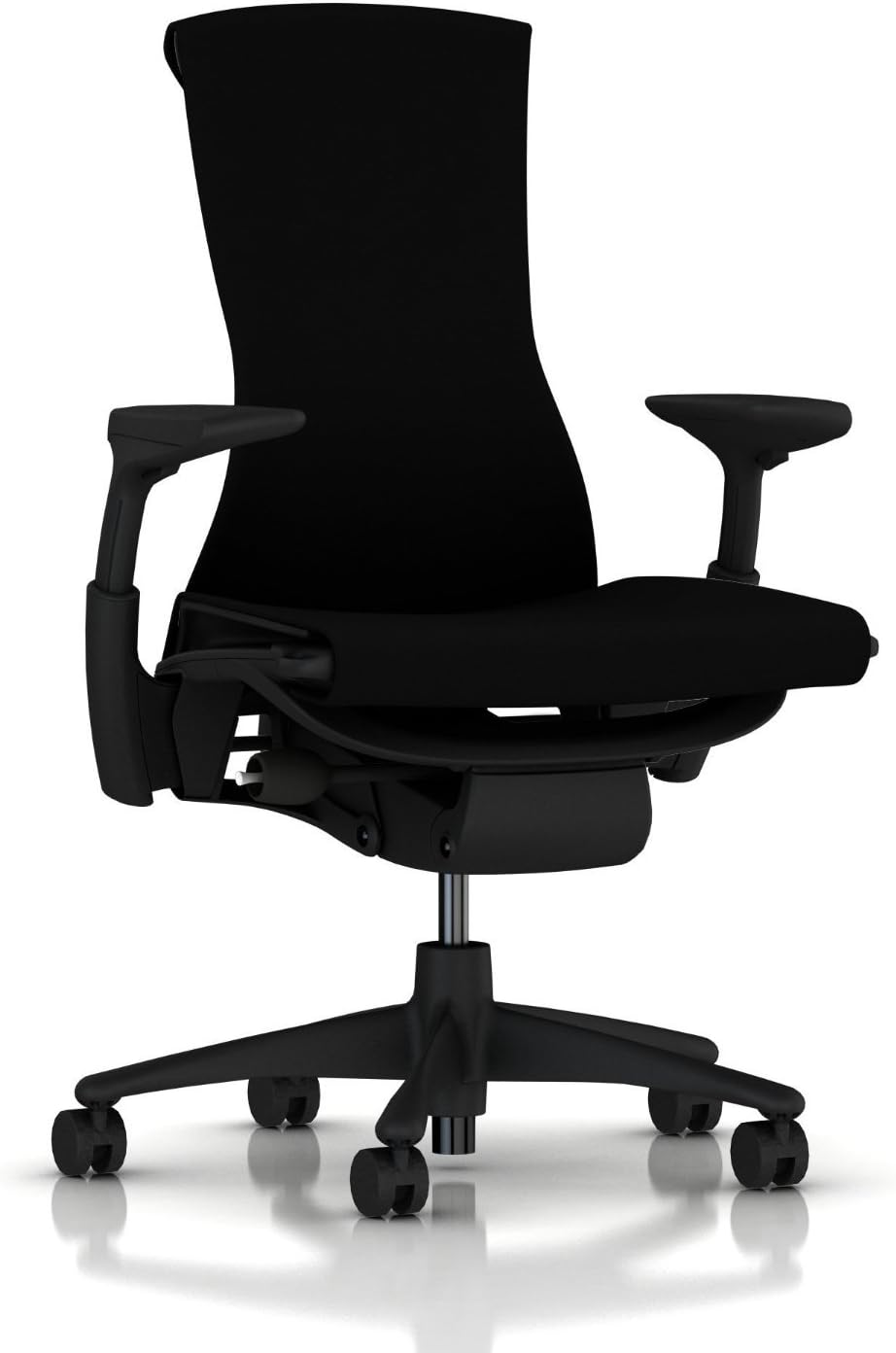
Spec sheet
Herman Miller Embody
- Model Number
- CN122AWAAG1G1BB3014
- Global Trade Identification Number
- 04250396429596
- Design Team
- Bill Stumpf and Jeff Weber (2008)
- Ergonomic Research Panel
- 20+ physicians and PhDs in biomechanics, vision, physical therapy, and ergonomics
- Seat Construction
- Four support layers with pixelated support matrix
- Backrest Technology
- Dynamic pixel matrix with central spine and flexible ribs
- Adjustment Mechanisms
- Backfit adjustment, adjustable seat depth, fully adjustable arms
- Recline Control
- Tilt limiter with 3 reclining positions
- Frame and Base Material
- Graphite base and frame with black arm pads
- Fabric and Casters
- Black Rhythm fabric; carpet casters
Figures as published by the manufacturer on the Amazon listing.
Pixelated Support Matrix and Four-Layer Seat Mechanics
The core innovation documented throughout the official herman miller embody specs is the complete elimination of static foam blocks in favor of dynamic pressure dissipation. More than twenty physicians and PhDs across biomechanics, physical therapy, and ergonomics guided the development of this architecture. Instead of packing dense foam into a molded pan, Herman Miller utilizes an open framework. The herman miller embody pixelated support system uses an active matrix of interconnected polymer pixels across the seat pan and backrest. These pixels flex independently, immediately mirroring the micro-movements of your pelvis and spine to distribute weight evenly across the entire surface.
The seat foundation relies on what Herman Miller classifies as layers of intelligence. The seat is comprised of four distinct support layers, each manufactured through separate industrial processes and possessing unique material properties. When combined, these four strata operate synergistically: the lower structural web provides load-bearing stabilization, the intermediate distribution tiers dissipate shear stress, and the upper contact deck cushions the sitting bones. Because these layers orient themselves to the user’s specific morphology, the chair prevents the localized pelvic pressure and tissue compression commonly caused by traditional office chair bases.
When conducting a refurbished herman miller embody inspection, this four-layer seat pan demands meticulous physical scrutiny. Over years of cyclic loading, worn units may suffer from fatigue in the sub-frame polymer pins or separation between the composite layers. Unlike standard suspension chairs such as the herman miller aeron chair size b, which relies on a monolithic elastomeric weave held under perimeter tension, the Embody’s pixel matrix features hundreds of independent flex nodes. Buyers must confirm that no individual plastic stems have cracked or collapsed, ensuring the floating sensation engineered by Stumpf and Weber remains fully intact.
Backfit Alignment and Thoracic Spine Kinematics
The backrest of the Embody is modeled directly on human anatomy, featuring an exposed central structural column paired with radiating flexible ribs. The herman miller embody backfit adjustment is controlled via a rotary knob mounted on the lower right chassis. Turning this knob adjusts the curvature of the central spine to match the unique lordotic curve of the user’s back. Once tuned, the backrest maintains continuous contact with the lumbar and thoracic regions whether the operator leans forward over a keyboard or reclines back to review documentation.
A notable mechanical feature is the chair’s narrow backrest profile. Traditional commercial office chairs use wide, planar backrests that lock the scapulae into a rigid plane. The Embody deliberately tapers inward along the thoracic region, allowing the user’s shoulders and torso to twist, reach, and rotate unimpeded. The manufacturer’s research indicates that accommodating these continuous physical micro-movements promotes venous blood flow, prevents stagnant muscular loading, and sends more oxygen to the brain during prolonged cognitive tasks.
In a refurbished Herman Miller Embody, the mechanical link connecting the Backfit control to the articulating spine must be vetted. A properly maintained Backfit mechanism provides smooth, continuous resistance across its adjustment arc without binding or skipping teeth. If a previous owner forced the control beyond its physical stops, the internal tensioner cable can slacken, preventing the flexible ribs from locking into the correct neutral posture profile.
Tilt Limiter Controls and Seat Depth Adjustability
Recline kinematics on the Embody are governed by an integrated mechanism featuring a multi-stage limiter. The listing confirms a dedicated tilt limiter offering 3 reclining positions. Rather than utilizing arbitrary friction locks that risk slipping under load, the Embody relies on a calibrated multi-position stop lever. This allows the user to operate in a fully upright tasking posture, select an intermediate recline for interactive computing, or open the mechanism to its maximum rearward limit for restorative reading.
Accommodating different leg lengths is achieved through the herman miller embody seat depth adjustment. Rather than sliding the entire seat pan forward and creating a gap between the lumbar support and the seat cushion, the Embody utilizes a flexible front perimeter that rolls outward or inward. By lifting two handles flanking the front edge of the seat, the user can extend or retract the pixelated support deck. This maintains uniform support beneath the thighs while ensuring the pelvis remains firmly planted against the Backfit spine.
Armrest mechanics provide full dimensional freedom, including height adjustment and inward/outward width positioning. The black arm pads mount to rigid graphite arm uprights that anchor directly to the chassis rather than the seat pan. When analyzing adjustability compared to other modular designs like the herman miller celle chair, the Embody’s arm assemblies exhibit minimal lateral play, provided the internal locking cams have not worn loose through heavy field deployment.
Rhythm Fabric Performance and Graphite Frame Durability
The upholstery specified for this model is the proprietary Black Rhythm fabric. The listing outlines that herman miller embody rhythm fabric is tight, smooth, and soft to the touch, engineered specifically to prevent heat buildup during extended sitting. Rhythm features a low-profile, breathable knit that stretches over the underlying pixel matrix without restricting the movement of the individual flex stems. Its tight weave eliminates the abrasive texture often found in heavy industrial polyesters, safeguarding delicate clothing fibers while resisting surface piling.
The structural chassis consists of a graphite base and frame engineered for heavy commercial duty. The listing notes that the Embody’s technology is not concealed under decorative plastic shrouds; rather, the functional mechanics are on full visual display. The exposed skeleton highlights the graphite framework, articulating spine connectors, and structural spine. When evaluating modern variants such as the herman miller logitech embody, the industrial foundation remains fundamentally rooted in this 2008 Stumpf and Weber architecture, emphasizing mechanical transparency and raw material durability.
The product specifications note a surface recommendation specifically for carpet, meaning the factory-supplied hard nylon dual-wheel casters are optimized to roll smoothly over low-to-medium pile office carpeting without stalling. If the chair is deployed on bare hardwood or tile, swapping to aftermarket soft polyurethane casters may be necessary, as the listing includes carpet casters exclusively.
Critical Checkpoints for a Refurbished Herman Miller Embody
Purchasing a refurbished task chair requires methodical mechanical verification. Because the Embody incorporates far more moving parts than standard static task seating, buyers assessing whether is herman miller embody worth it on the renewed market must run through a structured inspection. Begin at the base: examine the gas cylinder for axial play, hydraulic drift, or fluid leaks. The chair should swivel smoothly through 360 degrees without scraping or clicking within the graphite hub.
Next, perform an exhaustive refurbished herman miller embody inspection of the articulating back matrix. Apply firm pressure to each horizontal rib extending from the central spine. None of the elastomeric connectors should show stress whitening, micro-fractures, or split polymer bands. Sit in the chair and activate the 3-position herman miller embody tilt limiter across its full movement range. The mechanism should engage decisively at each of the 3 reclining positions without grinding, clunking, or uneven spring tension.
Finally, inspect the seat pan and upholstery. The Black Rhythm textile must be firmly anchored into the perimeter track without fraying or sagging. Cycle the seat depth adjustment handles several times: the coiled support deck should slide outward and retract under spring tension with equal resistance on both sides. Verifying these critical hardware components confirms that the refurbished unit retains the rigorous ergonomic standards established by Herman Miller’s engineering team.
Herman Miller Embody Pros and Cons
What works
- Dynamic pixelated support matrix dissipates focal pressure
- Four-layer intelligent seat flexes with micro-movements
- Backfit adjustment mimics natural human spinal curvature
- Three-position tilt limiter provides precise recline control
- Breathable Rhythm fabric prevents long-session heat buildup
- Tapered backrest enables free upper body movement
What to weigh up
- Included factory casters intended only for carpet
- Design does not include an integrated headrest
- Complex matrix requires thorough inspection on used units
Check Herman Miller Embody on Amazon
Who Should Buy the Herman Miller Embody
Buy It If
- You spend extended periods at a computer workstation and need an articulating backrest that matches your spine via the Backfit adjustment.
- You require uniform pressure distribution from a multi-layer pixelated seat matrix rather than standard flat foam or high-tension edge mesh.
- You want a narrow back profile that allows dynamic twisting, reaching, and shoulder articulation during intense focus.
- You work in a dedicated office setting with carpeting, making full use of the included carpet casters and graphite base.
Skip It If
- You operate primarily on delicate hardwood floors and do not plan to replace the carpet casters specified by the manufacturer.
- You prefer a chair with a plush, pillow-top cushion feel or an integrated headrest for prolonged reclining breaks.
- You need more than 3 reclining positions or require independent, forward-tilt seat angling options.
Final Verdict
3.9 / 5Amazon buyer rating, 481 ratings
The Herman Miller Embody stands out as a triumph of functional industrial design and medical biomechanics. By pairing an active pixelated support matrix with a human-mimicking spine, designers Bill Stumpf and Jeff Weber produced an ergonomic platform that remains technologically unmatched in pressure distribution. Its four-layer seat foundation and dynamic backfit system actively promote healthy vascular circulation, spine alignment, and subtle movement throughout demanding computing days.
Opting for a refurbished Herman Miller Embody offers exceptional value, provided you perform a meticulous inspection of its moving components. Verifying the integrity of the 3-position tilt limiter, the seat depth expansion coils, the flexible back ribs, and the Black Rhythm fabric ensures you receive the full health benefits intended by its team of physicians and biomechanics specialists. For dedicated desk workers, a structurally verified refurbished Embody is a high-yield, long-term workstation asset.
FAQ
How does the Herman Miller Embody Backfit adjustment work?
The Backfit adjustment utilizes a rotary control knob on the lower back of the chair to alter the curvature of the central spine. As you turn the knob, the central column shifts to mirror the natural curve of your spine, ensuring uniform contact from the sacrum through the thoracic region.
What are the four layers of intelligence in the Herman Miller Embody seat?
The Embody seat pan incorporates four distinct material layers created through different manufacturing processes. These layers work together to provide structural support, dissipate localized sitting pressure, and flex dynamically with the user’s micro-movements, preventing the bottoming-out sensation common to traditional foam.
What should I inspect first on a refurbished Herman Miller Embody?
Start your inspection by checking the polymer ribs and independent pixel nodes on both the backrest and seat pan for cracks or fatigue. Next, verify that the 3-position tilt limiter clicks crisply into each stop, the Backfit adjustment turns smoothly, and the seat depth extension retracts without binding.
How many recline positions does the Herman Miller Embody tilt limiter provide?
The Embody recline mechanism features a tilt limiter that offers 3 distinct reclining positions. This allows the user to operate in a locked upright posture, use an intermediate recline range, or open the mechanism fully to achieve maximum rearward recline.
Does the Herman Miller Embody Rhythm fabric prevent heat buildup?
Yes. The Black Rhythm fabric is engineered with a smooth, breathable weave that facilitates airflow and prevents heat buildup over long sitting sessions. Its elastic properties allow the underlying pixelated support matrix to move freely without fabric restriction or thermal retention.
See this listing on Amazon We may earn a commission if you buy through this link.
More in Office & Furniture



The weekly shortlist
Specs worth reading, once a week
New teardowns, spec sheets and buying notes from across the desk.
This demo form is not connected to a mailing service.