Sony FE 50mm F1.8 Analysis: Technical Specs and Optical Performance
The Sony FE 50mm F1.8 (model SEL50F18F/2) serves as the primary standard normal prime lens in Sony’s mirrorless optical lineup. Designed around a classic double-gauss optical arrangement and equipped with an aspherical surface, this…

As Amazon Associates, we earn from qualifying purchases. This means we may receive a small commission at no extra cost to you if you click through and make a purchase.
The Sony FE 50mm F1.8 (model SEL50F18F/2) serves as the primary standard normal prime lens in Sony’s mirrorless optical lineup. Designed around a classic double-gauss optical arrangement and equipped with an aspherical surface, this compact prime delivers a standard 39.6-degree angle of view alongside a bright f/1.8 maximum aperture. By balancing lightweight physical dimensions with full-frame sensor coverage, it functions as a functional baseline lens that achieves pleasing background defocusing and dependable center-frame resolving power without unnecessary mechanical bulk.
This standard prime is exceptionally well suited for full-frame photographers seeking a lightweight everyday walkaround optic, as well as APS-C system owners looking for an accessible portrait-length lens. The optical profile directly benefits portraiture, street photography, and low-light work where subject isolation and light transmission are paramount. However, creators who require built-in optical stabilization for handheld video or those who demand extreme macro reproduction capabilities should consider stabilized or dedicated close-up alternatives instead.
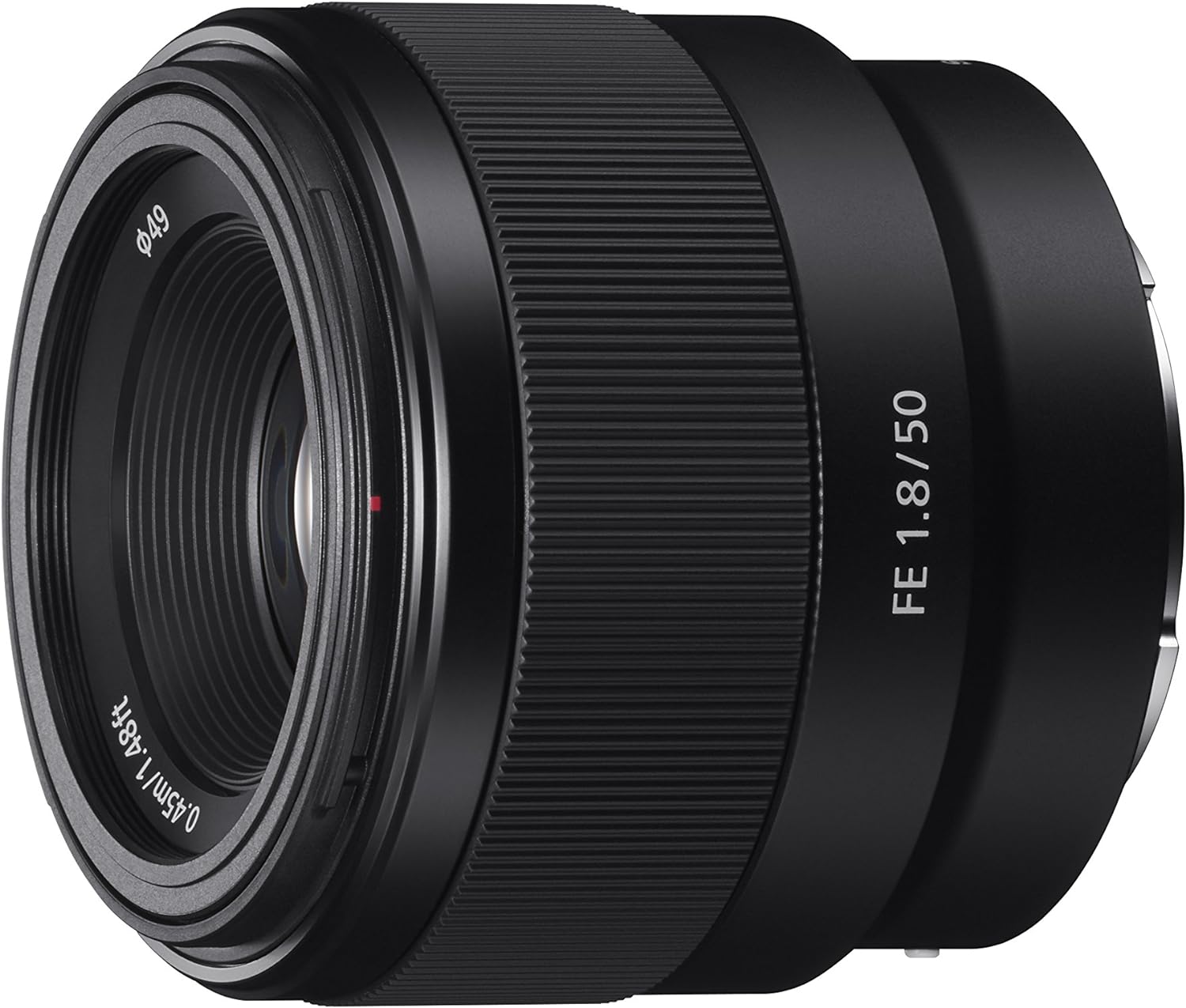
Spec sheet
Sony FE 50mm F1.8
- Focal Length
- 50mm
- Lens Mount
- Sony E-mount
- Format Compatibility
- All Sony E-mount camera models (Full-Frame & APS-C)
- Maximum Aperture
- f/1.8
- Minimum Aperture
- f/22
- Aperture Mechanism
- 7-blade circular diaphragm
- Optical Architecture
- Double-gauss configuration with 1 aspherical element
- Surface Treatment
- Nano AR Coating
- Angle of View
- 39.6 degrees (real angle of view)
- Maximum Magnification Ratio
- 0.14x (1:7.1 zoom ratio)
- Focus Drive System
- Auto Focus (DC motor actuator)
- Image Stabilization
- No internal optical stabilization
Figures as published by the manufacturer on the Amazon listing.
Optical Formula and Aberration Suppression
The internal optical layout of the Sony FE 50mm F1.8 relies on an established double-gauss design framework. Historically favored in standard normal prime lenses, the symmetrical double-gauss configuration effectively balances optical aberrations across the image plane. In this implementation, the primary mechanical role of the double-gauss layout is field curvature suppression and linear distortion reduction. By mirroring lens element clusters around the central diaphragm, optical engineers prevent the peripheral plane of focus from curving inward toward the sensor, preserving uniform edge-to-edge focal alignment across flat shooting planes.
To enhance the classical double-gauss core, Sony integrated an aspherical lens element into the rear optical grouping. Spherical aberration occurs when incoming light rays striking the perimeter of a spherical lens refract at steeper angles than central rays, focusing slightly ahead of the actual focal plane and causing low-contrast softness. The precision curvature of this aspherical element redirects marginal rays onto the exact target focal plane. This integration controls both spherical aberration and sagittal coma flare, maintaining clean rendering of pinpoint highlights when evaluating the sel50f18f optical performance across wide aperture settings.
Refraction control is further augmented by Sony’s specialized surface treatment. The implementation of Nano AR Coating dramatically curtails internal reflections at the air-to-glass boundaries within the lens barrel. By depositing a nano-engineered coating structure across critical lens surfaces, the lens curbs internal ghosting and veiling flare under direct backlighting. Photographers who examine manual alternatives such as the tt artisan 50mm will note that integrated anti-reflective coating technologies like Nano AR Coating are fundamental for preserving micro-contrast when shooting toward unshaded ambient light fixtures or open skies.
Furthermore, native sony 50mm f1.8 distortion control relies on this balanced geometry rather than intensive electronic correction alone. The symmetrical nature of the internal elements controls barrel distortion at the source, preventing horizontal and vertical lines from bowing visibly outward. This makes the standard focal length reliable for environmental portraits, architectural backdrops, and documentary captures where geometry must remain straight without stretching peripheral pixels during post-processing profile corrections.
Aperture Mechanics and Depth of Field Rendering
Light intake and selective depth of field are governed by the bright sony 50mm 1.8 aperture mechanism. Opening to an expansive f/1.8, the iris allows a high volume of ambient illumination to strike the camera sensor, facilitating lower camera ISO values and faster shutter speeds in dimmer settings. When stopped down, the aperture reaches a minimum setting of f/22, providing extensive depth of field and exposure flexibility in intense sunlight. The wide physical throat of the front glass matches the requirements of modern high-resolution sensors seeking optimal light distribution.
Background defocusing characteristics are molded by a 7-blade circular aperture diaphragm. Traditional straight-edged diaphragm blades tend to produce polygonal or heptagonal out-of-focus highlights as the lens is stopped down past its maximum setting. Sony’s curved blade architecture maintains a rounded aperture opening across wider f-stops. This design choice prevents harsh geometric artifacts in the background, yielding smoothly rolled defocus transitions and clean circular bokeh orbs in out-of-focus background light sources.
These optical characteristics establish the utility of the sony 50mm f1.8 for portraiture and close subject isolation. With a full-frame 50mm focal perspective and an f/1.8 entrance pupil, the optical separation between the primary subject and the background is pronounced. Facial features render with natural proportions free of wide-angle facial distortion or extreme telephoto facial flattening. The transition from pin-sharp plane of focus to softly blurred background textures allows isolated subjects to separate distinctly from visually complex backgrounds.
Autofocus Mechanics and Handling Architecture
The autofocus execution of this standard optic operates through an internal electric motor designed to move the entire rear double-gauss group. Because the double-gauss optical layout moves multiple glass elements together during focus transitions, the sony 50mm f1.8 autofocus speed is tuned primarily for steady accuracy rather than instantaneous acceleration. The internal motor system communicates directly with E-mount focus algorithms, tracking eye-detection metrics and continuous tracking modes reliably for still photography and controlled portrait scenarios.
Physically, the housing emphasizes an ultra-compact and lightweight footprint, aligning with the core design ethos of mirrorless bodies. With its black finish and minimalist exterior, the lens balances evenly on both small and mid-sized camera grips. The exterior barrel features a broad manual focus ring, while omitting external switches or physical aperture detents to keep the overall physical mass to an absolute minimum. This ensures the lens adds negligible fatigue during extended handheld shooting sessions or travel documentary workflows.
One critical technical specification to consider is the absence of internal optical image stabilization. The lens housing contains no shifting lens groups for shake reduction, meaning image stability is handled entirely by the host camera’s In-Body Image Stabilization (IBIS) system. On full-frame bodies equipped with sensor-shift stabilization, the camera compensates for pitch, yaw, and roll movements seamlessly. However, when mounted to camera bodies that lack sensor-shift stabilization, users must maintain appropriate shutter speeds to avoid handshake blur, particularly in low-light environments.
Mount Compatibility and Sensor Coverage
Designed around the versatile sony fe 50mm f1.8 e-mount specification, this prime connects natively to the full spectrum of Sony mirrorless bodies. The “FE” designation denotes complete 35mm full-frame image circle coverage, ensuring illumination reaches the perimeter of a 36x24mm sensor without mechanical vignetting. Because Sony maintains unified electrical and physical dimensions across its E-mount line, the lens mounts natively to full-frame alpha cameras as well as APS-C sensor platforms without requiring external mount adapters.
When deployed on an APS-C crop-sensor body such as the sony zv-e10 mark ii, the sensor crops the full-frame optical circle, resulting in an effective field of view equivalent to a 75mm medium telephoto lens. This 1.5x focal multiplier transforms the standard optic into a dedicated short-telephoto portrait prime. The optical qualities of the 50mm focal length remain unchanged, but the narrower framing isolates framing compositions tightly around head-and-shoulders portraits and detail-oriented commercial subjects.
Understanding angle of view differences is critical when comparing this fixed focal length prime to zoom options like the sigma 18-50mm f2.8 sony. On native full-frame sensors, this prime lens delivers a true 39.6-degree angle of view, approximating the human field of central visual perception. Close-up composition limits are governed by the 0.14x maximum magnification ratio (1:7.1 zoom ratio). While sufficient for framing medium-sized objects, environmental details, and torso-length portraits, this reproduction ratio confirms the lens is an everyday prime rather than a designated macro tool.
Sony FE 50mm F1.8 Pros and Cons
What works
- Bright f/1.8 maximum aperture
- Double-gauss design suppresses field curvature
- Aspherical element controls spherical aberration
- Nano AR Coating reduces internal reflections
- Compact and lightweight physical footprint
- Full compatibility across all Sony E-mount bodies
What to weigh up
- Lacks internal optical image stabilization
- Modest 0.14x maximum reproduction magnification
- Seven-blade diaphragm rather than higher blade counts
Check Sony FE 50mm F1.8 on Amazon
Who Should Buy the Sony FE 50mm F1.8
Buy It If
- You need a dedicated sony full frame 50mm prime that offers a bright f/1.8 aperture for subject separation and low-light work.
- You prioritize a compact, lightweight physical design that pairs effortlessly with Sony E-mount mirrorless bodies without adding front-heavy balance.
- You want a dual-purpose prime that functions as a natural standard lens on full-frame cameras and converts into a 75mm-equivalent portrait optic on APS-C bodies.
- You shoot in backlit or high-contrast environments where the Nano AR Coating and aspherical element help suppress ghosting, coma, and spherical aberration.
Skip It If
- You require integrated optical image stabilization because your camera body lacks in-body sensor stabilization and you frequently shoot handheld video.
- You need extreme macro performance or high-magnification close-up framing beyond the standard 0.14x (1:7.1) reproduction capability.
- You demand silent, instant linear motor autofocus tracking designed specifically for fast-paced professional sports or rapid action capture.
Final Verdict
9.4/10Our score
The Sony FE 50mm F1.8 provides an authoritative demonstration of how classic optical engineering can be modernized for digital mirrorless sensors. Grounded in a double-gauss architectural framework and updated with an aspherical glass element and Nano AR Coating, the lens achieves dependable image sharpness while keeping distortion and field curvature strictly in check. Its f/1.8 maximum aperture paired with a 7-blade circular diaphragm allows creators to isolate subjects cleanly, producing soft background blur that flatters portraits and documentary subjects alike.
When answering whether is sony 50mm f1.8 worth it, the decision centers directly on physical efficiency and pure optical utility. While the autofocus drive is geared toward precision over blazing speed and the barrel lacks internal image stabilization, the foundational sony 50mm f1.8 specs deliver an undeniable baseline of imaging performance. For photographers assembling a lightweight, high-performance prime kit for any Sony E-mount camera, this 50mm optic remains an essential full-frame standard prime that excels in daily photographic duty.
FAQ
What is the minimum and maximum aperture of the Sony FE 50mm F1.8?
The lens features a bright maximum aperture of f/1.8, allowing for substantial light intake and shallow depth of field. It stops down mechanically through its 7-blade circular diaphragm to a minimum aperture of f/22.
Does the Sony FE 50mm F1.8 feature internal optical image stabilization?
No, the lens does not contain internal optical image stabilization. Handheld stabilization relies entirely on the In-Body Image Stabilization (IBIS) systems integrated into compatible Sony camera bodies.
What is the angle of view when mounted on a full-frame camera?
On a 35mm full-frame E-mount camera body, the lens provides an exact real angle of view of 39.6 degrees, offering a natural field of view that closely mirrors normal human visual perspective.
Can the Sony FE 50mm F1.8 be used on Sony APS-C crop sensor cameras?
Yes, the lens is fully compatible with all Sony E-mount camera models, including APS-C bodies. On an APS-C camera, the 1.5x crop factor yields an effective focal length equivalent to approximately 75mm, making it an exceptional option for portraiture.
What optical elements are used to control aberrations in this lens?
The optical construction uses a double-gauss configuration designed to suppress field curvature and distortion. It incorporates an aspherical element to correct spherical aberration and coma, alongside Nano AR Coating to minimize surface reflections and flare.
See this listing on Amazon We may earn a commission if you buy through this link.
More in Cameras & Drones



The weekly shortlist
Specs worth reading, once a week
New teardowns, spec sheets and buying notes from across the desk.
This demo form is not connected to a mailing service.