Fujifilm Instax Wide 400 Technical Breakdown: Specs, Modes, and Usability
The Fujifilm Instax Wide 400 represents an analog wide-format instant camera built to deliver broad landscape, environmental, and large group framing through an automated operational workflow. Designed under model designation FJIW400 in a clean…

As Amazon Associates, we earn from qualifying purchases. This means we may receive a small commission at no extra cost to you if you click through and make a purchase.
The Fujifilm Instax Wide 400 represents an analog wide-format instant camera built to deliver broad landscape, environmental, and large group framing through an automated operational workflow. Designed under model designation FJIW400 in a clean black chassis, the camera pairs a dedicated zone-focus optical structure with automatic exposure metering and integrated electronic flash control to streamline instant print creation. For photographers who want the physical presence of wide-gauge instant chemistry without the operational friction of manual exposure calculations, this model stands as a straightforward, dependable imaging tool.
This wide-format camera suits family documentarians, event coordinators, landscape hobbyists, and group portrait shooters who need the expansive surface area of wide instant prints alongside dependable mechanical self-timing. Shooters who require fine manual control over apertures, variable shutter speeds, digital hybrid storage, or mirrorless interchangeable lenses like those found on the fujifilm x-t30 iii with kit lens or compact digital systems like the fujifilm mini evo should look elsewhere, as this unit remains strictly dedicated to pure analog output on large film packs.
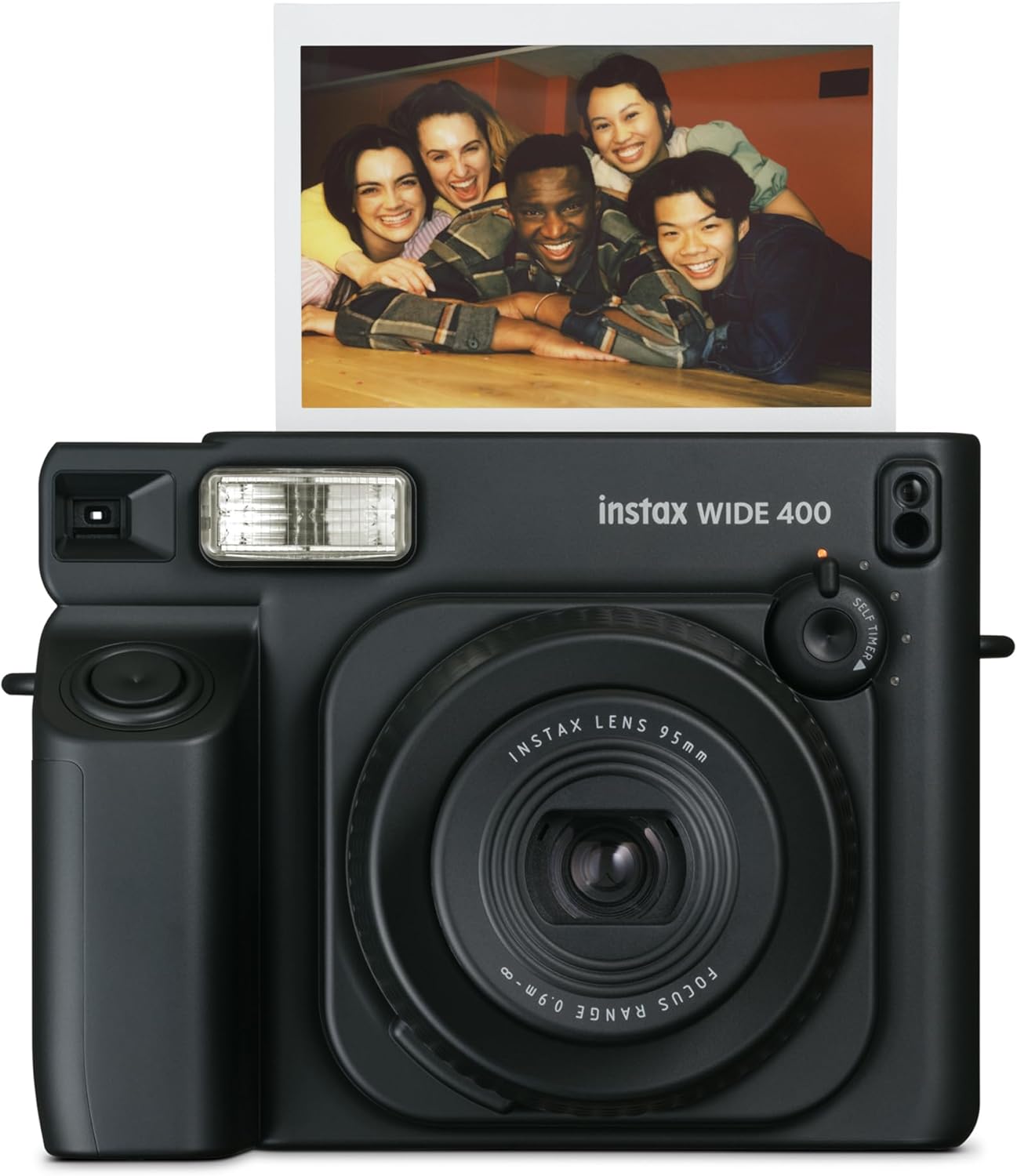
Spec sheet
Fujifilm Instax Wide 400
- Model Designation
- FJIW400
- Film Format Support
- Fujifilm Instax Wide Instant Film
- Film Sensitivity Baseline
- ISO 400
- Exposure Metering System
- Fully Automatic Exposure Control
- Flash Integration
- Built-In Automatic Flash Control
- Minimum Shutter Speed
- 1/125 sec
- Focusing Configurations
- Normal, Landscape, and Macro (via Close-Up Attachment)
- Self-Timer Mechanism
- Analog-Style Lever Dial, 2 to 10 Seconds with LED Countdown
- Chassis Color Profile
- Black
- Environmental Sealing
- Not Water Resistant
Figures as published by the manufacturer on the Amazon listing.
Exposure Automation and Shutter Architecture
The technical foundation of this camera centers on an integrated electronic metering system that pairs automatic exposure calibration with internal flash regulation. Operating around a native film speed of ISO 400, the onboard electronics continuously evaluate ambient lighting conditions to select an appropriate exposure value for each press of the shutter release. This removes the necessity for manual calculation under varying light levels, allowing the user to concentrate fully on framing wide scenes rather than tracking exposure indexes.
In terms of temporal performance, the technical specifications confirm a minimum shutter speed of 1/125 sec. While the listing does not specify the maximum shutter speed, the upper ceiling of the mechanical shutter works synchronously with the automated flash unit to provide fill lighting across high-contrast environments and maintain adequate scene illumination in dim settings. Because the camera lacks manual exposure compensation dials or independent aperture rings, users must rely on the automated metering circuit to manage daylight highlights and interior shadows, ensuring consistent emulsion development under typical ambient conditions.
For photographers evaluating the camera for dynamic lighting environments, it is worth noting that the exposure sequence is tightly coupled with the active flash system. The automatic flash fires to prevent underexposure whenever illumination levels drop below the internal threshold, minimizing the risk of ruined prints due to insufficient shutter duration. This automated balance is calibrated specifically for ISO 400 film chemistry, ensuring that contrast levels stay within the dynamic latitude characteristic of instant emulsion.
Optical Zone Configuration and Focus Modes
To accommodate subjects at varying physical distances, the camera employs a three-tier zone focusing architecture consisting of Normal mode, Landscape mode, and Macro mode. The primary barrel configuration manages intermediate and distant subject matter, allowing users to alternate between standard portrait distances and distant compositions with a physical turn of the lens collar. This zone system replaces conventional continuous autofocus assemblies with robust, mechanically defined focal planes, reducing battery draw and eliminating shutter lag caused by focus hunting.
For infinity-oriented captures such as mountain vistas, architectural facades, and wide environmental scenes, the Landscape mode shifts internal optical elements to lock sharp definition across the background plane. Conversely, the Normal mode serves everyday snapshots, standard group arrangements, and full-length portraits. This separation helps eliminate the soft focus artifacts that can occur when wide-angle optics attempt to maintain universal focus across broad spatial depths, offering a marked operational refinement over earlier platforms like the instax wide 300.
Close-range subject matter is addressed through the included close-up lens accessory, which snaps directly onto the front optical barrel to engage the Macro shooting mode. This supplementary optic alters the focal convergence point, allowing the user to record intimate details, tabletop arrangements, and tight individual portraits that would otherwise fall inside the minimum focusing distance of the native lens. The close-up attachment includes a built-in framing guide to help correct for parallax error, ensuring accurate subject placement when composing through the optical viewfinder at close range.
Self-Timer Mechanics and Angle Adjustment Hardware
A distinctive functional upgrade integrated into the chassis is the physical self-timer assembly, driven by an analog-style rotary control lever on the front body. Rather than relying on cryptic button combinations or multi-menu digital interfaces, users turn the physical dial to program delay intervals in two-second increments, up to a maximum duration of ten seconds. This tactile mechanical arrangement provides immediate physical confirmation of the selected delay setting, which is especially useful when orchestrating group portraits or family gatherings.
The self-timer workflow is visually augmented by a multi-segment LED countdown display located adjacent to the mechanical lever. Once the shutter button is actuated, the LED illuminates and counts down sequentially, providing a clear visual cue to subjects standing several meters away from the lens. This eliminates the guesswork often associated with analog camera self-timers, ensuring that all participants are fully prepared before the mechanical shutter triggers exposure.
To eliminate the common struggle of balancing an instant camera on uneven surfaces or makeshift props, the package includes an engineered camera angle adjustment accessory. This modular accessory features two distinct height adjustments and slides securely into a custom-molded mounting recess underneath the camera body. By setting the camera on a flat surface and inserting the angle adjustment tool, photographers can tilt the optical axis slightly upward or downward to frame subjects accurately without requiring a full-sized tripod, making tabletop and self-timer group shots significantly easier to execute.
Instax Wide Film Compatibility and Frame Geometry
The camera is built entirely around the Instax Wide film format, which delivers a finished print area roughly double the size of conventional mini instant formats. With an aspect ratio designed for landscape orientation, the physical dimensions of the image area give photographers sufficient room to position multiple subjects across the horizontal plane without crowding the margins. This format advantage is essential for wedding photo booths, corporate gatherings, and landscape photography where standard mini formats feel restrictive.
Film handling is purely chemical and instant: once exposed, an internal motorized drive ejects the print through the top slot of the camera housing. The print then develops automatically over several minutes, driven by reagent pods integrated into the bottom border of the film sheet. Because the emulsion carries a native light sensitivity rating of ISO 400, the film maintains a fine grain structure and balanced color rendition under natural daylight and controlled flash lighting alike.
Loading the film pack follows a standardized analog procedure requiring the alignment of optical registration marks inside the rear door cavity. Once the film cartridge is sealed inside the rear chamber, the camera automatically strips the protective black safety sheet on the initial cycle, priming the counter mechanism for the subsequent ten photographic sheets. The listing notes that the camera body and included accessories do not feature environmental sealing or water resistance, meaning cartridge loading and shooting should always take place away from heavy moisture, rain, or airborne debris.
Fujifilm Instax Wide 400 Pros and Cons
What works
- Automatic exposure with integrated flash control
- Analog self-timer lever with LED countdown
- Includes dual-height camera angle adjustment tool
- Three focus modes including macro lens attachment
- Expansive Instax Wide print format compatibility
What to weigh up
- No manual shutter or aperture override controls
- Chassis is not water resistant
- Fixed to ISO 400 film speed standard
Check Fujifilm Instax Wide 400 on Amazon
Who Should Buy the Fujifilm Instax Wide 400
Buy It If
- You need large-format instant prints for group portraits, events, or landscape documentation where standard mini film formats are too constrained.
- You value straightforward analog operation backed by automated exposure metering, automatic flash control, and a tactile mechanical self-timer lever.
- You frequently shoot group photos or self-portraits on flat surfaces and can make practical use of the included dual-height angle adjustment accessory.
- You prefer a dedicated zone-focus optical configuration with an included close-up attachment for clear macro captures without focusing hunting.
Skip It If
- You demand full manual control over shutter speeds, aperture selections, or manual flash deactivation for complex studio lighting setups.
- You require a ruggedized, weather-sealed camera body designed to withstand wet outdoor environments, heavy rain, or marine exposure.
- You are searching for a digital hybrid device with an internal memory card slot, LCD preview screen, or digital image transmission capabilities.
Final Verdict
10.0/10Our score
The Fujifilm Instax Wide 400 delivers a focused, technically cohesive shooting experience that modernizes analog wide-format instant capture without compromising its tactile appeal. By combining fully automated exposure calculation, automatic flash synchronization, and a baseline 1/125 sec minimum shutter speed with a high-latitude ISO 400 film format, the camera minimizes technical failure points for both novice and experienced instant photographers. Its thoughtful exterior additions—most notably the analog-lever self-timer with its LED countdown tracker and the specialized angle adjustment accessory—resolve the long-standing physical challenges of executing well-framed group photographs without elaborate field equipment.
While creative purists may lament the lack of manual aperture selections, bulb mode exposures, or weatherproofing, the camera achieves precisely what its engineering mandates: reliable, properly exposed wide instant prints produced through an intuitive mechanical workflow. For anyone seeking to capture rich, large-format tangible prints with minimal friction, this black-bodied instant camera stands out as an exceptionally capable and practical analog imaging tool.
FAQ
Does the Fujifilm Instax Wide 400 feature manual exposure controls?
No, the camera operates entirely with automatic exposure and automatic flash control. The internal metering system continuously assesses ambient light and synchronizes the shutter and flash to achieve an optimal exposure without requiring manual input from the photographer.
What is the minimum shutter speed on the Fujifilm Instax Wide 400?
The technical specifications specify a minimum shutter speed of 1/125 sec. The camera’s automated metering system controls the shutter duration within its operating parameters to balance ambient illumination and flash output.
How do the focus modes work on the camera?
The camera features three distinct shooting modes: Normal, Landscape, and Macro. Normal and Landscape modes are selected on the primary barrel for intermediate and distant scenes, while Macro mode is activated by attaching the included close-up lens accessory directly over the front optic.
How does the built-in self-timer operate?
The self-timer is operated via an analog-style lever dial located on the front of the body. Users can adjust the delay in two-second increments up to a total of ten seconds, with an integrated LED countdown display confirming the remaining time before shutter release.
Can the Fujifilm Instax Wide 400 use Instax Mini film cartridges?
No, the camera is engineered exclusively for Fujifilm Instax Wide instant film packs. It cannot accept Instax Mini or Instax Square cartridges due to physical dimension and mechanical feed differences.
What accessories are included with the camera in the box?
The package includes the camera body, a shoulder strap, the camera angle adjustment accessory, a close-up lens attachment, a quick start guide, and a 1-year limited warranty.
See this listing on Amazon We may earn a commission if you buy through this link.
More in Cameras & Drones



The weekly shortlist
Specs worth reading, once a week
New teardowns, spec sheets and buying notes from across the desk.
This demo form is not connected to a mailing service.