PlayStation VR Creed and Superhot Bundle: Detailed Hardware Analysis
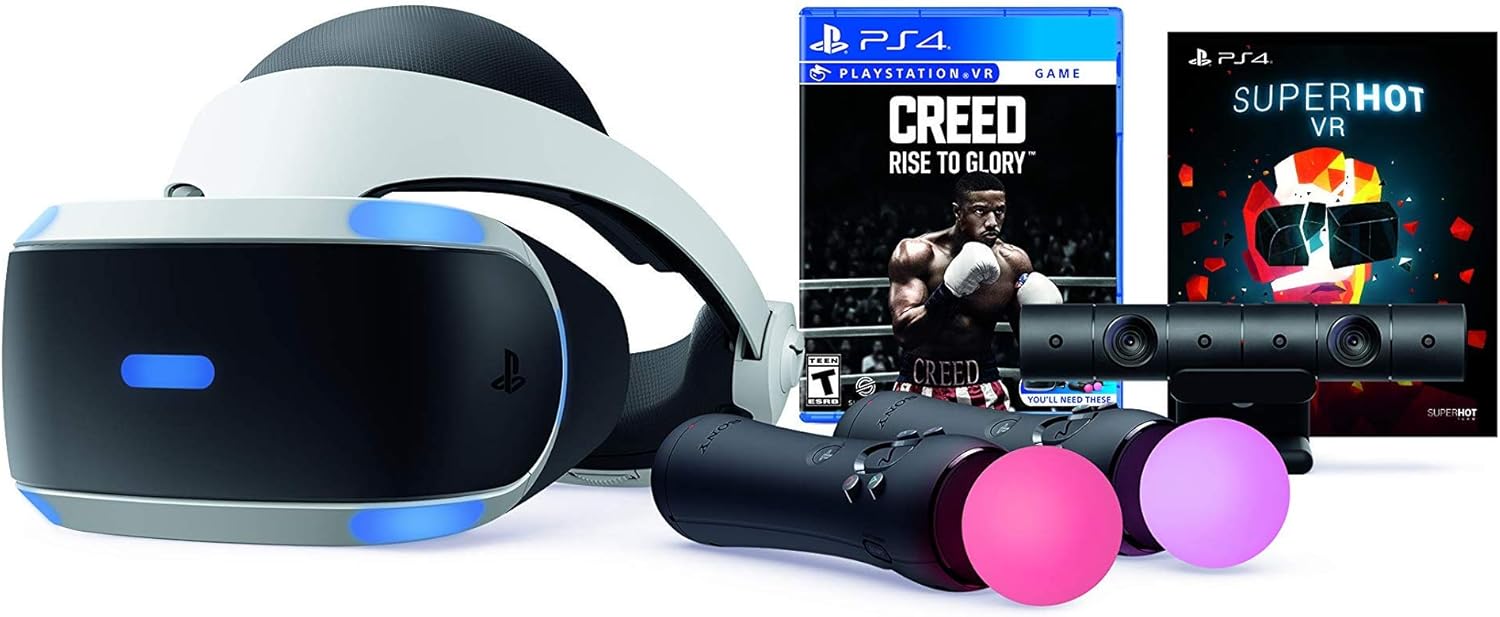
The PlayStation VR Creed Bundle represents Sony’s dedicated virtual reality package designed to bring interactive room-scale sports simulation and tactical combat directly into the console environment. Combining the tethered head-mounted display with dual motion…

As Amazon Associates, we earn from qualifying purchases. This means we may receive a small commission at no extra cost to you if you click through and make a purchase.
The PlayStation VR Creed Bundle represents Sony’s dedicated virtual reality package designed to bring interactive room-scale sports simulation and tactical combat directly into the console environment. Combining the tethered head-mounted display with dual motion controllers, an external optical tracking sensor, and software titles built specifically around physical mechanics, this package provides a complete hardware ecosystem out of a single box. Our technical analysis reveals that while the hardware pipeline relies on an established outside-in tracking paradigm that demands specific physical positioning, the balance of sensor telemetry and low-latency OLED display engineering produces an engaging simulation environment for interactive fitness and combat titles.
This hardware kit suits console gamers seeking an all-in-one virtual reality deployment featuring dedicated motion peripherals and physical simulation titles without requiring third-party accessory sourcing. Conversely, prospective users with constrained physical footprints, those sensitive to display subpixel visibility, or players prioritizing wireless mobility and wide-area inside-out tracking should examine modern alternate hardware architectures instead.
Spec sheet
PlayStation VR Creed Bundle
- Display Panel Type
- OLED
- Panel Diagonal Size
- 6 inches
- Advertised Array Resolution
- 3840 x 1080
- Maximum Display Resolution
- 1920 x 1080
- Optical Field of View
- 110 degrees
- Sensor Suite
- Accelerometer, Gyroscope, Magnetometer
- Tracking Architecture
- Outside-in optical tracking via PlayStation Camera
- Input Hardware
- Two PlayStation Move motion controllers
- System Connectivity
- HDMI interface
- Physical Media Included
- CREED: Rise to Glory Blu-ray, Demo Disc 2.0
Figures as published by the manufacturer on the Amazon listing.
Display Architecture and Visual Specifications
Visual presentation on the headset centers on a 6-inch OLED panel engineered to mitigate motion artifacts and visual latency during rapid physical gameplay. Virtual reality environments demand low-persistence panels where pixels switch states almost instantaneously, preventing the motion smearing commonly observed on standard LCD screens. The native organic light-emitting diode structure allows for true black reproduction, as unlit pixels emit zero luminescence. This dynamic contrast range is particularly noticeable in high-contrast visual environments where deep shadowing directly impacts scene depth perception.
Evaluating the psvr oled display resolution reveals distinct hardware values between the composite panel capability and the rendered output. The listing identifies an overall panel specification of 3840 x 1080 alongside a maximum display resolution figure of 1920 x 1080. In standard binocular visual arrangements, this configuration splits the horizontal pixel pipeline across both eyes, yielding a 960 x 1080 raster per eye. While this pixel density was foundational for early console virtual reality, users scrutinizing display metrics will notice the screen-door effect when focusing on distant background geometry. Modern capture hardware, such as the ultra-dense sensor arrays reviewed in our insta 360 4x analysis, highlights how high resolution transforms visual immersion, underscoring the baseline nature of this 1080p display implementation.
The optical system features a 110-degree field of view, matching contemporary performance parameters for immersion by effectively obscuring peripheral tunnel vision. Signal delivery to the display relies on dedicated HDMI interface cabling that connects the headset processing infrastructure to the host console. While the listing does not specify the precise hardware refresh rate or subpixel stripe matrix configuration, the integrated display panel operates within the timing thresholds dictated by the PlayStation OS to maintain synchronization between optical output and internal vestibular movement cues.
Tracking System Mechanics and Camera Sensor Setup
The tracking pipeline powering the headset depends on a multi-tiered sensor array combining internal inertial measurement with external optical localization. Inside the chassis, the system integrates a nine-axis sensor suite consisting of an accelerometer, a gyroscope, and a magnetometer. The accelerometer measures linear acceleration vectors along three spatial axes, the gyroscope calculates angular velocity to register head rotation, and the magnetometer provides continuous reference against magnetic drift, preserving absolute directional orientation across prolonged gaming sessions.
To tether these internal inertial measurements to the real-world gaming environment, the ps vr camera tracking setup uses outside-in tracking principles driven by the bundled PlayStation Camera. This dual-lens stereoscopic sensor monitors illuminated tracking markers mounted across the headset frame and peripheral controllers. By comparing the positional offset of these illuminated light sources between its dual lenses, the camera calculates spatial depth and three-dimensional coordinates in real time. This optical tracking data feeds directly into the PlayStation OS sensor-fusion engine, which reconciles camera coordinates with internal inertial telemetry to update the player avatar in virtual space.
This tracking methodology exhibits definite operational boundaries. Because the architecture relies entirely on the camera maintaining an unobstructed optical line of sight, turning fully away from the sensor can introduce controller occlusion. If a player rotates 180 degrees and shields the motion controllers with their torso, optical registration momentarily degrades, forcing the engine to rely purely on inertial estimation until the line of sight is restored. Proper calibration of camera elevation, room lighting conditions, and operational distance is critical to prevent tracking drift during active sessions.
Motion Peripherals and Input Capabilities
Kinetic input within the PlayStation VR Creed Bundle is handled through two dedicated PlayStation Move motion controllers. These cylindrical controllers feature illuminated elastomeric spheres at their tips, matching the optical wavelength captured by the external camera sensor. Internally, each Move unit houses independent motion-sensing hardware that relays acceleration and orientation changes back to the host system via wireless data links, allowing the software engine to calculate hand velocity, punch trajectories, and fine motor interactions.
Evaluating ps vr move controllers compatibility across different genres demonstrates their effectiveness in hand-centric simulations. The ergonomic grip layout allows players to manipulate virtual objects, aim weapons, and execute boxing stances without searching for traditional gamepad buttons. However, the physical controllers omit dedicated analog thumbsticks, relying instead on physical trigger actuation, face buttons, and gesture-driven movement schemes. In active sports and combat titles, this input configuration aligns well with real-world physical exertion, but complex traversal titles require players to adapt to alternative button-driven navigation methods.
The build quality and balance of these motion controllers support sustained physical movement, an essential characteristic when playing games centered on rapid kinetic input. Physical connectivity for charging and pairing interfaces directly with the console platform, mirroring the peripheral management workflows found across traditional gaming consoles like the playstation 5 disc version bundle. Maintaining controller sensor accuracy requires regular recalibration against ambient room lighting, as highly reflective surfaces or secondary light sources can occasionally interfere with the camera tracking matrix.
Software Integration and Phantom Melee Technology
The bundled software roster establishes the practical application of this hardware kit, delivering full-length titles alongside demonstration software. The package contains a physical CREED: Rise to Glory Blu-ray disc, a digital game voucher for SUPERHOT VR, and the Demo Disc 2.0 compilation. This combined playstation vr superhot bundle and boxing package immediately tests every layer of the hardware chain, from high-speed controller positional updates to rapid head evasion tracking.
Within the boxing simulation, the playstation vr creed rise to glory bundle implements proprietary ps vr phantom melee technology to overcome the tactile limitations of virtual reality. Because virtual reality hardware cannot physically stop a player’s real-world hand when contacting a virtual opponent, Phantom Melee introduces intentional situational desynchronization. When the player avatar sustains fatigue, experiences heavy staggering, or suffers a knockout blow, the in-game gloves physically separate from the player’s real-time controller positions. The avatar’s arms lag behind, mimic physical exhaustion, and require the player to manually realign their physical hands with the virtual gloves to recover stamina.
This kinetic feedback system transforms physical gameplay into a resource-management challenge. Instead of allowing endless, low-effort arm flailing, the software penalizes frantic movements by increasing avatar fatigue, rewarding measured combinations, defensive parries, and real-world cardiovascular pacing. In SUPERHOT VR, the tracking requirements shift toward spatial awareness and micro-movements, where in-game time advances only when the user moves. The dual Move controllers enable precise aiming, throwing, and ducking, fully leveraging the hardware’s 110-degree optical coverage to create high-tension tactical puzzles.
PlayStation VR Creed Bundle Pros and Cons
What works
- Vibrant 6-inch low-persistence OLED display panel
- Comprehensive package includes camera and dual controllers
- Wide 110-degree optical field of view
- Immersive situational feedback via Phantom Melee Technology
- Bundles both physical Blu-ray and digital voucher software
What to weigh up
- Outside-in camera tracking requires direct line of sight
- Maximum 1920×1080 resolution reveals visible subpixel structure
- Controllers lack physical analog sticks for continuous traversal
Check PlayStation VR Creed Bundle on Amazon
Who Should Buy the PlayStation VR Creed Bundle
Buy It If
- You want a complete out-of-the-box virtual reality hardware package containing the headset, camera, and dual motion controllers without sourcing peripherals separately.
- Your primary gaming interest focuses on physically active boxing, fitness, and room-scale tactical combat titles that utilize dynamic hand tracking.
- You value physical media ownership and appreciate having a dedicated Blu-ray disc copy of Creed alongside the Demo Disc 2.0 software.
- You operate within an existing PlayStation console environment and want a direct HDMI-tethered virtual reality setup.
Skip It If
- You require standalone, wire-free mobility or lack the dedicated room clearance needed for an external optical camera setup.
- You demand modern ultra-high-resolution panels that completely eliminate subpixel visibility and the screen-door effect.
- You primarily play expansive open-world titles that rely on physical analog thumbsticks for continuous smooth navigation.
Final Verdict
8.4/10Our score
When assessing whether the ps vr bundle creed specs justify inclusion in a modern gaming setup, the hardware package must be evaluated on its integration and functional scope. The PlayStation VR Creed Bundle delivers a coherent, fully featured entry into console-based motion gaming. By uniting an OLED display capable of 110-degree field of view visuals with dedicated dual Move controllers and the PlayStation Camera, Sony assembled a self-contained kit that avoids secondary peripheral hunting. The hardware pipeline performs reliably when configured within its recommended optical boundaries, translating real-world kinetic velocity into responsive in-game combat.
Addressing the central question of is ps vr creed bundle worth it requires balancing mechanical strengths against generational constraints. The outside-in camera tracking model requires careful room setup to avoid line-of-sight occlusions, and the 1920 x 1080 maximum resolution shows noticeable pixel structure compared to contemporary high-density panels. However, for users who prioritize active, physically demanding simulations powered by clever mechanics like Phantom Melee Technology, this package remains a balanced, hardware-complete solution that delivers genuine athletic engagement on the PlayStation platform.
FAQ
What is included in the ps vr hardware package contents?
The retail package contains the PlayStation VR head-mounted display, the PlayStation Camera, two PlayStation Move motion controllers, a physical Blu-ray copy of CREED: Rise to Glory, a digital game voucher for SUPERHOT VR, the Demo Disc 2.0 software, and the necessary HDMI cabling to connect the processing hardware to the console.
What are the core ps vr bundle creed specs regarding display hardware?
The headset incorporates a 6-inch OLED panel featuring an optical field of view measuring 110 degrees. The display specifications note an advertised array resolution of 3840 x 1080 with a maximum display output rating of 1920 x 1080, connecting via a wired HDMI interface.
How does the ps vr camera tracking setup function in small spaces?
The system uses outside-in tracking driven by the PlayStation Camera, which tracks illuminated points on the headset and Move controllers alongside internal accelerometer, gyroscope, and magnetometer telemetry. In compact environments, the camera must be positioned with an unobstructed line of sight roughly six feet away from the player to maintain adequate optical coverage without edge clipping.
What is ps vr phantom melee technology in Creed: Rise to Glory?
Phantom Melee Technology is an in-game mechanical system designed to simulate combat fatigue and kinetic resistance. When an avatar takes heavy damage or becomes exhausted, the virtual hands desynchronize from the real-world Move controllers, requiring the player to physically recover and realign their hands to regain control and stamina.
How does ps vr move controllers compatibility affect gameplay?
The two included Move controllers provide intuitive motion-sensing input tailored for natural hand interactions, punching, and gripping. However, because they lack physical analog thumbsticks, navigation in titles requiring free movement relies on button inputs or physical body stepping rather than traditional joystick manipulation.
See this listing on Amazon We may earn a commission if you buy through this link.
More in Audio



The weekly shortlist
Specs worth reading, once a week
New teardowns, spec sheets and buying notes from across the desk.
This demo form is not connected to a mailing service.