Google Nest Audio: Acoustic Architecture and Multi-Unit Analysis
The Google Nest Audio represents a deliberate pivot in connected acoustic engineering, shifting smart speaker design away from basic voice-relay pucks toward a dedicated listening platform built for balanced mid-bass response and multi-point network…

As Amazon Associates, we earn from qualifying purchases. This means we may receive a small commission at no extra cost to you if you click through and make a purchase.
The Google Nest Audio represents a deliberate pivot in connected acoustic engineering, shifting smart speaker design away from basic voice-relay pucks toward a dedicated listening platform built for balanced mid-bass response and multi-point network distribution. Outfitted with dual-band Wi-Fi and Bluetooth 5.0 hardware, this freestanding speaker integrates a physical 7.5-centimeter woofer alongside precision Google Assistant voice processing to supply room-filling audio across home, party, or gaming environments. As a comprehensive multi-unit package, the three-speaker bundle provides a turnkey framework for multi-zone distributed sound and discrete two-channel stereo separation. Our hardware evaluation confirms that this system establishes an exceptional benchmark for modular Cast-synchronized audio, delivering clean acoustic playback and responsive home automation control in a unified wireless form factor.
This multi-speaker configuration is ideally suited for smart home power users, multi-room audio planners, and listeners invested in the Android, Google Home, and Chromecast streaming architectures who need synchronized playback without routing analog speaker wire through walls. Households running music across living rooms, kitchens, and bedrooms simultaneously will benefit immensely from its low-latency Cast group buffers and hands-free voice automation. Conversely, listeners seeking outdoor moisture resistance, high-SPL sound reinforcement, or legacy analog audio interconnects should look elsewhere, as the enclosure lacks water resistance and depends entirely on wireless digital network streams.
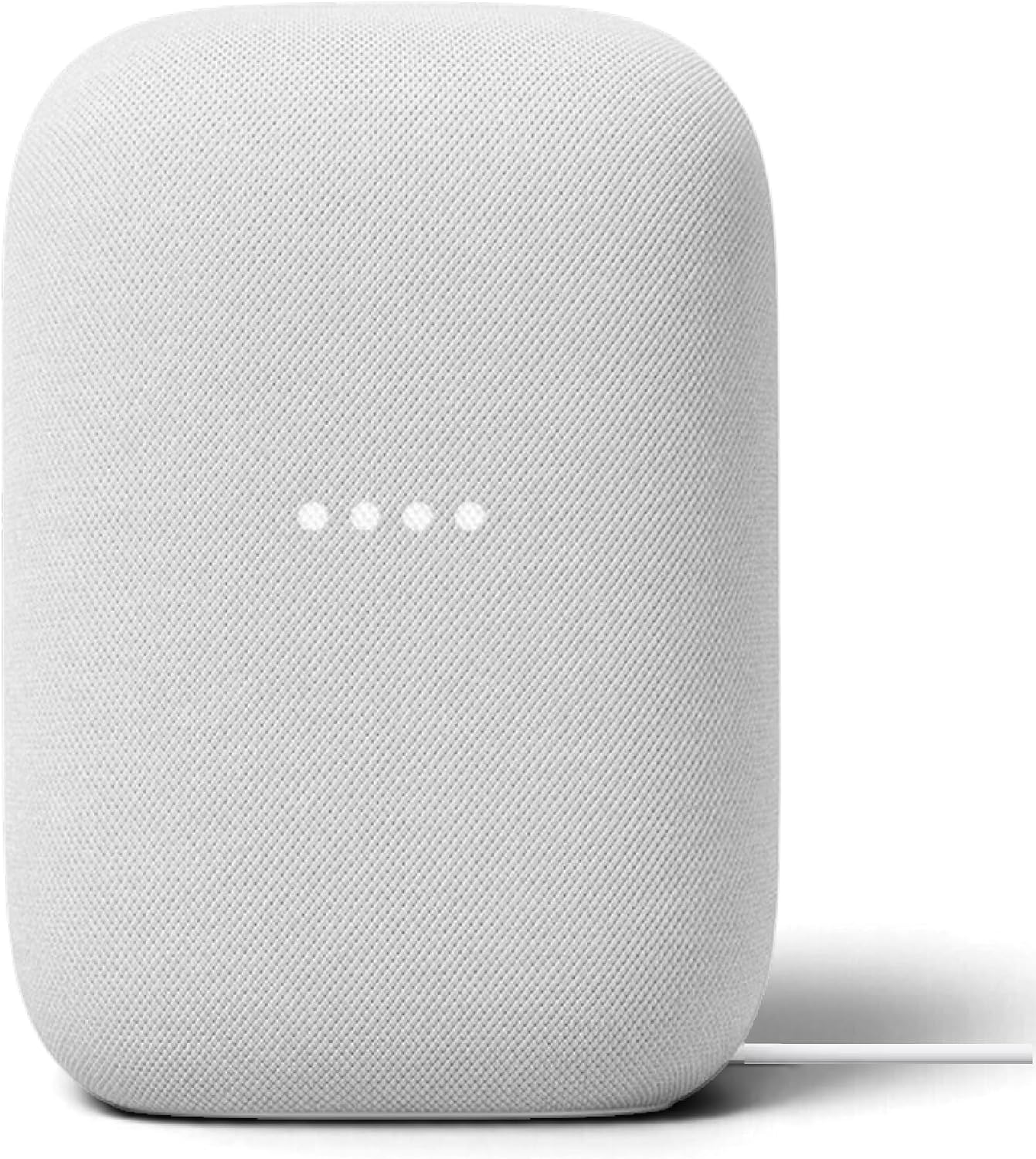
Spec sheet
Google Nest Audio
- Speaker Form Factor
- Smart speaker, freestanding enclosure
- Physical Height
- 6.89 inches
- Woofer Transducer Diameter
- 7.5 centimeters
- Audio Output Channels
- 2 channels (stereo output capable)
- Enclosure Materials
- Sustainable plastic and wood composite
- Wireless Networking
- Dual-band Wi-Fi, Bluetooth 5.0
- Maximum Bluetooth Range
- 10 meters (approximately 30 feet)
- Control Interfaces
- Capacitive touch controls, voice commands
- Included Package Units
- 3-pack bundle
Figures as published by the manufacturer on the Amazon listing.
Acoustic Architecture and Driver Engineering
The foundation of the acoustic output in this platform centers on its driver geometry and rigid enclosure construction. Evaluating the core nest audio speaker specs reveals that Google departed from tiny micro-transducers by engineering a 7.5-centimeter woofer inside a chassis measuring 6.89 inches in height. This 7.5 cm low-frequency transducer moves enough air within the sealed sustainable plastic and wood housing to reproduce articulate low-end and vocal warmth without the uncontrolled harmonic resonance common to thin-walled plastic enclosures. By dampening internal cabinet vibrations with dense, sustainable composite materials, the acoustic profile maintains clarity across speech, podcast midrange frequencies, and dense musical arrangements.
Unlike dedicated aftermarket automotive mid-woofers like the ct sounds meso 6.5 that rely on external high-current amplifiers and heavy magnet structures for raw acoustic excursion, the smart speaker platform optimizes its output using integrated digital signal processing tuned specifically to its cabinet volume. The hardware is specified with two audio channels, allowing a single freestanding node to deliver balanced dual-channel sound processing internally while avoiding harsh high-frequency clipping when driven at elevated volumes during social gatherings.
Physical interaction with the acoustic module is handled through a seamless hybrid interface. Users can govern playback volume, track selection, and voice capture using either integrated capacitive touch zones beneath the fabric mesh or voice prompts directed to the built-in Google Assistant. The acoustic front end filters background music out of microphone inputs, ensuring prompt execution of voice directives even while the internal 7.5 cm driver is actively reproducing dynamic audio content.
Multi-Room Cast Synchronization and Network Latency
Deploying the nest audio speaker for whole home audio relies on the Google Cast streaming architecture over local dual-band Wi-Fi networks. The primary technical hurdle in distributed audio has always been inter-speaker phase alignment; when identical audio streams play across open-concept floor plans, a network delay of just twenty milliseconds creates distracting echo and comb filtering. Within this ecosystem, Cast software continuously synchronizes buffer clocks among all connected nodes, ensuring that the three speakers included in the package maintain perfect temporal alignment across separate rooms.
Where a dedicated television soundbar such as the sony s400 soundbar focuses its processing power on front-stage virtual surround sound and television dialogue decoding in a single zone, the nest audio 3 pack provides decentralized multi-zone flexibility. A user can establish independent audio playback zones—such as streaming a podcast in the home office while sending Spotify playlists to the kitchen and patio door area—or dynamically unify all three units into a global whole-home audio group through the companion app or a single voice directive.
Dual-band Wi-Fi integration allows the streaming hardware to offload playback tasks entirely from host smartphones. When initiating playback from YouTube Music, Spotify, or other Chromecast-enabled applications, the speaker pulls audio packets directly from cloud servers over Wi-Fi. This network pathway preserves mobile device battery life, prevents incoming phone calls from interrupting the music stream, and maintains uncompressed bitrates within the boundaries of local network bandwidth.
Stereo Pairing Architecture and Bluetooth Transmission
Beyond distributed background audio, nest audio speaker stereo pairing provides a viable desktop or living room alternative to traditional wired bookshelf speakers. By assigning two identical units within the software configuration as a dedicated left and right stereo pair, the system splits incoming two-channel audio signals into discrete, non-overlapping channels. This channel separation substantially widens the horizontal soundstage, creating a defined center phantom image for vocals while resolving distinct instrument panning that a single standalone speaker cannot reproduce.
When comparing this wireless paired arrangement to traditional integrated tabletop audio consoles like the bose wave music system, the advantage lies in adjustable stereo width. Instead of drivers being physically fixed within an 18-inch chassis, paired smart units can be separated across an entire credenza or workstation, matching the acoustic dispersion to the exact physical dimensions of the listening position. The wireless inter-unit link handles channel timing and synchronization continuously over local Wi-Fi to eliminate acoustic drifting between the left and right enclosures.
For scenarios where local Wi-Fi networks are unavailable, Bluetooth 5.0 handles direct peer-to-peer streaming. The manufacturer lists the nest audio bluetooth range at 10 meters, or approximately 30 feet of line-of-sight wireless operational radius. Antenna routing is designated for seamless handshake connectivity with computers, gaming consoles, smartphones, tablets, music players, and televisions, allowing users to route system audio, video game soundtracks, or streaming video audio directly through the speaker hardware with reliable link stability.
Smart Ecosystem Compatibility and Physical Placement Constraints
Achieving a reliable nest audio speaker setup requires an understanding of both physical environmental boundaries and digital smart home protocols. From an infrastructure standpoint, the google nest audio compatibility matrix encompasses Android, iOS, and hundreds of Chromecast-enabled streaming platforms. Beyond entertainment streaming, the integrated Google Assistant serves as an active control hub, communicating directly with thousands of compliant connected devices to adjust thermostats, dim lighting fixtures, inspect system alerts, and toggle automated smart door locks via hands-free voice commands.
From an installation and durability perspective, the listing notes specific operational boundaries that purchasers must account for prior to deployment:
- Enclosure Protection: The speaker is officially classified as not water resistant, meaning it lacks sealed ingress gaskets and must never be exposed to rain, steam, poolside splash zones, or high-humidity bathroom environments.
- Mounting Configuration: The chassis is designed strictly for freestanding placement on flat, rigid surfaces like desks, sideboards, and bookshelves; it does not feature integrated wall-bracket threads or dynamic pole mounts.
- Acoustic Scale: While designated for home and party audio playback, users requiring bone-rattling sound-pressure levels for large outdoor venues should look toward high-output mobile cabinets like the jbl speaker party box rather than compact residential smart nodes.
- Cabinet Geometry: The gray exterior fabric wraps a body composed of sustainable plastic and wood composites, measuring 6.89 inches tall to minimize visual footprint while preserving acoustic cabinet volume.
Because the physical enclosure does not incorporate auxiliary 3.5-millimeter analog inputs, optical TOSLink ports, or USB-C audio pass-through, every input stream must originate over Wi-Fi Cast or Bluetooth 5.0. Maintaining high-speed dual-band wireless router coverage throughout the deployment zones is essential to avoid playback dropouts, voice recognition latency, or intermittent speaker grouping desynchronization.
Google Nest Audio Pros and Cons
What works
- Dedicated 7.5 cm woofer provides punchy mid-bass
- Flawless multi-room Cast synchronization across three units
- True two-channel stereo pairing capability
- Dual-band Wi-Fi and Bluetooth 5.0 wireless connectivity
- Seamless Google Assistant smart home hardware integration
What to weigh up
- Completely lacks water resistance or ingress protection
- No physical 3.5 mm or optical audio inputs
- Limited to 10-meter Bluetooth transmission range
Check Google Nest Audio on Amazon
Who Should Buy the Google Nest Audio
Buy It If
- You want a synchronized, three-zone multi-room audio system without installing physical copper speaker wiring throughout your walls.
- Your smart home ecosystem is built primarily around Google Assistant, Android, and Chromecast-enabled streaming services like YouTube Music and Spotify.
- You need the flexibility to toggle between whole-house ambient music grouping and true two-channel left-and-right stereo pairing.
- You prefer a compact, freestanding 6.89-inch gray enclosure constructed from sustainable plastic and wood materials that blends into interior decor.
Skip It If
- You require water resistance or weatherproofing for outdoor patio, poolside, or high-humidity bathroom installations.
- Your setup requires analog line-in jacks, optical inputs, or direct physical connectivity to turntables, legacy CD players, or AV receivers.
- You require a portable, battery-powered speaker that operates completely off-grid without continuous household electrical power.
Final Verdict
9.0/10Our score
When examining whether the multi-unit smart speaker bundle warrants investment, the conclusion depends on your networking environment and listening priorities. From an acoustic hardware perspective, the inclusion of a dedicated 7.5 cm woofer, dual-channel audio processing, and dense sustainable plastic/wood composite enclosures elevates this system far beyond entry-level voice pucks. The resulting output delivers articulate vocal playback, warm instrumental separation, and sufficient dynamic headroom for medium-sized residential rooms, gaming desks, and social spaces.
Ultimately, this 3-pack configuration delivers outstanding value by resolving two primary smart home challenges simultaneously: voice automation coverage and distributed multi-room audio synchronization. By leveraging Google Cast over dual-band Wi-Fi alongside Bluetooth 5.0 connectivity, the system gives users frictionless control over their streaming media across three separate living zones or within a unified stereo array. For users committed to the Google Assistant ecosystem seeking cohesive, wire-free sound distribution, this three-speaker package stands as a technically proficient, acoustically sound smart home solution.
FAQ
What are the physical dimensions and driver specifications of the Google Nest Audio?
The speaker measures 6.89 inches in height and features a freestanding enclosure built from sustainable plastic and wood materials. Acoustically, the unit houses a dedicated 7.5-centimeter woofer transducer, engineered to handle low and midrange frequencies with clean separation across two audio channels.
Can two Google Nest Audio speakers be paired together for dedicated stereo sound?
Yes, the hardware and software support stereo pairing. When two Nest Audio speakers are placed in the same room, you can assign them via software as a dedicated left and right stereo pair, creating true two-channel acoustic separation and a broader horizontal soundstage compared to a single standalone unit.
What is the wireless operational range for Bluetooth on the Google Nest Audio?
The listing specifies a maximum Bluetooth range of 10 meters, which equates to approximately 30 feet of wireless line-of-sight transmission. It supports connections to smartphones, tablets, computers, televisions, and gaming consoles utilizing Bluetooth 5.0 connectivity.
Is the Google Nest Audio waterproof or moisture resistant?
No, the Google Nest Audio is explicitly listed as not water resistant (waterproof: false). It should only be installed in dry indoor living areas, away from open windows, outdoor rain, splashing sinks, or high-humidity environments.
What streaming services and mobile platforms are compatible with this speaker?
The system features full compatibility with Android and iOS devices, as well as Chromecast-enabled applications. Users can stream music directly over Wi-Fi from platforms including Spotify and YouTube Music, or transmit local audio files directly from any compatible host device via Bluetooth.
See this listing on Amazon We may earn a commission if you buy through this link.
More in Audio


The weekly shortlist
Specs worth reading, once a week
New teardowns, spec sheets and buying notes from across the desk.
This demo form is not connected to a mailing service.