Nikon D3300 Body Bundle: Technical Specs and Hardware Breakdown
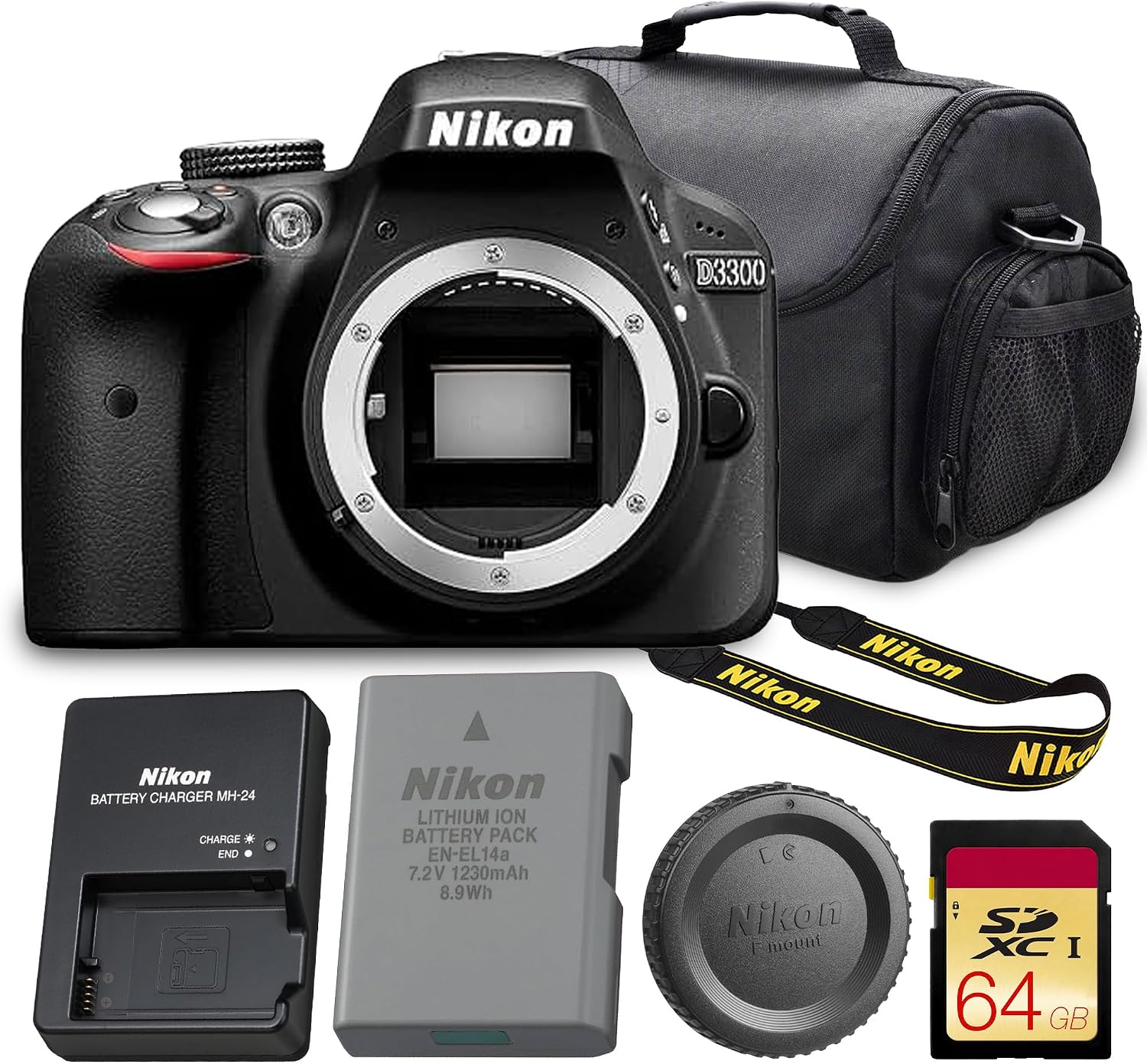
The Nikon D3300 is an entry-level DX-format digital single-lens reflex camera engineered around a high-resolution imaging architecture and traditional mechanical operation. Offered in a starter package that pairs the standalone black camera body with…

As Amazon Associates, we earn from qualifying purchases. This means we may receive a small commission at no extra cost to you if you click through and make a purchase.
The Nikon D3300 is an entry-level DX-format digital single-lens reflex camera engineered around a high-resolution imaging architecture and traditional mechanical operation. Offered in a starter package that pairs the standalone black camera body with a 64GB UHS-I memory card and a padded carrying case, this equipment bundle focuses purely on core capture capabilities rather than superficial novelty features. The hardware verdict is clear: by combining a 24.2-megapixel sensor lacking an optical low-pass filter with an optimized computational pipeline and an optical framing path, this platform provides exceptional raw resolving fidelity that decisively outperforms small-sensor mobile devices and dated point-and-shoot alternatives.
This specific nikon d3300 body bundle suits serious students, technical hobbyists, and value-minded photographers who want to develop manual exposure discipline while building a bespoke optical kit from scratch. Because the package provides the body and core storage without bundling a standard zoom, it prevents users from paying for basic kit optics they intend to bypass in favor of specialized glass. Conversely, multimedia shooters requiring modern 4K video recording pipelines, fully articulating touchscreens, or automated on-sensor subject tracking should bypass this traditional SLR and research mirrorless alternatives such as the nikon z30 kit instead.
Spec sheet
Nikon D3300
- Image Sensor
- 24.2-megapixel DX-format CMOS sensor
- Image Processing Engine
- Nikon EXPEED 4
- Lens Mount Compatibility
- Nikon F-mount supporting AF-S and AF-P NIKKOR optics
- Autofocus System
- 11-point phase-detection autofocus array with dynamic tracking
- Continuous Burst Rate
- Up to 5 frames per second
- ISO Sensitivity Range
- ISO 100 to 12800 (expandable to ISO 25600 equivalent)
- Video Capture Standard
- Full HD 1080p recording
- Viewfinder and Display
- Optical eye-level viewfinder and 3.0-inch rear LCD monitor
- Included Bundle Items
- Nikon D3300 body, 64GB UHS-I SD card, protective camera bag
- Package Dimensions and Weight
- 8.03 x 6.03 x 4.08 inches; 3.06 pounds total weight
Figures as published by the manufacturer on the Amazon listing.
Sensor Architecture and EXPEED 4 Image Pipeline
At the center of the imaging hardware lies a 24.2-megapixel DX-format CMOS sensor that defines the technical character of the platform. The physical dimensions of an APS-C DX sensor provide a massive light-gathering surface relative to compact cameras, ensuring superior light collection per pixel site. In technical terms, the nikon d3300 sensor specs allow for immense spatial resolution, giving photographers the latitude to execute aggressive crops or produce expansive physical prints without losing intricate texture. The sensor omits an optical low-pass filter, enabling the optical design to maximize the sharpness potential of attached high-grade lenses.
Managing the sensor’s data readout is the proprietary nikon d3300 expeed 4 computational engine. This processor handles the heavy mathematical conversion of analog sensor voltage into digital image files with exceptional fidelity, managing color gradation, highlight preservation, and real-time noise reduction algorithms. In Full HD 1080p video recording mode, the processor renders clean motion footage with rich color reproduction and minimized artifacting, ensuring that both static images and moving sequences share uniform tonal rendering.
Signal-to-noise performance remains predictable across a wide spectrum of illumination environments. The native nikon d3300 iso performance spans ISO 100 up to ISO 12800, with an extended boost mode achieving an ISO 25600 equivalent for extreme low-light situations. When evaluating exposure latitude against older pocket sensors like the nikon coolpix s3300, the D3300 demonstrates the unmistakable advantages of large-scale silicon, keeping shadow noise suppressed and edge contrast sharp even when shooting handheld indoors.
Lens Interoperability: AF-S, AF-P, and F-Mount Ecosystem
Optical versatility represents one of the most critical factors when assessing the Nikon F-mount ecosystem. Complete nikon d3300 lens compatibility requires careful attention to internal focusing motor technologies. The D3300 camera body lacks an integrated mechanical autofocus drive spindle, meaning it relies on modern lenses featuring integrated autofocus motors to drive focus automatically. Lenses featuring built-in Silent Wave Motors, designated as AF-S NIKKOR, pair seamlessly with the camera body to provide fast, reliable phase-detection focusing across wide-angle, telephoto, macro, and fast-aperture prime configurations.
A notable technical strength is full nikon d3300 af-p support out of the box. AF-P lenses utilize specialized stepper pulse motors designed for whisper-quiet operation and swift continuous focusing, which significantly enhances focus transitions during video recording and Live View usage. The camera body communicates natively with these modern stepper drive mechanisms, enabling photographers to mount modern, lightweight DX zoom lenses without experiencing the operational limitations or firmware lockouts found on older entry-level SLR platforms.
Acquiring this setup as a standalone body package offers considerable strategic value to photographers who know their optical requirements in advance. Rather than paying extra for a basic variable-aperture zoom lens that offers limited depth-of-field control, users can pair the chassis directly with specialized optics, such as a 35mm f/1.8 prime for low-light street work or a dedicated micro lens for macro reproduction. This modular approach ensures every component of the photographic pipeline serves a specific creative objective.
Autofocus Tracking and Continuous Shooting Dynamics
The phase-detection autofocus architecture is driven by an 11-point autofocus module positioned across the optical viewfinder path. This system features a central cross-type focus point sensitive to both horizontal and vertical contrast vectors, ensuring prompt lock-on even in low-contrast ambient environments. The array maintains sharp focus on moving subjects by utilizing predictive tracking algorithms that monitor subject displacement across the points, making the platform fully capable of tracking running children, pets, or approaching vehicles.
Action capability is supported by nikon d3300 continuous shooting speeds reaching up to 5 frames per second. Operating at 5 fps allows the mechanical mirror box and focal-plane shutter to cycle rapidly, capturing distinct motion phases during active sports or street sequences. The internal buffer and EXPEED 4 processing engine maintain uninterrupted burst sequences by streaming data quickly onto modern solid-state flash media, preventing the camera from bogging down during critical moments.
While cutting-edge mirrorless flagships like the nikon z9 camera utilize high-density on-sensor matrices driven by deep learning algorithms, the dedicated 11-point optical phase array in the D3300 offers distinct advantages in simplicity, physical battery conservation, and instant optical response. The dedicated AF sensor reads light reflected from the secondary mirror instantly, executing focus adjustments without the processing lag or display latency inherent to basic electronic live-view pipelines.
Optical Viewfinder, Rear Display, and Handling Controls
Composition on the D3300 centers on a bright optical viewfinder that provides an uninhibited, eye-level connection to the subject. Unlike electronic viewfinders that can introduce screen lag, motion tearing, or battery depletion in cold conditions, the optical pentamirror design transmits light in real time directly through the lens. This zero-latency visual path is supplemented by a 3-inch LCD monitor boasting high resolution for menu navigation, live framing, and critical image review after exposure.
Software features are thoughtfully tailored to make the nikon d3300 for beginners an exceptionally educational platform. Central to this approach is the built-in Guide Mode, an on-demand software assistant integrated directly into the top mode dial. Rather than forcing newcomers to memorize mechanical principles immediately, Guide Mode offers step-by-step graphical explanations on how to achieve specific creative effects, such as rendering blurred backgrounds for portraits or freezing fast-moving water, visually illustrating the relationship between aperture and shutter speed.
The internal processing software also incorporates comprehensive in-camera editing tools. Users can crop frames, correct optical distortions, adjust contrast curves, and apply creative filter adjustments directly from the rear monitor without transferring raw files to external software. For photographers stepping up from pocket compacts like the nikon coolpix s6200, this balance of dedicated physical dial controls, tactile buttons, and educational firmware makes learning the principles of manual exposure entirely intuitive.
Bundle Hardware Utility and Storage Practicality
Evaluating the practical utility of this package requires examining the included peripheral gear alongside the camera chassis. The d3300 nikon bundle specs highlight the inclusion of a 64GB UHS-I memory card, providing ample capacity right out of the retail packaging. A 64GB storage volume is well-proportioned for 24.2-megapixel capture, accommodating thousands of high-resolution JPEG files or hundreds of uncompressed raw frames alongside Full HD video clips without risking immediate memory exhaustion in the field.
The UHS-I bus interface of the bundled card matches the read and write requirements of the EXPEED 4 pipeline. When executing continuous 5 fps burst sequences, write speed determines how quickly the camera clears its internal memory buffer to restore full burst readiness. The included card delivers the necessary continuous throughput to eliminate bottlenecks during rapid capture, ensuring smooth frame transfers and responsive playback operations.
Transit protection is addressed through the included multi-compartment camera bag. Featuring structured padding, durable fabric construction, and internal partitions, the bag protects the optical mount, sensor chamber, and rear monitor against dust ingress and physical impacts during transit. Backed by official Nikon USA authorization under manufacturer item model number 1532_AG2I_1, the complete bundle arrives with verified factory specifications, balancing a 3.06-pound shipping footprint with dependable mechanical integrity.
Nikon D3300 Pros and Cons
What works
- 2MP DX-format CMOS sensor delivers crisp resolution
- Fast EXPEED 4 processor manages image pipeline
- Continuous burst shooting captures up to 5 fps
- Full compatibility with modern AF-S and AF-P lenses
- Includes 64GB UHS-I memory card and bag
- Integrated Guide Mode assists with exposure settings
What to weigh up
- Camera body bundle excludes an optical lens
- 11-point autofocus array offers limited edge coverage
- Video recording maxes out at Full HD 1080p
Who Should Buy the Nikon D3300
Buy It If
- You want a high-resolution 24.2MP DX sensor without paying extra for an optical low-pass filter.
- You already own AF-S or AF-P NIKKOR lenses and need an affordable, capable backup camera body.
- You prefer composing through a real-time optical viewfinder that consumes minimal battery power.
- You want structured, step-by-step guidance from an internal Guide Mode to learn manual camera settings.
Skip It If
- Your workflow requires 4K cinema video recording or advanced professional high-frame-rate codecs.
- You require a vari-angle articulating touchscreen display for self-recording, vlogging, or low-angle framing.
- You need an all-in-one kit out of the box and do not already own a compatible F-mount lens.
Final Verdict
4.5 / 5Amazon buyer rating
When considering if the is nikon d3300 worth it in modern photographic contexts, the hardware metrics deliver a resounding affirmative for still-imaging fundamentals. The integration of a 24.2-megapixel DX-format CMOS sensor, an EXPEED 4 processing engine, 5 fps continuous shooting, and comprehensive AF-S and AF-P lens interoperability establishes an exceptional core tool for building photographic technique. By skipping unnecessary computational gimmicks, the camera focuses resources entirely on optical clarity, dynamic range, and tactile hardware ergonomics.
The value of this specific bundle is further amplified by the inclusion of a high-capacity 64GB UHS-I storage card and a dedicated carrying bag, providing everything needed to protect the chassis and store thousands of high-resolution images right away. For enthusiasts, beginners, and traditionalists who value optical viewing, manual exposure control, and access to decades of F-mount glass, the Nikon D3300 stands as an enduring, mechanically sound choice.
FAQ
Does this Nikon D3300 bundle include a camera lens?
No, the listing specifies that this bundle includes the Nikon D3300 digital SLR camera body in black, along with a 64GB UHS-I memory card and a camera bag. A lens must be purchased separately or supplied from your existing collection of compatible NIKKOR optics.
Can the Nikon D3300 use both AF-S and AF-P lenses?
Yes, the camera body provides complete mechanical and electrical compatibility with both AF-S and AF-P NIKKOR lenses. The internal firmware communicates natively with the stepper pulse motors inside AF-P glass, delivering smooth, silent autofocus alongside traditional AF-S lenses.
What video recording resolution does the Nikon D3300 support?
The Nikon D3300 records Full HD 1080p video. Backed by the EXPEED 4 image processor, the camera captures sharp, detailed motion footage with rich color reproduction and effective noise management in low-light environments.
Is the included 64GB UHS-I card fast enough for 5 fps burst shooting?
Yes, the 64GB UHS-I card matches the data throughput capabilities of the camera’s bus architecture. It enables rapid buffer clearance during 5 frames per second continuous bursts, preventing long write pauses when recording high-resolution 24.2-megapixel images.
How does the built-in Guide Mode assist beginner photographers?
The built-in Guide Mode acts as an interactive software tutor accessed via the main mode dial. It displays step-by-step visual instructions on the 3-inch LCD monitor, explaining how to adjust shutter speed, aperture, and exposure settings to capture specific photographic scenarios effortlessly.
See this listing on Amazon We may earn a commission if you buy through this link.
More in Cameras & Drones


The weekly shortlist
Specs worth reading, once a week
New teardowns, spec sheets and buying notes from across the desk.
This demo form is not connected to a mailing service.