Canon EOS R7 Deep Dive: Sensor Density, Dual Pixel AF, and Shutter Limits
The Canon EOS R7 represents a concentrated push into high-density APS-C imaging within the mirrorless RF mount ecosystem. Engineered with an aggressive continuous drive architecture and an intelligent focus system driven by the DIGIC…

As Amazon Associates, we earn from qualifying purchases. This means we may receive a small commission at no extra cost to you if you click through and make a purchase.
The Canon EOS R7 represents a concentrated push into high-density APS-C imaging within the mirrorless RF mount ecosystem. Engineered with an aggressive continuous drive architecture and an intelligent focus system driven by the DIGIC X image processor, the cannon r7 camera provides demanding wildlife and sports enthusiasts with a fast, precision-oriented shooting tool. For photographers who require substantial optical reach without the extreme physical bulk of larger camera bodies, it stands as an uncompromising, high-speed crop-sensor solution.
This body caters directly to birders, field sports photographers, and action documentarians who need pixel density on subject alongside fast frame rates. Photographers migrating from entry-level DSLR bodies like the legacy canon eos rebel t7 camera will find a massive leap in focus acquisition and physical responsiveness. However, casual shooters looking for a simple carry-everywhere solution like the cannon powershot elph 180 may find the complex configuration options and telephoto emphasis beyond their routine daily needs.
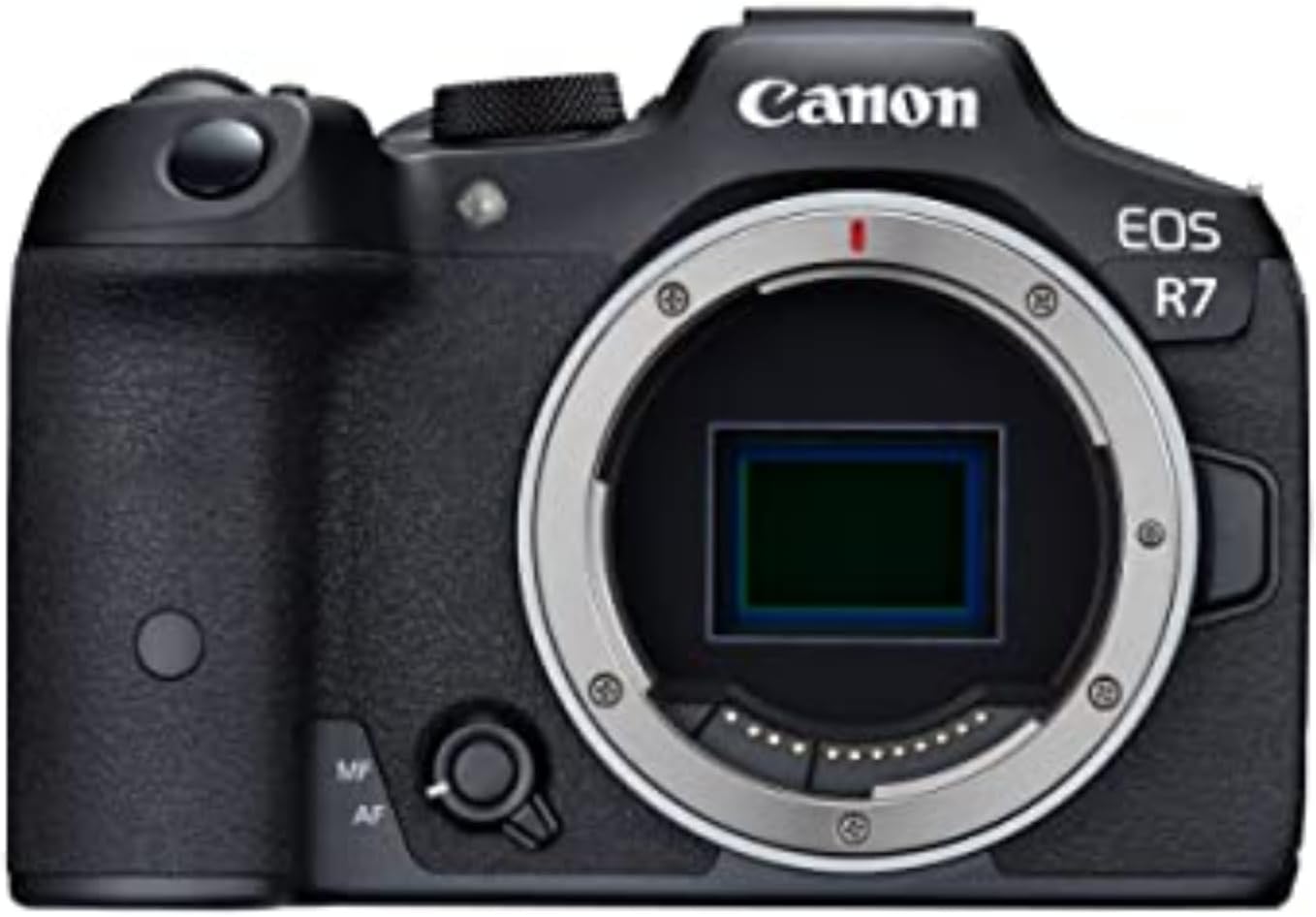
Spec sheet
Canon EOS R7
- Sensor Resolution
- 32.5 effective megapixels
- Sensor Type and Size
- APS-C CMOS (3:2 aspect ratio)
- Image Processor
- DIGIC X
- Lens Mount Compatibility
- Canon RF mount
- Autofocus Detection
- Dual Pixel CMOS AF with up to 651 zones (approx. 100% coverage)
- Continuous Drive Speeds
- 15 fps mechanical shutter, 30 fps electronic shutter
- Image Stabilization
- 5-Axis sensor-shift IBIS (up to 7 stops coordinated control)
- Video Capture Resolution
- 4K at up to 60p, continuous recording over 30 minutes
- Shutter Speed Range
- 1/16,000 to 1/250 seconds, plus Bulb mode
- Body Weight
- 1.1 pounds
Figures as published by the manufacturer on the Amazon listing.
High-Density Sensor Resolution and Telephoto Performance
At the mechanical center of the platform lies the canon eos r7 32.5mp aps-c sensor, a chip configured to capture exceptionally fine details across a 3:2 aspect ratio. Because an APS-C sensor concentrates 32.5 megapixels across a smaller physical surface area than a full-frame sensor, it provides an elevated pixel density. When paired with telephoto optics, this pixel arrangement places a substantial number of photo sites across distant subjects. This technical setup proves crucial for canon r7 for wildlife photography, where distant animals often occupy only a fraction of the native field of view, permitting aggressive cropping during post-processing while preserving critical structural feathers and fur patterns.
Processing this high data volume requires considerable throughput, which is handled directly by the onboard DIGIC X image processor. The hardware supports standard raw, compressed C-RAW, 10-bit HEIF, and universal JPEG capture formats. The C-RAW format is especially valuable for users managing extensive action sequences, as it reduces raw file footprints with negligible real-world penalties to latitude or detail. The expanded ISO minimum starts at ISO 100, providing clean base performance under daylight shooting conditions. For photographers assessing the canon eos r7 specs for deep field tracking, the sensor architecture delivers the resolving power necessary to document subjects that would otherwise demand significantly heavier and longer focal length lenses.
Autofocus Tracking and Subject Recognition Architecture
Focus performance relies entirely on the integrated canon r7 dual pixel af tracking system, which covers approximately 100 percent of the imaging area in both horizontal and vertical dimensions. Under active tracking modes, the system deploys up to 651 automated AF zones. Because Dual Pixel CMOS AF technology uses every individual pixel on the sensor surface to detect phase differences, the camera evaluates focus continuously across the frame without being constrained to a centralized cluster of phase points. This expansive coverage ensures erratic subjects remain sharp even when moving near the physical edges of the composition.
The DIGIC X processor executes sophisticated algorithmic subject detection capable of identifying animals, automobiles, and human movement during high-velocity sequences. This makes the canon r7 for sports an extraordinarily capable camera for tracking fast field athletes, motorsports, and quick directional pivots. During video acquisition, the Movie Servo AF system maintains relentless subject tracking, making sure that focus transitions remain sharp and continuous across varied depths of field. The wide focus distribution minimizes lost frames during rapid pans and erratic erratic target motion.
Continuous Drive Rates and Shutter Speed Capabilities
Action coverage requires rapid drive mechanisms, and the camera provides two distinct continuous capture configurations. The mechanical shutter fires at a rapid 15 frames per second, which effectively eliminates rolling shutter distortion while delivering the physical tactile feedback that action shooters depend upon. When absolute silent shooting or maximum capture rates are demanded, the canon r7 burst rate 30 fps electronic shutter takes over, recording twice as many frames per second to capture fine micro-movements, wing positions, or ball strikes.
Complementing these drive speeds is a dedicated RAW Burst Mode that incorporates a 1/2-second pre-shooting buffer. When this feature is active, the camera records frames into temporary storage while the shutter button is held halfway, committing the preceding half-second of images to the memory card the instant the shutter button is fully depressed. This pre-capture ability drastically reduces missed reaction moments caused by human reflex lag. On the technical ceiling, the electronic shutter operates up to a rapid 1/16,000 second, facilitating wide-aperture shooting in intense ambient lighting. For standard operational modes, the minimum mechanical shutter speed is rated at 1/250 second, while extensive long-exposure work is handled via the dedicated Bulb mode.
In-Body Image Stabilization and Continuous Video Execution
Camera movement often limits hand-held shooting at narrow focal lengths, which is why the canon r7 in body image stabilization mechanism serves as a fundamental asset for telephoto operators. The internal 5-axis sensor-shift hardware actively moves the image sensor to compensate for pitch, yaw, roll, and vertical or horizontal translation. When paired with stabilized RF optics, the coordinated control system delivers up to 7 stops of shake correction. This stabilization performance allows photographers to shoot handheld at slower shutter speeds without inducing micro-blur, expanding shooting viability during dusk, dawn, or deep canopy field excursions.
Video creators also gain significant versatility through this integrated stabilization system alongside auto-level technology, which corrects minor horizon tilts on the fly. The camera captures high-definition 4K 60p footage, offering crisp continuous motion suitable for dynamic content creation. Unlike many compact point-and-shoot alternatives such as the cannon g7x mark iii, which are strictly tuned for casual casual recording, the Canon EOS R7 supports continuous video recording sessions that stretch past 30 minutes without interruption. Coupled with Movie Servo AF and broad zone tracking, it operates as a viable production camera for field interviews, documentarians, and sporting event documentation.
Chassis Ergonomics, Controls, and Lens Mount Compatibility
Weighing approximately 1.1 pounds for the bare body, the chassis delivers an optimal balance between structural rigidity and portable field operation. The physical body incorporates a deep, comfortable handgrip that provides a firm purchase when mounting long, front-heavy telephoto zooms. The rear interface centers around a 3-inch LED liquid-crystal monitor, which features an anti-smudge coating and clear-view technology to preserve visibility under harsh sunlight. The interface supports a comprehensive range of shooting modes, including Program, Shutter Priority, Aperture Priority, Manual, and Bulb mode, giving users granular control over their operational parameters.
System versatility relies heavily on canon r7 rf lens compatibility. The native Canon RF mount allows users to mount modern RF glass directly, taking full advantage of the high-speed data communication pins that enable 7 stops of coordinated stabilization and real-time focus calculations. For power delivery, the camera includes an extra LP-E6NH battery pack in the listing configuration, ensuring extended capture capacity during long field shoots where charging infrastructure is absent. The compact footprint fits easily into standard field bags, letting outdoor photographers hike extensive distances without suffering physical fatigue from excessive gear weight.
Canon EOS R7 Pros and Cons
What works
- High-density 32.5MP APS-C sensor
- Rapid 30 fps electronic burst capture
- Coordinated 5-axis stabilization up to 7 stops
- Broad 651-zone Dual Pixel CMOS autofocus
- Continuous 4K 60p recording past 30 minutes
- Pre-shooting buffer in RAW Burst Mode
What to weigh up
- Dense sensor demands high-grade telephoto glass
- Minimum standard shutter speed limited to 1/250s
- Complex menu interface for entry-level beginners
Who Should Buy the Canon EOS R7
Buy It If
- You need maximum telephoto reach from your lenses, making full use of the 32.5-megapixel APS-C crop factor for bird, wildlife, and aviation photography.
- You require blazing capture rates up to 15 fps mechanical or 30 fps electronic to document rapid sports, running animals, and erratic motion.
- You regularly shoot handheld in variable lighting and depend on up to 7 stops of coordinated 5-axis in-body image stabilization to suppress camera shake.
- You produce 4K 60p video content and need sustained recording times that comfortably exceed the standard 30-minute clip restriction.
Skip It If
- Your primary creative discipline centers entirely on ultra-wide landscape or interior work where a full-frame sensor area is preferable.
- You need an ultra-simple, pocketable point-and-shoot camera without the operational complexity of interchangeable lenses.
- Your shooting workflow requires automated baseline mechanical shutter speeds below 1/250 second without switching into Bulb mode.
Final Verdict
9.4/10Our score
When analyzing whether is canon r7 worth it, the answer depends squarely on how your workflow intersects with speed and sensor density. The Canon EOS R7 gathers professional-grade features—including 30 fps electronic shooting, 1/16,000 second shutter speeds, Dual Pixel CMOS AF with 651 zones, and 5-axis IBIS—into a durable 1.1-pound body. Its ability to extract tremendous optical reach from telephoto lenses makes it an analytical front-runner for enthusiasts who prioritize action, wildlife, and high-cadence field documentation.
While the operational complexity and dense sensor layout require proper lens selection and disciplined technique, the rewards are unmistakable. The combination of pre-shooting buffer tools, robust autofocus tracking algorithms, and continuous 4K 60p video recording provides modern creators with an exceptionally versatile technical foundation. For the action-oriented photographer working within the Canon RF system, the Canon EOS R7 stands as one of the most capable APS-C tools currently available.
FAQ
What is the continuous shooting speed of the Canon EOS R7?
The Canon EOS R7 captures action at continuous rates of up to 15 frames per second when utilizing the physical mechanical shutter, and up to 30 frames per second when engaging the silent electronic shutter. It also features a RAW Burst Mode equipped with a 1/2-second pre-shooting buffer to record moments before the shutter button is fully pressed.
Does the Canon EOS R7 include in-body image stabilization?
Yes, the camera incorporates an internal 5-axis sensor-shift in-body image stabilization system. When combined with compatible Canon lenses featuring optical stabilization, the coordinated control IS system provides up to 7 stops of shake correction and includes auto-level technology.
What lens mount does the Canon EOS R7 use?
The camera features the native Canon RF lens mount, allowing it to interface directly with Canon RF lenses to enable high-speed data transmission, advanced Dual Pixel CMOS AF tracking, and coordinated image stabilization.
Can the Canon EOS R7 record video clips longer than 30 minutes?
Yes, the Canon EOS R7 offers extended recording capability that allows users to record high-quality 4K 60p video for durations exceeding 30 minutes without standard clip-length interruptions.
What types of subjects can the autofocus system automatically track?
The Dual Pixel CMOS AF system utilizes up to 651 autofocus zones across approximately 100 percent of the frame to automatically detect, acquire, and track animals, sports athletes, moving vehicles, and daily active subjects across both photography and video modes.
See this listing on Amazon We may earn a commission if you buy through this link.
More in Cameras & Drones


The weekly shortlist
Specs worth reading, once a week
New teardowns, spec sheets and buying notes from across the desk.
This demo form is not connected to a mailing service.