Canon EOS R7 Body: In-Depth Sensor, AF, and Speed Analysis
The Canon EOS R7 establishes itself as a benchmark APS-C hybrid body, combining deep subject-detection autofocus with high continuous drive rates. Engineered around a 32.5-megapixel APS-C CMOS sensor and the DIGIC X processing engine,…

As Amazon Associates, we earn from qualifying purchases. This means we may receive a small commission at no extra cost to you if you click through and make a purchase.
The Canon EOS R7 establishes itself as a benchmark APS-C hybrid body, combining deep subject-detection autofocus with high continuous drive rates. Engineered around a 32.5-megapixel APS-C CMOS sensor and the DIGIC X processing engine, this camera brings enthusiast and professional-tier tracking capabilities to a smaller sensor footprint. The bottom-line verdict is definitive: for outdoor, action, and telephoto-centric photographers, this camera delivers exceptional autofocus intelligence, rapid frame rates, and integrated sensor-shift stabilization at a competitive weight profile.
This body serves field photographers, birding specialists, and sports documentarians who demand extra telephoto reach without carrying massive full-frame setups. Those requiring ultra-wide environmental fields of view, uncropped wide-angle coverage, or maximum low-light ISO flexibility may want to consider larger sensors such as the canon eos r6 mark ii mirrorless camera body instead of an APS-C crop platform.
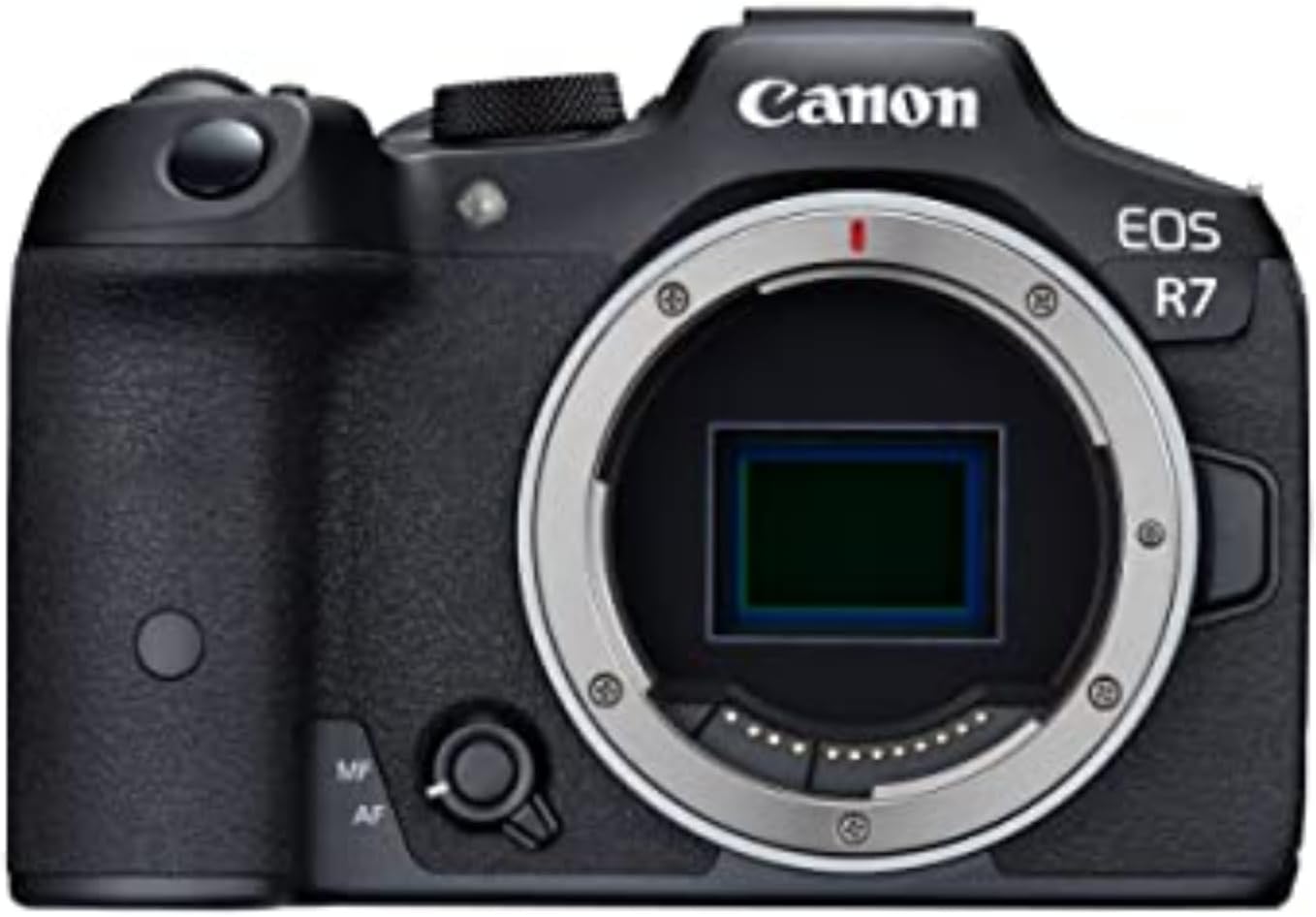
Spec sheet
Canon EOS R7
- Sensor Resolution
- 32.5 effective megapixels
- Sensor Format
- APS-C CMOS (3:2 aspect ratio)
- Autofocus System
- Dual Pixel CMOS AF with up to 651 AF zones
- Autofocus Frame Coverage
- Approximately 100% width and 100% height
- Continuous Drive (Mechanical)
- Up to 15 frames per second
- Continuous Drive (Electronic)
- Up to 30 frames per second
- Image Stabilization
- 5-axis sensor-shift IBIS (up to 7 stops coordinated control)
- Maximum Shutter Speed
- 1/16,000 second (electronic)
- Video Capture Resolution
- 4K 60p with continuous recording over 30 minutes
- Body Weight
- 1.1 pounds (body only)
Figures as published by the manufacturer on the Amazon listing.
Sensor Resolution and APS-C Pixel Density
At the center of the canon r7 body specs is its 32.5-megapixel APS-C CMOS sensor. Squeezing this pixel count into an APS-C area yields dense pixel pitch, allowing aggressive cropping and resolving intricate subject textures such as bird plumage, fur, and distant sports jerseys. The 3:2 aspect ratio maintains standard photographic framing, while file format versatility covers RAW, compressed C-RAW, modern 10-bit HEIF, and standard 8-bit JPEG formats to balance post-processing flexibility against storage demands.
The high pixel density inherently grants a 1.6x field-of-view crop compared to 35mm full-frame sensors. When mounting telephoto glass, this crop factor multiplies effective focal length without requiring physical optical teleconverters that degrade lens aperture values. Studio landscape shooters or architectural photographers who need broad vistas may encounter framing limitations on the wide end, but detailed performance benchmarks highlighted in our cannon r7 camera analysis illustrate that this canon r7 sensor resolution excels where subject distance is the primary challenge.
The camera listing specifies an expanded ISO minimum of 100, providing clean base-level sensitivity for bright daylight environments. Exposure control options span full manual, aperture priority, shutter priority, program, and bulb modes. For demanding lighting conditions where highlights must be preserved alongside deep shadows, pairing RAW captures with the DIGIC X processor ensures dependable highlight roll-off and manageable shadow retrieval.
Dual Pixel CMOS AF Tracking and Coverage
Autofocus execution relies on canon r7 dual pixel cmos af technology, which deploys every photodiode across the sensor surface for phase detection. The system features up to 651 automated AF zones, spanning approximately 100 percent of the horizontal and vertical frame. This edge-to-edge tracking ensures that erratic subjects moving along the borders of the frame remain pinned in sharp focus without forcing the photographer to keep targets locked exclusively in the center.
The autofocus algorithms are configured for multi-category subject recognition. Dedicated tracking modes identify and cling to cars, sports competitors, and various wildlife species. When using the canon r7 for wildlife, the system tracks eyes, heads, and bodies across unpredictable flight paths or dense foliage. The integration of Movie Servo AF extends these precise subject-detection capabilities into video workflows, preventing hunting artifacts during high-motion pans.
The focusing array operates seamlessly alongside the camera DIGIC X processor to evaluate subject vector changes in real time. Because the tracking calculations execute concurrently with drive bursts, the camera maintains critical eye focus on approaching athletes or airborne birds even as burst capture rates peak.
Continuous Shooting Speed and Shutter Dynamics
For high-speed documentation, the canon r7 continuous shooting speed sets a demanding benchmark in the mirrorless crop category. Using the physical focal-plane mechanism, the camera fires bursts at up to 15 frames per second, matching or exceeding many professional full-frame sports DSLRs. When switching to the electronic shutter, drive rates reach 30 frames per second, capturing minute increments of fast action that mechanical shutters miss entirely.
Pushing the canon r7 electronic shutter speed opens shutter velocities up to 1/16,000 second, which is invaluable for freezing high-speed propeller rotation, wing flutter, or ball impacts under midday sun. The listing indicates a minimum shutter speed rating of 1/250 second. Action shooters will also benefit from the integrated RAW Burst Mode, which includes a 1/2-second pre-shooting cache. This pre-buffering stores frames captured half a second before full shutter depress, preventing missed moments caused by human reaction lag.
Operating at 30 fps via an electronic shutter on a high-density sensor can occasionally introduce rolling shutter distortion on rapid horizontal pans. For fast-panning motorsports or erratic aerial maneuvers, relying on the 15 fps mechanical shutter eliminates read-out skew while preserving high throughput.
5-Axis In-Body Image Stabilization Performance
Physical handheld stabilization is managed via sensor-shift architecture. The canon r7 ibis performance utilizes a 5-axis internal stabilization mechanism that counteracts yaw, pitch, roll, and horizontal/vertical translation. According to the manufacturer data, this system provides up to seven stops of shake correction when operating with coordinated control alongside optically stabilized RF lenses.
This level of correction transforms low-light handheld shooting, allowing photographers to drag shutter speeds several stops slower than traditional reciprocal shutter rules dictate. The system incorporates auto-level technology, which automatically adjusts the physical sensor orientation to preserve a level horizon line during handheld tracking and run-and-gun recording.
Because the stabilization works directly at the sensor level, unassisted optical lenses still benefit from primary rotational and translational stabilization. For telephoto action, coordinated IS links the lens gyro sensors with the in-camera accelerometer array, ensuring that high-frequency hand tremors do not blur micro-detail captured across the 32.5-megapixel plane.
Video Capability and Thermal Run Times
Video production benefits from uncropped 4K capture, with support for frame rates up to 4K 60p. Backed by Movie Servo AF, tracking functions remain actively engaged during recording, smoothly transitioning focus between detected faces and foreground objects without erratic focus pulses.
A notable update over older hybrid architectures is continuous recording endurance. The camera body delivers recording runtimes exceeding the traditional 30-minute operational limit, avoiding sudden thermal or firmware shutoffs during extended interviews, sporting events, or stage presentations. Upgrading from older DSLR platforms like the 6d canon body only highlights how far video runtimes and real-time tracking have progressed in mirrorless bodies.
Power management is anchored by the included LP-E6NH rechargeable lithium-ion battery pack. This higher-capacity pack supports sustained video captures and heavy burst shooting sequences. The camera is also compatible with standard LP-E6 series variants, though maximum drive speeds and video recording times are optimized when running modern high-draw packs.
RF Mount Compatibility and Body Ergonomics
The canon r7 rf mount compatibility allows direct pairing with native Canon RF and RF-S lenses, utilizing the short flange distance and wide diameter of Canon modern mirrorless standard. Mounting high-end L-series glass provides full electronic aperture and autofocus synchronization, while compact RF-S zooms keep the total kit footprint small.
Despite housing an internal 5-axis stabilization unit and dual-motor drive, the chassis weighs just 1.1 pounds in its canon eos r7 body only configuration. The physical shell is engineered with an ergonomic, deep handgrip that provides positive leverage when holding hefty telephoto primes. Physical monitoring is handled through a 3.0-inch clear-view LED liquid-crystal monitor, treated with an anti-smudge coating to maintain screen visibility in bright outdoor environments. While heavy-duty magnesium bodies like the canon camera r5 body offer distinct structural properties, this lightweight composite body optimizes portability for hiking and extended field work.
Canon EOS R7 Pros and Cons
What works
- 15 fps mechanical and 30 fps electronic shutter
- High-density 32.5 MP APS-C sensor
- Dual Pixel CMOS AF with 651 zones
- 5-axis IBIS with up to 7 stops correction
- Uncapped 4K video recording over 30 minutes
- Pre-shooting buffer in RAW burst mode
What to weigh up
- Electronic shutter subject to rolling distortion
- APS-C crop limits wide-angle coverage
- Listed minimum shutter speed of 1/250 second
Who Should Buy the Canon EOS R7
Determining whether the camera fits your workflow comes down to subject distance, mobility preferences, and sensor requirements. Review the situational profiles below to assess your specific shooting needs.
Buy It If
- You specialize in bird, wildlife, or aviation photography where the 1.6x crop factor and 32.5 MP resolution maximize telephoto magnification.
- You need rapid continuous shooting rates, benefiting from 15 fps mechanical bursts and 30 fps electronic capture with pre-shooting buffer tools.
- You record long-format video or field events requiring 4K 60p capture without a 30-minute cutoff.
- You demand reliable handheld sharpness through a 5-axis IBIS system delivering up to seven stops of coordinated correction.
Skip It If
- Your primary focus is ultra-wide landscape or architectural photography requiring native, uncropped wide-angle sensor dimensions.
- You frequently shoot high-speed horizontal action where electronic shutter rolling-effect distortion compromises straight lines.
- Your projects demand full-frame high-ISO noise characteristics for extreme low-light environments without flash.
Final Verdict
9.4/10Our score
The question of whether is canon r7 worth it finds a clear answer in its technical specifications. Canon has produced a specialized speed machine that leverages APS-C pixel density to great effect. By pairing a 32.5 MP sensor with 15 fps mechanical drive limits, a 30 fps electronic shutter, 100 percent Dual Pixel AF coverage, and robust 5-axis IBIS, this body answers the performance demands of sports and wildlife photographers who prefer a lightweight kit.
While studio and wide-angle purists may still lean toward full-frame sensors to bypass the 1.6x crop multiplier, action and telephoto specialists will appreciate the reach and responsiveness engineered into this mirrorless camera. For creators seeking professional tracking algorithms, extended 4K recording capabilities, and reliable in-body stabilization, the Canon EOS R7 stands as one of the most competent APS-C hybrid bodies on the market.
FAQ
What is the maximum continuous shooting speed of the Canon EOS R7?
The camera achieves continuous shooting speeds of up to 15 frames per second using its mechanical shutter and up to 30 frames per second when utilizing the electronic shutter mode. It also offers a RAW Burst Mode featuring a 1/2-second pre-shooting feature to preserve frames before the shutter is fully engaged.
Does the Canon EOS R7 body feature in-body image stabilization?
Yes, the camera incorporates a 5-axis sensor-shift in-body image stabilization (IBIS) mechanism. When paired with compatible optically stabilized RF lenses, the coordinated control system delivers up to seven stops of shake correction, along with integrated auto-level technology.
How long can the Canon EOS R7 record 4K video continuously?
The camera listing confirms that the EOS R7 can record continuous video for longer than 30 minutes without stopping, eliminating the traditional half-hour recording clip limit found on older hybrid cameras.
Which lens mount is integrated on the Canon EOS R7?
The camera is built with the native Canon RF lens mount, providing direct compatibility with Canon full-frame RF lenses and dedicated APS-C RF-S optics.
What frame coverage does the autofocus system provide?
The Dual Pixel CMOS AF system utilizes every imaging pixel for focus detection, offering up to 651 autofocus zones and covering approximately 100 percent of the sensor width and 100 percent of its height for edge-to-edge subject tracking.
See this listing on Amazon We may earn a commission if you buy through this link.
More in Cameras & Drones


The weekly shortlist
Specs worth reading, once a week
New teardowns, spec sheets and buying notes from across the desk.
This demo form is not connected to a mailing service.