Canon EF-S 55-250mm f/4-5.6 IS STM: Technical Deep Dive
The Canon EF-S 55-250mm f/4-5.6 IS STM serves as Canon’s dedicated telephoto zoom engineered specifically for crop-sensor DSLRs, delivering a versatile 88–400mm full-frame equivalent focal range paired with advanced stepping motor autofocus and optical…
As Amazon Associates, we earn from qualifying purchases. This means we may receive a small commission at no extra cost to you if you click through and make a purchase.
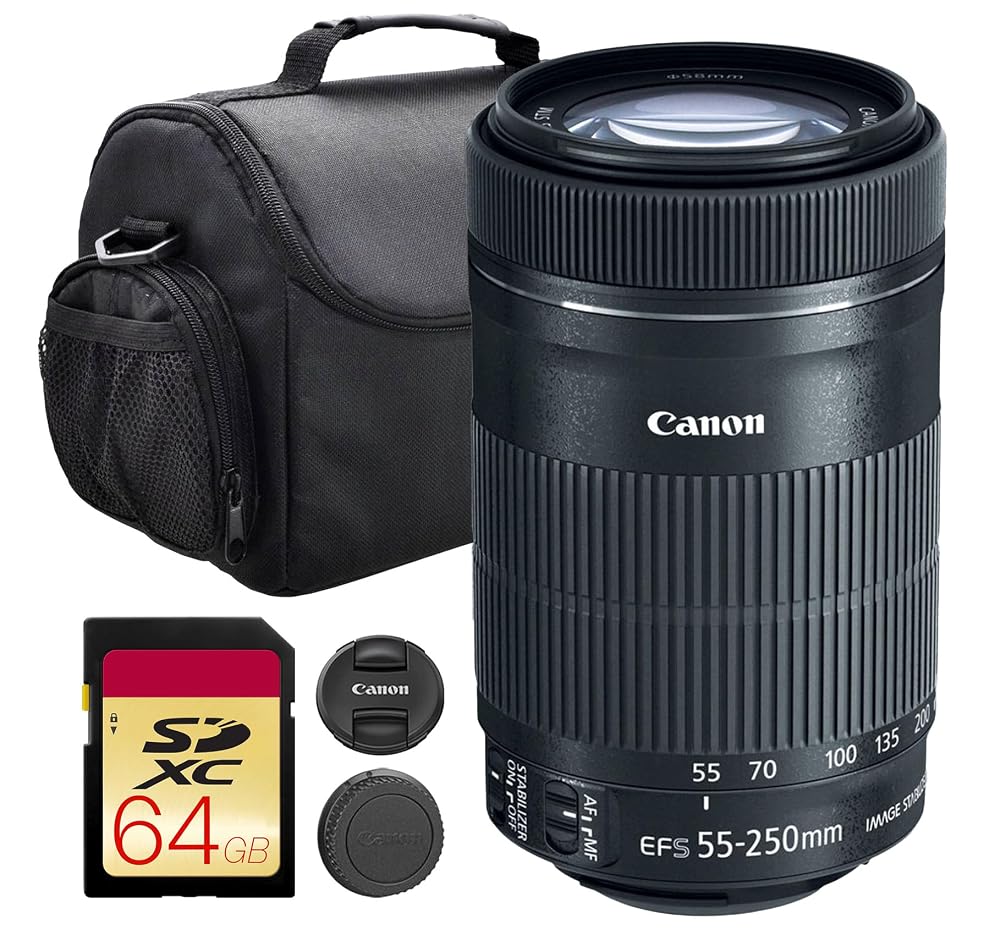
The Canon EF-S 55-250mm f/4-5.6 IS STM serves as Canon’s dedicated telephoto zoom engineered specifically for crop-sensor DSLRs, delivering a versatile 88–400mm full-frame equivalent focal range paired with advanced stepping motor autofocus and optical stabilization. For photographers seeking an accessible, lightweight telephoto optic that maintains crisp resolution across varying focal lengths without unwieldy physical bulk, this package represents an exceptionally balanced engineering achievement.
This telephoto zoom is built specifically for APS-C DSLR owners who need extended reach for field sports, distant wildlife, and outdoor travel photography where mobility remains paramount. Photographers who demand constant wide apertures for low-light indoor arenas or those operating full-frame camera systems will need to look elsewhere, as this lens utilizes an EF-S bayonet mount that cannot project an image circle large enough to cover a 35mm full-frame sensor.

Spec sheet
Canon EF-S 55-250mm f/4-5.6 IS STM
- Optical Focal Length
- 55–250mm (88–400mm equivalent on APS-C)
- Maximum Aperture Range
- f/4 at 55mm to f/5.6 at 250mm
- Lens Mount Type
- Canon EF-S
- Optical Stabilization
- Built-in Optical Image Stabilizer (up to 3.5 stops)
- Autofocus Drive System
- STM Stepping Motor with high-speed CPU
- Manual Focus Override
- Full-time manual focus capability
- Optical Formula Highlights
- One Ultra-Low Dispersion (UD) element
- Lens Coating Technology
- Super Spectra coating
- Bundled Kit Inclusions
- Shoulder bag and 64GB memory card
- Physical Dimensions and Weight
- The listing does not specify exact measurements
Figures as published by the manufacturer on the Amazon listing.
Optical Architecture and Dispersion Control
The internal optical layout of the Canon EF-S 55-250mm f/4-5.6 IS STM incorporates an Ultra-Low Dispersion (UD) glass element engineered to eliminate secondary spectrum chromatic aberrations. In long telephoto zoom formulations, longitudinal and lateral chromatic aberrations frequently cause secondary color fringing along high-contrast boundaries, such as dark tree branches or athletic uniforms outlined against bright skies. By integrating UD glass into the refractive grouping, this lens corrects the differing focal points of blue and red wavelengths, yielding clean edges and uniform sharpness across the entire zoom travel.
Complementing the specialized glass chemistry is Canon’s proprietary Super Spectra coating, applied to internal lens elements to reduce internal reflections and optical anomalies. Without multi-layer anti-reflective coatings, telephoto barrels with numerous air-to-glass surfaces are vulnerable to internal bounce flare, which degrades contrast and washes out shadow details. The Super Spectra treatment maintains color neutrality and optimizes light transmission, ensuring that distant subjects retain tonal separation even when shooting in back-lit environments or bright midday sunlight. For photographers who frequently balance telephoto work alongside classic focal lengths like the canon ef 50mm f/1.8, having consistent color rendition across your lens kit eliminates tedious white balance corrections in post-production.
Rigorous canon ef-s 55-250mm sharpness analysis indicates that the optical resolution holds up remarkably well throughout the focal spread. In earlier generations of variable-aperture telephoto lenses, resolution frequently collapsed at the maximum telephoto extension, forcing users to stop down significantly to achieve acceptable clarity. In contrast, this STM iteration retains strong central definition wide open at 250mm, with the UD element suppressing color halos that traditionally degrade perceived edge contrast. For users scrutinizing overall canon 55-250 stm optical performance, the lens provides an impressive balance of micro-contrast and resolution that maximizes the resolving capabilities of modern crop sensors.
Image Stabilization and Handheld Shooting Dynamics
Telephoto photography dramatically magnifies the visual impact of slight hand tremors, where even micro-vibrations translate into noticeable image blur at long focal lengths. The built-in Optical Image Stabilizer in this lens provides up to 3.5 stops of shake compensation based on standard testing criteria. In practical terms, this mechanism allows photographers to capture sharp handheld frames at shutter speeds significantly slower than the traditional reciprocal rule of shutter speed calculation. When extended to the 250mm position—which equates to 400mm on an APS-C camera—a photographer would conventionally require a minimum shutter speed of 1/400 second to avoid blur, but the stabilization system permits clean exposures at speeds as low as 1/30 to 1/50 second.
Evaluating the canon 55-250mm image stabilization performance reveals substantial benefits during handheld panning and stationary subject tracking. The internal gyroscopic sensors detect angular movement and command a specialized lens group to shift orthogonally, neutralizing pitch and yaw motions before the light hits the camera sensor. This physical movement compensation stabilizes the viewfinder image as well, providing a steady frame that assists in precise subject composition and focus target tracking. While pro-grade full-frame zoom lenses like the canon rf 24-105mm f2.8 rely on massive front glass elements and complex mechanical chassis, this optic delivers effective handheld stability within an impressively lightweight footprint.
This level of stabilization proves indispensable when capturing scenes during early morning or late afternoon hours when ambient light levels fall. Because the variable maximum aperture narrows to f/5.6 at the long end of the zoom, the optical stabilizer offsets the modest light-gathering power of the physical diaphragm. Photographers can keep their camera’s ISO settings at lower, cleaner values rather than being forced to amplify digital sensor gain, thereby preserving maximum dynamic range and avoiding coarse digital noise in fine subject textures.
Autofocus Tracking and STM Motor Implementation
The autofocus drive mechanism represents one of the most consequential design evolutions in this lens, powered by Canon’s stepping motor (STM) technology. Unlike noisy, gear-driven direct-current micro-motors of previous decades, the STM assembly drives the internal focusing groups via a quiet helicoid lead-screw configuration. This mechanical architecture delivers ultra-smooth, near-silent physical transitions that eliminate jarring focus jumps during video capture, ensuring the internal camera microphone does not register distracting mechanical rattles while recording.
Autofocus responsiveness is augmented by a dedicated high-speed central processing unit (CPU) running optimized focusing algorithms. When analyzing real-world canon 55-250mm f4-5.6 autofocus speed, the lens locks onto moving subjects swiftly and accurately during single-shot and continuous autofocus tracking modes. The integration of modern stepping motors has become a hallmark across Canon’s ecosystem, mirroring the smooth motor operation found on contemporary mirrorless designs such as the canon rf50mm f1.8 stm lens. The internal focus layout keeps the physical front element stationary throughout operation, allowing uninterrupted use of circular polarizing filters without accidental orientation changes.
Furthermore, the electronic focus ring incorporates full-time manual focus override. Even while the autofocus system remains engaged via the camera body, the photographer can manually intervene and fine-tune the focal plane by rotating the focus ring without toggling physical switches. This capability allows instantaneous corrections when shooting through foreground obstructions, such as wire fencing at athletic events or tall grasses obscuring a distant animal.
Focal Range Utility and APS-C Sensor Reach
Due to the standard 1.6x crop factor inherent to Canon APS-C sensor formats, the physical 55–250mm focal spread delivers an effective field of view equivalent to an 88–400mm lens mounted on a traditional 35mm full-frame camera. This dramatic amplification factor makes the optic exceptionally potent for isolating distant subjects. The 88mm equivalent wide end handles tight environmental portraits and medium-range field scenes, while the 400mm telephoto boundary provides the compression necessary to isolate small or inaccessible subjects.
This magnification is particularly advantageous for enthusiasts exploring canon 55-250mm stm wildlife photography. Approaching untamed animals closely is often impossible or disruptive, making generous canon 55-250mm aps-c reach a crucial asset in the field. At the 400mm equivalent setting, the lens allows you to fill the frame with songbirds, waterfowl, or distant mammals while maintaining a safe, respectful distance that avoids altering their natural behaviors. The compact design ensures you can carry the lens during prolonged hikes through nature reserves without the physical fatigue commonly associated with massive telephoto primes.
Beyond wildlife applications, this zoom range offers remarkable flexibility for sideline sports and travel photography. During outdoor sporting matches, you can frame full-body player action at 55mm and instantly zoom into 250mm to capture tight facial expressions and intense gameplay moments from across the pitch. When traveling, the telephoto compression alters perspective by visually pulling distant architectural landmarks or mountain ranges closer to mid-ground elements, producing captivating visual compositions that standard wide-angle kit zooms simply cannot render.
Mount Compatibility and Mechanical Engineering
A rigorous inspection of the canon ef-s 55-250mm f/4-5.6 is stm specs highlights that this lens is engineered exclusively around the Canon EF-S lens mount. The EF-S bayonet system features a shortened back-focus distance, allowing the rear optical elements to sit deeper inside the camera body than standard EF lenses. Because of this mechanical design, this lens cannot be mounted on full-frame Canon EOS DSLRs, as the protruding rear housing would interfere with the larger swinging reflex mirror. Understanding canon ef-s telephoto zoom lens compatibility is critical for building a coherent lens collection.
While restricted to crop sensors, this specialized EF-S engineering allows the barrel to remain remarkably compact and lightweight. By designing the glass elements to cover only the smaller APS-C image circle rather than a full 36x24mm sensor area, the diameter and mass of every glass element inside the optical barrel are substantially reduced. The resulting package minimizes physical strain during extended handheld shooting sessions, fitting easily into the included protective shoulder bag alongside extra gear.
The mechanical build features smooth zoom ring dampening that prevents accidental zoom creep while carrying the camera downward on a shoulder strap. The package also includes a 64GB high-capacity memory card, providing ample storage bandwidth to capture continuous raw image bursts and extended video sequences right out of the box. Although the listing does not specify exact physical measurements or weather-sealing gaskets, the construction provides a tight, precise assembly that resists normal operational wear under dry, fair-weather conditions.
Canon EF-S 55-250mm f/4-5.6 IS STM Pros and Cons
What works
- 5-stop optical image stabilization system
- Silent STM autofocus stepping motor
- Ultra-Low Dispersion element reduces color fringing
- Expansive 88-400mm equivalent APS-C reach
- Full-time manual focus override capability
- Includes shoulder bag and 64GB memory card
What to weigh up
- Restricted exclusively to Canon EF-S mounts
- Variable f/4 to f/5.6 maximum aperture
- Listing omits weather sealing specifications
Check Canon EF-S 55-250mm f/4-5.6 IS STM on Amazon
Who Should Buy the Canon EF-S 55-250mm f/4-5.6 IS STM
Buy It If
- You own a Canon APS-C DSLR and need genuine 88–400mm equivalent telephoto reach for sports, wildlife, and outdoor events.
- You require effective 3.5-stop optical image stabilization to shoot crisp handheld images without demanding a tripod.
- You record video footage or track active subjects and require silent, fluid autofocus tracking powered by an STM stepping motor.
- You want a lightweight, complete telephoto starter kit that includes a 64GB memory card and a dedicated shoulder bag.
Skip It If
- You shoot with a full-frame Canon DSLR body, as the EF-S mount is physically incompatible with 35mm full-frame mirror boxes.
- You frequently photograph indoor sports or night scenes requiring constant wide f/2.8 apertures to gather maximum light.
- You regularly work in heavy rain or extreme dusty conditions where fully weather-sealed pro-grade barrels are required.
Final Verdict
9.2/10Our score
When asking is canon ef-s 55-250mm is stm worth it, the answer is an emphatic yes for any APS-C shooter looking to expand their visual reach beyond the standard kit lens. By pairing a high-performance Ultra-Low Dispersion glass element with Canon’s proven Super Spectra coatings, this telephoto zoom bypasses the soft optical performance that historically burdened entry-level variable-aperture zooms. The optical image stabilizer compensates for up to 3.5 stops of movement, ensuring your 400mm equivalent shots remain crisp and detailed even when working handheld under shifting light conditions.
The addition of the smooth, whisper-quiet STM stepping motor makes the lens equally capable of tracking erratic field action and capturing smooth, rattle-free video sequences. While its variable f/4 to f/5.6 maximum aperture requires good ambient light or disciplined shutter management, its lightweight ergonomics and generous focal reach make it an indispensable field companion. For APS-C photographers demanding strong telephoto performance, stable framing, and excellent everyday utility, this package provides outstanding technical capability.
FAQ
Can I mount the Canon EF-S 55-250mm f/4-5.6 IS STM on a full-frame Canon DSLR?
No, the lens features a dedicated Canon EF-S mount designed exclusively for crop-sensor (APS-C) camera bodies. Because EF-S lenses feature a shorter back-focus distance with rear elements extending deeper into the body, mounting this lens on a 35mm full-frame DSLR could cause physical contact with the camera’s reflex mirror.
What does the 88–400mm equivalent focal range mean in practice?
Because Canon APS-C image sensors are smaller than standard 35mm full-frame sensors, they apply a 1.6x crop factor to the image. Multiplying the physical 55–250mm focal length by 1.6 results in an effective angle of view identical to an 88–400mm lens on a full-frame body, providing significant telephoto magnification for distant subjects.
How does the STM stepping motor benefit video recording?
The STM (Stepping Motor) drive uses a lead-screw mechanism to smoothly shift internal focusing elements with virtually silent operation. This prevents distracting mechanical motor clicking from being captured by the camera’s built-in microphone during video recording and eliminates sudden focus hunting during live autofocus transitions.
Does this lens allow manual focus adjustments while autofocus is active?
Yes, the lens incorporates full-time manual focus override. Even when your camera’s autofocus system is switched on, you can manually rotate the electronic focusing ring to make fine adjustments to the focus plane without having to disengage the autofocus toggle switch on the barrel.
What accessories are included in this specific package?
According to the product listing details, this bundle includes the Canon EF-S 55-250mm f/4-5.6 IS STM lens along with a protective shoulder bag and a 64GB high-capacity memory card.
See this listing on Amazon We may earn a commission if you buy through this link.
More in Cameras & Drones



The weekly shortlist
Specs worth reading, once a week
New teardowns, spec sheets and buying notes from across the desk.
This demo form is not connected to a mailing service.