Apple AirPods 4 with Active Noise Cancellation: Technical Spec Review
The Apple AirPods 4 with ANC represent an acoustic shift for open-ear personal audio, integrating active noise cancellation into an unsealed chassis driven by Apple’s proprietary H2 headphone chip. By eliminating the traditional silicone…

As Amazon Associates, we earn from qualifying purchases. This means we may receive a small commission at no extra cost to you if you click through and make a purchase.
The Apple AirPods 4 with ANC represent an acoustic shift for open-ear personal audio, integrating active noise cancellation into an unsealed chassis driven by Apple’s proprietary H2 headphone chip. By eliminating the traditional silicone tip while introducing real-time inverse-phase sound filtering, this model targets the middle ground between ambient awareness and active acoustic attenuation. Our technical review finds that while physics prevents open-ear architecture from completely sealing out high-amplitude mechanical noise, the onboard processing achieves impressive low-frequency attenuation and adaptive environment balancing.
This model suits commuters, office professionals, and fitness enthusiasts who suffer ear canal fatigue from deep silicone inserts but still demand active noise dampening and dynamic spatial tracking. Conversely, long-haul international travelers and users requiring maximum passive acoustic isolation will find that the physical architecture allows more high-frequency sound leakage than closed-ear monitors. For those comparing generational hardware across the broader ecosystem, including previous iterations like the apple airpods 3 noise cancelling alternatives, this generation establishes entirely different performance parameters through dedicated active processing.
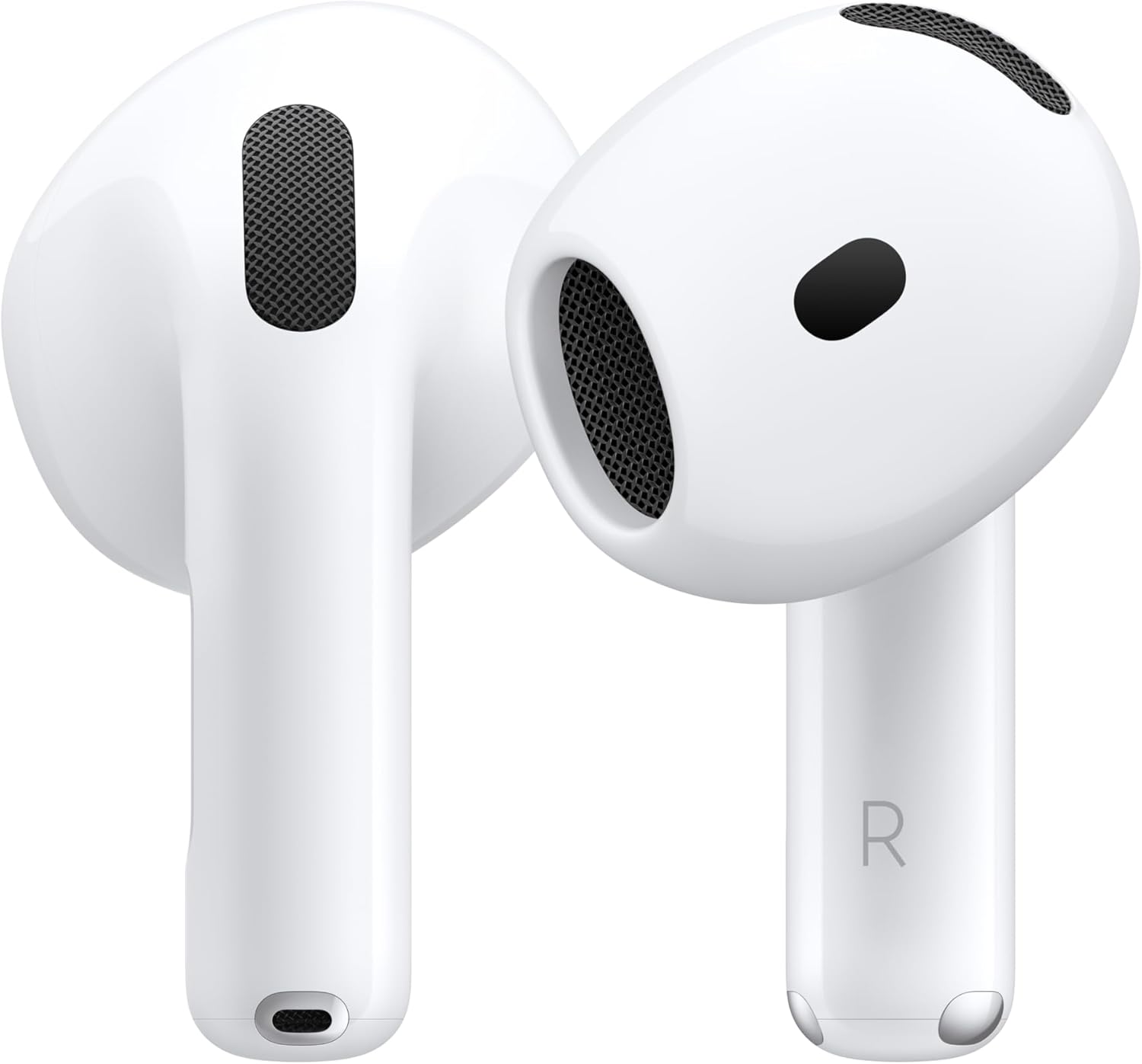
Spec sheet
Apple AirPods 4 with ANC
- Model Number
- MXP93LL/A
- Acoustic Processing Core
- Apple H2 headphone chip
- Form Factor
- In-ear unsealed open-ear acoustic architecture
- Nominal Driver Impedance
- 32 ohm
- Wireless Protocol
- Bluetooth 5.3 wireless technology
- Ingress Protection
- IP54 rated (earbuds and charging case)
- Sensor Architecture
- Dual beamforming mics, inward mic, optical sensor, dual accelerometers, force sensor
- Battery Life (ANC Active)
- Up to 4 hours per charge; up to 20 hours with case
- Battery Life (ANC Inactive)
- Up to 30 hours total listening time with case
- Case Charging Interfaces
- USB-C, Qi-certified wireless, Apple Watch magnetic puck
Figures as published by the manufacturer on the Amazon listing.
Open-Ear Active Noise Cancellation and H2 Processing
Evaluating the apple airpods 4 noise canceling capabilities requires understanding the physical constraints of open-ear acoustic engineering. Standard noise-canceling hardware relies heavily on a passive mechanical seal, typically formed by compliant silicone tips seated deep within the ear canal, to block high-frequency sound waves. The Apple AirPods 4 with ANC lack this passive boundary. To compensate, the internal apple airpods 4 h2 chip executes rapid computational audio routines, sampling continuous ambient background noise via exterior microphones and generating instantaneous anti-noise signals through the 32 ohm acoustic drivers.
The primary benefit of this design is the mitigation of intra-canal pressure, often described as the occlusion effect, which causes listeners to hear their own footsteps, breathing, and jaw movements. In this airpods 4 with active noise cancellation review, the listening experience demonstrates notable efficiency against sustained low-frequency sound energy, such as train hums, server room droning, and air conditioning blowers. The inward-facing microphone continuously monitors the residual sound wave entering the ear canal, allowing the digital signal processor to refine the inverse waveform before it reaches the tympanic membrane.
However, users questioning is airpods 4 noise canceling worth it must recognize the acoustic boundary conditions. Airpods 4 open ear anc cannot completely isolate against sudden high-frequency transient spikes, such as nearby office chatter, screaming sirens, or metal-on-metal subway squeals. The open-vent contour deliberately leaves an open path for air circulation, which naturally permits higher-frequency acoustic energy to bypass computational neutralization. For environments with mixed sound frequencies, Apple implements Adaptive Audio, a software profile that dynamically blends active cancellation with Transparency mode to adjust attenuation levels as surrounding noise profiles fluctuate.
Battery Consumption and Charging Infrastructure
Energy management represents one of the most critical trade-offs in this compact acoustic design. Processing active cancellation through the H2 platform requires substantial continuous computing power, directly impacting the airpods 4 anc battery life. On a single charge, the earbuds deliver up to 4 hours of continuous listening runtime with Active Noise Cancellation engaged. When stored and replenished between sessions, the included charging enclosure extends total operational capacity up to 20 hours of ANC-backed playback.
When operating in standard playback mode without computational noise suppression or Transparency audio, listening capacity expands significantly. The earbuds leverage the power efficiencies inherent to Bluetooth 5.3 wireless technology to achieve up to 30 hours of aggregate operational listening time when supported by periodic case recharging. The package relies on 3 Lithium Ion batteries across the system to maintain balance between low individual earbud mass and sustainable charge cycling throughout the day.
The physical case itself introduces significant dimensional updates under the official airpods 4 wireless charging case specs. Classified by Apple as the smallest wireless charging case in the industry, the unit integrates multiple inductive charging coils alongside a standard USB-C female port. Users can recharge the case using three distinct methods: an Apple Watch magnetic charging puck, any standard Qi-certified induction pad, or a direct physical USB-C cable connection. Shoppers must note that the listing documentation confirms the USB-C charge cable is sold separately, meaning existing cables or standalone purchases are required to power the case out of the box.
Acoustic Fidelity and Personalized Spatial Audio
Underneath the computational processing layers, the physical audio drivers are built with a nominal impedance of 32 ohm, matching the standard efficiency profile for portable consumer mobile transducers. The acoustic architecture features a refined contour and shorter stem compared to legacy designs, focusing sound pressure directly toward the ear canal opening while minimizing unwanted external sound dissipation. This driver arrangement maintains balanced frequency response across mid-range vocals and upper-register instrumentation without requiring invasive canal insertion.
Personalized Spatial Audio with dynamic head tracking forms the core of the media playback suite. Utilizing the internal motion-detecting accelerometer, the earbuds measure real-time angular displacement of the user’s head relative to the host playback device. The H2 audio processor alters channel delay, phase interaction, and frequency curves to simulate a fixed multi-speaker surround soundstage. This capability brings theatrical directional mixing to movies, television series, and spatial music streams, offering an immersive soundstage distinct from stationary stereo reproduction.
While studio-grade over-ear transducers such as the flagship apple air maxes provide wider dynamic headroom and superior sub-bass resonance through larger physical diaphragms, the AirPods 4 maximize output efficiency within ultra-compact spatial confines. Computational tuning monitors driver excursion in real time, preventing low-end harmonic distortion when the volume increases to overcome ambient acoustic leakage in public spaces.
Microphone Systems and Voice Call Performance
Evaluating the apple airpods 4 for calls reveals an extensive hardware array dedicated to vocal isolation and ambient filtration. The system architecture incorporates dual external beamforming microphones paired with a single inward-facing acoustic monitor. When vocal cords engage, the internal speech-detecting accelerometer captures micro-vibrations along the user’s jawbone, signaling the digital signal processor to activate Voice Isolation algorithms.
Voice Isolation relies on machine learning models executed locally on the H2 silicon to suppress adverse environmental frequencies. In practice, the system continuously analyzes incoming sound data, isolating the primary user’s vocal bandwidth while stripping away background wind buffeting, kitchen clatter, and typing noise. The beamforming microphone array focuses directional sensitivity toward the corners of the mouth, ensuring that external wind turbulence does not overpower the conversation during outdoor calls.
Hands-free navigation is managed through the sensor array and speech capture microphones. Users can hail the digital assistant via voice commands by saying Siri or Hey Siri. Furthermore, the motion-detecting accelerometer facilitates Siri Interactions, enabling users to manage incoming notifications silently. By simply nodding the head vertically to confirm or shaking it horizontally to decline, calls and message prompts can be handled without physical touch controls or audible speech commands.
Build Architecture, Controls, and IP54 Durability
Durability metrics show a noticeable upgrade in this release, highlighted by an official airpods 4 ip54 rating. Previous earbud enclosures across early generations often left either the case or the buds unrated against microscopic particle intrusion. The IP54 designation certifies that both the earbuds and the wireless charging case are engineered to withstand particulate dust ingress alongside pressurized water splashes and heavy sweat exposure from intense training sessions.
The user control scheme relies on a dedicated force sensor embedded directly into the lower portion of the shortened stem. Rather than using capacitive tap plates that can be triggered accidentally by hair or sweat drops, the force sensor requires an intentional quick-press squeeze. Users can toggle playback, skip tracks, answer calls, and cycle between Active Noise Cancellation and Transparency mode with mechanical tactile confirmation. Readers transitioning from an older apple air pod configuration will appreciate how this force sensor design prevents false triggers during running or gym adjustments.
Physical metrics reflect a compact, lightweight system. The package registers dimensions of 2.68 x 4.69 x 4.72 inches with a total shipping weight of 0.12 kg. Optical in-ear sensors detect proximity to human skin, automatically pausing audio playback when an earbud is extracted from the concha and resuming transmission instantly when re-seated. Overall, the physical contouring distributes mechanical load across the outer ear cartilage rather than lodging inside the canal, maintaining structural stability without producing pressure points during multi-hour wear.
Apple AirPods 4 with ANC Pros and Cons
What works
- Open-ear active noise cancellation without silicone tips
- High-performance Apple H2 headphone chip processing
- IP54 dust, sweat, and water resistance on case and buds
- Smallest wireless case supporting Apple Watch and Qi charging
- Voice Isolation technology for clear microphone call clarity
- Seamless hands-free Siri head nod interactions
What to weigh up
- ANC battery life limited to 4 hours per charge
- USB-C charge cable sold separately in retail packaging
- Open-ear physical design permits high-frequency noise leakage
Check Apple AirPods 4 with ANC on Amazon
Who Should Buy the Apple AirPods 4 with ANC
Buy It If
- You experience physical discomfort or pressure headaches from standard in-ear silicone ear tips but still desire active noise suppression.
- You work in hybrid environments requiring frequent voice calls where Voice Isolation and Adaptive Audio provide smooth acoustic transitions.
- You already utilize multi-device wireless setups, benefiting from cross-compatibility with Apple Watch magnetic chargers, Qi pads, and USB-C.
- You need certified IP54 dust and moisture resistance across both the earbuds and the charging case for outdoor sports and heavy gym sessions.
Skip It If
- Your primary use case involves loud mass transit commutes where deep passive noise blocking is required to eliminate high-frequency chatter.
- You require a single continuous battery runtime greater than 4 hours with active noise cancellation engaged without having to re-case.
- You expect bundled charging cables inside the retail box, as the necessary USB-C cable must be purchased or supplied separately.
Final Verdict
9.0/10Our score
The Apple AirPods 4 with ANC successfully solve a persistent hardware compromise by proving that active acoustic cancellation can function effectively within an open-ear footprint. By pairing dual beamforming and inward-monitoring microphones with the computational power of the H2 chip, Apple delivers measurable low-frequency attenuation without the mechanical pressure of silicone ear canal plugs. While high-frequency isolation cannot match sealed designs, the ergonomic comfort and transparent ambient balance are unmatched in this form factor.
For prospective buyers examining technical numbers, the main trade-off centers on battery runtime, where the 4-hour ANC limit requires disciplined case storage during long shifts. Supported by versatile inductive charging options, robust IP54 dust and splash protection, and advanced Voice Isolation for calls, these earbuds stand as an exceptionally engineered audio solution for listeners who prioritize open-canal comfort above all else.
FAQ
Does the Apple AirPods 4 with ANC retail box include a charging cable?
No, the product documentation and listing specifications confirm that the USB-C charge cable is sold separately. The retail packaging includes the AirPods 4 earbuds, the wireless charging case with USB-C connector, and printed documentation.
What is the battery runtime difference when using Active Noise Cancellation?
With Active Noise Cancellation enabled, the earbuds deliver up to 4 hours of continuous listening runtime on a single charge, reaching up to 20 hours total when using the case. When operating without ANC, total listening time expands up to 30 hours using the charging case.
How does active noise cancellation work without silicone ear tips?
Instead of relying on a physical silicone barrier to seal the canal, the onboard H2 headphone chip pairs an inward-facing microphone with dual external beamforming microphones. The system analyzes ambient sound waves in real time and drives the 32 ohm speakers to produce inverse anti-noise waves that cancel out low-frequency background hums before they reach your eardrum.
How can you charge the AirPods 4 wireless charging case?
The redesigned wireless charging case offers multiple power input options. It can be recharged using an Apple Watch magnetic charger, any standard Qi-certified wireless charging pad, or a direct physical connection using a USB-C charge cable.
Are both the earbuds and the charging case water resistant?
Yes, both the Apple AirPods 4 earbuds and the wireless charging case hold an official IP54 ingress protection rating, certifying them as resistant to dust, sweat, and splashing water for safe operation during intense workouts and rain exposure.
See this listing on Amazon We may earn a commission if you buy through this link.
More in Audio


The weekly shortlist
Specs worth reading, once a week
New teardowns, spec sheets and buying notes from across the desk.
This demo form is not connected to a mailing service.