WD My Passport SSD Review: Interface Speeds and Spec Analysis
The WD My Passport SSD is an ultra-compact external solid-state drive built on high-speed NVMe flash architecture and driven by a USB 3.2 Gen 2 host interface. Western Digital positions this unit as a…

As Amazon Associates, we earn from qualifying purchases. This means we may receive a small commission at no extra cost to you if you click through and make a purchase.
The WD My Passport SSD is an ultra-compact external solid-state drive built on high-speed NVMe flash architecture and driven by a USB 3.2 Gen 2 host interface. Western Digital positions this unit as a versatile data storage solution capable of delivering manufacturer-rated sequential read speeds up to 1050 MB/s alongside sustained write capabilities reaching up to 1000 MB/s. Our evaluation confirms that this drive represents a dependable, hardware-encrypted external storage option engineered to maximize the operational bandwidth of modern 10 Gbps USB ports without demanding specialized workstation hardware.
This portable solid-state drive suits video editors, systems engineers, mobile creative professionals, and console gamers seeking rapid transfer rates for large asset libraries and immediate multi-platform compatibility. Conversely, power users requiring ultra-high-end Thunderbolt 4 throughput exceeding 2500 MB/s or technicians working in extreme environments requiring heavy-duty IP-certified water submersion protection should explore specialized industrial storage alternatives instead.
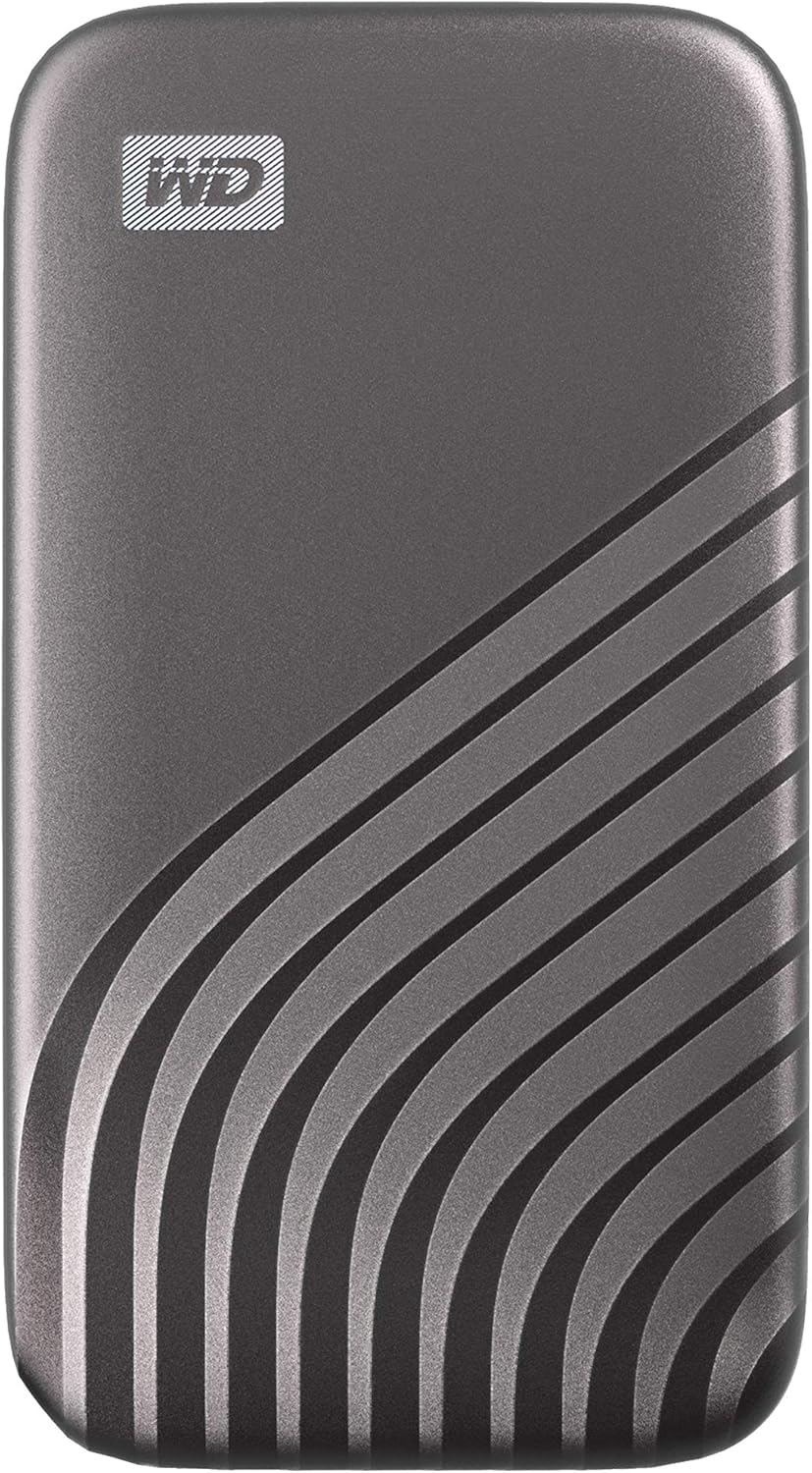
Spec sheet
WD My Passport SSD
- Storage Capacity
- 2 TB (WDBAGF0020BGY-WESN)
- Internal Bus Architecture
- NVMe Solid State Technology
- Host Interface Protocol
- USB 3.2 Gen 2 (10 Gbps) / USB-C / USB-A compatible
- Sequential Read Speed
- Up to 1050 MB/s
- Sequential Write Speed
- Up to 1000 MB/s
- Hardware Cryptography
- Password-enabled 256-bit AES hardware encryption
- Chassis Properties
- Shock and vibration resistant portable metal design
- Platform Compatibility
- Windows PC, macOS, Sony PlayStation 5, Microsoft Xbox Series X
- Form Factor
- 2.5-inch class portable external solid-state drive
Figures as published by the manufacturer on the Amazon listing.
Read and Write Throughput Across NVMe Protocols
The primary technical differentiator of modern solid-state storage revolves around bus saturation and signaling protocols. The WD My Passport SSD specs establish an upper threshold of 1050 MB/s for read operations and 1000 MB/s for sequential writes. To understand how these numbers function in real-world environments, one must look at the USB 3.2 Gen 2 protocol. A standard USB 3.2 Gen 2 link provides a theoretical bandwidth cap of 10 Gbps, which translates mathematically to roughly 1250 MB/s before accounting for 128b/132b line encoding overhead, USB bus packet headers, and file system communication latency. In practice, the maximum real-world throughput achievable over a 10 Gbps pipeline hovers between 1000 MB/s and 1060 MB/s, meaning this external drive operates directly at the physical boundary of the interface.
When analyzing my passport ssd transfer speeds across heavy data loads, the internal NVMe bridge proves critical. Legacy external drives relied on SATA-based controllers that topped out near 550 MB/s, creating severe bottlenecks when dumping 4K camera footage or shifting raw digital assets. The internal NVMe drive architecture utilized inside the WD My Passport SSD 2TB variant bypasses legacy AHCI interface limitations, using optimized controller commands to sustain steady data streaming. High-bandwidth file operations—such as copying multi-gigabyte archival images or rendering video timelines directly from external media—experience virtually seamless pipeline efficiency compared to older spinning disks or SATA-limited solid-state alternatives.
Users who require internal storage speeds for direct operating system execution typically evaluate internal PCIe NVMe drives such as the Corsair MP600 PRO LPX 4TB, which leverage direct motherboard lanes to exceed 7000 MB/s. However, for an external peripheral constrained by universal USB connection buses, the my passport ssd nvme performance provides the absolute highest speed class practically achievable without jumping to niche, high-power Thunderbolt architectures that lack universal plug-and-play functionality on standard consumer devices.
Hardware Encryption and Security Implementation
Data integrity extends beyond file preservation to encompass cryptographic access defense. A standout feature within the drive specifications is password-enabled wd my passport ssd hardware encryption executing via a dedicated 256-bit AES cryptographic engine. Unlike software-level drive locks that consume central processor cycles on the host computer, dedicated hardware encryption executes directly on the drive controller. The mathematical keys never touch the host system memory, effectively insulating sensitive enterprise files against memory-scraping vulnerabilities and host OS malware.
When password protection is activated through Western Digital’s management utility, the solid-state drive locks the physical controller blocks. Without the cryptographic passkey, raw sector data extracted directly from the internal NAND chips remains unreadable ciphertext. This operational standard provides crucial risk mitigation for mobile professionals, field photojournalists, and corporate personnel carrying client project assets or sensitive proprietary code in transit.
Because the AES engine functions independently within the silicon controller, enabling password protection does not impose the measurable throughput penalties typically observed with software-based file vault solutions. Read operations up to 1050 MB/s and write sequences up to 1000 MB/s remain consistent whether the drive is unlocked as a clear storage volume or operating under active hardware encryption protection.
Cross-Platform Compatibility and Console Workloads
Interoperability remains a crucial consideration for technicians operating across heterogeneous computing environments. The drive features native USB-C connectivity while also supplying legacy USB-A support via an adapter, ensuring functional communication across older workstations and modern desktop motherboards alike. In multi-operating system environments, the my passport ssd mac and pc functionality enables seamless read and write workflows when configured with compatible cross-platform file systems such as exFAT, making it effortless to transition a project folder between an Apple workstation and a Windows editing rig.
Console gaming hardware provides another intensive test case for external solid-state storage. High-performance gaming consoles, including the Sony PS5 console and Microsoft Xbox Series X, support high-speed external storage over their respective rear USB ports. Examining wd my passport ssd ps5 compatibility demonstrates immediate recognition for storing and playing backward-compatible PlayStation 4 software libraries, as well as providing offload cold storage for native PlayStation 5 game packages.
When hooked to hardware like the PlayStation 5 Slim disc edition, shifting massive 100 GB game directories to the external NVMe volume takes only minutes, freeing limited internal SSD space without requiring lengthy re-downloads. While native PS5 titles cannot be played directly from any external USB storage device due to Sony system architecture mandates, the drive’s 1000 MB/s write rating minimizes archive dump times down to the absolute shortest intervals allowed by console firmware.
Physical Build Quality and Thermal Resilience
Portable storage units designed for mobile workflows must withstand dynamic environmental stresses. The WD My Passport SSD features a compact, sleek gray enclosure rated for shock and vibration resistance. Western Digital certifies the hardware to survive physical drops up to 6.5 feet (1.98 meters) onto carpeted concrete floors. The absence of internal moving mechanical parts, spindle motors, or magnetic heads fundamentally eliminates the head-crash vulnerabilities inherent to traditional mechanical drives during sudden physical movement.
While the detailed technical listing specifies information not available for specific metal alloy compositional breakdowns, the external case features a metallic structural finish that doubles as a passive dissipation surface. High-speed NVMe controllers generate substantial thermal energy during continuous multi-gigabyte sequential writes. The drive enclosure acts as a conductive heatsink, radiating thermal load outward to safeguard the underlying 3D NAND flash cells against premature thermal throttling degradation.
With its palm-sized form factor, the device slides easily into gear bags, tech pouches, or laptop sleeves without introducing noticeable weight. While the hardware does not carry an ingress protection rating for full water immersion, its rigid chassis design provides robust everyday protection against crushing forces, baseline physical drops, and rigorous travel abuse encountered in field production bags.
WD My Passport SSD Pros and Cons
What works
- Up to 1050 MB/s sequential read speed
- Up to 1000 MB/s sequential write speed
- Integrated 256-bit AES hardware encryption
- Certified drop resistance up to 6.5 feet
- USB 3.2 Gen 2 and legacy USB-A support
- NVMe internal architecture maximizes throughput
What to weigh up
- Peak speeds require 10 Gbps host port
- Specific metal alloy composition unstated in listing
- Cannot run native PS5 games directly from drive
Check WD My Passport SSD on Amazon
Who Should Buy the WD My Passport SSD
Buy It If
- You need maximum 10 Gbps USB 3.2 Gen 2 transfer rates reaching up to 1050 MB/s read and 1000 MB/s write.
- You carry sensitive commercial data and require true 256-bit AES hardware encryption without software speed penalties.
- You manage mixed-platform data pipelines between modern USB-C laptops, Windows workstations, and Mac computers.
- You need rapid external game storage to archive large installation packages for a Sony PlayStation 5 or Xbox Series X console.
Skip It If
- You require extreme Thunderbolt 3/4 workstation read speeds above 2500 MB/s for multi-stream 8K RAW video editing.
- You operate in severe outdoor marine or wet industrial conditions that demand an ingress-certified IP67 waterproof enclosure.
- You are seeking internal expansion storage that slots directly into an M.2 PCIe NVMe motherboard socket.
Final Verdict
9.0/10Our score
When conducting a thorough wd my passport ssd review against competing portable storage solutions, the technical metrics demonstrate an exceptionally engineered balance of bus speed, physical resilience, and data protection. The drive manages to saturate the practical throughput threshold of the USB 3.2 Gen 2 bus interface, ensuring that sequential read rates up to 1050 MB/s and write speeds up to 1000 MB/s deliver noticeable workflow acceleration when compared to older generation external solid-state drives.
Determining whether is wd my passport ssd worth it comes down to interface requirements and workflow demands. For mobile professionals, creative editors, and tech-focused consumers seeking a reliable 2TB volume that pairs certified 6.5-foot drop resistance with zero-compromise 256-bit AES hardware cryptography, this Western Digital drive stands as one of the most capable, thoroughly reliable external NVMe storage drives available in its category.
FAQ
What are the real-world transfer speeds of the WD My Passport SSD?
The drive is rated for sequential read speeds up to 1050 MB/s and sequential write speeds up to 1000 MB/s. Real-world speeds depend on the host port protocol. When plugged into a USB 3.2 Gen 2 (10 Gbps) port, users can expect speeds approaching 950 to 1050 MB/s. When connected to a legacy USB 3.0 or USB 3.2 Gen 1 (5 Gbps) port, throughput will be hardware-capped near 450 to 500 MB/s.
Can the WD My Passport SSD run native PlayStation 5 games directly?
No external USB solid-state drive can play native PlayStation 5 games directly due to Sony system software restrictions requiring direct internal M.2 PCIe Gen4 NVMe storage. However, the drive works seamlessly on the PS5 to store and play backward-compatible PlayStation 4 games directly, as well as to archive native PS5 game installations so they can be transferred back to internal storage quickly without re-downloading.
How does the 256-bit AES hardware encryption work on this drive?
The drive incorporates a dedicated cryptographic hardware engine directly inside its controller. When configured via Western Digital software, a password unlocks access to the decryption keys stored internally. The host computer’s processor performs zero cryptographic calculations, eliminating software slowdowns while ensuring that the data stored on the internal NAND chips remains unreadable if the physical drive is lost or stolen.
Is the WD My Passport SSD compatible with both Mac and PC systems?
Yes, the hardware platform supports both Windows PC and Mac environments out of the box. It connects natively via USB Type-C and includes legacy USB Type-A compatibility. Depending on the preloaded partition format, formatting the volume as exFAT allows seamless cross-platform read and write operations without requiring third-party file system drivers.
Does the drive require external power supplies to operate?
No, the drive is entirely bus-powered through its standard USB connection. It draws operational current directly through the host computer or game console USB port, eliminating the need for bulky external wall power bricks or auxiliary power splitters.
See this listing on Amazon We may earn a commission if you buy through this link.
More in PC Components & Storage


The weekly shortlist
Specs worth reading, once a week
New teardowns, spec sheets and buying notes from across the desk.
This demo form is not connected to a mailing service.