WD My Book External Hard Drive: In-Depth Hardware & Performance Breakdown
The WD My Book is a dedicated high-capacity desktop external storage solution engineered for high-volume data archiving, local workstation backups, and hardware-secured data retention. Built around a 3.5-inch internal form factor and driven by…

As Amazon Associates, we earn from qualifying purchases. This means we may receive a small commission at no extra cost to you if you click through and make a purchase.
The WD My Book is a dedicated high-capacity desktop external storage solution engineered for high-volume data archiving, local workstation backups, and hardware-secured data retention. Built around a 3.5-inch internal form factor and driven by a SuperSpeed USB 3.0 interface, the unit provides a consolidated repository capable of absorbing massive multi-terabyte system images, raw media libraries, and cold storage archives. With onboard 256-bit AES hardware encryption and integrated utility management, the drive acts as an autonomous hardware vault that delivers reliable, static data security for professional workstations and home desktop environments alike.
This desktop drive is specifically optimized for creative professionals, software engineers, and small-business operators who manage vast local repositories and cannot rely on network-bound cloud storage limitations. It suits anyone demanding extensive single-drive capacity paired with non-intrusive, automated backup routines and controller-level security. However, users searching for lightweight mobile storage that operates exclusively on bus power, or field technicians who require ruggedized, shock-absorbent field enclosures, should bypass this stationary unit and look toward compact portable alternatives.
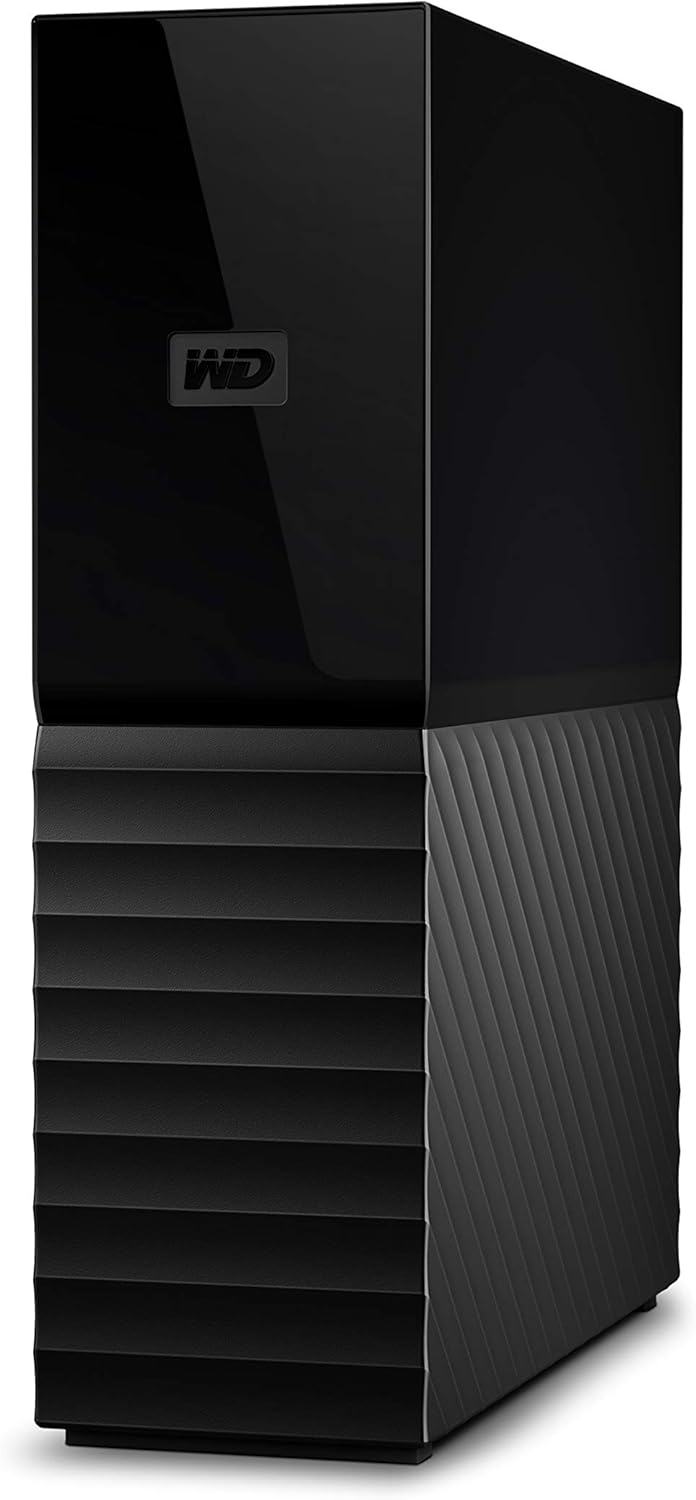
Spec sheet
WD My Book
- Digital Storage Capacity
- 18000 GB (18 TB)
- Hard Drive Form Factor
- 3.5-inch Desktop Enclosure
- Host Interface
- USB 3.0 (SuperSpeed 5 Gbps, USB 2.0 Compatible)
- Listed Data Transfer Rate
- 600.0 MB/s (Read / Media Speed)
- Hardware Security
- 256-bit AES Hardware Encryption
- Supported Platforms
- Desktop PC, Mac
- Physical Dimensions
- 9.0 inches L x 8.0 inches W x 3.5 inches Thick
- Unit Weight
- 2.8 pounds
Figures as published by the manufacturer on the Amazon listing.
Storage Capacity and Archival Workloads
The primary engineering highlight of this desktop unit is its expansive digital ceiling. Offering an 18000 GB allocation, the wd my book 18tb capacity is built to eliminate storage fragmentation across creative and administrative workstations. Western Digital defines storage capacity under the industrial standard where one terabyte equals one trillion bytes. Because operating systems calculate capacity using binary notation where a kibibyte is 1,024 bytes, the actual usable capacity reported by your host machine will display slightly below the absolute mathematical 18,000-gigabyte threshold. Nevertheless, this massive ceiling provides ample room for storing thousands of uncompressed RAW image sequences, high-bitrate video projects, virtual machine environments, and complete system restore images without dividing assets across disparate external enclosures.
Managing extensive file repositories on a single localized drive dramatically reduces workspace friction compared to cycling through smaller external volumes. For power users balancing expansive projects, deploying the seagate 16tb expansion desktop usb 3.0 external hard drive or this 18TB platform ensures that active catalogs stay consolidated in one place. The single-drive architecture eliminates the overhead of multi-enclosure power supplies and cluttered host USB topologies, making it a functional cornerstone for continuous local backups and structured folder hierarchies.
Archival reliability on high-capacity mechanical drives relies on stable sector health over long operational cycles. Because this 3.5-inch drive is engineered specifically for business and personal desktop environments, it handles heavy sequential read and write loads gracefully. Whether archiving years of financial documents, maintaining cold backups of offloaded media libraries, or setting up redundant data shares, the capacity ensures long-term operational runway before requiring secondary drive expansion.
Data Transfer Speeds and USB Interface Throughput
Throughput capabilities dictate how effectively a high-capacity drive interacts with demanding workstations. The wd my book transfer speed parameters are rooted in its SuperSpeed USB 3.0 controller, which provides a theoretical signaling rate of 5 Gbps. In the official hardware specifications, the manufacturer notes a maximum data transfer rate, read speed, and media speed of 600 megabytes per second. This 600 MB/s metric reflects the maximum theoretical burst interface throughput supported by internal SATA-to-USB bridge controller architecture, ensuring the bridge itself never bottlenecks the physical media inside the enclosure during rapid data transfers.
In practice, sustained sequential throughput on a single 3.5-inch mechanical hard drive operates within physical platter density boundaries. While solid-state drives rely on flash NAND chips for hyper-fast burst transfers, high-density mechanical drives excel at moving large contiguous files like 4K video renders, compressed archives, and disk images over extended periods. Because the drive negotiates over the USB 3.0 protocol, large payload transfers proceed with minimal controller lag, maintaining steady pipeline communication between the host operating system and the internal storage platters.
Host connectivity is bolstered by backward compatibility with legacy USB 2.0 standards. While connecting over a legacy port throttles interface bandwidth down to USB 2.0 interface maximums, the wd my book usb 3.0 compatibility ensures immediate plug-and-play operation across both modern high-speed workstation ports and older legacy office terminals without requiring specialized hardware adapters or expansion cards.
Hardware Encryption and Security Architecture
Data protection extends beyond physical drive retention, especially in corporate, medical, or creative production settings where sensitive intellectual property is stored. The integrated wd my book hardware encryption leverages a dedicated 256-bit AES cryptographic engine embedded directly inside the drive controller architecture. This hardware-level approach ensures that all sectors written to the platters are encrypted in real time at silicon level, preventing unauthorized extraction of data even if the internal drive mechanism is removed from its external enclosure.
Unlike software-based encryption suites that consume host CPU cycles and throttle workstation performance during intensive file transfers, hardware encryption executes independently of host system resources. Workstations can maintain peak processing power for rendering, compiling, or database manipulation while the storage controller transparently handles cryptographic computation. Users who previously relied on unencrypted alternatives like the standard wd elements 16tb will appreciate the dedicated security partition, which requires password authorization before the host operating system can mount the storage volume.
Managing this cryptographic protection is straightforward via the bundled utility suite. Users configure their personal access credentials during initial device initialization. The listing specifies that device management and password protection software require user download, software installation, and acceptance of terms and conditions, with user account registration potentially required. Once configured, access remains barred to anyone lacking the assigned password, providing institutional-grade data privacy right on the desk.
Form Factor, Acoustics, and Thermal Boundaries
The physical footprint of the WD My Book reflects its intended role as a stationary workstation fixture. Featuring a dedicated 3.5-inch internal mechanical hard drive, the external chassis measures 9.0 inches in length, 8.0 inches in width, and 3.5 inches in thickness. With a total weight of 2.8 pounds, this enclosure possesses enough mass to sit securely on a desk, studio credenza, or server rack shelf without sliding when cables are adjusted or neighboring hardware vibrates.
Thermal management is an essential parameter for high-density 18TB storage platforms. The hardware listing outlines precise operating thermal limits spanning from 5°C to 35°C (41°F to 95°F), alongside a safe non-operating storage threshold ranging from –20°C to 65°C (–4°F to 149°F). Workstation operators must ensure the chassis is placed in a well-ventilated area where ambient office temperatures do not breach the 35°C operational ceiling, allowing internal heat to dissipate naturally through the enclosure vents without requiring loud, high-RPM internal fans.
Because the unit weighs 2.8 pounds and houses a mechanical 3.5-inch drive mechanism, acoustic output and internal vibration dampening are critical design considerations. The vertical profile utilizes stable base pads to reduce physical resonance transferred into wooden or metal desks. While mechanical drives produce audible seek and write head clicks during intensive random read and write cycles, the rigid external housing helps muffle drive chatter during long, unattended background backup routines.
Cross-Platform Compatibility and Software Ecosystem
Modern production environments frequently blend different operating systems, requiring adaptable host interface support. The wd my book mac and pc compatibility ensures that the hardware functions across both Windows desktop platforms and Apple macOS computers. While file system formatting out of the box may be pre-configured for one specific platform, the drive can be reformatted or partitioned using standard operating system disk utilities to support native APFS, HFS+, NTFS, or exFAT file systems depending on workflow needs.
System redundancy is reinforced through the drive ecosystem’s support for automated backup applications. Western Digital includes software designed for automated device management and scheduled backups, pairing seamlessly with custom local backup routines. For Mac environments, the drive is engineered to integrate perfectly with Apple Time Machine, allowing seamless hourly snapshots, system state recovery, and comprehensive file version tracking without manual user intervention.
Additionally, the manufacturer highlights software capabilities for social media and cloud storage import. This feature enables users to pull remote assets, photos, and digital documentation down from cloud services directly onto the local drive, creating a secure physical copy on premise. As noted in the listing, utilizing these supplementary management applications requires downloading the installation packages, agreeing to software licensing terms, and potentially completing a user account registration.
WD My Book Pros and Cons
What works
- Massive 18TB storage capacity
- Integrated 256-bit AES hardware encryption
- SuperSpeed USB 3.0 interface with USB 2.0 compatibility
- Native support for Mac Time Machine and automated backups
- Sturdy 2.8-pound chassis prevents desktop sliding
What to weigh up
- Requires stationary desk placement and external power
- Operating temperature capped at 35°C
- Management software requires download and account registration
Who Should Buy the WD My Book
Buy It If
- You manage vast digital repositories and need a single massive 18000 GB allocation for centralized archiving.
- Your data security protocol mandates 256-bit AES hardware encryption without sacrificing host workstation CPU bandwidth.
- You need an established stationary backup hub that pairs seamlessly with automated utilities or Apple Time Machine.
- You run stationary PC or Mac workstations equipped with SuperSpeed USB 3.0 ports and stable desktop desk space.
Skip It If
- You require an ultra-portable, bus-powered drive for mobile field operations, such as a compact seagate portable 2tb external hard drive that fits in a pocket.
- Your operating workspace regularly exceeds the strict 35°C maximum operational temperature ceiling.
- You manage zero-software air-gapped workstations where downloading external device utilities or registering user accounts is strictly prohibited.
Final Verdict
8.8/10Our score
Evaluating whether this external storage platform matches your workstation depends entirely on your balance between capacity requirements and physical portability. When looking at the comprehensive wd my book external hard drive specs, the drive delivers exceptional storage density, providing 18TB of consolidated space alongside robust 256-bit AES hardware encryption. By offloading cryptographic processing directly to the hardware controller, it guarantees strong data privacy without bogging down host computing resources, making it a premier candidate for workstation archiving and automated system imaging.
Ultimately, if you ask is wd my book worth it for high-volume data retention, the answer is a clear yes for stationary deployments. The unit excels when utilized as a dependable wd my book for desktop backup, running silently alongside a Mac or PC workstation to preserve critical archives. While mobile creators and field photographers will need smaller bus-powered storage options, those seeking a secure, ultra-high-capacity desktop workhorse will find the WD My Book to be a dependable, high-density storage anchor.
FAQ
Does the WD My Book require an external power connection to operate?
Yes. Because the WD My Book utilizes a 3.5-inch desktop-class mechanical hard drive mechanism, it requires dedicated external power and cannot function solely on USB bus power. It is designed specifically for stationary desktop workstation installations rather than on-the-go mobile environments.
How does the 256-bit AES hardware encryption protect stored files?
The 256-bit AES hardware encryption engine is built directly into the internal drive controller. Data written to the drive is encrypted at the silicon level before it hits the mechanical platters. Access to the volume requires the correct user password, ensuring that files cannot be accessed or extracted even if the physical drive is removed from its chassis.
Can the WD My Book be used interchangeably between Windows and macOS?
Yes. The hardware platform supports both PC and Mac host computers. Depending on how the drive is formatted out of the box, users can utilize standard Windows Disk Management or macOS Disk Utility to format the drive with cross-platform file systems like exFAT, or format it exclusively for macOS Time Machine backups or Windows NTFS storage.
What accounts for the 600 MB/s data transfer rate specification in the listing?
The 600 megabytes per second metric listed in the manufacturer specifications represents the maximum interface burst speed supported by the internal SATA-to-USB bridge hardware. Real-world continuous read and write throughput operates within the mechanical limits of 3.5-inch hard drive platters over a SuperSpeed USB 3.0 5 Gbps bus.
Is software installation mandatory to use the storage capacity?
Basic file storage and drag-and-drop operations do not require proprietary software, as modern operating systems recognize the drive as a standard mass storage device. However, accessing device management features, password protection, and the proprietary wd my book backup software requires downloading and installing Western Digital utilities and completing registration as indicated in the product listing.
See this listing on Amazon We may earn a commission if you buy through this link.
More in PC Components & Storage



The weekly shortlist
Specs worth reading, once a week
New teardowns, spec sheets and buying notes from across the desk.
This demo form is not connected to a mailing service.