Turtle Beach VelocityOne Race Hardware Analysis: Direct Drive & Telemetry Specs
The Turtle Beach VelocityOne Race enters the sim racing hardware landscape as a unified direct-drive ecosystem engineered specifically for Xbox consoles and Windows PC environments. Featuring a custom K: Drive 3.2Nm force feedback motor,…
By Maria Carver

As Amazon Associates, we earn from qualifying purchases. This means we may receive a small commission at no extra cost to you if you click through and make a purchase.
The Turtle Beach VelocityOne Race enters the sim racing hardware landscape as a unified direct-drive ecosystem engineered specifically for Xbox consoles and Windows PC environments. Featuring a custom K: Drive 3.2Nm force feedback motor, a full-color Race Management Display, magnetic paddle shifters, and an adjustable Hall-effect throttle and brake pedal assembly, this hardware package represents an ambitious all-in-one solution for racers seeking direct-drive fidelity without assembling piecemeal equipment. Based on listing specifications and technical design analysis, it delivers an impressive integration of linear force feedback, real-time dashboard telemetry, and cross-platform flexibility, establishing itself as a compelling turnkey option for sim racers who prioritize streamlined digital calibration.
This hardware bundle specifically suits sim racing enthusiasts, intermediate drivers, and dedicated Xbox and PC racers who demand precise non-contact pedal sensing, instant telemetry access, and direct motor-to-wheel feedback in a self-contained footprint. Drivers looking for an integrated desktop-friendly or cockpit-ready wheel with extensive digital tuning options will find its feature set exceptionally well-tailored. Conversely, sim drivers seeking high-torque commercial wheelbase outputs exceeding 5Nm or specialized multi-brand hub swaps should evaluate whether a higher-output dedicated wheelbase better serves their long-term mechanical demands.
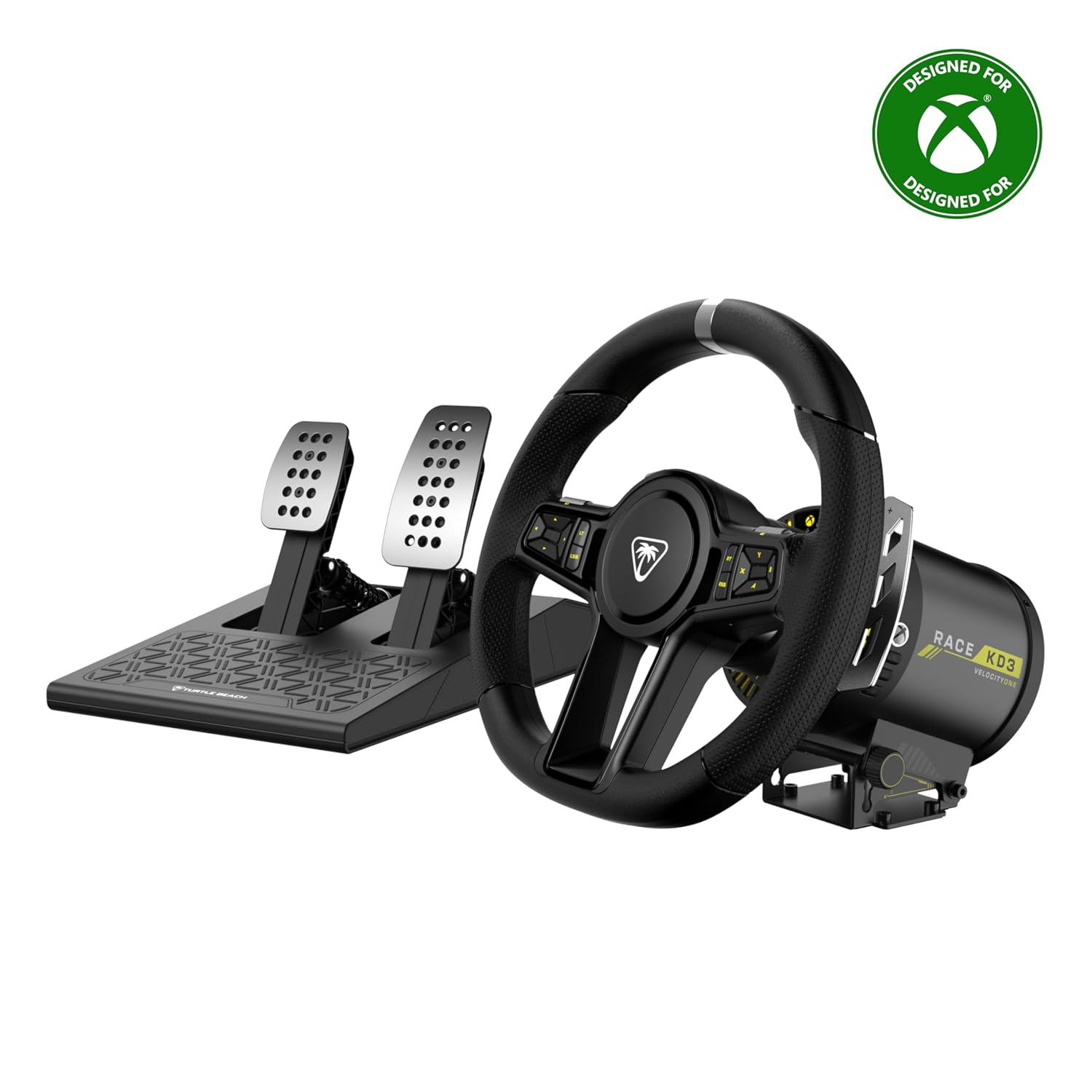
Spec sheet
Turtle Beach VelocityOne Race
- Brand & Model
- Turtle Beach VelocityOne Race KD3 (Model TBS-0003-05)
- Motor Architecture
- Custom K: Drive Direct Drive Force Feedback Motor
- Peak Torque Output
- 3.2Nm
- Pedal Sensor Technology
- Non-contact Hall-Effect Throttle and Brake Sensors
- Gear Shifter Mechanism
- Dual Magnetic Paddle Shifters
- Integrated Telemetry
- Race Management Display (RMD)
- Platform Compatibility
- Xbox Series X|S, Xbox One, Windows 10/11 PC
- Connectivity & Power
- USB C Interface, Corded Electric Power Source
- Mounting Hardware
- Included Table Clamp or Integrated Threaded Inserts
- System Weight & Footprint
- 14.4 pounds; 4.61 x 11.77 x 11.54 inches
Figures as published by the manufacturer on the Amazon listing.
K: Drive Direct Drive Motor Performance and Force Feedback
At the mechanical center of the system is the custom K: Drive force feedback motor, which establishes the core performance profile of the unit. Unlike legacy gear-driven or dual-belt wheelbase designs that suffer from mechanical backlash, internal gear lash, and rubber belt friction, a direct-drive powertrain mounts the steering wheel rim directly to the electric motor shaft. In the case of the turtle beach velocityone race direct drive configuration, the custom motor produces 3.2Nm of direct torque. This mechanical directness ensures that rotational resistance, tire scrub, road surface texture, and curbside vibrations transfer immediately to the driver without compliance or dampening delays.
While an output of 3.2Nm positions the wheelbase on the lighter end of the direct-drive spectrum, the technical benefit of direct coupling remains clearly evident in transient response and detail fidelity. Gear systems often exhibit a noticeable center deadzone and notchiness caused by gear teeth meshing, whereas belt systems can introduce high-frequency friction that absorbs subtle vehicle weight transfers. The turtle beach velocityone race k drive motor eliminates these intervening mechanical stages, delivering zero-latency force resolution. Racers navigating technical circuits can identify understeer threshold slips and rear-axle yaw rotations with immediate tactile clarity.
Operating a 3.2Nm direct-drive motor requires conscious configuration within supported simulation titles to optimize dynamic headroom. In high-downforce open-wheel racing scenarios where sustained cornering forces challenge the physical motor limits, proper telemetry tuning prevents signal clipping. By utilizing the onboard calibration settings, drivers can adjust rotational gain, dampening coefficients, and force linearity to maintain micro-detail sensations over curbing even when loaded up in high-G sweepers. For console and desktop sim racers transitioning from entry-level gear-driven wheels, the jump to linear direct-drive output represents a substantial leap in mechanical fidelity.
Race Management Display and Telemetry Capabilities
One of the most defining architectural innovations of the package is the integrated Race Management Display positioned directly behind the wheel rim on the base housing. Sim racers frequently rely on secondary external phone mounts or third-party digital dashboard software to monitor vital telemetry data during competitive sessions. The turtle beach velocityone race telemetry display streamlines this instrumentation by housing a full-color digital screen natively within the hardware casing. This eliminates the clutter of secondary device mounts and extra communication cables, presenting telemetry figures directly in the driver’s forward line of sight.
The functionality of the Race Management Display extends beyond passive real-time telemetry into active hardware control. Racers can cycle through performance statistics including vehicle speed, gear positioning, engine RPM levels, lap times, and sector deltas across supported simulation titles. Furthermore, the display functions as an integrated onboard tuning computer. Instead of suspending or alt-tabbing out of a race to adjust force feedback curves, steering lock angles, or pedal sensitivity maps, drivers can execute adjustments in real time via the base controls, verifying settings directly on the digital panel.
Complementing the onboard screen is the dedicated Tuner Companion App, available across Xbox consoles, Windows PC platforms, and mobile devices. This multi-platform software ecosystem allows drivers to construct, save, and export customized performance profiles tailored to distinct motorsport disciplines. A rally stage configuration requiring fast steering wheel rotation and aggressive force response can be toggled instantly to an endurance sports car profile favoring smooth, dampening-heavy stability. The synergy between the mobile app, console interface, and the physical Race Management Display elevates setup personalization beyond traditional hardware presets.
Pedal Assembly and Hall-Effect Sensor Precision
The included pedal unit provides a critical foundation for car control, pairing a rugged two-pedal architecture with non-contact sensing technology. The turtle beach velocityone race pedals feature customizable throttle and brake pedal surfaces designed to accommodate different foot sizes, spacing requirements, and driving techniques. Built from durable, racing-grade materials, the pedal base is engineered to withstand forceful braking events without flexing or shifting during hard deceleration zones.
From an engineering standpoint, the standout attribute of the pedal set is the implementation of turtle beach velocityone race hall effect sensors across both the accelerator and the brake. Traditional entry-level sim pedals rely heavily on potentiometers, which operate via physical mechanical wipers moving over conductive tracks. Over time, friction, environmental dust, and contact wear degrade potentiometer accuracy, leading to erratic signal spikes, deadzones, or incomplete input registration. Hall-effect sensors eliminate mechanical contact entirely, detecting pedal displacement via magnetic field variations to guarantee drift-free precision and consistent input linearity over thousands of race hours.
The customizable nature of the pedal assembly allows sim racers to modify the physical travel and resistance profile to match personal driving styles. Drivers who favor progressive threshold braking can tune the resistance feel to simulate hydraulic resistance curves, improving muscle memory repeatability when trail-braking into tight apexes. Combined with magnetic paddle shifters that provide crisp, tactile mechanical actuation without flimsy switch play, the pedal and shifter package delivers reliable mechanical response that complements the precision of the direct-drive steering motor.
System Compatibility, Mounting Options, and Setup
Cross-platform versatility is a primary design pillar of the system, offering certified velocityone race xbox compatibility alongside comprehensive Windows support. The hardware interfaces smoothly with Xbox Series X, Xbox Series S, and Xbox One consoles, as well as Windows 10 and Windows 11 operating systems. For console drivers who regularly move between living room entertainment centers and dedicated computer desks, the universal plug-and-play USB C connectivity and corded electric power architecture streamline initial cable routing and signal distribution.
Executing a stable turtle beach velocityone race pc setup or console workstation requires proper physical anchoring, and the unit provides multiple mounting avenues to suit different cockpit arrangements. Weighing in at 14.4 pounds across its primary assemblies, the wheelbase possesses enough physical mass that unanchored desktop operation is impossible. To address diverse desk environments, the system includes turtle beach velocityone race mounting options comprising an included table clamp for quick-release desk attachment and integrated threaded inserts for rigid cockpit hard-mounting. The included table clamp fastens firmly to desktop surfaces, while the threaded mounting holes allow direct bolting to standard sim racing wheel stands and extruded aluminum chassis rigs.
The physical packaging measures 4.61 inches deep, 11.77 inches wide, and 11.54 inches high, maintaining a relatively compact footprint despite incorporating an onboard telemetry screen. On PC, initial calibration is handled through the Tuner companion software, ensuring firm firmware synchronization and direct USB C communication. The physical wheelbase features two primary physical control buttons directly on the base unit, while secondary driving inputs, profile toggles, and navigation commands are managed through the steering wheel rim controls and the companion application interface.
Build Engineering and VelocityOne Modular Architecture
Turtle Beach built the VelocityOne Race with durable, racing-grade materials designed to bridge the gap between consumer gaming peripherals and structural sim racing cockpits. The combination of rigid plastics, metallic internal bracing, and hard-wearing touchpoints ensures minimal chassis squeak or structural deflection under heavy counter-steering forces. This focus on structural integrity is consistent with the broader engineering standards seen across the brand’s gaming hardware lineup, such as the turtle beach stealth product family, where tactile feedback and operational durability remain primary design priorities.
A crucial technical element highlighted in the turtle beach velocityone race specs is its modular design, engineered specifically for future interoperability with other compatible VelocityOne accessories. Rather than trapping users in an entirely static, closed system, the modular interface allows the core wheelbase and pedal set to accommodate expanded peripherals such as modular gear shifters, handbrakes, or specialized rim configurations as Turtle Beach expands its motorsport catalog. This structural foresight ensures that sim racers can grow their physical setup over time as their sim racing ambitions and budget develop.
The tactile realism generated by the direct drive motor, magnetic paddle shifters, and hall-effect pedal assembly delivers a visceral driving dynamic reminiscent of the fierce competition portrayed in historic motorsport sagas like race for glory. Whether fighting for traction on loose gravel stages or managing tire degradation on endurance asphalt tracks, the cohesive mechanical integration of the VelocityOne platform delivers direct sensory immersion without requiring convoluted multi-brand driver installations or third-party adapter hubs.
Turtle Beach VelocityOne Race Pros and Cons
What works
- Custom K: Drive 3.2Nm direct drive motor
- Integrated full-color Race Management Display
- Hall-effect throttle and brake pedal assembly
- Dual magnetic paddle shifters
- Companion Tuner app for Xbox, PC, and mobile
What to weigh up
- Modest 3.2Nm peak torque output
- Corded electric connection required
- Clutch pedal not included in base assembly
Check Turtle Beach VelocityOne Race on Amazon
Who Should Buy the Turtle Beach VelocityOne Race
Buy It If
- You want an all-in-one direct-drive package with native Xbox Series X|S, Xbox One, and Windows PC compatibility.
- You value an integrated full-color telemetry display that provides real-time dashboard data and onboard hardware tuning without extra screens.
- You require non-contact Hall-effect pedal sensors that eliminate potentiometer wear, dirt buildup, and signal drift.
- You need flexible mounting options, switching easily between an included desk table clamp and integrated threaded chassis inserts.
Skip It If
- You demand high-torque industrial force feedback exceeding 5Nm for specialized high-resistance training rigs.
- You exclusively race on PlayStation console platforms, as the hardware platform natively supports Xbox and Windows environments.
- You want a three-pedal setup with a physical clutch pedal included straight out of the box.
Final Verdict
7.6/10Our score
When evaluating whether the turtle beach velocityone race is worth it, the answer depends on your priorities regarding convenience, telemetry integration, and direct-drive tactile precision. By uniting a custom 3.2Nm K: Drive direct-drive motor, non-contact Hall-effect throttle and brake pedals, magnetic paddle shifters, and the innovative Race Management Display into a singular corded electric bundle, Turtle Beach has eliminated the compatibility headaches and mounting clutter typical of piecemeal sim racing setups. It serves as a formidable gateway into direct-drive sim racing that balances mechanical fidelity with sophisticated digital customization.
While extreme simulation purists may eventually demand heavier torque figures beyond the 3.2Nm threshold, the linear force feedback resolution, zero-lash responsiveness, and rich onboard telemetry deliver an authentic motorsport experience for desktop and cockpit drivers alike. Supported by the companion Tuner app across Xbox and PC platforms, the VelocityOne Race proves that an accessible direct-drive setup can provide premium sensor technology, reliable build materials, and advanced telemetry without demanding a labyrinth of third-party hardware modules.
FAQ
What are the primary Turtle Beach VelocityOne Race specs?
The Turtle Beach VelocityOne Race specs include a custom 3.2Nm K: Drive direct-drive force feedback motor, a full-color Race Management Display for telemetry and tuning, dual magnetic paddle shifters, and a Hall-effect throttle and brake pedal assembly. The system weighs 14.4 pounds, measures 4.61 by 11.77 by 11.54 inches, utilizes USB C connectivity, and runs on corded electric power with certified support for Xbox Series X|S, Xbox One, and Windows 10/11 PC.
How does the K: Drive direct drive motor compare to belt-driven wheels?
The K: Drive motor is a direct-drive unit, meaning the steering wheel connects directly to the motor shaft without intermediate belts, pulleys, or gear teeth. This architecture eliminates mechanical friction, belt dampening, and gear lash, delivering immediate force feedback response, superior rotational smoothness, and clearer micro-detail sensations when detecting tire slippage and track curb impacts.
Does the Turtle Beach VelocityOne Race support both Xbox and PC platforms?
Yes, the hardware features full cross-platform compatibility with Xbox Series X, Xbox Series S, Xbox One, and Windows 10/11 PC systems. Drivers can easily switch between console and desktop setups, with both hardware platforms supporting profile calibration via the companion Tuner app and native telemetry output through the Race Management Display.
What mounting options are included with the system?
The system provides versatile mounting options right out of the box, featuring both an included heavy-duty table clamp for desktop attachment and integrated threaded inserts on the underside of the base. This dual-mounting capability allows racers to secure the 14.4-pound unit temporarily to standard office desks or hard-mount it permanently to dedicated sim racing cockpits and wheel stands.
How do Hall-effect sensors enhance the pedal assembly?
Hall-effect sensors utilize magnetic fields rather than physical contact potentiometers to measure pedal displacement. Because there are no mechanical contact points to wear down, gather dust, or oxidize, Hall-effect sensors deliver smooth, drift-free input precision over time, ensuring that your throttle modulation and threshold braking inputs remain perfectly consistent throughout extended endurance racing sessions.
Can you customize settings directly on the wheel without opening software?
Yes, the integrated Race Management Display allows drivers to adjust force feedback parameters, steering rotation angles, and pedal profiles directly on the base unit using the onboard controls. This functionality enables quick, on-the-fly calibration during practice sessions and race events without the need to pause gameplay or navigate external computer menus.
Before finalizing a cockpit layout, drivers weighing shifter tactile response alongside pedal resistance can consult our Paddle Board Verdict to gauge long-term mechanical durability. Ultimately, the VelocityOne Race succeeds as a streamlined, self-contained direct-drive bundle for enthusiasts prioritizing telemetry integration over raw motor torque.
See this listing on Amazon We may earn a commission if you buy through this link.
More in Gaming



The weekly shortlist
Specs worth reading, once a week
New teardowns, spec sheets and buying notes from across the desk.
This demo form is not connected to a mailing service.