Seagate IronWolf 8TB NAS HDD: Technical Specs and RAID Analysis
The Seagate IronWolf 8TB is an enterprise-grade performance hard drive built specifically for network-attached storage enclosures, delivering an optimal balance of sustained throughput and continuous multi-drive reliability. Built around a 7200 RPM rotational spindle…

As Amazon Associates, we earn from qualifying purchases. This means we may receive a small commission at no extra cost to you if you click through and make a purchase.
The Seagate IronWolf 8TB is an enterprise-grade performance hard drive built specifically for network-attached storage enclosures, delivering an optimal balance of sustained throughput and continuous multi-drive reliability. Built around a 7200 RPM rotational spindle and a generous 256MB multi-segmented data cache, this 3.5-inch SATA 6.0 Gb/s unit addresses the throughput bottlenecks commonly encountered in multi-user storage arrays. Our assessment reveals a drive engineered to deliver sustained media transfer rates reaching up to 210 MB/s, offering demanding storage environments the consistency required for continuous backup jobs, multi-stream media indexing, and synchronized file sharing across demanding local networks.
This drive suits network administrators, creative professionals, and prosumers operating multi-drive enclosures who require dependable storage pooling without sacrificing individual disk transfer speeds. System builders managing home media servers or small business environments with concurrent user demands will appreciate its hardware-level vibration mitigations and dedicated firmware tracking. Conversely, individual desktop operators looking for a silent, single-drive office machine backup or enterprise data center engineers deploying high-density rack deployments beyond eight drive bays will find better efficiency in dedicated desktop disks or high-capacity data center hardware.
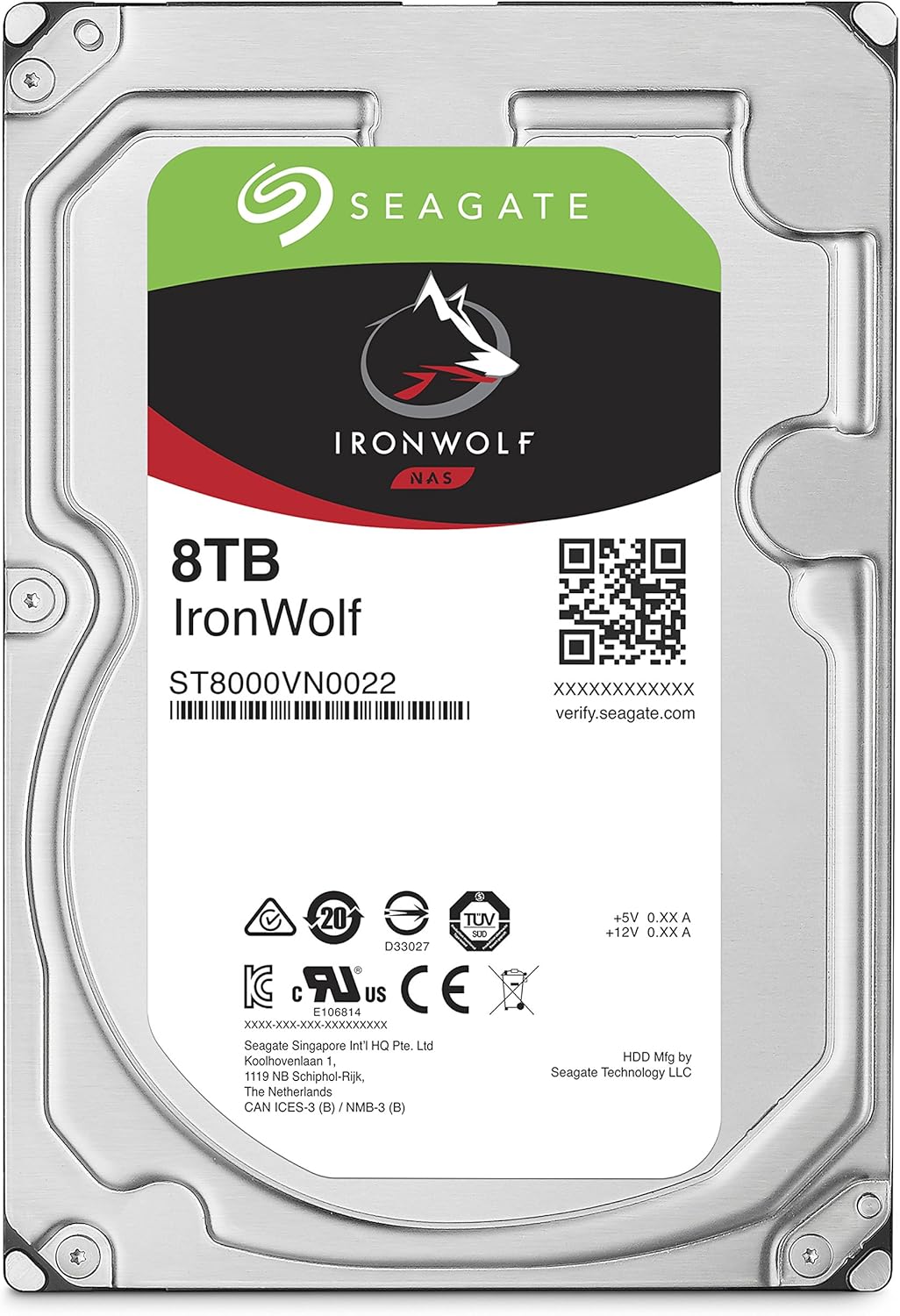
Spec sheet
Seagate IronWolf 8TB
- Model Number
- ST8000VN0022
- Formatted Capacity
- 8 TB
- Physical Form Factor
- 3.5-inch Internal HDD
- Interface Protocol
- SATA 6.0 Gb/s
- Spindle Rotational Speed
- 7200 RPM
- Buffer Memory Cache
- 256 MB
- Rated Media Speed
- Up to 210 MB/s
- Array Scalability
- Up to 8 Drive Bays
- Mean Time Between Failures (MTBF)
- 1,000,000 Hours
- Unit Weight
- 780 g
- Manufacturer Warranty
- 3-Year Limited Warranty
Figures as published by the manufacturer on the Amazon listing.
Rotational Spindle Velocity and Real-World Media Throughput
A primary factor defining the ironwolf 8tb 7200 rpm performance profile is its spindle speed. While many entry-level network storage hard disks utilize conservative 5400 RPM or 5900 RPM motors to save modest amounts of energy, this drive operates at a full 7200 RPM rotational velocity. The mechanical advantage of a 7200 RPM spindle directly reduces rotational latency, allowing the internal read and write heads to position over targeted sectors considerably faster during random transactional workloads. When evaluating raw drive mechanics against standard PC storage, such as the wd black 6tb performance desktop hard disk drive, the sustained media speeds of the IronWolf series highlight its dedication to steady multi-gigabyte sequential block delivery.
In practice, the drive is engineered to deliver sustained media transfer speeds reaching up to 210 MB/s over its SATA 6.0 Gb/s connection. For network storage arrays, this 210 MB/s maximum internal media speed ensures that a single drive can easily saturate a standard 1 Gigabit Ethernet (GbE) local link, which traditionally tops out around 112 to 118 MB/s in practical network transfers. When aggregated into multi-disk striping configurations such as RAID 0, RAID 5, or RAID 10, a sequential st8000vn0022 benchmark profile illustrates that array read operations can readily scale past 2.5 GbE and 5 GbE networking interfaces, preventing network storage hardware from acting as an unexpected bandwidth choke point.
Sequential speeds only illustrate one facet of storage performance. During sustained parity-check operations or background deduplication passes, the 7200 RPM platters maintain dependable input/output operations per second (IOPS). The listing specifies an interface data transfer ceiling of 750 gigabits per second alongside the standard SATA protocol rates, reflecting robust internal bus communication that efficiently routes disk data pipelines directly into host storage controllers without throttling mechanical throughput.
Multi-Bay Architecture and RAID Array Scalability
Storage drives designed for network arrays must endure operational demands that standard desktop hard drives never encounter. The Seagate IronWolf 8TB specs demonstrate that the drive is optimized specifically for enclosures spanning up to 8 drive bays. Inside multi-bay enclosures, closely stacked spinning platters generate constructive mechanical vibrations that can cause head skew, increased tracking errors, and catastrophic performance drops on non-NAS hardware. Seagate tackles this using specialized balancing mechanics that ensure little to no noise and vibration within populated multi-bay chassis, protecting adjacent disks from rotational turbulence.
Network storage arrays rely on swift, deterministic error handling to maintain system responsiveness. In standard desktop drives, an unreadable sector can cause the internal controller to spend upwards of 30 to 60 seconds attempting recovery, often causing RAID controllers to drop the unresponsive disk from the array entirely. This model implements specialized firmware routines engineered for multi-user NAS environments, ensuring no lags or downtime occur when coordinating block reads across large storage pools. Users configuring a multi-disk pool with the larger seagate ironwolf 10tb or smaller capacities will find uniform behavioral standards across the broader IronWolf ecosystem.
When deploying the seagate ironwolf 8tb for synology nas setups, QNAP enclosures, or custom TrueNAS storage servers, seagate ironwolf 8tb raid compatibility delivers predictable array rebuilding times. Rebuilding an 8TB drive after an unexpected pool degradation places massive continuous read stress on surviving disks while writing thousands of gigabytes of reconstructed parity data to the replacement drive. The combination of sustained 210 MB/s media rates and robust internal mechanics ensures parity rebuild cycles finish predictably, greatly reducing the time window in which an array remains vulnerable to secondary drive failures.
Cache Optimization and Multi-User Concurrency Handling
Network attached storage is fundamentally a collaborative tool, rarely serving a single stream of data at a time. The seagate ironwolf 8tb 256mb cache functions as a massive temporary staging buffer for high-frequency metadata, directory indexes, and burst write commands. By maintaining 256MB of multi-segmented onboard memory, the drive firmware caches frequent input requests before they touch physical magnetic media, smoothing out the random IOPS spikes caused when multiple workstations access the NAS enclosure simultaneously.
This substantial memory buffer directly boosts multi-user file sharing performance. In an active office environment where one client edits video footage, another triggers an automated workstation backup, and a third browses photo libraries, storage drives must constantly interleave disparate disk tracks. The 256MB cache retains write commands long enough for the actuator arm to map the most mechanically efficient path across the 8TB platters, substantially lowering mechanical wear and tear over years of round-the-clock service.
Beyond traditional desktop OS environments, the listing confirms extended platform and hardware compatibility spanning personal computers as well as select gaming consoles, including the Microsoft Xbox 360, Sony PlayStation 4, and Nintendo Switch through compatible interfaces. This extensive cross-system support verifies the controller firmware’s ability to interpret diverse filesystem structures and partition schemes without interface anomalies or protocol handshake failures.
Reliability Metrics, Acoustic Footprint, and Drive Monitoring
Continuous storage reliability is quantified through mean time between failures (MTBF), where this 8TB unit achieves a rated 1,000,000 hours MTBF. Paired with a three-year limited warranty protection plan, this drive represents a dependable storage investment for mission-critical personal libraries and small-to-medium enterprise data shares. The underlying hardware build is purposefully engineered to operate 24 hours a day, 7 days a week, delivering lower power consumption and diminished wear during non-stop active states compared to repurposed desktop drives.
Maintaining array awareness requires detailed drive telemetry, which is handled directly by the integrated IronWolf Health Management 8TB system (IHM). When installed in compatible network storage enclosures, IHM actively monitors hundreds of drive parameters, assessing operational variables like vibration, operating temperature, and interface integrity. Rather than relying entirely on reactive SMART error notifications after bad sectors have already proliferated, IHM empowers the host operating system to deliver proactive maintenance recommendations, enabling administrators to safely migrate data before a critical mechanical failure unfolds.
Acoustic management is another vital consideration for drives running inside small offices or living areas. Operating at 7200 RPM naturally generates more acoustic presence than lower-spindle alternatives, yet seagate ironwolf 8tb noise levels remain controlled thanks to the physical balancing mechanisms integrated into the 780-gram chassis. By minimizing rotational resonance, the drive dampens acoustic chatter during heavy seek operations, making it acceptable for shelf-mounted enclosures while maintaining the rigorous throughput necessary for continuous workloads. For environments requiring higher workload limits across enterprise racks, checking options like the ironwolf pro 4 tb can provide comparative baseline perspectives on workload ratings.
Seagate IronWolf 8TB Pros and Cons
What works
- Fast 7200 RPM spindle rotational speed
- Generous 256MB cache buffer
- Up to 210 MB/s sustained media rate
- Engineered for 1-to-8 bay RAID enclosures
- Integrated IronWolf Health Management monitoring
- 1,000,000 hours MTBF with 3-year warranty
What to weigh up
- Limited to 8-bay enclosures
- Acoustic seek chatter from 7200 RPM motor
Check Seagate IronWolf 8TB on Amazon
Who Should Buy the Seagate IronWolf 8TB
Buy It If
- You manage a 1-to-8 bay NAS enclosure requiring high-capacity 8TB disks with verified multi-drive rotational vibration mitigation.
- You need the fast access latency and sustained 210 MB/s transfer speeds provided by a 7200 RPM spindle and 256MB buffer cache.
- You operate compatible network storage hardware that benefits from proactive IronWolf Health Management diagnostic integration.
- Your network storage ecosystem routinely handles concurrent read and write requests from multiple clients across a local network.
Skip It If
- Your storage deployment demands an enterprise-scale storage rack exceeding an 8-bay chassis capacity.
- You require totally silent storage operation for an open-room desktop workstation where any mechanical rotational noise is unacceptable.
- You only require a simple, occasional external USB backup disk where specialized NAS firmware and multi-disk vibration controls are unnecessary.
Final Verdict
8.4/10Our score
The Seagate IronWolf 8TB establishes itself as an outstanding storage foundation for small-office and enthusiast multi-bay storage environments. By combining a true 7200 RPM motor with an expansive 256MB cache buffer and sustained data throughput up to 210 MB/s, it eliminates the performance compromises often found in slower rotational NAS drives. Its 1,000,000-hour MTBF rating, three-year limited warranty, and dedicated IronWolf Health Management integration provide the structural and operational assurances that storage administrators require when safeguarding expansive data arrays.
When asking if the Seagate IronWolf 8TB is worth it, the answer depends entirely on your performance expectations within a networked pool. For users seeking dependable RAID compatibility, continuous multi-client accessibility, and the rapid parity recovery times granted by a 7200 RPM spindle, this drive hits the sweet spot of capacity, speed, and endurance. It remains a premier choice for 1-to-8 bay network enclosures that need reliable, high-volume storage without compromising sustained transfer velocity.
FAQ
Is the Seagate IronWolf 8TB compatible with Synology NAS systems?
Yes, the Seagate IronWolf 8TB is purpose-built for multi-bay NAS hardware and features extensive compatibility with Synology enclosures. It supports Synology DiskStation Manager operating systems and directly integrates with IronWolf Health Management on supported models for real-time drive diagnostics and condition monitoring.
Does this drive run at 5400 RPM or 7200 RPM?
The Seagate IronWolf 8TB runs at a rotational speed of 7200 RPM. This higher spindle velocity provides lower rotational latency and faster sustained media transfer speeds up to 210 MB/s compared to lower-speed 5400 RPM drives.
How does the 256MB cache help in a RAID array?
The 256MB cache acts as a temporary memory buffer for incoming write data and frequently referenced system metadata. In a multi-user RAID array, this cache allows the drive to optimize write operations and maintain steady file-sharing performance even when multiple users access the system simultaneously.
What is the MTBF rating and warranty on the Seagate IronWolf 8TB?
The drive features a Mean Time Between Failures rating of 1,000,000 hours, reflecting its design for continuous 24/7 multi-drive operation. Seagate covers the drive with an included three-year limited warranty protection plan.
Can I use this hard drive in an enclosure with more than 8 bays?
The standard Seagate IronWolf series is officially rated and optimized for enclosures containing up to 8 drive bays. Deployments requiring larger high-density enclosures spanning 9 to 24 or more bays should look toward enterprise-grade product lines designed for higher chassis vibration thresholds.
See this listing on Amazon We may earn a commission if you buy through this link.
More in PC Components & Storage


The weekly shortlist
Specs worth reading, once a week
New teardowns, spec sheets and buying notes from across the desk.
This demo form is not connected to a mailing service.