Samsung 870 EVO 1TB Breakdown: Spec Analysis and Interface Limits
The Samsung 870 EVO 1TB stands as a refined 2.5-inch solid-state drive engineered to extract every drop of throughput possible from the aging SATA III interface. Built with Samsung’s proprietary V-NAND architecture and paired…

As Amazon Associates, we earn from qualifying purchases. This means we may receive a small commission at no extra cost to you if you click through and make a purchase.
The Samsung 870 EVO 1TB stands as a refined 2.5-inch solid-state drive engineered to extract every drop of throughput possible from the aging SATA III interface. Built with Samsung’s proprietary V-NAND architecture and paired with a dedicated DRAM buffer, this drive acts as an uncompromising drop-in replacement for mechanical hard drives and early-generation solid-state media. Our technical evaluation confirms that it successfully pushes sequential read and write figures straight to the physical ceiling of the 6 Gbps SATA bus, making it an exceptional legacy component.
This drive directly targets PC builders refreshing older desktop motherboards, users looking to execute a reliable laptop storage swap, and technicians outfitting secondary bays or network-attached storage pools. If your host device features standard 2.5-inch SATA mounting and cabling, the drive delivers predictable stability and high write endurance. However, power users with contemporary motherboards sporting available M.2 slots should direct their attention to high-bandwidth NVMe alternatives like the samsung 980 1tb nvme ssd, as SATA solid-state drives cannot compete with the throughput of modern PCIe lanes.
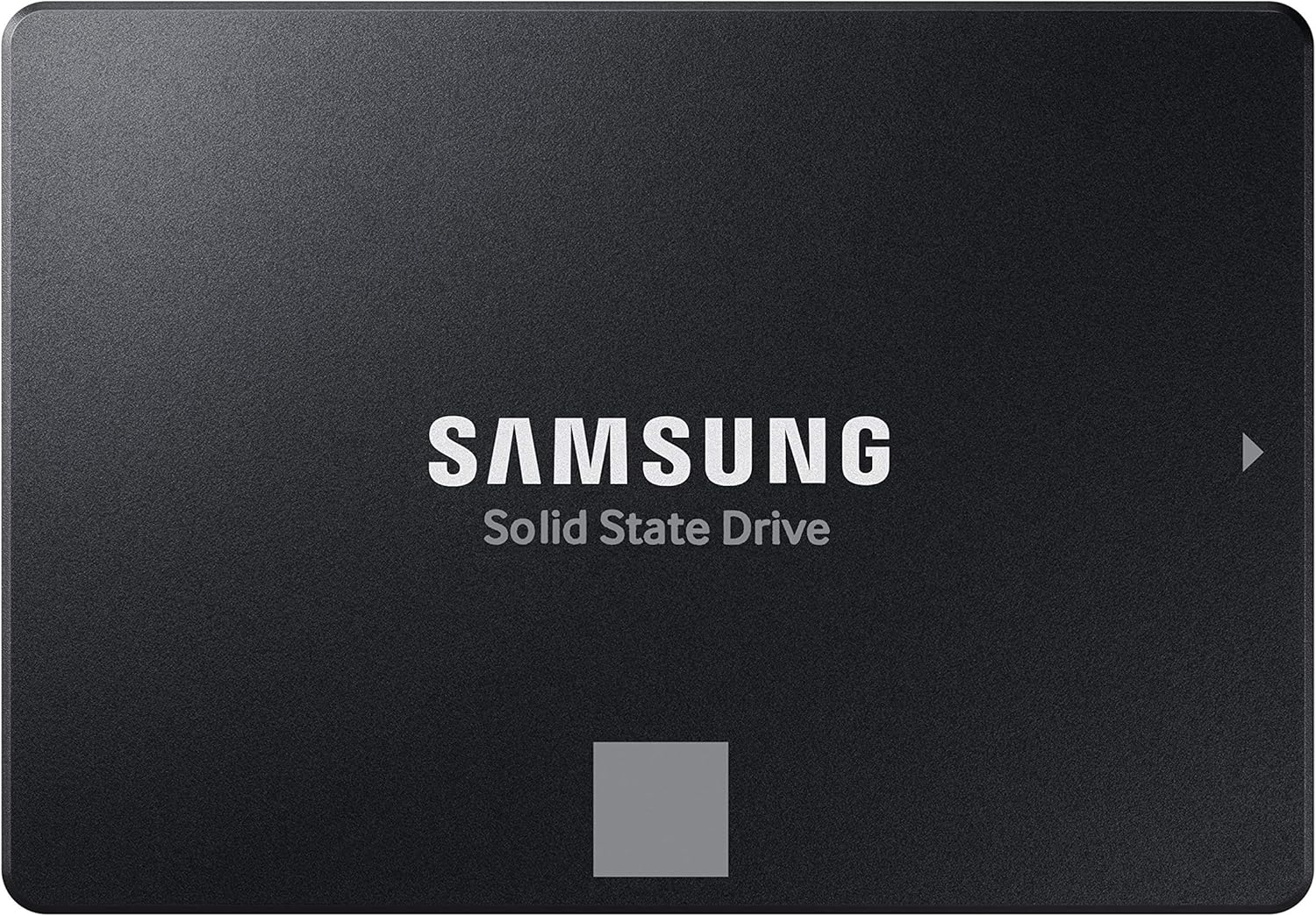
Spec sheet
Samsung 870 EVO 1TB
- Digital Storage Capacity
- 1 TB
- Physical Form Factor
- 2.5-inch (7mm thickness)
- Hardware Interface
- SATA III 6.0 Gb/s
- Sequential Read Speed
- Up to 560 MB/s
- Sequential Write Speed
- Up to 530 MB/s
- Flash Memory Technology
- MLC V-NAND Technology
- Installed Cache Memory
- 1 GB DRAM Cache
- Security and Encryption
- AES 256-bit (Class 0), TCG/Opal, IEEE1667
- Dimensions and Weight
- 3.94 x 2.76 x 0.27 inches; 3.04 ounces
Figures as published by the manufacturer on the Amazon listing.
Sequential Throughput and SATA III Bus Saturation
When evaluating the samsung 870 evo sata iii performance, the immediate engineering hurdle is the physical throughput limit of the SATA revision 3.0 interface itself. Operating with a theoretical raw bandwidth of 6.0 Gbps and utilizing 8b/10b line encoding, the interface incurs roughly twenty percent signaling overhead. This leaves a maximum theoretical data transfer ceiling in the neighborhood of 560 to 570 MB/s under ideal conditions. The Samsung 870 EVO sequential read write ratings of 560 MB/s read and 530 MB/s write demonstrate that the drive operates at the absolute outer edge of what this interface can mathematically transport.
To sustain these figures during sustained file transfers, the listing specifies that the drive accelerates write operations using a larger variable buffer. Solid-state drives often suffer from steep throughput penalties when their internal single-level cell write buffers saturate during large continuous file operations. By engineering a variable buffer mechanism, the 870 EVO maintains high-speed transfers far longer than budget drives lacking dynamic buffer scaling. For workloads such as ingesting uncompressed video or moving large application directories, this buffering approach minimizes sudden write speed collapse.
While these sequential figures represent peak achievements for the legacy form factor, they also demonstrate why protocol limits matter. Users transitioning from spinning disks will experience immediate reductions in boot times and application loading sequences. However, if your hardware accepts PCIe storage, a drive such as the samsung 970 evo plus 500gb will dramatically outstrip these 560 MB/s numbers by bypassing the SATA controller entirely. Within the context of the SATA standard, though, the 870 EVO leaves no accessible performance unused on the bus.
Hardware Architecture, V-NAND, and DRAM Caching
A granular look at the samsung evo 1tb specs reveals why this model maintains consistency under heavier workloads where cheaper solid-state drives falter. Samsung designs all internal hardware in-house, manufacturing the controller, flash memory, and volatile cache memory within its own production pipeline. The listing highlights the use of Samsung MLC V-NAND technology, which stacks memory cells vertically to improve density and reduce cell-to-cell interference. This architecture underpins both the drive’s thermal control and its continuous transfer reliability during extended write operations.
A crucial technical element outlined in the specification sheet is the presence of an installed 1 GB cache memory size. The presence of this dedicated samsung evo 1tb dram cache sets the drive apart from DRAM-less budget solid-state options. A dedicated DRAM module allows the internal controller to keep the Flash Translation Layer (FTL) mapping table stored in ultra-fast volatile memory rather than constantly accessing NAND cells. This architecture yields consistent access latencies, prevents command stuttering when managing millions of small files, and drastically reduces physical wear on the flash cells.
When examining the progression of the samsung 870 evo vs 860 evo, this refined internal hardware package delivers stabilized low-queue-depth responsiveness and enhanced write buffering. While the predecessor 860 EVO had already pushed close to the SATA interface ceiling, the 870 EVO standardizes improved component integration. Samsung’s unified in-house engineering ensures that the controller communicates natively with the V-NAND flash, avoiding the timing anomalies and thermal throttling inconsistencies that can arise when third-party controllers are paired with disparate memory dies.
Endurance Ratings, TBW Limits, and Long-Term Reliability
For storage engineers and homelab builders, physical drive endurance often carries greater operational weight than peak burst speeds. The samsung 870 evo 1tb tbw endurance is rated at 600 TBW (Terabytes Written), backed by a 5-year limited warranty framework. In practical engineering terms, a 600 TBW threshold on a 1TB drive equates to overwriting the entire drive’s usable capacity 600 full times before expecting flash wear depletion. That permits roughly 328 gigabytes of continuous host writes per day, every day, across the full span of the five-year warranty period.
This high endurance threshold makes the drive suitable not merely for office desktop computing, but also for demanding write cycles such as multi-stream video recording, secondary scratch disk duties, and continuous local backup indexing. The listing specifically notes that the drive handles tasks extending up to 8K video processing workflows. Furthermore, integrated S.M.A.R.T. (Self-Monitoring, Analysis, and Reporting Technology) support allows storage administrators to query internal wear attributes, block reallocations, and temperature logs in real time, catching component degradation before uncorrectable data loss occurs.
Hardware-level data security is another defining pillar of this unit’s controller design. The 870 EVO integrates full AES 256-bit hardware-based encryption compliant with TCG/Opal and IEEE1667 standards. Unlike software encryption utilities that burden the host CPU with cryptographic calculations and degrade read-write operations, the 870 EVO’s internal controller encrypts and decrypts blocks on the fly without throughput penalties. This makes it an exceptionally safe option for enterprise systems, mobile laptop field deployment, and business storage applications handling regulated data.
Form Factor, Installation, and Legacy Compatibility
The drive’s physical architecture adheres to the standardized 2.5-inch form factor, measuring 3.94 inches in length, 2.76 inches in width, and a slim 0.27 inches (7mm) in thickness, with a total weight of 3.04 ounces. This thin 7mm profile makes the drive universally suited for a samsung evo 1tb for laptop upgrade, easily sliding into tight drive bays designed for modern low-profile mechanical storage. For older desktop chassis lacking dedicated 2.5-inch trays, standard 3.5-inch adapter brackets easily bridge the gap, while the physical SATA data and SATA power connectors ensure universal backplane alignment.
Broad samsung 870 evo compatibility is reinforced by manufacturer testing across a wide range of platforms. The listing notes validation for major host systems and applications, encompassing chipsets, motherboards, network-attached storage (NAS) units, and dedicated video recording devices. Whether installed in an aging Mac workstation, a consumer Windows desktop, or a multi-bay Linux file server, the drive communicates across standard AHCI protocols without requiring proprietary controller drivers. The listing also highlights renewed migration software, which streamlines the cloning process when transferring boot volumes from mechanical drives to the solid-state partition.
It is important to remember that modern storage density has evolved toward high-capacity M.2 form factors. For instance, builders modernizing desktop systems equipped with PCIe 4.0 or 5.0 capabilities might evaluate multi-terabyte drives like the 990 evo plus 2tb to minimize case wiring and maximize raw throughput. Nevertheless, for hardware configurations where M.2 connectivity does not exist or where all motherboard M.2 slots are populated, the standard 2.5-inch SATA form factor remains an essential, highly functional physical standard.
Drive Management with Samsung Magician Software
Maintaining solid-state drive health requires visibility into firmware behavior, cell wear, and operational temperature. The samsung magician software 870 evo ecosystem (specifically version 6 and newer, as cited in the listing) provides a centralized utility suite to interface directly with the drive controller. Through this software, users can inspect the overall drive health status, assess operating temperatures, verify current connection interface link speeds, and review total bytes written across the unit’s lifespan.
Firmware maintenance represents one of the most critical functions managed by the Samsung Magician suite. While flash memory cells physically hold stored charge states, the controller’s low-level firmware governs wear leveling algorithms, garbage collection routines, bad block retirements, and read disturb mitigation. The software notifies users of available firmware deployments, allowing non-destructive updates that optimize controller stability over the long term. This centralized toolset removes the guesswork from monitoring storage reliability, ensuring that the drive continues to operate within its defined performance tolerances.
Samsung 870 EVO 1TB Pros and Cons
What works
- Saturates SATA III bus with 560 MB/s reads
- Generous 600 TBW endurance rating
- Onboard 1 GB DRAM cache buffer
- Hardware AES 256-bit encryption support
- Universal 2.5-inch 7mm drive compatibility
What to weigh up
- Constrained by legacy 6 Gbps interface speeds
- Bulkier 3.04-ounce footprint compared to M.2
- Requires SATA data and power cabling
Check Samsung 870 EVO 1TB on Amazon
Who Should Buy the Samsung 870 EVO 1TB
Determining whether the samsung evo 1tb is worth it hinges entirely on the hardware environment and expansion slots available in your host machine. If you are servicing an existing system bound to SATA interfaces, this drive offers the pinnacle of stability and throughput without requiring motherboard upgrades.
Buy It If
- You are upgrading an older laptop or desktop that exclusively accepts standard 2.5-inch SATA hard drives.
- You need a dependable 1TB drive with an onboard 1 GB DRAM cache for steady write speeds during continuous file workloads.
- You require robust write endurance, demanding up to 600 TBW for NAS appliances or continuous video recording arrays.
- You want native AES 256-bit hardware encryption without consuming host processor cycles.
Skip It If
- Your computer motherboard features open M.2 NVMe slots capable of supporting multi-gigabyte PCIe bandwidth.
- You are expanding the internal storage of portable handheld devices that mandate flash memory cards like the samsung evo select line.
- You are seeking an external, plug-and-play USB backup unit and do not intend to install a drive internally or supply your own SATA enclosure.
Final Verdict
9.6/10Our score
The Samsung 870 EVO 1TB stands as the definitive culmination of 2.5-inch SATA storage technology. By reaching 560 MB/s sequential read and 530 MB/s sequential write speeds, the drive pushes the physical SATA III 6 Gbps bus to its absolute operational ceiling. The integration of in-house MLC V-NAND, an onboard 1 GB DRAM cache, and a specialized write buffer ensures that performance remains rock-solid even when managing extensive, sustained data pipelines.
While the broader computing industry has shifted its primary performance tier to the PCIe NVMe protocol, millions of operational laptops, workstations, and NAS appliances rely strictly on SATA connectivity. For these environments, settling for DRAM-less budget media frequently introduces latency bottlenecks and shortened lifespans. With its 600 TBW endurance rating, robust hardware encryption, and Samsung Magician software monitoring, the 870 EVO 1TB provides unmatched reliability for legacy preservation and dependable secondary storage.
FAQ
What sequential read and write speeds does the Samsung 870 EVO 1TB achieve?
The Samsung 870 EVO 1TB delivers sequential read speeds of up to 560 MB/s and sequential write speeds of up to 530 MB/s. These figures represent the maximum functional throughput achievable across a 6.0 Gbps SATA III connection after accounting for standard bus protocol overhead.
Does the Samsung 870 EVO 1TB contain a dedicated DRAM cache?
Yes, the specifications confirm that the Samsung 870 EVO 1TB includes 1 GB of installed cache memory. This onboard DRAM buffer allows the controller to maintain instant access to flash translation mapping tables, preventing performance drops and latency spikes during random read and write tasks.
What is the total endurance rating of the 1TB model?
The Samsung 870 EVO 1TB features an endurance rating of up to 600 TBW (Terabytes Written) supported under a 5-year limited warranty framework. This allows users to write substantial amounts of data daily throughout the entire warranty cycle before exhausting the flash memory endurance.
Can I install the Samsung 870 EVO 1TB into a laptop?
The drive utilizes a standard 2.5-inch form factor with a 7mm thickness (0.27 inches), making it physically compatible with laptop drive bays designed for 2.5-inch SATA storage. Users should ensure their specific laptop model utilizes internal SATA connections rather than soldered flash or M.2-exclusive interfaces.
What security and management software is supported by the drive?
The 870 EVO supports hardware-based AES 256-bit encryption compliant with TCG/Opal and IEEE1667 standards. For drive maintenance, health diagnostics, S.M.A.R.T. tracking, and firmware updates, the drive is fully compatible with Samsung Magician software.
See this listing on Amazon We may earn a commission if you buy through this link.
More in PC Components & Storage


The weekly shortlist
Specs worth reading, once a week
New teardowns, spec sheets and buying notes from across the desk.
This demo form is not connected to a mailing service.