Raspberry Pi 4 Model B 1GB Review: Technical Breakdown and RAM Benchmarks
The Raspberry Pi 4 1GB serves as an entry-level single-board computer powered by the Broadcom BCM2711 quad-core processor, establishing a functional hardware foundation for dedicated, single-purpose embedded applications. Shoppers researching a raspberry pi 5…

As Amazon Associates, we earn from qualifying purchases. This means we may receive a small commission at no extra cost to you if you click through and make a purchase.
The Raspberry Pi 4 1GB serves as an entry-level single-board computer powered by the Broadcom BCM2711 quad-core processor, establishing a functional hardware foundation for dedicated, single-purpose embedded applications. Shoppers researching a raspberry pi 5 1gb configuration quickly learn that the fifth-generation single-board computer does not offer a 1GB memory tier, leaving the fourth-generation 1GB model as the primary point of reference for developers evaluating entry-tier 64-bit ARM computing. From our analysis of its official specifications and hardware capabilities, this board delivers robust input and output throughput for lightweight server tasks, though its strict memory capacity requires precise workload management.
This compact computing platform suits system administrators, automation engineers, and embedded hobbyists building dedicated network appliances or lightweight terminal utilities that operate without a graphical interface. Conversely, users planning to host multi-container orchestration platforms, local machine learning models, or interactive desktop environments should bypass this 1GB hardware tier and evaluate higher-capacity alternatives like the raspberry pi 5 8gb.
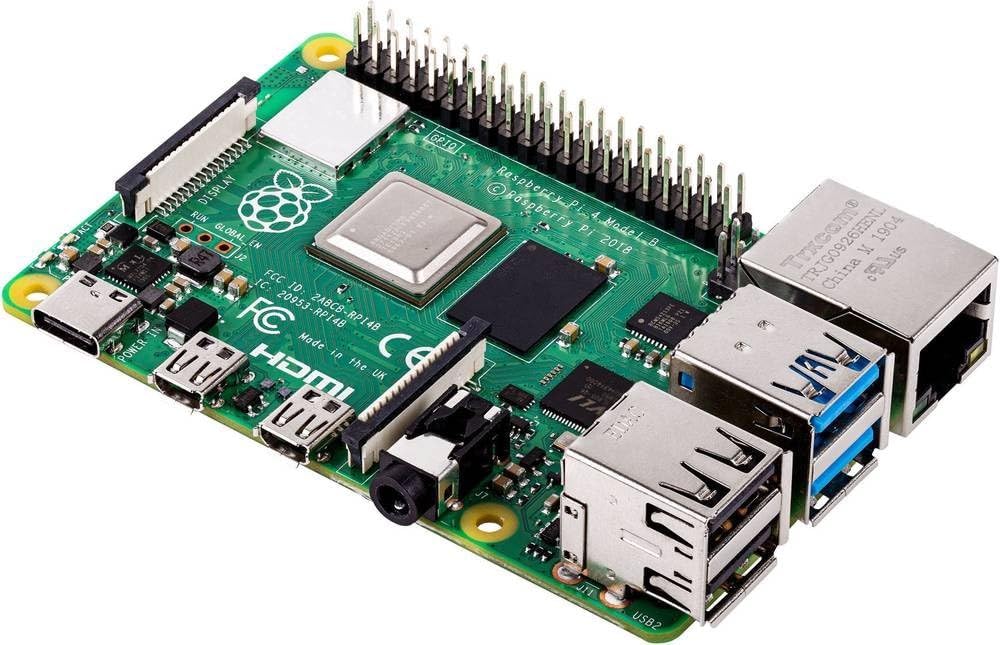
Spec sheet
Raspberry Pi 4 1GB
- System on Chip
- Broadcom BCM2711
- CPU Architecture
- Quad-core Cortex-A72 (ARM v8) 64-bit SoC @ 1.5GHz
- Installed Memory
- 1GB LPDDR4-3200 SDRAM
- Wireless Connectivity
- 2.4GHz and 5.0GHz IEEE 802.11ac wireless, Bluetooth 5.0, BLE
- Wired Networking
- Gigabit Ethernet
- USB Ports
- 2 USB 3.0 ports, 2 USB 2.0 ports (4 total)
- Expansion Header
- Standard 40-pin GPIO header
- Supported Operating System
- Raspbian
Figures as published by the manufacturer on the Amazon listing.
Memory Architecture and BCM2711 1GB Performance
At the center of the platform sits the Broadcom BCM2711 system on chip, housing four ARM Cortex-A72 cores operating at a rated clock speed of 1.5GHz. Evaluating bcm2711 1gb performance requires understanding the balance between raw CPU compute and memory allocation. The quad-core 64-bit processor provides modern out-of-order execution pipelines and capable arithmetic processing, but its 1GB LPDDR4-3200 SDRAM pool acts as a tight physical boundary for operating system resources and concurrent application tasks.
When assessing a practical raspberry pi 4 1gb ram benchmark context, the operational friction rarely comes from the processor itself. The Cortex-A72 cores handle computational math, lightweight scripting, and network packet sorting with high efficiency. However, because memory is physically capped at 1GB, high-concurrency tasks quickly exhaust available RAM. When the Raspbian operating system exhausts volatile memory, it begins swapping pages to the storage medium, resulting in elevated I/O wait states that can temporarily degrade CPU responsiveness.
The high-speed LPDDR4 memory bus delivers significant memory bandwidth improvements over earlier single-board iterations utilizing older SDRAM generations. Even with this faster memory bus, the sheer capacity limitation dictates that software running on this board must be carefully optimized. The listing notes that memory capacity varies across the product family, and choosing this 1GB configuration means prioritizing execution efficiency over large data buffer caching.
Headless Deployment and Server Workloads
Operating a raspberry pi 4 1gb headless server represents the most technically appropriate implementation for this hardware configuration. In a headless environment, the system boots into a clean Linux shell without running an X11 display server, Wayland compositor, or desktop rendering pipeline. This minimal software footprint leaves hundreds of megabytes of LPDDR4 RAM completely free for dedicated system services, background daemons, and network processing utilities.
Developers weighing compact computing nodes against alternatives such as the raspberry pi zero 2 w will find that the Model B form factor provides vastly superior expansion, dedicated power delivery, and full-speed Gigabit Ethernet. Where ultra-compact micro-boards struggle with shared USB buses and constrained thermal dissipation, this board provides independent peripheral routing that maintains reliable uptime during continuous network operations.
Practical server deployments that fit comfortably within the 1GB RAM budget include local DNS sinkholes, lightweight MQTT message brokers, secure shell jump hosts, and network monitoring endpoints. Because the underlying BCM2711 processor features hardware-accelerated encryption instructions and robust multi-core thread scheduling, background daemons execute smoothly without creating computational bottlenecks, provided the host services avoid expansive runtime environments.
IO Throughput and Hardware Connectivity
A major architectural advancement detailed in the raspberry pi 4 model b specs is the physical separation of the networking controller and USB infrastructure. The integrated Gigabit Ethernet interface connects directly to the system bus rather than bridging across a shared USB pipeline. This design permits line-rate network throughput, allowing the board to process inbound and outbound data streams simultaneously without bus contention.
External hardware expansion is facilitated by four onboard USB ports, configured as two high-speed USB 3.0 ports and two USB 2.0 ports. For storage arrays and external communication bridges, the USB 3.0 ports provide high bandwidth for solid-state storage or sensor arrays. Hardware developers can also pair external peripherals like the raspberry pi camera module 3 through dedicated interface options to construct computer vision nodes that process individual frame triggers without maintaining heavy continuous frame buffers.
The wireless subsystem integrates dual-band 2.4GHz and 5.0GHz IEEE 802.11ac wireless networking alongside Bluetooth 5.0 and Bluetooth Low Energy. Combined with the backward-compatible 40-pin GPIO header, this connectivity suite provides flexible embedded interfacing. Developers can manage peripheral sensors, direct motor drivers, and industrial communication buses while transmitting collected telemetry over high-speed local wireless networks without secondary adapter cards.
Practical Memory Bottlenecks and Raspberry Pi 1GB vs 2GB
Despite the manufacturer listing noting that the platform can provide a complete desktop experience with multiple open browser tabs and office presentation software, the real-world raspberry pi 4 1gb limitations become glaringly obvious when running a full graphical user interface. A modern desktop browser rendering complex client-side scripts can easily consume hundreds of megabytes within a few tabs, leaving minimal headroom for the base operating system and triggering immediate memory starvation.
When analyzing raspberry pi 1gb vs 2gb options, the 2GB tier offers double the volatile memory space, which completely transforms desktop responsiveness and general-purpose multitasking. With 1GB of RAM, software stacks that rely on large runtime dependencies, such as complex Python graphical libraries, Node.js applications, or local database engines, encounter frequent out-of-memory kernel termination events. Readers evaluating ultra-lean embedded hardware like an orange pi zero must weigh software ecosystem support against memory capacity when planning long-term projects.
Deciding whether is raspberry pi 4 1gb worth it comes down to project scope and software architecture. If your application relies on compiling large codebases natively on the device or running containerized microservice stacks, the 1GB memory ceiling will prove restrictive. Conversely, for projects designed around tight, memory-conscious C, Go, or shell scripts running in command-line environments, this board provides modern processing power and complete hardware compatibility without unnecessary resource overhead.
Raspberry Pi 4 1GB Pros and Cons
What works
- Quad-core Broadcom BCM2711 1.5GHz processor
- True Gigabit Ethernet with dedicated bus routing
- Two high-speed USB 3.0 ports included
- Dual-band 802.11ac wireless and Bluetooth 5.0
- Standard 40-pin backward-compatible GPIO header
What to weigh up
- 1GB LPDDR4 RAM restricts desktop multitasking
- Heavy multi-tab web browsing causes memory swapping
- Insufficient memory capacity for complex container clusters
Check Raspberry Pi 4 1GB on Amazon
Who Should Buy the Raspberry Pi 4 1GB
Buy It If
- You need a dedicated headless Linux server to run lightweight services like DNS sinkholes, VPN endpoints, or network monitors.
- Your project demands true Gigabit Ethernet and USB 3.0 data transfer rates without the overhead of a desktop graphical interface.
- You require a standardized 40-pin GPIO header for embedded robotics, sensor telemetry, and automation scripts.
- You manage optimized software deployments that operate strictly within constrained memory footprints.
Skip It If
- You plan to use the single-board computer as a primary desktop workstation with multiple web browser tabs and document suites.
- Your workloads include container clusters, heavy web application stacks, or local relational database engines.
- You are searching for the newer generation architecture of a raspberry pi 5 1gb, which does not exist in the manufacturer catalog.
Final Verdict
4.5 / 5Amazon buyer rating, 94 ratings
The Raspberry Pi 4 Model B 1GB remains an effective, precision-targeted single-board computer when utilized within its physical hardware limits. Built around the Broadcom BCM2711 quad-core processor, it delivers dependable computational performance, true Gigabit Ethernet networking, and flexible USB 3.0 expandability. For embedded projects and headless Linux deployments, it functions as a stable computing engine backed by extensive Raspbian operating system support.
However, its strict 1GB LPDDR4 memory ceiling prevents it from fulfilling the marketing claim of a complete, uncompromised desktop experience. Potential buyers searching for an entry-level single-board computer must recognize that this model excels at lean, single-purpose services rather than general-purpose multitasking. If your deployment requirements match its memory constraints, the 1GB board offers a reliable, well-engineered foundation for embedded computing.
FAQ
Does an official Raspberry Pi 5 1GB model exist?
No, the manufacturer did not release a 1GB variant of the fifth-generation board. The Raspberry Pi 5 architecture begins at higher memory capacities, making the Raspberry Pi 4 Model B 1GB the primary baseline option for users requiring a minimal-memory 64-bit computing board within the official ecosystem.
What operating system is officially supported on the Raspberry Pi 4 1GB?
The product listing specifies Raspbian as the primary operating system. Modern 32-bit and 64-bit builds of the official operating system function on the hardware, though lightweight headless installations are strongly recommended on this 1GB memory model to preserve volatile RAM.
Can the Raspberry Pi 4 1GB handle desktop web browsing?
While the listing states the hardware supports desktop web surfing and document editing, real-world browsing is severely limited by the 1GB RAM pool. Modern dynamic websites consume significant memory, which can lead to aggressive page swapping and degraded system responsiveness when multiple tabs are open.
What wired networking speed does the board support?
The board features true Gigabit Ethernet routed directly to the system processor. This design allows the board to achieve full Gigabit network transfer speeds without competing with USB peripherals for bandwidth.
How many USB ports are available on the Raspberry Pi 4 Model B 1GB?
The board is equipped with four total USB ports. This layout includes two high-speed USB 3.0 ports for fast external storage transfers and two standard USB 2.0 ports for connecting input peripherals, sensors, and microcontrollers.
See this listing on Amazon We may earn a commission if you buy through this link.
More in Computers & Laptops



The weekly shortlist
Specs worth reading, once a week
New teardowns, spec sheets and buying notes from across the desk.
This demo form is not connected to a mailing service.