Olympus Stylus 150 Technical Breakdown & Optics Analysis
The Olympus Stylus 150 stands out in the compact imaging realm by packing an expansive 37.5-150mm optical magnification system into a pocket-sized, weather-resistant silver chassis. Documented in catalog listings as the Olympus Stylus 150…

As Amazon Associates, we earn from qualifying purchases. This means we may receive a small commission at no extra cost to you if you click through and make a purchase.
The Olympus Stylus 150 stands out in the compact imaging realm by packing an expansive 37.5-150mm optical magnification system into a pocket-sized, weather-resistant silver chassis. Documented in catalog listings as the Olympus Stylus 150 35mm camera kit, this device pairs a versatile 4x zoom capability with high-grade optical glass and an intelligent multi-point targeting matrix. For photographers evaluating hardware purely on field readiness and focal versatility, the verdict is definitive: it delivers an exceptional focal reach and advanced framing tools in an extraordinarily portable package, provided you understand the automated nature of its exposure system.
This compact tool suits travel documentarians, amateur snapshot enthusiasts, and casual street shooters who need immediate transition from moderate wide-angle framing to tight telephoto portraits without swapping lenses. Conversely, those seeking fully mechanical tactile controls, manual exposure wheels, or specialized studio sync hardware will find the automated architecture limiting. When weighing whether the camera justifies a place in your everyday kit, a close inspection of the published Olympus Stylus 150 specs clarifies its distinct hardware balance. Historical collectors familiar with classic SLR lines like the om 3 camera will notice a stark shift here toward modern automation, motorized zoom mechanics, and automated metering.
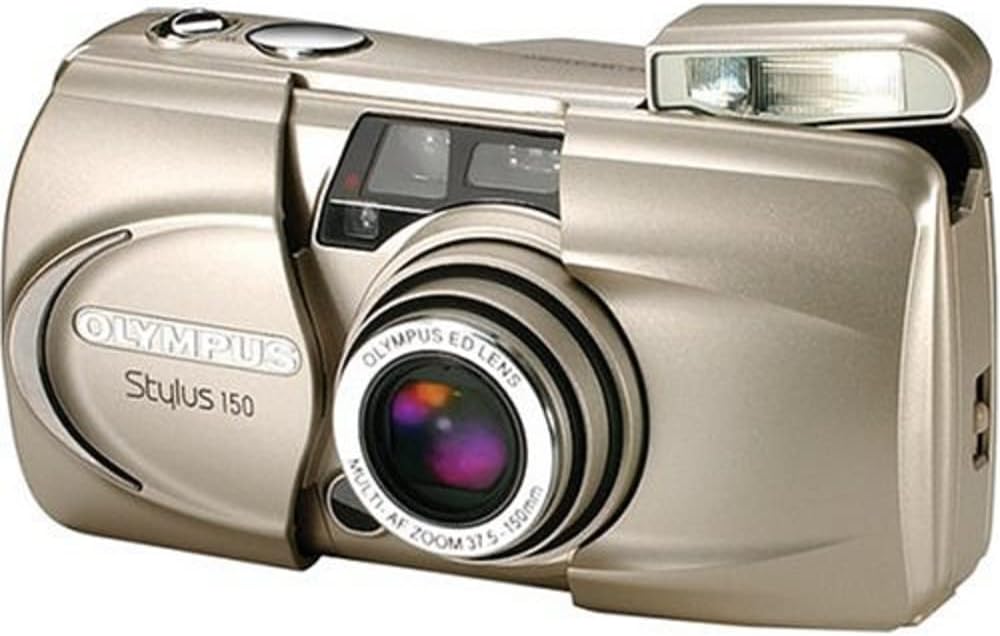
Spec sheet
Olympus Stylus 150
- Optical Zoom Range
- 37.5-150mm (4x optical zoom ratio)
- Lens Glass Construction
- ED (Extra-low Dispersion) glass with 2 double-sided aspherical elements
- Autofocus Matrix
- Multi-wide 11-point active autofocus system
- Maximum Shutter Velocity
- 0.0005 seconds (1/2000s shutter floor)
- Blur Reduction System
- Movement compensating sensors with camera shake indicator
- Built-in Flash Settings
- Variable power flash: Auto, On, Off, Slow Synch, Rear Curtain Synch
- Exposure Management
- Automatic exposure system with multiple scene programs
- Data Recording
- Quartz date and time imprint mechanism
- Chassis Form Factor
- Ultracompact, all-weather construction in silver finish
- Reported Capture Specifications
- 1/2.3-inch CMOS, 4:3 aspect ratio, RAW / JPEG, 1080p video, Electronic Viewfinder
Figures as published by the manufacturer on the Amazon listing.
Lens Optics and Zoom Performance
The primary engineering achievement of this model centers on the Olympus Stylus 150 lens specs. Housing a 37.5-150mm zoom assembly inside a clamshell form factor requires careful optical compromises. Rather than relying solely on standard spherical elements, the optical block incorporates an Extra-low Dispersion (ED) glass element alongside two double-sided aspherical lenses. In optical physics, extended zoom ratios routinely introduce chromatic aberration, manifested as purple or green fringing along high-contrast boundaries. The integration of ED glass actively counteracts secondary spectrum wavelength dispersion, while the aspherical surfaces correct spherical aberrations and edge distortion that typically plague compact zoom barrels.
Evaluating the Olympus Stylus 150 zoom range reveals genuine real-world versatility. At the wide end of 37.5mm, the field of view captures environmental scenes, architectural context, and group portraits with minimal optical barrel distortion. Extending the motorized zoom out to 150mm provides a substantial 4x telephoto multiplication, isolating architectural details, distant wildlife, or candid facial expressions. This extensive focal reach compresses visual planes, generating distinct background separation even with automated aperture settings. Travelers packing lean gear kits often prioritize multi-use items, much like carrying a compact notebook alongside a durable zebra telescopic pen, making an integrated 37.5-150mm lens array exceptionally functional for field mobility.
Because the physical barrel retracts fully behind the protective sliding all-weather cover when switched off, the delicate front and rear elements remain shielded from rain splashes, sand, and pocket debris. The listing highlights an all-weather designation, offering confidence during sudden precipitation or coastal mist. While the listing does not specify the maximum variable aperture values across the zoom stroke, physics dictate that compact zooms lose light transmission as the focal length extends to 150mm. The camera mitigates this reduced light intake by synchronizing its exposure algorithms with motorized shutter responses and integrated illumination systems.
Multi-Wide 11-Point Autofocus System
Focusing precision on compact point-and-shoot hardware often represents the primary bottleneck for sharp imagery. The Olympus Stylus 150 autofocus addresses this technical vulnerability through a multi-wide 11-point AF system. Conventional compact cameras from this developmental era typically utilized single-point central autofocus sensors or primitive three-point arrays. A single central sensor forces the photographer to aim at the subject, lock focus, and recompose the frame, a technique that frequently causes focus displacement when shooting at wide apertures or long telephoto extensions.
With an 11-point multi-wide array spanning a substantial portion of the framing area, the onboard processor evaluates subject distance across multiple overlapping sectors simultaneously. The algorithm intelligently prioritizes the closest foreground subject or identifies primary focal planes within complex scenes. This wider targeting zone is particularly advantageous when tracking unpredictable subjects such as running pets or active children, ensuring edge-to-edge optical clarity across the frame without requiring constant manual pre-focus maneuvers.
Furthermore, the 11-point targeting array operates harmoniously with the automated scene programs. Whether engaged in Sports, Portrait, or Macro modes, the focusing module tailors its response time and drive velocity to match subject movement. For close-up framing, the dedicated Macro mode calibrates the focus mechanism to lock onto fine textures and small objects at minimum operational distances, ensuring the resolving power of the aspherical glass elements translates into crisp detail on the capture medium.
Camera Shake Mitigation and Exposure Control
Operating a telephoto lens extended to 150mm introduces the physical reality of angular camera shake. Because telephoto magnification magnifies even imperceptible hand tremors, shooting hand-held at long focal lengths risks ruining images with motion blur. To counteract this issue, the Olympus Stylus 150 camera shake indicator serves as an active visual warning mechanism. Paired with movement compensating sensors, the camera actively measures physical motion instability and warns the user when the shutter duration exceeds safe hand-held thresholds, preventing the accidental exposure of blurred frames.
The exposure control system functions on fully automatic logic, continuously measuring ambient luminance to assign appropriate capture values. The camera features a shutter speed capable of firing as fast as 0.0005 seconds (equivalent to 1/2000 of a second). This rapid shutter velocity is essential for two distinct shooting conditions:
- Freezing high-speed athletic movements in bright daylight under the dedicated Sports shooting program.
- Preventing overexposure in intense outdoor light, allowing the automated system to maintain balanced exposures across landscapes and reflective environments.
In low-light scenarios where shutter speeds naturally lengthen, the camera’s internal movement compensating sensors collaborate with exposure safety routines. If the shutter drops into a zone vulnerable to hand shake, the camera shake indicator alerts the user to brace the camera against a firm surface or enable flash support, functioning as a real-time fail-safe for sharp imagery.
Shooting Modes, Flash Versatility, and Date Imprinting
Versatility extends into the camera’s comprehensive array of programmatic capture settings. The published technical data specifies an expansive suite of shooting modes: Auto, Flash On, Flash Off, Slow Sync, Rear Sync, Portrait, Landscape, Sports, Macro, Night, Underwater, Easy, Movie, Custom, and Panorama. This diverse collection of operational states adjusts metering sensitivity, focus tracking, and flash firing profiles to simplify capture across drastically differing environments without demanding manual exposure calculation.
The built-in variable power flash plays an essential role in balancing difficult lighting. Rather than discharging a uniform, blinding burst of light, the intelligent flash system calculates subject distance and background ambient illumination to dial in exact output intensity. Advanced flash modes include Slow Synch and Rear Curtain Synch:
- Slow Synch: Keeps the shutter open longer while firing the flash, properly exposing dimly lit background environments while freezing the foreground subject.
- Rear Curtain Synch: Fires the flash burst at the conclusion of the exposure duration rather than the beginning, producing natural-looking light trails trailing behind moving subjects in night scenes.
Another prominent feature is the Olympus Stylus 150 quartz date module. This integrated timekeeping imprint system burns the date or time directly onto the lower corner of the image plane. For documentary work, scientific field notes, travel logs, and family scrapbooks, quartz date stamping provides indelible chronological context. While modern mirrorless imaging powerhouses like the olympus omd em5 mk ii catalog capture metadata digitally within EXIF data headers, the direct visual timestamp of the quartz date module remains a distinctly practical and stylized aesthetic feature.
Olympus Stylus 150 Pros and Cons
What works
- 5-150mm 4x optical zoom range
- ED glass and dual aspherical elements
- Multi-wide 11-point autofocus system
- Integrated camera shake warning indicator
- All-weather durable ultracompact housing
- Built-in quartz date time imprint
What to weigh up
- Fully automatic exposure without manual controls
- Telephoto zoom reduces light transmission
- No external hot shoe flash support
Check Olympus Stylus 150 on Amazon
Who Should Buy the Olympus Stylus 150
Buy It If
- You need a massive 37.5-150mm zoom ratio encased in an ultracompact, pocketable chassis for daily carry.
- You value optical sharpness backed by premium ED glass and dual double-sided aspherical lens elements.
- You want the compositional freedom and accuracy afforded by an advanced 11-point multi-wide autofocus system.
- You frequently shoot telephoto snapshots hand-held and need an active camera shake indicator to prevent motion blur.
- You appreciate chronological visual stamping provided by an integrated quartz date imprint function.
Skip It If
- You require manual exposure wheels to set discrete mechanical apertures and shutter speeds independently.
- You demand an ultra-fast, fixed wide-aperture prime lens for shooting in dark environments without flash illumination.
- You intend to connect external studio strobes or mount professional accessories via a standard hot shoe.
Final Verdict
4.0 / 5Amazon buyer rating, 3 ratings
The Olympus Stylus 150 represents a pinnacle of consumer-oriented optical packaging. By engineering a 4x optical zoom array containing specialized Extra-low Dispersion glass and two dual-surface aspherical elements into a pocketable all-weather body, the manufacturer created a go-anywhere tool that handles everything from broad street scenes to distant telephoto framing. When asking is Olympus Stylus 150 worth it, the answer depends entirely on your operational priorities: if your workflow thrives on pocketable convenience, reliable automated autofocusing, and broad focal flexibility, this model delivers outstanding technical utility.
While the automated exposure logic removes granular manual shutter and aperture selection, the camera compensates with intelligent scene algorithms, advanced flash synch modes, and an innovative camera shake warning system. It stands as an exceptional example of compact imaging design, giving amateur photographers, travelers, and documenting enthusiasts a durable, high-resolving optical package that slips effortlessly into a jacket pocket.
FAQ
What optical focal length does the Olympus Stylus 150 cover?
The Olympus Stylus 150 features an integrated 4x optical zoom lens spanning a focal range of 37.5mm at the wide end to 150mm at maximum telephoto. This range covers standard landscape framing, environmental street photography, medium close-ups, and distant subject isolation.
How does the Olympus Stylus 150 multi-wide autofocus function?
The camera uses an 11-point multi-wide autofocus matrix that monitors multiple sectors across the viewing frame simultaneously. This wide sensor area identifies off-center subjects accurately, eliminating the need to lock focus in the center and recompose the shot.
What does the Olympus Stylus 150 camera shake indicator do?
The camera shake indicator utilizes internal movement compensating sensors to detect physical camera motion. When shooting hand-held at slower shutter speeds or maximum telephoto extension, the indicator warns the photographer of potential blur risk so they can brace the camera or utilize flash.
How does the Olympus Stylus 150 vs Stylus Epic compare conceptually?
When comparing the Olympus Stylus 150 vs Stylus Epic, the defining difference lies in optical configuration. The Stylus Epic is renowned for a fixed wide-angle prime lens with a faster maximum aperture, whereas the Stylus 150 trades prime speed for substantial framing versatility with its motorized 37.5-150mm zoom reach and 11-point AF system.
What information is provided by the Olympus Stylus 150 quartz date feature?
The integrated quartz date and time imprint mechanism records chronological data directly onto the image plane. Users can configure the system to imprint the year, month, day, or capture time onto the frame for organizational and archival record-keeping.
Where can users find instructions in an Olympus Stylus 150 manual?
Operational instructions, battery installation guidelines, and scene mode explanations are documented in the official Olympus Stylus 150 manual, which details procedures for switching between the built-in flash modes, cycling quartz date formats, and engaging the all-weather sliding cover.
See this listing on Amazon We may earn a commission if you buy through this link.
More in Cameras & Drones


The weekly shortlist
Specs worth reading, once a week
New teardowns, spec sheets and buying notes from across the desk.
This demo form is not connected to a mailing service.