Nikon Coolpix P1000 Technical Breakdown: 3000mm Superzoom Analyzed
The Nikon Coolpix P1000 represents an extraordinary technical milestone in consumer superzoom engineering, highlighted by an astonishing 125x optical zoom lens that spans from a wide 24mm equivalent out to an unprecedented 3000mm telephoto…

As Amazon Associates, we earn from qualifying purchases. This means we may receive a small commission at no extra cost to you if you click through and make a purchase.
The Nikon Coolpix P1000 represents an extraordinary technical milestone in consumer superzoom engineering, highlighted by an astonishing 125x optical zoom lens that spans from a wide 24mm equivalent out to an unprecedented 3000mm telephoto focal length. For photographers examining retail options with a Nikon P1000 for sale in mind, the camera provides an unmatched standalone optical reach that bypasses the substantial bulk, weight, and financial investment demanded by massive prime telephoto lenses or specialized digiscoping adapters. Our technical assessment concludes that while the camera’s astronomical reach is genuinely revolutionary for daytime birding, wildlife observation, and lunar tracking, the physical reality of pairing an ultra-long zoom ratio with a 1/2.3-inch sensor demands calculated exposure discipline and realistic expectations regarding dynamic range and low-light noise.
This specialized bridge camera is engineered specifically for birders, wildlife documentation enthusiasts, and lunar astrophotography hobbyists who prioritize maximum subject magnification in a unified, all-in-one platform without the hassle of lens swaps. Conversely, indoor event photographers, fast-action sports shooters requiring deep burst memory buffers, and portrait photographers seeking shallow depth of field will find the small sensor geometry, modest maximum burst depth, and slower variable apertures at telephoto extensions fundamentally restrictive compared to larger-sensor mirrorless setups.
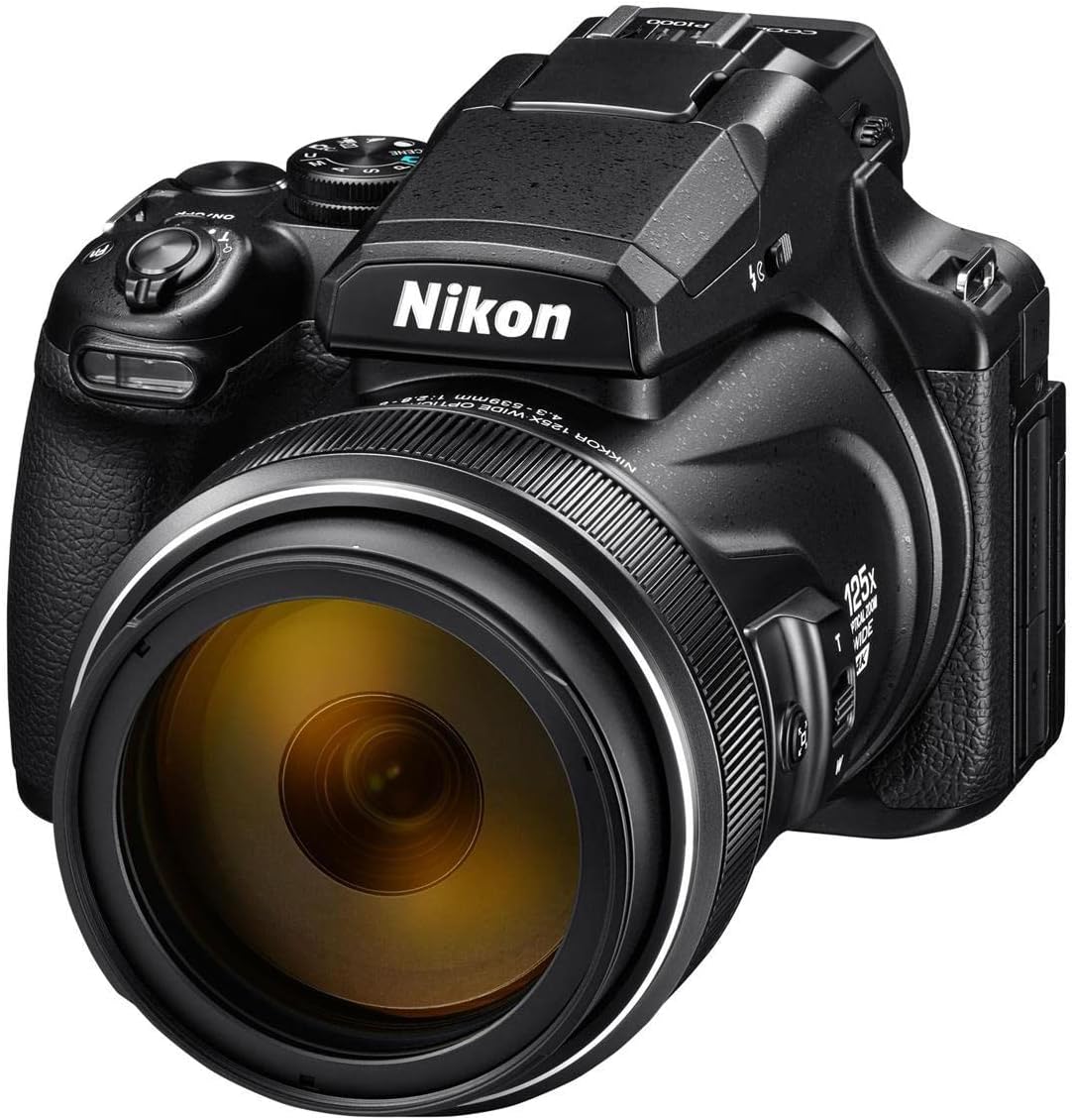
Spec sheet
Nikon Coolpix P1000
- Optical Zoom Range
- 125x optical zoom (3000mm maximum optical zoom reach)
- Sensor Resolution and Type
- 16 MP effective resolution, 1/2.3-inch CMOS image sensor
- Maximum Lens Aperture
- f/2.8 maximum aperture at wide angle (listed as 2.8 millimeters maximum aperture)
- Image Stabilization System
- Hybrid Dual Detect VR (Lens shift for stills; lens shift and electronic VR for movies)
- Video Recording Capabilities
- 4K Ultra HD video with stereo sound, clean HDMI output, and accessory hot shoe
- Still Image File Formats
- RAW (NRW) format support and standard JPEG capture
- ISO Sensitivity Range
- ISO 100 to 1600; expandable to ISO 3200 and 6400 in P, S, A, M, or Movie Manual modes (base ISO 125 in movie manual)
- Shutter Speed Capabilities
- 1/4000 to 1 sec; 1/4000 to 30 sec (ISO 100 in M mode); Bulb and Time settings up to 60 sec (ISO 100 in M mode); 1/8000 to 1/30 sec for video
- Continuous Shooting Buffer
- Up to 7 shots at approximately 7 frames per second at full resolution
- Displays and Viewfinder
- 0.39-inch 2359k-dot equivalent OLED EVF (-3 to +3 diopter); 3.2-inch vari-angle TFT LCD with anti-reflection coating
Figures as published by the manufacturer on the Amazon listing.
Optical Zoom Reach and Telephoto Lens Architecture
The centerpiece of the Nikon P1000 specs is undeniably its 125x optical zoom assembly, yielding a phenomenal focal range culminating in an unprecedented 3000mm equivalent field of view. Constructing a built-in optic with this level of telephoto power establishes the camera as a unique instrument in digital imaging. At the widest 24mm equivalent setting, the lens opens to an aperture of f/2.8, gathering ample ambient light for expansive landscape scenes, wide documentary framing, and environmental compositions. However, as the internal optical groups travel forward toward maximum extension, the physical aperture narrows down substantially, requiring abundant daylight or disciplined support to maintain sharp subject acquisition without introducing motion blur.
Operating a camera at the outer boundary of the Nikon P1000 3000mm zoom introduces optical and physical dynamics rarely experienced on standard zoom platforms. At 3000mm, the angle of view is exceptionally narrow, meaning that even fractional hand tremors produce significant target shifts on the sensor plane. The massive physical barrel extension shifts the center of gravity forward, placing distinct mechanical demands on how the camera is supported in the field. For outdoor observers accustomed to scanning habitats through conventional observation optics like the nikon monarch m7 10×42, transitioning to a digital capture mechanism at several hundred times higher magnification requires deliberate framing discipline and steady mechanical bracing to keep distant subjects centered.
Focus acquisition boundaries also scale in direct correlation with the focal length. At the wide-angle setting, the optical assembly achieves focus from approximately 1 foot (30 centimeters) out to infinity, dropping to approximately 0.4 inches (1 centimeter) when engaging the dedicated macro close-up mode. When racking the lens out toward maximum telephoto reach, however, the minimum focusing distance expands to approximately 23 feet (7.0 meters). This technical parameter means that close-range backyard songbirds, insects, or nearby wildlife cannot be brought into sharp focus at extreme telephoto settings without stepping back to satisfy the 23-foot minimum focus threshold, an essential operational metric for wildlife photographers planning their physical hides.
Sensor Geometry and Image Quality Limitations
Beneath the imposing optical barrel sits an effective 16-megapixel CMOS sensor. When conducting a technical evaluation of the camera, prospective owners must recognize that the Nikon Coolpix P1000 sensor size is 1/2.3-inch, a compact footprint standard among fixed-lens bridge cameras rather than the larger APS-C or full-frame standards found in modular camera bodies. Much like the compact sensor architectures employed across legacy point-and-shoot cameras such as the nikon coolpix s3300, packing 16 million effective pixels onto a 1/2.3-inch surface yields small individual photosites. This engineering trade-off is precisely what makes a 3000mm equivalent optical reach physically transportable without requiring an industrial trailer, but it inherently defines the camera’s baseline signal-to-noise ratio and optical dynamic range.
To counteract the processing limits and compression artifacts inherent to compact sensor formats, Nikon P1000 RAW format support enables the recording of uncompressed NRW image files alongside standard JPEG outputs. Shooting in raw format is essentially mandatory when operating this camera near the outer limits of its zoom envelope. Within desktop image processing applications, NRW raw files afford shooters the dynamic latitude needed to recover delicate highlight details in plumage, lift shadow information from high-contrast scenes, and apply selective noise mitigation routines tailored to the specific shot, bypassing the camera’s internal JPEG sharpening algorithms which can smudge micro-textures when illumination drops.
The native sensitivity ladder operates from ISO 100 to ISO 1600 under automated routines, with ISO 3200 and ISO 6400 unlockable across Program, Shutter Priority, Aperture Priority, Manual, and Movie Manual exposure modes. For optimal optical resolving power, keeping the sensor pinned at ISO 100 or ISO 200 is vital. As the sensitivity climbs into ISO 800 and above, the compact photosites generate noticeable luminance and chrominance noise patterns that progressively soften delicate feather barbules, distant foliage, and fine structural surfaces. Consequently, the camera delivers its sharpest, highest-contrast technical output in clean, direct outdoor sunlight or when using stable support platforms that allow longer exposure durations at base ISO.
Dual Detect Image Stabilization and Motion Control
Composing frames at extreme focal lengths without advanced optical compensation would prove impossible, as natural physical tremors and minor environmental wind currents would instantly toss the subject entirely outside the active framing zone. To mitigate this challenge, the camera integrates Nikon P1000 image stabilization powered by a Dual Detect optical Vibration Reduction system. For still photography, the hardware deploys a physical lens-shift mechanism that measures angular movement via onboard sensors and shifts lens groups along horizontal and vertical axes. When recording video, the platform upgrades to a hybrid stabilization pipeline, coupling optical lens-shift VR with electronic stabilization to smooth out directional panning movements and minor walking shakes.
While the Dual Detect system is highly capable of steadying the live electronic preview, optical physics dictates that shutter speed management remains critical. The camera supports mechanical shutter speeds up to 1/4000 second, down to 1 second in automated modes, and expanding up to 30 seconds when locked at ISO 100 in full Manual mode. Dedicated Bulb and Time exposure settings permit continuous exposures up to 60 seconds at ISO 100 in Manual mode. Handholding the camera at 3000mm without maintaining shutter speeds of at least 1/500s or faster invites micro-blur caused by subtle hand movements, making a rigid tripod or heavy monopod a necessary field companion when attempting pixel-sharp telephoto captures.
Continuous shooting performance is tailored toward brief, decisive action windows rather than extended continuous tracking. The Nikon Coolpix P1000 captures full-resolution still images at speeds up to approximately 7 frames per second, but the internal buffer is strictly capped at up to 7 shots per sequence. Because the burst buffer fills in a single second of sustained shooting, wildlife photographers cannot simply hold down the shutter release through erratic animal movement. Instead, field work requires precise timing: anticipating the apex of a bird’s takeoff or a predator’s strike, executing the 7-frame burst, and waiting while the hardware commits the image data to the storage card.
Video Capabilities and Manual Operational Control
Moving beyond still capture, the platform features robust Nikon P1000 4K video recording, capturing Ultra HD footage at 3840×2160 resolution alongside standard Full HD modes. In movie manual mode, the operational shutter speed extends from 1/8000 second down to 1/30 second, while the lowest available sensitivity is designated at ISO 125. The inclusion of a clean HDMI output feed enables videographers to route an uncompressed signal directly into external field monitors or offboard recorders, significantly simplifying real-time focus verification on distant subjects that occupy modest real estate on the built-in camera display.
Audio recording is managed by an integrated stereo microphone array, while an integrated accessory hot shoe mounted above the electronic viewfinder housing allows videographers to attach external directional shotgun microphones, auxiliary lighting units, or optical dot sights. The firmware also integrates automated time-lapse and super-lapse shooting modes, which compile individual interval frames into finished video clips. These specialized time-lapse functions provide exceptional utility for recording cloud evolutions across mountain horizons, marine tidal shifts, or day-to-night transitions without requiring laborious multi-frame assembly in desktop video editing suites.
Operational control is reinforced through an expansive suite of exposure modes designed to accommodate diverse field scenarios. Users can switch seamlessly between Auto, Program, Shutter Priority, Aperture Priority, and full Manual modes depending on how much direct control is required over exposure parameters. For quick field setups, the camera provides twelve specialized scene modes, including Landscape, Sunset, Night Landscape, Fireworks, Panorama, Food, Party/Indoor, Snow, Beach, Portrait, and Night Portrait. The exposure engine supports a native 16:9 aspect ratio mode alongside traditional framing parameters, allowing users to match widescreen video displays without incurring post-capture compositional cropping.
Real-World Deployment: Wildlife Tracking and Lunar Imaging
In applied outdoor tracking, employing the Nikon P1000 for wildlife establishes an entirely distinct operational profile compared to traditional camera gear. Birders and wildlife researchers frequently carry high-magnification field tools like the nikon prostaff xr to scan broad treelines and distant marshes before deploying heavy optical setups. With the P1000, the camera functions simultaneously as an observational spotting scope and a high-resolution recording device. Its capability to resolve skittish wading birds, high nesting raptors, and shy mammals from distances exceeding 100 yards ensures that animal behaviors remain completely undisturbed, maintaining ethical observation distances that standard 300mm or 400mm consumer lenses simply cannot achieve.
Equally prominent in the camera’s technical repertoire is the application of the Nikon P1000 for astrophotography. Because a 3000mm equivalent optical reach equals or exceeds the magnification profiles of many consumer astronomical telescopes, pointing this camera toward the night sky yields striking celestial views. The optical assembly easily resolves individual lunar impact craters, jagged crater rims, and expansive basaltic plains across the surface of the Moon with remarkable clarity. According to manufacturer specifications, the camera possesses sufficient magnification to track the International Space Station in flight and resolve the planetary ring structure of Saturn under clear, steady atmospheric seeing conditions without requiring specialized telescope barrel couplers or motorized equatorial tracking hardware.
However, successful extreme-distance telephoto imaging demands active management of atmospheric interference. When attempting to capture subjects miles away across warm terrestrial surfaces or through thick nocturnal atmospheric layers, thermal air currents, atmospheric haze, and suspended particulates will scatter light waves, softening overall resolution regardless of lens quality. To maximize image clarity, photographers must schedule field sessions during periods of thermal equilibrium, shoot through the thinnest possible atmospheric columns, and use the camera’s 0.39-inch 2359k-dot OLED electronic viewfinder (complete with -3 to +3 diopter adjustment) or the 3.2-inch vari-angle anti-reflective TFT LCD to verify focus with pinpoint precision.
Nikon Coolpix P1000 Pros and Cons
What works
- Unmatched 125x optical zoom reaching 3000mm equivalent
- Dual Detect hybrid optical Vibration Reduction
- 4K Ultra HD video with clean HDMI output
- RAW NRW format support for advanced processing
- High-resolution 2359k-dot OLED electronic viewfinder
- Vari-angle 3.2-inch LCD screen with anti-reflection coating
What to weigh up
- Small 1/2.3-inch sensor limits low-light dynamic range
- Continuous burst buffer capped at 7 full-resolution shots
- Minimum focus distance extends to 23 feet at telephoto
Check Nikon Coolpix P1000 on Amazon
Who Should Buy the Nikon Coolpix P1000
Determining whether the Nikon Coolpix P1000 fits your photographic gear bag hinges on balancing your absolute focal length requirements against the physical constraints of a compact image sensor. If extreme magnification is your non-negotiable metric, no other self-contained compact digital camera on the market replicates this optical range.
Buy It If
- You need unmatched 3000mm optical zoom reach in a single, self-contained camera without transporting multiple heavy telephoto prime lenses.
- Your core focus is daytime wildlife documentation, bird identification, or lunar and planetary astrophotography where standard 400mm or 600mm lenses lack sufficient reach.
- You demand full manual exposure controls, uncompressed RAW (NRW) image capture, and 4K Ultra HD video with an accessory hot shoe for microphone expansion.
- You require versatile shooting angles aided by a 3.2-inch fully articulating vari-angle LCD and a detailed 2359k-dot OLED electronic viewfinder.
Skip It If
- You regularly shoot indoor events, dim concert venues, or nighttime action where the small 1/2.3-inch sensor will introduce heavy digital noise at elevated ISOs.
- You require continuous high-speed action tracking with sustained burst buffers beyond the camera’s 7-frame maximum capacity.
- You want a lightweight, pocket-friendly everyday camera that operates without substantial physical lens barrel extension.
Final Verdict
9.0/10Our score
The Nikon Coolpix P1000 stands as an engineering achievement that redefines the outer boundaries of superzoom bridge camera design. By housing a 125x optical zoom lens alongside Dual Detect optical Vibration Reduction, RAW NRW image processing, and 4K Ultra HD video recording, Nikon crafted an exceptional tool that bridges the gap between field photography and astronomical telescope observation. When evaluating whether a Nikon P1000 for sale aligns with your gear requirements, the primary calculation centers on whether your priority is extreme 3000mm telephoto magnification over the low-light signal purity of larger-sensor, multi-lens camera systems.
Ultimately, is the Nikon P1000 worth it? For naturalists, avid bird watchers, and lunar astrophotographers who understand the operational demands of a 1/2.3-inch sensor and are willing to utilize rigid tripod support in challenging lighting conditions, this camera opens up framing opportunities that are physically impossible with standard camera gear at anywhere near this footprint. Provided you operate within its technical envelope and respect its optical boundaries, the P1000 delivers an unmatched window into distant visual realms.
FAQ
What is the optical zoom reach of the Nikon Coolpix P1000?
The camera houses a 125x optical zoom lens delivering a focal length span equivalent to 24mm at the wide-angle setting all the way to 3000mm at full telephoto extension. This constitutes the most powerful optical zoom lens ever incorporated into a Nikon Coolpix series camera.
Does the Nikon Coolpix P1000 support RAW image capture?
Yes, the camera provides full RAW format support utilizing Nikon’s proprietary NRW file structure. Users can record pure RAW files, standard compressed JPEGs, or write both simultaneously, providing substantial latitude during post-processing for shadow recovery, highlight preservation, and custom noise reduction.
How does the Dual Detect image stabilization function at maximum telephoto?
The camera features a Dual Detect Vibration Reduction system that employs optical lens-shift stabilization for still photography to counter hand tremor along horizontal and vertical axes. During video capture, the camera combines physical lens-shift VR with electronic stabilization. While it effectively steadies the live electronic viewfinder image, a heavy-duty tripod is strongly recommended at 3000mm to eliminate micro-blur.
Can the Nikon Coolpix P1000 record 4K video?
Yes, the camera captures 4K Ultra HD video with stereo sound and offers clean HDMI output for external monitoring. It also features a dedicated movie manual mode with shutter speeds reaching up to 1/8000s and a base sensitivity of ISO 125, alongside time-lapse and super-lapse recording modes.
What is the maximum continuous burst shooting speed?
The camera delivers continuous shooting speeds of up to approximately 7 frames per second at full 16-megapixel resolution. However, the internal burst buffer holds a maximum of 7 shots per continuous burst before requiring time to commit the files to the memory card.
See this listing on Amazon We may earn a commission if you buy through this link.
More in Cameras & Drones


The weekly shortlist
Specs worth reading, once a week
New teardowns, spec sheets and buying notes from across the desk.
This demo form is not connected to a mailing service.