Nintendo 64 (NUS-001) Deep Dive: Hardware Specs, Architecture, and Compatibility
The Nintendo 64 represents one of the most consequential milestones in video game hardware engineering, marking the industry transition from flat sprite planes to expansive, textured 3D environments. Identified by its original base model…
By Maria Carver

As Amazon Associates, we earn from qualifying purchases. This means we may receive a small commission at no extra cost to you if you click through and make a purchase.
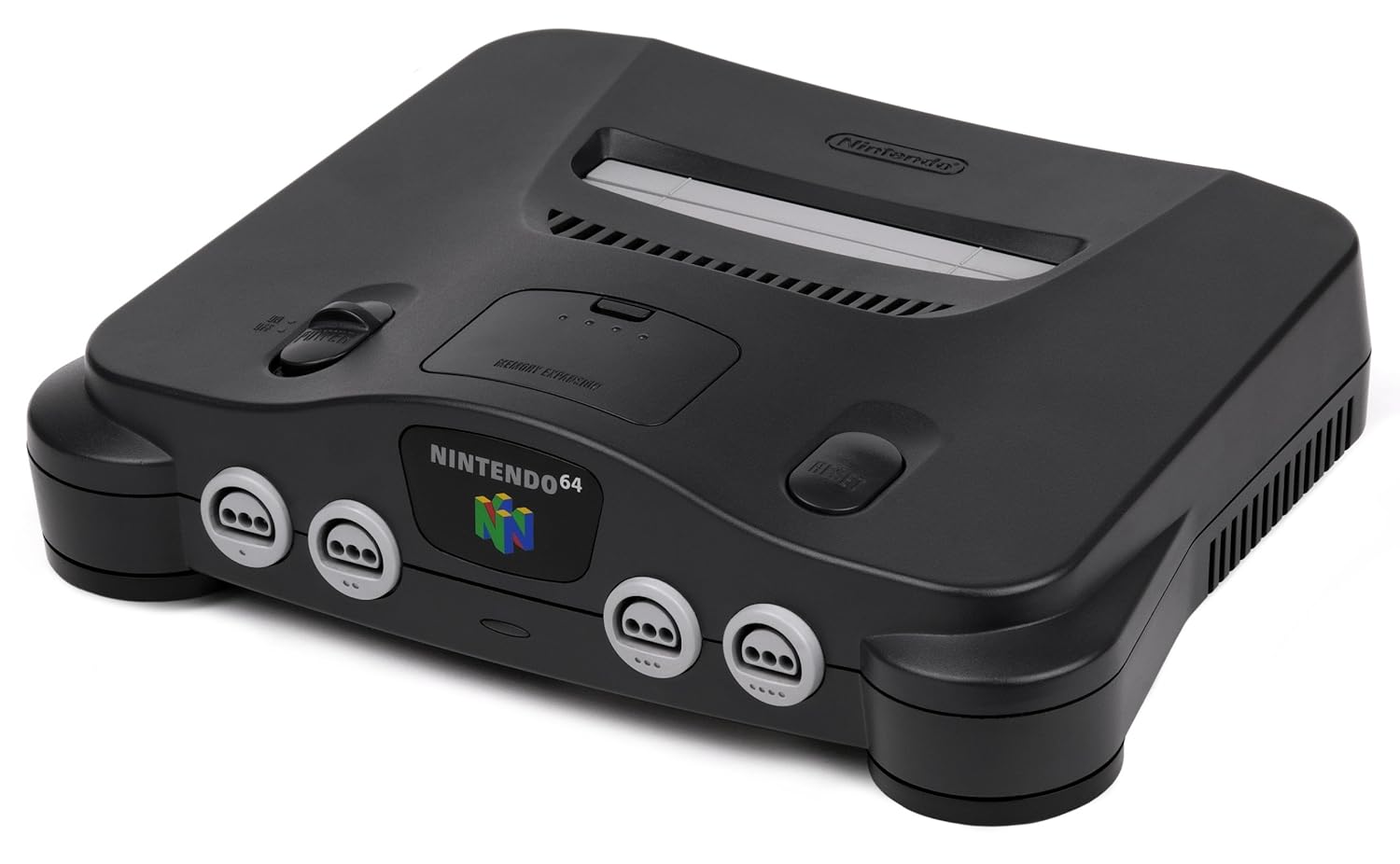
The Nintendo 64 represents one of the most consequential milestones in video game hardware engineering, marking the industry transition from flat sprite planes to expansive, textured 3D environments. Identified by its original base model number NUS-001 and manufactured by Nintendo in its signature Charcoal Grey finish, this 64-bit console introduced groundbreaking processing capabilities alongside an enduring, silicon-based physical architecture. If you seek an authentic period-accurate machine that plays classic cartridges instantly without loading screens or optical disc degradation, this legendary system stands as an essential foundation for any serious gaming hardware collection.
This unit is engineered specifically for retro gaming purists, hardware preservationists, and collectors who prioritize instant bus access, physical cartridge longevity, and four-player couch multiplayer directly out of the chassis. Those seeking plug-and-play simplicity on modern high-definition flat panels, native wireless peripherals, or digital game delivery will find the analog hardware demanding, and players desiring modern visual fidelity might prefer modern ecosystems like the sony ps5 console instead of vintage analog output.
Spec sheet
Nintendo 64
- Model Number
- NUS-001
- Manufacturer Part Number
- NUS-001
- Color Finish
- Charcoal Grey
- Platform System
- Nintendo 64
- Item Weight
- 3.6 pounds
- Listing Stated Resolution
- 4K (Amazon listing specification)
- Physical Media Format
- Cartridge based game system
- Software Update Supported to Date
- Unknown
- Software Catalog Scale
- Over 300 games available
Figures as published by the manufacturer on the Amazon listing.
64-Bit Graphics and Hardware Architecture
The core silicon defining the n 64 hardware architecture represented a deliberate departure from the 16-bit and 32-bit platforms that preceded it. Built around a 64-bit computing structure, the console was designed to process complex geometric math, perspective-correct texture mapping, and real-time z-buffering in ways consumer electronics had never previously attempted. This advanced internal pipeline enabled groundbreaking titles such as Super Mario 64 to render fully explorable 3D worlds with fluid camera positioning, establishing camera control conventions that remain standard in 3D gaming today.
Under the Charcoal Grey shell, the engineering prioritized sustained computational throughput over brute storage capacity. Evaluating the n 64 console specs highlights a tightly integrated unified memory configuration, allowing the central processor and graphical co-processor to access the same high-speed memory pool without routing bottlenecks. This hardware layout allowed developers to experiment with custom microcode and advanced anti-aliasing routines directly in hardware, a design philosophy vastly distinct from modern high-bandwidth split-bus systems found in contemporary machines like the playstation 5 slim console.
The result was a distinctive visual aesthetic characterized by smooth, filtered polygon edges and atmospheric fog effects that masked hardware draw distance constraints. While early polygon titles from that era often suffered from heavy jitter or severe texture warping on competing architectures, the mathematical precision of the 64-bit pipeline ensured geometric stability across the screen, making the hardware a distinct evolutionary leap for early 3D rendering.
Cartridge System and Hardware Longevity
One of the most defining design decisions of the nintendo 64 nus-001 was Nintendo’s commitment to solid-state ROM cartridges rather than optical compact discs. The manufacturer listing emphasizes this physical attribute with the promise of a cartridge based game system featuring no scratched games. Because cartridges feature no exposed optical layers or moving mechanical trays, game data remains shielded inside durable plastic enclosures, allowing software to survive drops, dust, and decades of physical handling without read errors.
From an engineering standpoint, nintendo 64 cartridge compatibility guarantees near-zero latency when transferring data between the game media and the system bus. Unlike disc-based systems that require spindle motors, optical pickup lasers, and mechanical drive sleds—components prone to laser burnout or gear stripping in older hardware like a ps4 not used—the cartridge architecture relies solely on direct bus contacts. This lack of moving mechanical parts is a primary reason why the 3.6-pound console remains exceptionally reliable decades after its initial assembly.
However, solid-state read-only memory introduced capacity trade-offs that shaped software development across the entire generation. ROM chips were far more constrained in storage capacity than CD-ROMs, preventing developers from incorporating extensive pre-rendered full-motion video sequences or uncompressed orchestral audio tracks. In response, developers engineered creative procedural audio engines and real-time in-engine cutscenes, ultimately yielding an acclaimed catalog of over 300 games that emphasized deep gameplay mechanics over passive multimedia playback.
Video Output Options and Modern Display Compatibility
Connecting vintage hardware to modern displays requires a clear technical understanding of n 64 video output options. While the Amazon product data listing intriguingly notes a resolution of 4K, this is an artifact of modern listing metadata rather than native legacy silicon capabilities. In its original hardware configuration, the console processes and outputs standard-definition analog signals, typically rendering internal graphics at 240p or 480i resolutions designed for cathode-ray tube displays.
The back panel of the chassis utilizes Nintendo’s proprietary multi-out analog connector, which can deliver standard composite video, RF coaxial signals, or S-video depending on the specific cable utilized. Composite video merges luminance and chrominance signals into a single pin, which can result in a softer picture on modern flat-screen televisions. Users seeking the cleanest video output from an unmodified NUS-001 unit generally utilize dedicated S-video cables, which separate the color and brightness channels to deliver crisper polygon boundaries and sharper text rendering.
Integrating this console into modern entertainment setups often involves pairing the analog multi-out connector with dedicated external upscalers or line doublers. These external processing boxes sample the console’s native 240p signal and scale it cleanly to digital formats without introducing input latency. Purists who maintain an authentic n 64 console for retro gaming frequently prefer connecting the unit directly to a CRT monitor, where the console’s built-in anti-aliasing and blurring filters blend naturally into physical phosphors as original developers intended.
Controller Ports and Multiplayer Capabilities
A critical hardware feature engineered directly into the front fascia of the console is the array of four dedicated nintendo 64 controller ports. Prior to this release, home gaming systems typically featured only two front-facing peripheral connections, requiring gamers to purchase separate multitap adapters to enjoy four-player gameplay. By integrating four inputs directly onto the main motherboard, the console democratized local multiplayer and established couch-gaming staples that defined an entire era.
The proprietary controller interface utilized a specialized single-wire serial communication protocol capable of polling four independent controllers seamlessly. In conjunction with this hardware capability, the revolutionary trident-shaped controller introduced an integrated analog thumbstick designed specifically for 360-degree precision in three-dimensional environments. The controller also featured a rear expansion slot that supported modular peripherals such as battery-backed Controller Paks for memory saves and Rumble Paks for tactile vibration feedback.
Processing four simultaneous camera viewpoints placed substantial demands on the system hardware during split-screen sessions. Titles like GoldenEye 007, Mario Kart 64, and Super Smash Bros pushed the silicon to its operational boundaries, occasionally reducing frame rates during intense multi-vehicle or multi-combatant encounters. Despite these performance trade-offs, the convenience of native four-player ports transformed the nintendo 64 console into the undisputed king of local multiplayer competition during the late 1990s.
Chassis Build Quality and Console Revisions
Weighing in at a substantial 3.6 pounds, the Charcoal Grey console boasts exceptional physical build quality designed to withstand prolonged gameplay sessions. The chassis is built around a heavy-gauge internal metal RF shielding cage that doubles as an expansive passive heat sink. Because the internal architecture generates moderate thermal output without relying on noisy mechanical cooling fans, the unit operates in complete silence, ensuring long-term thermal reliability free of fan-bearing failures.
Throughout its production cycle, several n 64 console revisions were introduced under the broader NUS-001 designation. Internal motherboard layouts evolved through various revisions, designated internally as CPU-01 through CPU-08, altering specific video encoder chips and motherboard traces while maintaining strict software compatibility across the entire library. Early board revisions featured distinct digital video routing traces that made them particularly desirable among enthusiasts for specialized analog RGB modifications, whereas later motherboard revisions integrated consolidated chipsets to streamline production efficiency.
Evaluating whether an n 64 console is worth it in the current retro gaming market requires balancing these hardware considerations. As indicated by the listing specification noting that software updates supported to date are unknown, the system has no operating system firmware to patch, no internet connectivity requirements, and no account activations standing between you and your software. It is a pure, self-contained hardware ecosystem that boots games the millisecond the physical power switch is engaged.
Nintendo 64 Pros and Cons
What works
- Durable cartridge format eliminates scratched game media
- Four built-in controller ports ready for local multiplayer
- Instant boot times without loading screens or patches
- Silent passive cooling with no mechanical fan noise
- Over 300 classic titles available in the library
What to weigh up
- Analog output requires upscalers for modern HDMI displays
- Cartridge storage constraints restrict audio and cutscenes
- No native wireless controller connectivity out of the box
Who Should Buy the Nintendo 64
Buy It If
- You value pure physical media that boots instantly without load times, installations, or mandatory system updates.
- You want to experience foundational 3D masterpieces like Super Mario 64 on authentic original hardware.
- You enjoy local couch multiplayer and want four built-in controller ports ready for party play right out of the box.
- You prioritize hardware longevity and durability, benefiting from a cartridge system that avoids scratched discs and laser drive wear.
Skip It If
- You expect native high-definition digital outputs or modern plug-and-play convenience on 4K flat panels without buying extra upscalers.
- You dislike early 3D camera mechanics, low polygonal counts, and aggressive hardware texture filtering.
- You prefer modern gaming conveniences such as wireless controllers, internal storage, and digital storefront accessibility.
Final Verdict
4.6 / 5Amazon buyer rating, 2,149 ratings
The Nintendo 64 NUS-001 is a legendary piece of consumer electronics that fundamentally shaped the modern three-dimensional gaming landscape. By pairing pioneering 64-bit silicon with an unyielding solid-state cartridge format, Nintendo crafted a machine defined by rapid performance, indestructible game media, and peerless four-player social gaming. Its distinctive Charcoal Grey silhouette and robust 3.6-pound frame reflect an era when hardware was engineered for durability, tactile mechanical operation, and uncompromised local play.
While connecting its analog video output to modern high-definition displays requires specialized cables or external scaling hardware, the experiential rewards of original hardware are unmatched. For retro enthusiasts, hardware collectors, and gaming historians who want to experience the genesis of true 3D level design without emulation artifacts or mechanical disc drive failures, this classic console remains an indispensable cornerstone of video game history.
FAQ
Does the Nintendo 64 natively output video in 4K resolution?
No, the console outputs standard-definition analog signals, primarily 240p and 480i. Although the Amazon listing lists a 4K resolution specification, this is an inaccurate catalog attribute. Connecting the system to modern 4K televisions requires external line doublers, upscalers, or dedicated video converters.
Can the Nintendo 64 scratch or ruin game cartridges during play?
No, cartridges contain no optical media to scratch. Because the game data is housed safely inside durable plastic cartridges and read via solid-state electrical bus contacts, games do not suffer from the disc rot, scratches, or read errors common with compact discs.
What video cables can be used with the Nintendo 64 console?
The console features a proprietary multi-out port compatible with composite AV cables, S-video cables, and RF switches. For standard unmodified consoles, an S-video cable paired with a CRT television or dedicated scaler delivers the sharpest possible analog video signal.
How many controllers can be plugged into the console simultaneously?
The console comes equipped with four built-in controller ports directly on the front panel. This hardware design allows four players to participate in local multiplayer games simultaneously without needing external multitap adapters or peripheral splitters.
Does the Nintendo 64 require internet connectivity or software updates?
No, the system operates completely offline without network capabilities or internal firmware updates. As noted in the listing specifications where software update support is unknown, games boot immediately upon engaging the physical power switch without requiring operating system downloads or patches.
See this listing on Amazon We may earn a commission if you buy through this link.
More in Gaming


The weekly shortlist
Specs worth reading, once a week
New teardowns, spec sheets and buying notes from across the desk.
This demo form is not connected to a mailing service.