Minisforum MS-S1 Max 128GB Architecture Analysis: Bandwidth, Compute, and Thermals
The Minisforum MS-S1 Max represents a fundamental shift in compact workstation engineering, condensing a 16-core high-density processor and an enormous 128GB unified memory pool into a small-form-factor chassis. Built around AMD Zen 5 processing…

As Amazon Associates, we earn from qualifying purchases. This means we may receive a small commission at no extra cost to you if you click through and make a purchase.
The Minisforum MS-S1 Max represents a fundamental shift in compact workstation engineering, condensing a 16-core high-density processor and an enormous 128GB unified memory pool into a small-form-factor chassis. Built around AMD Zen 5 processing cores and integrated RDNA 3.5 graphics, this compact workstation challenges traditional workstation configurations by eliminating discrete graphics cards in favor of a massive, shared low-latency memory pipeline. In our technical minisforum ms-s1 max review, the platform proves to be an exceptionally focused hardware implementation engineered to process heavy AI workloads and virtualization deployments that previously demanded bulky multi-socket desktop towers.
This machine suits machine learning engineers, data scientists, and systems architects who require significant unified memory density to run parameter-heavy models locally without incurring the thermal and spatial penalties of full-sized workstations. Readers tracking the broader evolution of the amd ryzen™ ai max+ 395 –evo-x2 ai mini pc hardware ecosystem will appreciate how effectively this architecture eliminates memory capacity ceilings. However, general desktop users seeking casual web browsing, standard office productivity, or basic video streaming should look elsewhere, as the high-throughput memory configuration, specialized cooling apparatus, and complex clustering features represent unneeded capability for standard daily software tasks.
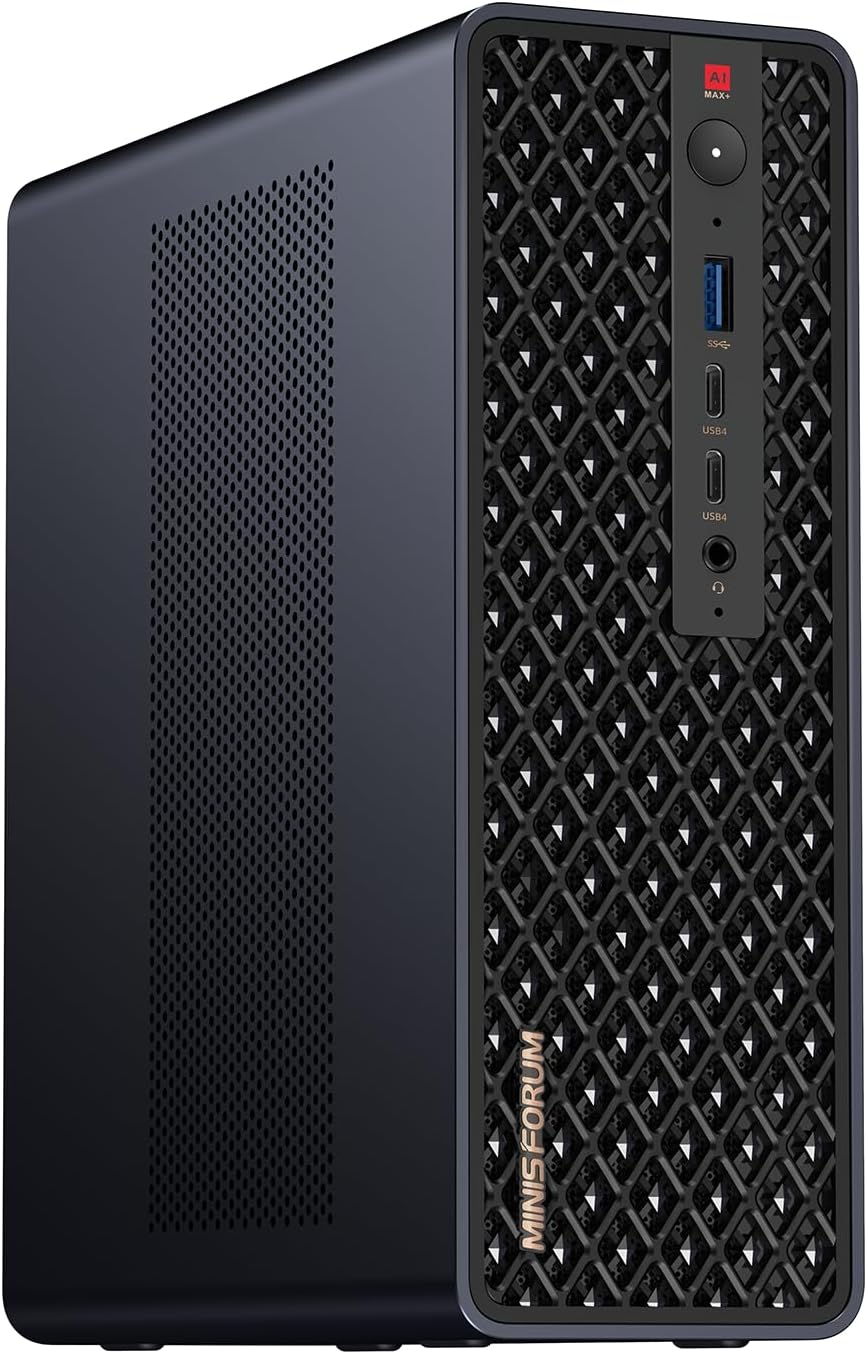
Spec sheet
Minisforum MS-S1 Max
- Processor (APU)
- AMD Ryzen AI Max+ 395 (16 Cores, 32 Threads, up to 5.1GHz, 64MB L3 Cache)
- Graphics Architecture
- AMD RDNA 3.5 Integrated Graphics
- Neural Processing Unit
- Dedicated NPU providing 50 TOPS (126 TOPS Total System Output)
- Unified System Memory
- 128GB LPDDR5x-8000 MT/s Shared Architecture
- Internal Storage Interface
- Dual M.2 PCIe 4.0 Slots with Hardware RAID 0/1 Support up to 16TB
- Hardware PCIe Expansion
- Single Full-Length PCIe x16 Slot
- Network Interfaces
- Dual 10GbE RJ45 LAN Ports and Wi-Fi 7 Wireless Module
- External Display and I/O
- USB4 V2 (80Gbps), HDMI 2.1 (up to 8K at 60Hz), Dual DMIC Noise-Canceling Array
- Thermal and Power Envelope
- 320W Power Supply Unit Supporting 130W Continuous Thermal Output
Figures as published by the manufacturer on the Amazon listing.
APU Architecture and System Compute Scaling
At the mechanical core of the chassis sits the AMD Ryzen AI Max+ 395 processor, an APU built on AMD Zen 5 processing architecture. Operating with 16 physical cores and 32 simultaneous execution threads, the processor achieves a peak boost clock of 5.1GHz alongside a massive 64MB allocation of L3 cache. This compute arrangement delivers massive throughput when crunching complex scientific operations, running dense multi-threaded simulations, or managing dozens of virtual machines simultaneously. Because Zen 5 introduces notable IPC improvements and branch prediction optimizations, instructions process with minimal stalls, maintaining consistent compute velocity under sustained compilation tasks.
Complementing the Zen 5 CPU array is an integrated AMD RDNA 3.5 graphics processor paired with an advanced onboard Neural Processing Unit (NPU). The standalone NPU achieves an operational throughput rating of 50 TOPS, designed specifically to accelerate low-precision matrix operations without pulling execution bandwidth away from main CPU routines. When combined with the parallel vector processing capabilities of the RDNA 3.5 GPU and the CPU vector units, the ryzen ai max+ 395 mini pc delivers a combined system performance figure of 126 TOPS, giving software developers a balanced platform for heterogenous compute tasks.
Examining the minisforum ms-s1 max 128gb specs reveals how radically this APU changes multi-tier compute workflows. In typical desktop environments, data must shuttle across the PCIe bus between the system processor and an expansion GPU, introducing measurable latency that throttles batch pipeline processing. The tightly coupled Zen 5 and RDNA 3.5 design bypasses that physical bottleneck entirely. Users evaluating modern amd ryzen ai max hardware configurations will find that having unified compute access directly adjacent to high-speed cache lines significantly shortens data iteration loops during algorithmic model training.
Unified Memory Architecture and Local Model Execution
The defining technological achievement of this platform is the implementation of 128GB of LPDDR5x unified memory operating at a transfer rate of 8000 MT/s. In traditional workstation architectures, system RAM and discrete GPU video memory (VRAM) exist as distinct, physically isolated memory domains. If an artificial intelligence model exceeds the dedicated VRAM of an installed graphics card, execution must either fail or spill over onto a slower system memory bus, devastating execution speeds. With the minisforum ms-s1 max unified memory architecture, the entire 128GB address space is accessible to both the CPU cores and the RDNA 3.5 graphics hardware under a single, cohesive low-latency framework.
This massive allocation enables users to deploy the minisforum ms-s1 max for local llm execution on a scale previously impossible inside a miniature chassis. High-parameter open-weights models requiring 60GB, 70GB, or even 100GB of working memory can load completely into the unified pool without requiring model pruning or severe down-quantization. For enterprise developers handling sensitive data that cannot leave local hardware infrastructure, running 70B parameter models at high quantization precision locally preserves operational data privacy while providing reliable generation throughput.
Scalability extends beyond single-system limits through coordinated clustering configurations. According to official system performance figures, two interconnected units deployed in a dual-node arrangement can load and execute an enormous 235B Q4 quantized model completely locally. In this configuration, the combined cluster maintains an inference output speed of 10.87 tokens per second, a benchmark that validates its utility as a localized compute node. While mobile form factors like a ryzen ai max+ 395 laptop must enforce aggressive thermal throttling on shared memory controllers, this desktop enclosure provides uninterrupted electrical current and signal stability to sustain 8000 MT/s across the entire 128GB array continuously.
Thermal Engineering, Acoustic Modulation, and Power Infrastructure
Sustaining 126 TOPS of total system compute alongside high-frequency memory operations requires a robust thermal dissipation platform. To prevent frequency degradation under load, the chassis integrates an aerospace-grade aluminum alloy housing combined with a thick copper base plate. Heat moves away from the APU silicon through six precision copper heat pipes that distribute thermal energy directly into high-density fin stacks. Active air movement is generated by dual turbine fans, while advanced phase-change material (PCM) provides optimal thermal interface contact between the processor die and heat sink assembly.
This cooling assembly is rated to support a continuous power draw of 130W without inducing thermal throttling. Power is delivered through a high-capacity 320W power supply unit, ensuring that transient power spikes generated by simultaneous CPU, GPU, and NPU operations never destabilize system rails. In a minisforum ms-s1 max benchmark run under continuous high-matrix workloads, the thermal subsystem successfully prevents throttling cascades, keeping core frequencies elevated even when multi-hour batch inferencing operations saturate the silicon.
Acoustic and thermal profiles can be tailored dynamically through four switchable operating profiles embedded in the system firmware:
- Performance Mode: Maximizes fan velocity curves and thermal headroom, delivering sustained 130W output for intensive computational training and local batch inference.
- Balanced Mode: Balances thermal dissipation and acoustic emissions for daily development, virtualization tasks, and interactive coding workflows.
- Silent Mode: Restricts fan RPM to suppress operational noise, ideal for noise-sensitive office environments during lightweight debugging and document processing.
- Rack Mode: Calibrates airflow parameters specifically for high-density 2U server rack enclosures where directional ambient cooling is managed externally.
High-Throughput I/O, Storage Capabilities, and PCIe Expansion
Networking and storage capabilities are tailored directly to data-intensive enterprise tasks. The rear I/O panel includes minisforum ms-s1 max dual 10gbe ethernet ports, providing 20Gbps of aggregated physical network bandwidth. These dual 10-Gigabit interfaces are critical for clustering multiple mini PCs together, ingesting real-time sensor streams, or communicating directly with high-speed network-attached storage (NAS) arrays without creating an I/O bottleneck. Complementing the wired connections is a next-generation Wi-Fi 7 wireless module that delivers broader channel bandwidth and lower latency in congested wireless environments.
Peripheral expansion and display options match workstation expectations through the inclusion of USB4 V2 and HDMI 2.1 interfaces. The USB4 V2 connector supports data transfer speeds reaching up to 80Gbps, enabling ultra-fast external storage arrays, external capture hardware, or high-bandwidth peripherals. The HDMI 2.1 video output interface drives modern high-resolution displays up to 8K resolution at 60Hz (7680 pixels), providing crisp visual space for detailed timeline editing, high-resolution rendering, and extensive multi-window code development.
Internal hardware expansion stands out thanks to an innovative slide-out mechanical chassis design. Users can slide the internal frame forward to reveal a full-length PCIe x16 expansion slot alongside dual M.2 PCIe 4.0 storage slots. This minisforum ms-s1 max pcie expansion capability allows administrators to install specialized interface cards, secondary high-speed networking adapters, or capture devices directly onto the system board. The dual M.2 interfaces support RAID 0 and RAID 1 operational modes with a storage ceiling of up to 16TB, ensuring massive local datasets can be cached with extreme read and write velocities.
Minisforum MS-S1 Max Pros and Cons
What works
- 128GB LPDDR5x-8000 unified memory architecture
- 16-core AMD Ryzen AI Max+ 395 processor
- Integrated 50 TOPS NPU with 126 total TOPS
- Dual 10GbE network interfaces and Wi-Fi 7
- Full-length PCIe x16 slot and dual M.2 RAID
- 130W sustained cooling with 320W power supply
What to weigh up
- Overpowered for standard desktop and office tasks
- Requires multi-node clustering for 200B+ models
- Mini workstation form factor limits dual-slot GPUs
Check Minisforum MS-S1 Max on Amazon
Who Should Buy the Minisforum MS-S1 Max
Determining whether this specialized hardware aligns with your production environment depends largely on your memory capacity needs and software architecture demands.
Buy It If
- You need 128GB of high-speed unified memory to run large local language models without investing in complex multi-GPU enterprise server racks.
- Your workflow requires dual 10GbE networking to construct compact compute clusters, connect to high-bandwidth storage arrays, or run high-throughput virtualized networks.
- You require a compact machine with a full-length PCIe x16 expansion slot and dual M.2 RAID support for flexible hardware customization in lab or 2U rack deployments.
- You deploy multi-modal AI systems that can take advantage of the integrated 50 TOPS NPU alongside the Zen 5 CPU and RDNA 3.5 graphics.
Skip It If
- Your computing demands are centered around standard office software, light web browsing, or basic desktop productivity where 128GB of unified RAM remains completely unutilized.
- You primarily seek a standard consumer gaming rig, where dedicated desktop graphics cards with proprietary gaming driver optimizations remain the standard choice.
- You do not require local AI execution, virtualization, or multi-node clustering, making simpler mini PC platforms far more practical for everyday operations.
Final Verdict
9.0/10Our score
The Minisforum MS-S1 Max represents a decisive technological pivot in the compact workstation landscape. By integrating an AMD Ryzen AI Max+ 395 processor with 128GB of unified LPDDR5x-8000 memory, the system breaks the conventional memory barriers that have historically held back compact machines from running massive local AI workloads. Its 130W continuous cooling engineering, 320W power envelope, dual 10GbE network interfaces, and flexible PCIe expansion slot establish a new standard for localized machine learning inference and high-density virtualization.
When asking whether the is minisforum ms-s1 max worth it question holds up under analytical scrutiny, the answer is an unambiguous yes for engineers, researchers, and technical organizations. It completely redefines what can be achieved within a miniature chassis, democratizing access to large-scale local AI inference and high-speed network clustering without requiring expansive server racks. For those demanding uncompromised memory density and versatile compute scaling in an exceptionally dense footprint, this minisforum ms-s1 max ai workstation stands out as an engineering triumph.
FAQ
What makes the 128GB unified memory on this system different from standard mini PC RAM?
Unlike conventional mini PCs that divide memory between standard DDR5 SODIMM system slots and a small dedicated graphics buffer, this system employs an integrated 128GB LPDDR5x-8000MT/s unified memory pool. Both the Zen 5 CPU cores and the RDNA 3.5 graphics compute units share direct, low-latency access to the same memory space, enabling massive datasets and large AI models to run smoothly without the bandwidth penalties of traditional PCIe bus transfers.
Can the Minisforum MS-S1 Max be deployed in server racks?
Yes. The hardware features a dedicated firmware Rack Mode that optimizes fan profiles for directional airflow within server enclosures, and its chassis design supports 2U rack deployment. Multiple units can be cascaded across server racks to create a high-efficiency distributed computing cluster.
How does the dual-unit clustering feature operate for large language models?
By connecting two units over high-speed networking, the systems can pool compute resources to run massive models, such as a 235B parameter Q4 quantized model, yielding sustained generation speeds of approximately 10.87 tokens per second. This provides enterprise-level local inference without requiring dedicated discrete datacenter accelerators.
What expansion interfaces are available inside the slide-out chassis?
The slide-out mechanical design grants direct access to a full-length PCIe x16 expansion slot and dual M.2 PCIe 4.0 storage slots. The storage configuration supports RAID 0 and RAID 1 setups with total capacities reaching up to 16TB, while the PCIe x16 slot accommodates add-in cards for expanded functionality.
What audio input capabilities are built into the hardware for voice AI interaction?
The system integrates a dual DMIC AI noise-canceling microphone array directly into the front enclosure. This hardware array actively suppresses ambient acoustic interference, enabling clear and accurate voice command ingestion for voice-driven AI workflows and real-time transcription models.
See this listing on Amazon We may earn a commission if you buy through this link.
More in Computers & Laptops


The weekly shortlist
Specs worth reading, once a week
New teardowns, spec sheets and buying notes from across the desk.
This demo form is not connected to a mailing service.