JBL Go 5 Breakdown: Acoustic Performance, IP68 Build & Specs
Audio enthusiasts who frequently evaluate pro-grade hardware like jbl control 5 speakers understand that physical cabinet volume and driver displacement establish hard laws in sound reproduction. However, the ultra-portable audio market operates under completely…

As Amazon Associates, we earn from qualifying purchases. This means we may receive a small commission at no extra cost to you if you click through and make a purchase.
Audio enthusiasts who frequently evaluate pro-grade hardware like jbl control 5 speakers understand that physical cabinet volume and driver displacement establish hard laws in sound reproduction. However, the ultra-portable audio market operates under completely different engineering priorities, focusing on extreme physical efficiency and rugged field resilience rather than stationary acoustic mass. The JBL Go 5 is an ultra-compact Bluetooth loudspeaker engineered to deliver pocket-sized sound backed by an official IP68 durability standard and an integrated digital signal processor. Our research of the manufacturer specifications, acoustic architecture, and intended deployment scenarios indicates that this miniature unit provides a focused 4.8-watt output stage designed for personal listening zones, daily transit, and adverse weather environments.
This micro-speaker specifically suits mobile professionals, hikers, commuters, and casual listeners seeking a drop-proof audio device that slips effortlessly into a jacket pocket or travel pack without noticeable bulk. Conversely, users searching for expansive dynamic headroom, deep sub-bass reproduction for house gatherings, or wide multichannel dispersion will find the physical confines of a palm-sized chassis restrictive. Listeners desiring studio-grade dispersion or massive output levels would be better served exploring high-output stationary cabinets or dedicated multi-driver installations rather than an ultra-mobile single-transducer enclosure.
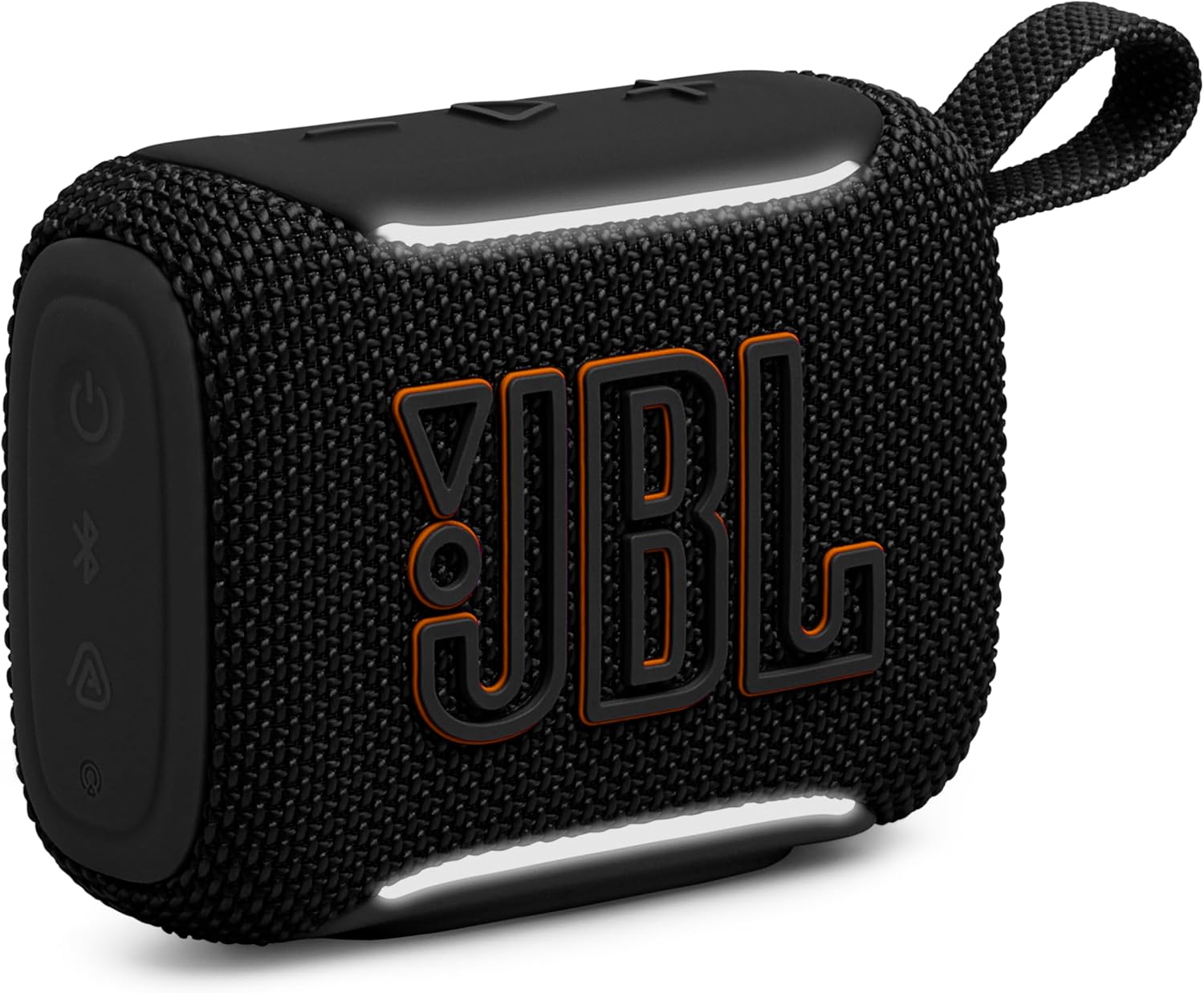
Spec sheet
JBL Go 5
- Model Designation
- Go 5 (Model Number: JBLGO5BLKAM)
- Amplifier Output Power
- 4.8 Watts Maximum
- Frequency Response Metric
- 20 Hz (Manufacturer Listing Claim)
- Signal-to-Noise Ratio
- 85 dB
- Ingress Protection Class
- IP68 Waterproof and Dustproof
- Chassis Dimensions
- 1.7"D x 3.98"W x 3.05"H
- Unit Net Weight
- 8.16 Ounces
- Battery Configuration
- 1x Lithium Polymer (Up to 8 Hours, or 10 Hours with Playtime Boost)
- Wireless Topology
- Auracast Multi-Speaker Broadcast and AirTouch Stereo Pairing
- Aesthetic and Control Hardware
- Ambient Edge LED Lighting, Touch Controls, App Management
Figures as published by the manufacturer on the Amazon listing.
Acoustic Architecture and Output Transducer Performance
When analyzing the technical foundation of the jbl go 5 specs, the primary hardware metric that defines its operating ceiling is the 4.8-watt maximum output power rating. In micro-speaker engineering, a 4.8-watt amplifier stage driving a micro-transducer must balance acoustic pressure with thermal dissipation and electrical current draw from a compact internal cell. While traditional bookshelf or commercial installations like jbl control 5 speakers leverage large cabinets and continuous high-voltage power to move massive columns of air, the Go 5 relies on digital sound processing to extract clean, punchy output from its miniature enclosure. The resulting soundstage is calibrated to project forward with pronounced clarity in vocal ranges and acoustic instrumentation, making personal playback crisp even in open outdoor air.
A critical point of evaluation for prospective buyers is the jbl go 5 frequency response specification, which the official product listing cites at 20 hertz. In acoustic physics, reproducing an authentic 20 Hz fundamental frequency demands immense driver excursion and significant enclosure air displacement, characteristics physically impossible within a 1.7-inch-deep handheld shell. This listing figure reflects the digital receiver’s incoming signal acceptance threshold rather than an unattenuated acoustic output at sub-audible bass frequencies. In real-world operation, the low-end frequency profile emphasizes upper-bass punch, giving rhythm tracks tangible snap without inducing driver distortion. Listeners who need true room-energizing low-end should contrast this portable profile with heavy-duty cabinets such as the jbl partybox encore essential, which integrates substantial woofer displacement for deep low-frequency authority.
Signal clarity remains well-governed across typical operating levels thanks to a measured signal-to-noise ratio of 85 dB. An 85 dB SNR ensures that during quiet audio passages, podcasts, or low-volume desk playback, underlying amplifier hiss and idle ground noise remain imperceptible to the human ear. The listing also notes surround audio mode capabilities and Hi-Res Audio decoding support, indicating that the internal digital-to-analog conversion hardware processes detailed audio streams smoothly before feeding the amplification channel. The jbl go 5 output wattage is intentionally capped to prevent excessive harmonic distortion at peak output, keeping playback intelligible up to the limits of its driver excursion.
Environmental Durability and IP68 Enclosure Engineering
Durability engineering represents one of the strongest technical arguments for this micro-loudspeaker, highlighted by the official jbl go 5 ip68 waterproof rating. The International Electrotechnical Commission standard 60529 defines ingress protection through two distinct metric digits. The first digit, a level 6, indicates complete sealing against solid foreign particles, certifying the internal circuitry against fine beach sand, airborne dust, and trail grit. The second digit, an 8, elevates the Go 5 beyond common splash-resistant alternatives, designating verified protection against sustained water immersion beyond one meter under specified pressures. This structural seal ensures that sudden torrential downpours, accidental pool drops, or muddy hiking environments pose zero threat to internal components.
Beyond liquid ingress defense, the chassis architecture incorporates drop-proof structural reinforcement. The exterior shell utilizes ruggedized shock-absorbing materials wrapped along the vulnerable perimeter edges, insulating internal solder joints, battery brackets, and driver mountings from kinetic impact. For active users navigating rocky trails, boat decks, or tiled bathroom surfaces, this impact resistance eliminates the anxiety typically associated with consumer electronics. While delicate monitoring gear demands cautious handling inside controlled studio walls, this enclosure is intentionally built to endure mechanical shock, abrasion, and unpredictable environmental exposure without compromising acoustic integrity.
The sealed architecture also extends to the physical interface, which relies on integrated touch controls and protective gaskets across all seams. Because dust and water cannot bypass the exterior barrier, the capacitive and pressure-sensitive control nodes remain responsive even when wet. Unlike larger multi-component speaker configurations such as the jbl stage 3 automotive series that rely on vehicle doors for structural and moisture isolation, the Go 5 provides a completely self-contained, hermetically sealed operational envelope capable of functioning on wet sand, poolside concrete, or shower shelves.
Wireless Networking and Auracast Multi-Speaker Ecosystem
Modern micro-audio devices rely heavily on advanced wireless topologies to compensate for the acoustic limitations of a single physical driver. The implementation of jbl go 5 auracast stereo pairing marks a major generational leap over legacy Bluetooth protocols. Auracast functions as an advanced broadcast audio standard operating over Bluetooth Low Energy, allowing a single host device to transmit synchronized audio packets to an unlimited cluster of compatible receiving units. This technology allows multiple compatible JBL speakers scattered across a patio, campsite, or multi-room layout to play identical audio streams simultaneously without experiencing transmission lag or packet collision.
For listeners who demand genuine spatial separation, the Go 5 introduces AirTouch pairing mechanics. By physically bumping two Go 5 units together, onboard sensors immediately register proximity and automatically configure the speakers into an authentic discrete left-and-right stereo pair. This hardware-level handoff bypasses complicated smartphone application menus, allowing users to deploy an immediate stereo soundstage in the field. Splitting audio channels into discrete physical channels fundamentally widens the soundstage, delivering positional accuracy and instrument separation that cannot be replicated by any standalone single-point speaker regardless of its digital surround processing algorithms.
While this wireless flexibility offers immense convenience in portable scenarios, it targets a different listening profile than dedicated home theater soundbars like the vizio elevate se 5.1.2 soundbar, which uses physical HDMI eARC pipelines and dedicated upward-firing drivers to construct height channels. The Go 5 prioritizes ad-hoc mobile synchronization, making it effortless to link up with friends’ gear during outdoor gatherings. Smartphone antenna positioning is optimized internally to maintain an unbroken wireless tether, ensuring signal stability even when the host phone is carried in a pocket across typical line-of-sight wireless distances.
Chassis Ergonomics, Weight, and Field Deployment
The physical footprint of an ultra-portable speaker dictates how often it actually leaves the house, and the jbl go 5 dimensions weight metrics position it squarely within true pocket-carry territory. Measuring precisely 1.7 inches deep, 3.98 inches wide, and 3.05 inches tall, the enclosure occupies negligible volume inside daypacks, briefcase organizers, or cycling handlebar pouches. At an official weight of 8.16 ounces, the speaker adds barely half a pound of payload, making the jbl go 5 for travel one of the most efficient acoustic companions on the market for minimalist backpackers and weight-conscious travelers.
Ergonomically, the device is designated with a floor-standing mounting orientation, utilizing a stable non-slip base that prevents low-frequency vibrations from causing the unit to creep across slick surfaces during high-volume playback. The perimeter of the chassis integrates ambient edge lighting that serves both functional and aesthetic purposes. The edge illumination delivers immediate visual feedback regarding battery charge thresholds, wireless pairing sequences, and power status, while also offering selectable ambient light themes to establish an evening mood around a campsite or hotel nightstand. The soft edge glow enhances operational visibility in pitch-black settings without producing harsh glare.
Hardware control options provide redundant management pathways via onboard touch buttons or a paired smartphone application. Users can adjust sound profiles, toggle lighting patterns, and monitor exact battery percentages directly from their mobile screen. For users transitioning between home audio spaces and travel, comparing this palm-sized package against transportable party speakers like the jbl encore 2 plus highlights the sharp design trade-off between massive acoustic displacement and effortless physical carry. The Go 5 is fundamentally engineered for individuals who refuse to sacrifice luggage space for sound.
Battery Architecture, Power Rails, and Playtime Boost
Continuous operational endurance in micro-electronics requires stringent power management, especially when powering both an active Class-D amplifier stage and integrated LED illumination. The jbl go 5 battery life profile is anchored by an internal rechargeable Lithium Polymer battery cell engineered to deliver up to 8 hours of continuous standard playback under moderate volume levels. Because continuous wireless packet reception, high-volume transducer excursion, and active edge lighting draw substantial current, the actual operating duration varies based on user configuration and ambient temperature conditions.
To extend operational life during extended outings where AC recharging is inaccessible, the Go 5 features an innovative Playtime Boost mode that extracts up to 2 additional hours of runtime, stretching total potential playback to 10 hours. This algorithmic power-saving protocol operates by dynamically optimizing amplifier power delivery and filtering out energy-intensive sub-bass frequencies that draw disproportionate amounts of electrical current from the battery cell. By selectively tapering the lowest frequencies where human hearing is least sensitive at moderate volumes, the digital processor conserves substantial milliampere-hours, ensuring the soundtrack continues through long days away from a wall charger.
Furthermore, power draw can be actively managed by controlling the ambient edge lighting themes through the mobile application. Disabling the decorative lighting or maintaining moderate listening levels directly preserves battery reserves. The Lithium Polymer chemistry provides stable voltage discharge characteristics across its cycle life, preventing sudden volume dips or premature system shutdowns as the remaining charge approaches its reserve floor. For active outdoor travel, this predictable power curve ensures reliable performance from morning excursions to late-night gatherings.
JBL Go 5 Pros and Cons
What works
- IP68 waterproof, dustproof and drop-proof chassis
- AirTouch physical bump stereo pairing
- Auracast multi-speaker broadcast support
- Up to 10 hours runtime with Playtime Boost
- Lightweight 8.16-ounce pocket-sized form factor
- Ambient edge lighting with selectable themes
What to weigh up
- Modest 4.8-watt maximum amplifier output
- Physical driver size limits deep sub-bass reproduction
- No analog auxiliary 3.5mm input connection
Who Should Buy the JBL Go 5
Determining whether this micro-loudspeaker aligns with your audio requirements involves balancing its extreme portability and ruggedness against the inherent physical boundaries of a pocket-sized transducer.
Buy It If
- You need an ultra-compact acoustic solution that measures under 4 inches wide and weighs just 8.16 ounces for daily commuting, hiking, or international travel.
- Your operating environment demands certified IP68 water and dust protection alongside a drop-proof exterior that withstands submersion, beach sand, and accidental impacts.
- You want cutting-edge wireless flexibility, including Auracast multi-speaker broadcast linking and one-touch AirTouch physical bump stereo pairing.
- You value extended battery endurance and appreciate an algorithmic Playtime Boost feature that pushes operational runtime up to 10 continuous hours.
Skip It If
- You require high-SPL party volume or deep sub-bass frequencies that exceed the physical capacity of a 4.8-watt single micro-driver enclosure.
- You are seeking stationary multi-driver acoustic monitoring or a permanent home theater soundstage that requires physical cable connections and expansive stereo separation.
- Your workflow relies on legacy 3.5mm analog auxiliary input jacks, as this unit functions purely as a modern wireless ecosystem.
Final Verdict
9.2/10Our score
When assessing whether is jbl go 5 worth it, the answer depends entirely on your operational expectations. The JBL Go 5 does not attempt to mimic the acoustic power of larger cabinet systems or professional studio monitors like jbl control 5 speakers; instead, it establishes an exceptional benchmark within the micro-loudspeaker category. By pairing a resilient 4.8-watt amplifier with an impenetrable IP68 waterproof and dustproof shell, JBL has created an audio tool engineered to survive severe environmental abuse while delivering clean, intelligible, and articulate personal audio.
The inclusion of next-generation Auracast broadcasting, intuitive AirTouch stereo pairing, and an adaptable Playtime Boost runtime mode confirms that this unit is far more than a basic cosmetic refresh. While its acoustic physics naturally limit deep sub-bass reproduction, its lightweight 8.16-ounce form factor and reliable 10-hour extended battery profile make it an outstanding investment for travelers, outdoor adventurers, and daily commuters who prioritize rugged mobility above all else.
FAQ
How does the Playtime Boost feature extend battery life on the JBL Go 5?
Playtime Boost is an integrated power-saving algorithm that optimizes amplifier output and selectively filters out energy-demanding sub-bass frequencies. Because deep bass excursion consumes the largest share of battery reserves, attenuating these frequencies extends playback by up to an additional 2 hours without muddying vocal or mid-range clarity.
Can the JBL Go 5 be submerged in water without sustaining hardware damage?
Yes, the Go 5 features an official IP68 rating, which certifies the enclosure against both dust ingress and continuous water immersion beyond 1 meter under standard test parameters. The hermetically sealed chassis protects the internal driver, amplifier, and lithium cell from liquid penetration even when fully submerged.
How does AirTouch stereo pairing work on the JBL Go 5?
AirTouch utilizes physical proximity sensors that allow users to bump two JBL Go 5 speakers together to establish an instant wireless connection. The hardware automatically splits incoming audio into dedicated left and right stereo channels, creating an authentic dual-speaker stereo soundstage without manual configuration menus.
What is the maximum acoustic output wattage of the JBL Go 5?
The Go 5 features a maximum amplifier output rating of 4.8 watts. This power envelope is tuned specifically to maximize dynamic clarity and volume from its micro-transducer while avoiding thermal overload and severe acoustic distortion.
Does the JBL Go 5 support Auracast multi-speaker broadcasting?
Yes, the Go 5 includes Auracast broadcast support over Bluetooth Low Energy. This enables the speaker to connect wirelessly to an unlimited network of compatible Auracast-enabled JBL speakers, broadcasting the same synchronized audio stream across multiple units simultaneously.
Can the ambient edge lighting on the JBL Go 5 be customized or turned off?
The ambient edge lighting features selectable light themes and can be adjusted through the companion mobile app. It provides visual cues for power status, pairing mode, and battery levels, and can be dimmed or toggled to conserve battery runtime during long trips.
See this listing on Amazon We may earn a commission if you buy through this link.
More in Audio


The weekly shortlist
Specs worth reading, once a week
New teardowns, spec sheets and buying notes from across the desk.
This demo form is not connected to a mailing service.