Insta360 GO Ultra Lens Kit Analysis: Focal Specs and Mount Compatibility
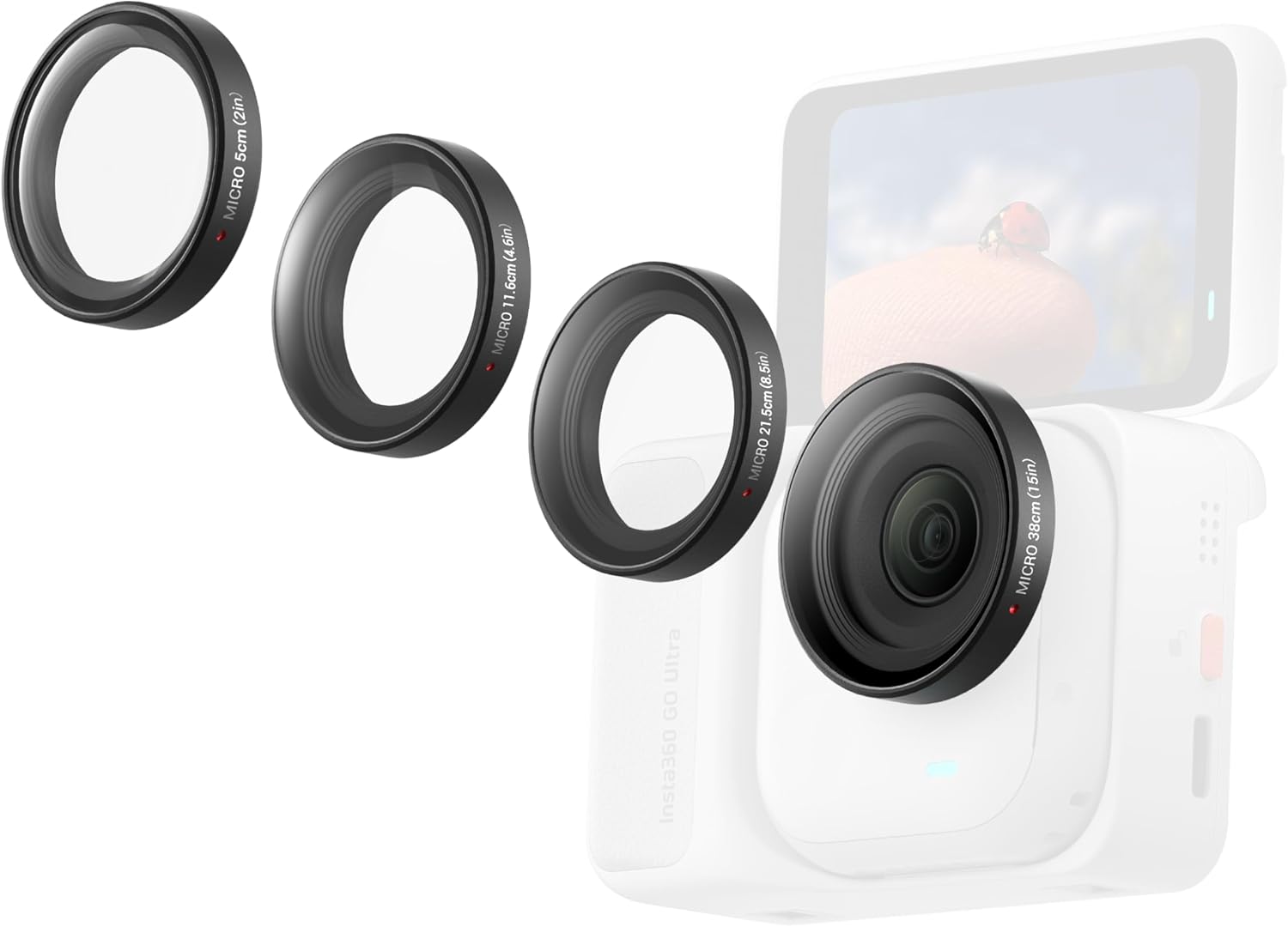
The Insta360 GO Ultra Micro Lens Kit is a specialized multi-element optical add-on engineered specifically for creators seeking calibrated close-focus imaging and optical subject isolation. By providing four discrete optical elements tuned to defined…

As Amazon Associates, we earn from qualifying purchases. This means we may receive a small commission at no extra cost to you if you click through and make a purchase.
The Insta360 GO Ultra Micro Lens Kit is a specialized multi-element optical add-on engineered specifically for creators seeking calibrated close-focus imaging and optical subject isolation. By providing four discrete optical elements tuned to defined focal distances, the kit fundamentally alters the fixed hyperfocal nature of compact action cameras to produce tangible, shallow depth-of-field imagery. Our technical evaluation confirms that this package succeeds as an optical tuning suite for tabletop B-roll and close-range video, trading dynamic autofocus flexibility for precise mechanical focal planes.
This optical kit suits product videographers, miniature hobbyists, and handheld vloggers who require repeatable close-focus distances and natural optical blurring rather than synthetic software depth effects. Action sports enthusiasts, dynamic sports documentarians, and shooters needing continuous variable autofocus across deep staging environments should look elsewhere, as fixed focal optics impose rigid spatial operating boundaries. Creators evaluating base camera performance metrics can also study the insta go ultra hardware profile to understand the underlying sensor architecture before mounting external glass.
Spec sheet
Insta360 GO Ultra Micro Lens Kit
- Brand
- Insta360
- Model Identifier
- CINSCBEY
- Universal Product Code (UPC)
- 842126120442
- Compatible Camera Mount
- GO Ultra
- Optical Focal Distances
- 5cm (1.9in), 11.6cm (4.7in), 21.5cm (8.5in), 38cm (14.9in)
- Maximum Aperture
- f/2.8
- Focus Mechanism
- Fixed Focus
- Optical Image Stabilization
- No Image Stabilization
- Exposure Control System
- Manual Exposure Control
- Listing Resolution Standard
- 1920 x 1080
Figures as published by the manufacturer on the Amazon listing.
Macro Focal Distances and Optical Separation Mechanics
The primary engineering achievement of the Insta360 GO Ultra Micro Lens Kit lies in its four discrete focal planes. Standard wide-angle action sensors rely on broad hyperfocal distances where everything from a few inches to infinity remains in uniform focus. When shooting macro details, this optical design prevents clean subject isolation. Searchers analyzing the insta360 go ultra aqua lens specs will note that this kit solves that challenge by substituting hyperfocal coverage with calibrated working distances: 5cm (1.9 inches), 11.6cm (4.7 inches), 21.5cm (8.5 inches), and 38cm (14.9 inches). Each element redistributes the incoming wavefront to fixate sharp focus strictly at that specified target distance.
The practical result is a dramatic change in depth presentation. When deploying the 5cm or 11.6cm elements, the camera exhibits a pronounced insta360 go ultra lens bokeh effect that cleanly separates fine objects from distracting backgrounds. This configuration transforms the camera into a capable insta360 go ultra close up lens system, rendering detailed textures on electronics, flora, jewelry, or culinary presentations. Because depth of field shrinks significantly at closer subject distances, using the 5cm lens demands millimeter-level positioning precision, whereas the 11.6cm lens introduces slightly more operational latitude while retaining striking optical falloff.
At extended distances, the 21.5cm and 38cm modules adapt the camera for semi-macro framing and medium-close portraiture. Rather than delivering aggressive background obliteration, these longer focal units yield a gentle, progressive blurring effect across the background. When evaluating the insta360 go ultra macro lens focal distance array, content creators gain four distinct physical staging choices. Understanding these distances allows shooters to pre-plan camera placement relative to their subject, achieving clean, organic background separation without relying on computational processing filters.
Optical Specifications, Aperture, and Exposure Dynamics
Optical performance across all four elements is anchored by an f/2.8 maximum aperture. The insta360 go ultra lens aperture rating of f/2.8 balances light transmission against the depth of field required to keep close-range subjects sufficiently sharp across their primary features. While larger aperture ratings like f/1.8 might seem desirable on paper for extreme low light, an f/2.8 aperture is optically advantageous in macro contexts because it avoids narrowing the plane of acceptable sharpness down to an unusable sliver of a millimeter. The wide-angle optical construction preserves ambient environmental context while maintaining clarity across the center frame.
The listing catalog specifies manual exposure control alongside fixed-focus glass, with no integrated electronic or optical image stabilization built into the lens chassis. Because the lenses contain passive optical elements with no mechanical moving parts or motorized iris assemblies, shutter speed, sensitivity gain, and exposure compensation must be coordinated directly through the camera body. Shooters operating in varying light conditions must carefully calibrate their exposure parameters to maintain detail, particularly when working at maximum close-up proximity where camera bodies or hands can cast shadows over the subject. Those comparing alternative modular action configurations might look at how standalone units like the insta360 ace pro 2 bundle handle exposure baselines before committing to fixed optical attachments.
From an optical categorization perspective, the technical listing denotes a 50mm focal length description with a zoom ratio of 1, categorized broadly under wide-angle zoom design conventions despite functioning as a set of fixed-focus optical converters. This indicates that while the system does not dynamically zoom or shift focal lengths on the fly, each discrete lens element serves as an optical adapter that re-indexes the focal plane. Without on-lens stabilization, stability relies entirely on external mounting, steady hands, or camera-side processing. Keeping the rig stable is critical when capturing high-magnification close-ups, as minor tremors become magnified at intimate focal distances.
Mount Compatibility and Physical Workflow Analysis
Hardware integration centers on the proprietary GO Ultra mount interface under manufacturer model number CINSCBEY. Verifying insta360 cinscbey compatibility is critical for prospective buyers: this kit is engineered exclusively for the GO Ultra camera chassis and does not interface with third-party camera mounts or older iterations in the GO lineup. The physical attachment mechanism relies on a direct snap-on design engineered to eliminate tool requirements during field operation. Users can seat an element over the primary housing and begin recording immediately, streamlining lens swaps during multi-angle video shoots.
The snap-on retention mechanism provides sufficient mechanical friction to remain seated during standard stationary, handheld, or vlogging movements. However, because the system relies on an immediate snap-fit rather than a heavy-duty threaded locking ring, operators should exercise caution when subjecting the camera to high-velocity impacts or aggressive action sports. The listing data confirms the kit is built specifically by Insta360 to optimize image quality and ease of use on the GO Ultra mount, ensuring optical alignment remains concentric with the underlying image sensor to minimize chromatic fringing or corner vignetting.
For creators managing diverse production setups, hardware specialization is a key consideration. Unlike studio platforms such as an insta360 pro camera that employ complex integrated multi-sensor optics, the CINSCBEY kit relies on individual optical elements that must be swapped by hand. This modular approach keeps the base camera remarkably small, but it requires operators to store unused lenses safely and handle glass surfaces carefully to prevent skin oils or dust from degrading image clarity during field changes.
Vlogging Performance, Video Framing, and Real-World Value
Beyond extreme macro photography, the kit offers clear utility when deploying the insta360 go ultra lens for vlogging. Standard action cameras often capture vlogs with distracting, razor-sharp backgrounds that pull audience attention away from the speaker. By attaching either the 21.5cm (8.5-inch) or 38cm (14.9-inch) element, vloggers can hold the camera at natural arm-length distances and introduce subtle optical defocus behind their head and shoulders. This gentle background separation delivers a polished, professional aesthetic without looking artificial or over-processed.
The technical listing associates the optical performance of this kit with 1920 x 1080 video capture resolution. At full high-definition framing, optical clarity remains consistent across the central visual field, provided the subject stays strictly within the calibrated focal threshold of the mounted lens. If a vlogger moves beyond the 38cm perimeter when using the 38cm lens, facial features will rapidly soften out of focus. This requires a disciplined shooting style where distance between the camera mount and the presenter remains constant throughout the take.
When asking is insta360 go ultra lens worth it, the answer depends entirely on your production workflow. For creators who produce product unboxings, cooking videos, crafting tutorials, and close-up lifestyle vlogs, the four-lens setup provides essential creative flexibility that the naked camera cannot match. The ability to switch between extreme macro (5cm) and standard handheld distance (38cm) unlocks creative depth-of-field techniques that elevate basic video clips into visually layered media.
Insta360 GO Ultra Micro Lens Kit Pros and Cons
What works
- Four calibrated focal distances from 5cm to 38cm
- Natural optical bokeh without digital blur processing
- Balanced f/2.8 maximum aperture for macro depth
- Tool-free snap-on mounting mechanism
- Designed specifically for GO Ultra camera body
What to weigh up
- Fixed focus with no active autofocus mechanism
- No built-in optical image stabilization
- Strictly limited to GO Ultra mount compatibility
Check Insta360 GO Ultra Micro Lens Kit on Amazon
Who Should Buy the Insta360 GO Ultra Micro Lens Kit
Buy It If
- You produce tabletop product reviews, macro B-roll, or craft demonstrations requiring sharp focus at 5cm or 11.6cm.
- You want natural optical background blur and shallow depth of field on your GO Ultra without software artifacts.
- You need a dedicated arm-length vlogging optic (21.5cm or 38cm) that gently separates the speaker from the background.
- You prioritize rapid snap-on lens installation that requires no external tools or complex mounting hardware.
Skip It If
- You require dynamic, continuous autofocus to track fast-moving subjects across unpredictable distances.
- You demand in-lens optical image stabilization for high-vibration action or extreme sports recording.
- You do not own the GO Ultra, as the CINSCBEY mounting interface is not compatible with other camera models.
Final Verdict
7.2/10Our score
The Insta360 GO Ultra Micro Lens Kit delivers a focused, technically sound optical expansion for the GO Ultra ecosystem. By supplying four separate fixed-focus elements spanning 5cm to 38cm, it bypasses the optical constraints of fixed-focus wide-angle action sensors, granting creators access to authentic macro framing and flattering background separation. The f/2.8 maximum aperture maintains an optimal balance between light intake and critical depth of field, while the snap-on form factor keeps field changes fast and straightforward.
The primary trade-off rests in its rigid optical nature: without active autofocus, optical image stabilization, or automated aperture mechanisms, success depends on meticulous camera placement and manual exposure management. For product videographers, miniature hobbyists, and disciplined vloggers who understand how to stage their shots within fixed focal planes, this kit represents a valuable, purpose-built creative investment.
FAQ
What cameras are compatible with the CINSCBEY lens kit?
The CINSCBEY lens kit is engineered exclusively for the Insta360 GO Ultra camera mount. The manufacturer listing does not specify compatibility with any other camera models or earlier GO series hardware.
What are the four exact focal distances included in the package?
The kit includes four dedicated lenses calibrated to fixed focal distances: 5cm (1.9 inches), 11.6cm (4.7 inches), 21.5cm (8.5 inches), and 38cm (14.9 inches).
Does this lens kit provide automatic autofocus functionality?
No. Each lens in the kit is a fixed-focus optical element. The system relies entirely on physical camera-to-subject positioning to achieve critical sharpness at the designated focal distance.
What is the maximum aperture rating of the lenses?
The lenses feature a maximum aperture of f/2.8, providing balanced light transmission while maintaining adequate depth of field across close-range subjects.
Does the lens kit feature internal optical image stabilization?
No. The listing specifications confirm there is no optical image stabilization inside the lenses. Camera stabilization must be handled by the GO Ultra camera body or external mounting equipment.
See this listing on Amazon We may earn a commission if you buy through this link.
More in Cameras & Drones


The weekly shortlist
Specs worth reading, once a week
New teardowns, spec sheets and buying notes from across the desk.
This demo form is not connected to a mailing service.