Hisense U8 Mini-LED Spec Breakdown: Benchmarking the 75U8QG Panel
The Hisense U8, evaluated here in its 75-inch configuration (model 75U8QG), represents a technically ambitious deployment of Mini-LED Pro backlighting engineered for extreme dynamic range reproduction. Featuring an immense peak brightness ceiling of up…

As Amazon Associates, we earn from qualifying purchases. This means we may receive a small commission at no extra cost to you if you click through and make a purchase.
The Hisense U8, evaluated here in its 75-inch configuration (model 75U8QG), represents a technically ambitious deployment of Mini-LED Pro backlighting engineered for extreme dynamic range reproduction. Featuring an immense peak brightness ceiling of up to 5,000 nits paired with up to 5,600 local dimming zones, this 4K UHD display sets an aggressive benchmark for specular highlight precision and black-level depth. For home theater planners and AV enthusiasts analyzing the hisense u8 2026 specs, the verdict is clear: this panel delivers extraordinary luminance control and daytime visibility that few consumer displays can match.
This television suits dedicated media rooms with uncontrolled ambient sunlight, cinephiles seeking complete HDR format handling, and high-framerate PC or console gamers. Prospective buyers transitioning from entry-level displays like the Hisense U6 Pro will experience an exponential upgrade in dimming zone density, color volume, and reflection handling. However, shoppers requiring ultra-wide off-axis viewing for broad perimeter seating or competitive players demanding sub-millisecond response times should explore alternative display technologies. In addition, those with compact room layouts may find the physical footprint of this 75-inch flat-screen chassis overly demanding.
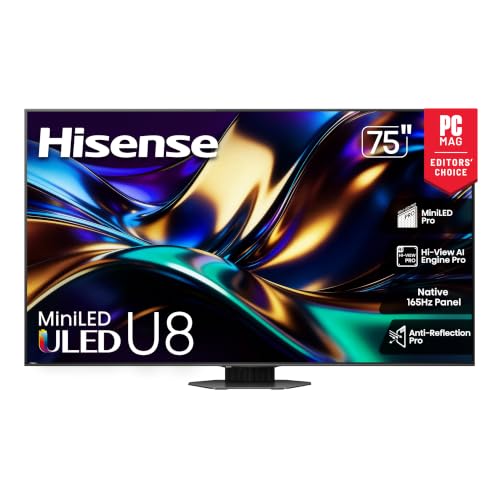
Spec sheet
Hisense U8
- Model Code
- 75U8QG
- Display Format
- 75-inch flat screen, 16:9 aspect ratio
- Resolution
- 4K UHD (3840 x 2160)
- Backlight Type
- Direct LED Mini-LED Pro with Full Array Local Dimming
- Local Dimming Zones
- Up to 5,600 individual zones (LD5600)
- Peak Luminance
- Up to 5,000 nits maximum display brightness
- Refresh Rate
- Native 165Hz (VRR 48Hz to 165Hz, Game Booster 288)
- Color Reproduction
- QLED Quantum Dot Color, Wide Color Gamut, Pantone Validated
- HDR Formats
- Dolby Vision IQ, HDR10+ Adaptive, HDR10, HLG
- Acoustic Output
- 4.1.2 Multi-Channel Surround, up to 82W output, Dolby Atmos
Figures as published by the manufacturer on the Amazon listing.
Luminance and Backlight Architecture: 5,000 Nits and 5,600 Dimming Zones
At the center of the hisense 75u8qg specs is a dense direct LED backlight architecture designated as Mini-LED Pro. By distributing thousands of miniature diodes across the panel, the hardware achieves an exceptional hisense u8 local dimming zones count of up to 5,600 individual clusters. This segmented grid allows the panel to illuminate fine bright elements against pitch-black backgrounds, producing a contrast ratio categorized as extremely high. The high zone density significantly limits haloing and blooming around high-contrast transitions.
When assessing the hisense u8 vs oled comparison, peak luminance remains the primary differentiator. While organic self-emissive displays offer per-pixel shutoff, they enforce aggressive thermal brightness limiting. The Hisense U8 overcomes this with its massive hisense u8 5000 nits peak output, ensuring specular highlights remain vivid and punchy even in bright spaces. To prevent glare in sunlit rooms, Hisense incorporates its Anti-Reflection Pro coating directly into the liquid crystal layer to diffuse ambient reflections without softening picture clarity.
Managing this output requires sophisticated dynamic range execution. Through its Total HDR Solution, the display processes Dolby Vision IQ, HDR10+ Adaptive, HDR10, and HLG. By utilizing onboard ambient light sensors, tone curves adjust dynamically to room conditions. As a result, whether mastering files target 1,000 nits or higher mastering limits, the 5,000-nit headroom avoids clipping, preserving nuanced highlight textures across sky gradients and reflections.
Motion Handling and High-Frame-Rate Gaming Capabilities
The panel introduces elevated frequency headroom with a native hisense u8 165hz refresh rate alongside Game Booster 288 technology. While standard high-end televisions typically cap output at 120Hz or 144Hz, this panel supports high refresh cycles engineered for performance PC setups and modern consoles. Evaluated for anyone considering the hisense u8 2026 for gaming, this 165Hz capability provides noticeably smoother frame tracking and reduced input lag during fast-paced play.
Variable synchronization is equally comprehensive, with hisense u8 vrr performance supported across a native 48Hz to 165Hz window. AMD FreeSync Premium Pro, Auto Low Latency Mode (ALLM), and Low Latency MEMC work in tandem to eliminate screen tearing and minimize latency during sudden framerate fluctuations. Furthermore, the Enhanced Game Bar overlay gives gamers real-time telemetry to monitor live refresh rates, toggle latency settings, and inspect active HDR parameters on the fly.
Motion resolution is reinforced by Motion Rate 480 processing alongside a manufacturer-rated response time of 8 milliseconds. While 8ms is standard for high-output liquid crystal panels, competitive players accustomed to near-instantaneous OLED pixel response may detect slight trailing during rapid camera pans. Nevertheless, the combination of Low Latency MEMC and 165Hz panel driving successfully reduces sample-and-hold blur, delivering fluid tracking across fast-moving sports and gaming content.
Color Science and Processing: Quantum Dots and Hi-View AI Engine Pro
Color rendition relies on QLED Quantum Dot Color technology, which employs microscopic semiconductor nanocrystals to convert blue Mini-LED illumination into saturated primary red and green wavelengths. This optical stack powers a Wide Color Gamut capable of reproducing over one billion distinct shades. The display is also Pantone Validated, ensuring that skin tones, complex gradients, and natural textures adhere strictly to recognized digital production standards.
Processing is managed by the proprietary Hi-View AI Engine Pro chipset, which executes real-time scene analysis to balance depth, sharpness, and shadow detail. When decoding local high-bitrate media files from an external drive such as a Samsung T7 Shield 2TB, the processor cleans up gradient stepping and scales content accurately to the native 4K UHD matrix without creating unnatural edge halos.
Cinematic viewing is supported by dedicated Filmmaker Mode and IMAX Enhanced certification. Filmmaker Mode disables post-processing motion interpolation, artificial sharpening, and forced aspect ratio alterations, showing films exactly as intended at their native 24 frames per second. Simultaneously, IMAX Enhanced certification ensures cinema releases mastered with DTS audio and expanded dynamic profiles render with authentic contrast and theatrical sound reproduction.
Integrated Audio Architecture: The 82W 4.1.2 Multi-Channel System
While ultra-thin flat-panel televisions frequently compromise on sound output, the Hisense U8 integrates an ambitious 4.1.2 multi-channel surround sound system with up to 82W of total audio power. The physical layout features left and right primary front channels, left and right surround channels, dedicated up-firing height drivers, and an integrated subwoofer. This creates a multi-directional soundstage straight from the television cabinet.
With native Dolby Atmos decoding and DTS-powered IMAX Enhanced audio immersion, the up-firing drivers project overhead sound cues off ceilings to simulate spatial effects. For buyers seeking a clean room setup without speaker cables, this 82W array provides clear dialogue and surprising low-frequency authority. However, listeners wanting deeper sub-bass extension or physical rear surround separation can pair the screen with a dedicated sound system like the Hisense AX700 5.1.4 ch soundbar with wireless subwoofer for an expanded acoustic presence.
Hisense U8 Pros and Cons
What works
- Peak brightness reaching up to 5,000 nits
- Up to 5,600 local dimming zones
- Native 165Hz refresh rate with FreeSync Premium Pro
- Comprehensive HDR support including Dolby Vision IQ
- Integrated 82W 4.1.2 multi-channel surround sound
What to weigh up
- Rated panel response time of 8 milliseconds
- Off-axis contrast drop typical of LCD panels
- Substantial 75-inch physical footprint requires significant space
Who Should Buy the Hisense U8
Buy It If
- You watch in bright, sunlit rooms: Delivering up to 5,000 nits and equipped with an Anti-Reflection Pro coating, this panel effectively combats direct sunlight and ambient glare.
- You play on high-framerate PC gaming systems: The native 165Hz refresh rate, 48Hz to 165Hz VRR range, Game Booster 288, and AMD FreeSync Premium Pro deliver fluid gameplay with minimal input lag.
- You require wide HDR format support: Full onboard processing for Dolby Vision IQ, HDR10+ Adaptive, HDR10, and HLG ensures optimal tone mapping across every major streaming service and physical disc.
- You want powerful integrated audio: The built-in 82W 4.1.2 channel speaker array with Dolby Atmos and an integrated subwoofer offers spatial depth without requiring an immediate soundbar.
Skip It If
- You have wide off-axis seating: Despite a rated 178-degree viewing angle, liquid crystal architecture exhibits minor color desaturation and contrast loss when viewed from wide side angles.
- You demand sub-millisecond response times: Competitive esports players seeking absolute zero ghosting may find the 8ms response time slower than dedicated gaming monitors.
- You have limited room space: The physical size of this 75-inch flat-screen chassis demands substantial credenza space or heavy-duty wall mounting.
Final Verdict
4.9 / 5Amazon buyer rating
The Hisense U8 represents a substantial leap in Mini-LED panel design, combining high-intensity light output with granular backlight control. By pairing up to 5,600 local dimming zones with an extraordinary 5,000-nit peak luminance ceiling, the 75U8QG minimizes traditional LCD contrast weaknesses. For buyers considering whether is hisense u8 2026 worth it, the published technical specifications show that it provides reference-grade HDR impact, superb specular detail, and dependable daytime clarity that rival top-tier competitors.
Complementing its illumination engine are a native 165Hz refresh rate, broad VRR protocols, comprehensive HDR format compatibility, and an integrated 82W 4.1.2 audio system. Although shoppers must account for typical LCD viewing angle limits and an 8ms response time, this hisense u8 2026 review confirms that the display delivers a powerful balance of brightness, color accuracy, and high-speed motion performance for discerning home entertainment setups.
FAQ
Does the Hisense U8 support 165Hz gaming on current consoles?
PlayStation 5 and Xbox Series X consoles output at a maximum of 120Hz at 4K resolution. The native 165Hz refresh rate and Game Booster 288 features on the Hisense U8 are utilized when connected to a compatible gaming PC, though console players still benefit from full 120Hz VRR and Auto Low Latency Mode.
How does the 5,000-nit peak brightness affect everyday HDR content?
A peak luminance ceiling of up to 5,000 nits allows the television to render intense specular highlights—such as explosions, sunlight, and reflections—without clipping fine detail. This high output also ensures that HDR imagery remains vibrant and clearly visible in sun-drenched viewing environments.
What is the benefit of having up to 5,600 local dimming zones?
Having up to 5,600 local dimming zones allows the Mini-LED Pro backlight to control light across small clusters on the 75-inch screen. This granular control allows the panel to display deep blacks right alongside bright objects, significantly reducing haloing or blooming around subtitles and high-contrast edges.
Can the built-in 4.1.2 channel audio replace an external soundbar?
With an 82W total output, dedicated primary speakers, surround drivers, up-firing Dolby Atmos height channels, and an integrated subwoofer, the Hisense U8 provides significantly better clarity and bass than standard flat-screen TV speakers, making an external soundbar optional for casual viewing.
What operating system and HDR formats are included on the 75U8QG?
The 75U8QG runs the Smart Google TV platform for streaming content, navigation, and app support. For high dynamic range playback, it incorporates Hisense’s Total HDR Solution, supporting Dolby Vision IQ, HDR10+ Adaptive, HDR10, and HLG.
See this listing on Amazon We may earn a commission if you buy through this link.
More in TV & Home Theater



The weekly shortlist
Specs worth reading, once a week
New teardowns, spec sheets and buying notes from across the desk.
This demo form is not connected to a mailing service.