Topmaxions Google Cardboard VR Specs, Compatibility & Hardware Breakdown
The Topmaxions Google Cardboard is a flat-pack mobile stereoscopic enclosure designed to convert everyday modern smartphones into basic virtual reality viewers. Operating on the open-source spatial architecture pioneered by Google, this unit incorporates precision…
As Amazon Associates, we earn from qualifying purchases. This means we may receive a small commission at no extra cost to you if you click through and make a purchase.
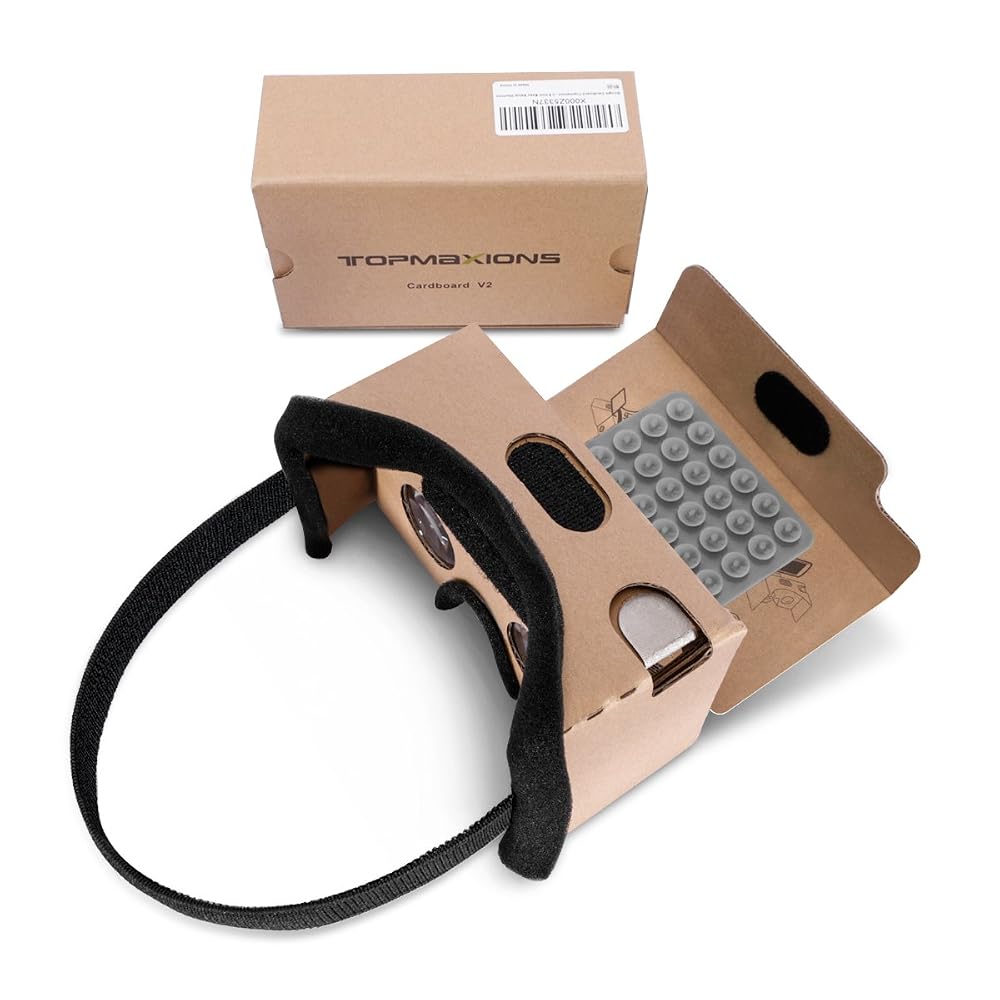
The Topmaxions Google Cardboard is a flat-pack mobile stereoscopic enclosure designed to convert everyday modern smartphones into basic virtual reality viewers. Operating on the open-source spatial architecture pioneered by Google, this unit incorporates precision die-cut paperboard, optical viewing elements, and an integrated capacitive trigger system to present split-screen interactive environments. For mobile device owners seeking an immediate, low-barrier hardware viewer to inspect stereoscopic photos, spatial 3D movies, or basic classroom demonstrations, this enclosure provides functional core utility without the operational setup required by dedicated consumer hardware.
This entry-level kit suits students, software developers evaluating baseline stereoscopic UI deployments, and casual hobbyists who require an ultra-portable viewer for short-duration sessions. Those seeking high-refresh visual pipelines, low-latency room-scale tracking, or long-term hardware rigidity should bypass folding paperboard assemblies entirely and investigate dedicated standalone computing hardware such as the vr headset meta quest 3. As an analytical assessment of published technical specifications reveals, mechanical alignment and device chassis dimensions dictate the ceiling of the viewer experience.

Spec sheet
Topmaxions Google Cardboard
- Compatible Screen Dimensions
- 3.5 inches to 6.0 inches
- Optical Field of View
- 100 degrees
- Internal Display Maximum Resolution
- 1280 x 720
- Chassis Material and Finish
- Pre-cut cardboard with sweatproof treatment
- Device Retention System
- Non-marring suction cup mounting array
- Interactive Control Type
- Triangular wing capacitive screen contact mechanism
- Facial Ergonomics
- Dedicated sponge forehead pad and sponge nose pad
- Head Strap System
- Lengthened elastic tension headband
- Platform Compatibility
- Android and Apple iOS mobile devices
- Power and Connectivity Data
- USB connector, 1 battery required, 2.6 amp_hours capacity, 4 hours average life
Figures as published by the manufacturer on the Amazon listing.
Chassis Compatibility and Suction Retention Mechanics
Evaluating real-world google cardboard vr headset compatibility requires examining internal phone tray clearances and retention mechanics. The Topmaxions unit accommodates handsets ranging from 3.5 inches up to 6.0 inches in diagonal screen measurement. This bracket covers smaller legacy smartphones alongside standard modern handsets, although devices exceeding 6.0 inches will face structural frame overhang. For users seeking a mobile vr viewer 6 inch phone configuration, the enclosure limits physical lateral space, meaning protective outer bumpers or thick rubberized cases must be removed prior to seating the phone inside the tray.
Phone stability inside the chassis relies on a specialized google cardboard suction cup mount located on the drop-down interior flap. Unlike older iteration viewers that relied solely on friction or hook-and-loop closures to trap the handset, the suction matrix adheres directly to the backplate of the mobile device. This suction array serves two distinct functions: preventing the phone from shifting off-axis during rapid head movement and protecting polished chassis materials from frictional abrasion against raw cardboard edges. Smooth glass-backed phones achieve optimal seal integrity, whereas handsets sporting textured matte finishes, faux leather, or high-relief camera bumps may experience uneven suction contact.
Whether utilized as a cardboard vr headset for android or an entry-level cardboard vr headset for iphone, visual centering remains entirely manual. Because the viewer lacks mechanical centering pins or sliding clamp trays, the user must align the split-screen divider rendered on the smartphone screen with the structural center partition of the cardboard frame. Minor alignment errors introduce optical parallax, resulting in immediate eye strain. Ensuring clean adherence to the suction array while visually centering the handset screen is mandatory for maintaining optical stability.
Optical Configuration and Field of View Performance
The optical system of the Topmaxions assembly determines overall visual immersion and geometric distortion. The product specifications list an optical google cardboard field of view rated at 100 degrees. In mobile stereoscopic viewers, reaching the stated 100-degree field of view depends directly on using a screen near the upper physical threshold of 6.0 inches. When pairing smaller 3.5-inch to 4.5-inch displays with the fixed bi-convex lenses, the structural edges of the phone display become visible inside the peripheral frame, effectively reducing visual immersion and narrowing the perceived viewing angle.
Visual fidelity is intrinsically bounded by both the inserted handset and the optical limitations specified in the google cardboard vr headset specs. While the product listing registers a display maximum resolution of 1280 x 720, the actual pixel density delivered to the retina is governed by the host smartphone display divided across two eyes. Fixed-focal lenses magnify the subpixel structure of the inserted panel, making display panel resolution critical. Premium dedicated tethered solutions like the htc vive pro 2 vr headset utilize custom multi-element optics and physical interpupillary distance adjustments to eliminate chromatic aberrations; by comparison, this cardboard optical stack features fixed lens cutouts without individual focal or interpupillary distance calibration.
Users who fall outside the standard adult interpupillary range may observe edge blur and optical fringing around the outer thirds of the visual frame. The simple bi-convex lens profile provides acceptable center-point clarity for static imagery and panoramic video, but fast panning introduces noticeable barrel distortion along the edges. Maintaining optimal image clarity requires aligning the smartphone display precisely parallel to the lens plane, relying on the internal suction pad to prevent physical tilt.
Capacitive Input Systems and Control Hardware
Interactive spatial media requires a functional method to register user clicks within virtual applications. The Topmaxions unit implements an updated google cardboard capacitive input system, replacing the temperamental magnetic pull-rings found on legacy Google Cardboard v1 units. The physical control operates via flexible triangular wings that press inward from the exterior chassis. When depressed, conductive material routed through the wing makes physical contact with the handset display screen, transmitting the capacitive electrical pulse of the user’s hand directly into the software interface.
This mechanical touch architecture resolves fundamental compatibility shortcomings inherent to earlier magnetic toggle designs. Magnetic switches relied on an onboard digital magnetometer to register tiny fluctuations in magnetic fields, which frequently conflicted with phone sensor orientation loops. The direct capacitive mechanism works universally across both capacitive touchscreens regardless of manufacturer or internal sensor layout. The mechanism registers single-tap actions cleanly, handling core interactions such as pausing stereoscopic 3D movies, advancing educational slideshows, and firing primary inputs in casual games.
Technical product specifications also note sensor associations alongside electrical metrics, citing accelerometer, gyroscope, and magnetometer compatibility, alongside a USB connector profile and a 2.6 amp_hours battery specification with a 4-hour operational duration. Within standard smartphone VR frameworks, positional orientation is processed entirely by the internal inertial measurement unit of the docked smartphone rather than active electronic boards inside the paperboard. The listing does not clarify whether the battery specification refers to an external auxiliary support element or a baseline handset consumption rating, but the passive mechanical capacitive trigger itself requires zero electrical charging to operate.
Ergonomic Enhancements and Chassis Durability
Structural wear and facial discomfort represent primary engineering vulnerabilities in traditional cardboard viewers. Topmaxions addresses contact stress by integrating targeted sponge cushioning across critical facial touchpoints. A dedicated sponge nose pad and forehead pad distribute resting pressure across the nasal bridge and brow line. Standard unpadded paperboard edges often cut sharply into skin under the downward weight of an inserted mobile device; the added foam barriers mitigate chafing during extended educational or viewing applications.
Facial perspiration represents another significant point of degradation for any diy cardboard vr headset. Raw paperboard rapidly absorbs skin oils and facial moisture, leading to structural softening and cosmetic discoloration. This model incorporates a sweatproof protective barrier across its cardboard exterior, extending chassis rigidity against moderate humidity and moisture. While significantly more resilient than basic corrugated paper, it remains an organic cellular material that will degrade if exposed to heavy moisture or improper storage.
Hands-free retention is managed via an elongated elastic headband. Early cardboard specifications forced users to hold the viewer up to their eyes manually to prevent disorientation and sudden head-turning nausea. The inclusion of an adjustable, lengthened strap secures the chassis against the head, allowing passive media playback without hand fatigue. However, because the front tray carries the entirety of the mobile phone weight without a rigid counterbalancing rear battery pack, the center of gravity sits far forward on the facial cheekbones, necessitating occasional manual adjustment during longer use.
Software Ecosystem and Spatial Utility
Understanding whether a platform fits a user workflow requires answering a fundamental baseline question: is google cardboard vr headset worth it for standard media tasks? The hardware functions entirely within mobile VR software frameworks supported by Android and iOS app stores. Compatible applications include YouTube VR 360-degree video streaming, stereoscopic split-screen video players, mobile museum walkthroughs, and entry-level cardboard games available across app ecosystems.
Unlike wearable micro-OLED optical glasses such as google glasses smart glasses 2026 wearable concepts that overlay transparent digital data onto the physical world, the Topmaxions viewer provides an enclosed, fully occluded stereoscopic chamber. It functions as an isolated dark room for your mobile screen. For home entertainment enthusiasts who consume media via hardware like the onn 4k plus streaming device on flat televisions, this viewer presents an entirely distinct experience, isolating each eye to create stereoscopic depth perception from dual-rendered video files.
However, software capabilities remain limited to three degrees of freedom (3DoF). The docked smartphone tracks rotational movement—pitch, roll, and yaw—via its internal gyroscope and accelerometer, but cannot detect translational movement through physical space. Users cannot lean forward, duck, or walk through virtual environments without causing visual-vestibular mismatch. Consequently, the Topmaxions hardware is strictly optimized for stationary seated or standing experiences where the user remains at the rotational center of the virtual camera.
Topmaxions Google Cardboard Pros and Cons
What works
- Integrated sponge forehead and nose cushioning
- Suction cup array prevents phone slippage
- Triangular wing capacitive input mechanism
- Wide 100-degree field of view
- Extended elastic headband for hands-free use
What to weigh up
- Cardboard construction degrades with heavy perspiration
- No manual interpupillary or focal distance adjustments
- Limited to phones under six inches
Check Topmaxions Google Cardboard on Amazon
Who Should Buy the Topmaxions Google Cardboard
Buy It If
- You need a low-friction, disposable viewer to experience short 360-degree videos, mobile stereoscopic media, or Google Expeditions classroom modules.
- You own a smartphone with a screen size between 3.5 inches and 6.0 inches sporting a smooth glass backplate compatible with suction mounting.
- You want hands-free operation and facial cushioning without paying for complex electronics or active computing hardware.
- You require an easily packable, lightweight spatial testing frame for entry-level mobile application development.
Skip It If
- Your primary smartphone measures larger than 6.0 inches diagonally or features a thick, non-removable protective outer casing.
- You demand adjustable interpupillary distance, independent lens focal depth sliders, or optical diopter correction for prescription eyewear.
- You expect six-degree-of-freedom positional tracking, high-end PC VR gaming, or active motion controllers.
Final Verdict
3.6 / 5Amazon buyer rating, 3,022 ratings
The Topmaxions Google Cardboard delivers a practical, functionally enhanced adaptation of standard open-source mobile stereoscopic hardware. By resolving historical comfort pain points through the integration of sponge forehead and nasal pads, extending the head strap for hands-free positioning, and substituting mechanical pull-magnets with a direct capacitive wing trigger, it refines the basic paper viewer format. The internal suction cup grid provides effective stabilization for compatible smartphones under 6.0 inches, securing the handset against sudden slippage during rotational head movement.
Nevertheless, hardware buyers must evaluate the unit against the strict physical and optical limits of mobile VR enclosures. The absence of mechanical lens adjustment mechanisms means visual clarity remains entirely dependent on how closely a user’s facial anatomy aligns with the fixed optical geometry. For lightweight spatial experimentation, 3D video playback, and academic demonstrations, the Topmaxions kit provides reliable entry-level baseline utility, provided your smartphone meets its exact chassis dimension requirements.
FAQ
What phones fit inside the Topmaxions Google Cardboard tray?
The viewer accommodates smartphones with diagonal screen sizes ranging between 3.5 inches and 6.0 inches across both Android and Apple iOS platforms. Handsets exceeding 6.0 inches or devices equipped with heavy-duty protective cases will not seat correctly within the internal retention bay.
How does the capacitive input button function without electronics?
The input control utilizes flexible triangular wings lined with conductive contact material. When pressed inward, the wing contacts the smartphone capacitive touchscreen, simulating a physical finger tap on the glass to trigger software actions without internal batteries or Bluetooth pairing.
Can you wear prescription eyeglasses while using this viewer?
The interior chamber width is constrained by the folding cardboard frame and does not incorporate dedicated temple cutouts for standard eyeglasses frames. Users who require strong optical correction may experience uncomfortable frame contact against the cardboard edges and lenses.
Does the viewer provide six-degree-of-freedom tracking?
No, the unit provides strictly three-degree-of-freedom rotational tracking powered by your docked smartphone internal gyroscope, accelerometer, and magnetometer. It tracks rotational head movement but does not register forward, lateral, or vertical body translation.
How do the internal suction cups protect the phone?
The internal suction matrix firmly grips the flat rear surface of the smartphone, holding it flush against the chassis door to prevent downward slipping during head tilt while shielding the phone finish from direct abrasive friction against raw cardboard surfaces.
See this listing on Amazon We may earn a commission if you buy through this link.
More in Audio


The weekly shortlist
Specs worth reading, once a week
New teardowns, spec sheets and buying notes from across the desk.
This demo form is not connected to a mailing service.