Educational Insights GeoSafari Jr. Talking Microscope Analysis
The GeoSafari Jr. Talking Microscope is an early-learning slide viewer manufactured by Learning Resources under the Educational Insights brand, built to give preschoolers a tactile introduction to scientific inquiry without the frustration of complex…

As Amazon Associates, we earn from qualifying purchases. This means we may receive a small commission at no extra cost to you if you click through and make a purchase.
The GeoSafari Jr. Talking Microscope is an early-learning slide viewer manufactured by Learning Resources under the Educational Insights brand, built to give preschoolers a tactile introduction to scientific inquiry without the frustration of complex focal adjustments. Engineered as an interactive audio viewer rather than a traditional optical compound magnifier, the unit pairs illuminated specimen imagery with scientific audio voiced by Wildlife Warrior Bindi Irwin. For caregivers and preschool educators who need an accessible, frustration-free science tool that reinforces animal and plant identification through narrated facts and interactive questions, it serves as a reliable introductory station.
This viewer is exceptionally well matched for children ages three to five who are building foundational observation habits, fine-motor control, and vocabulary through self-directed play. However, families seeking an authentic magnification instrument capable of analyzing custom outdoor specimens, pond water droplets, or home-prepared slides should look elsewhere, as the unit relies solely on a proprietary library of fixed slide images.
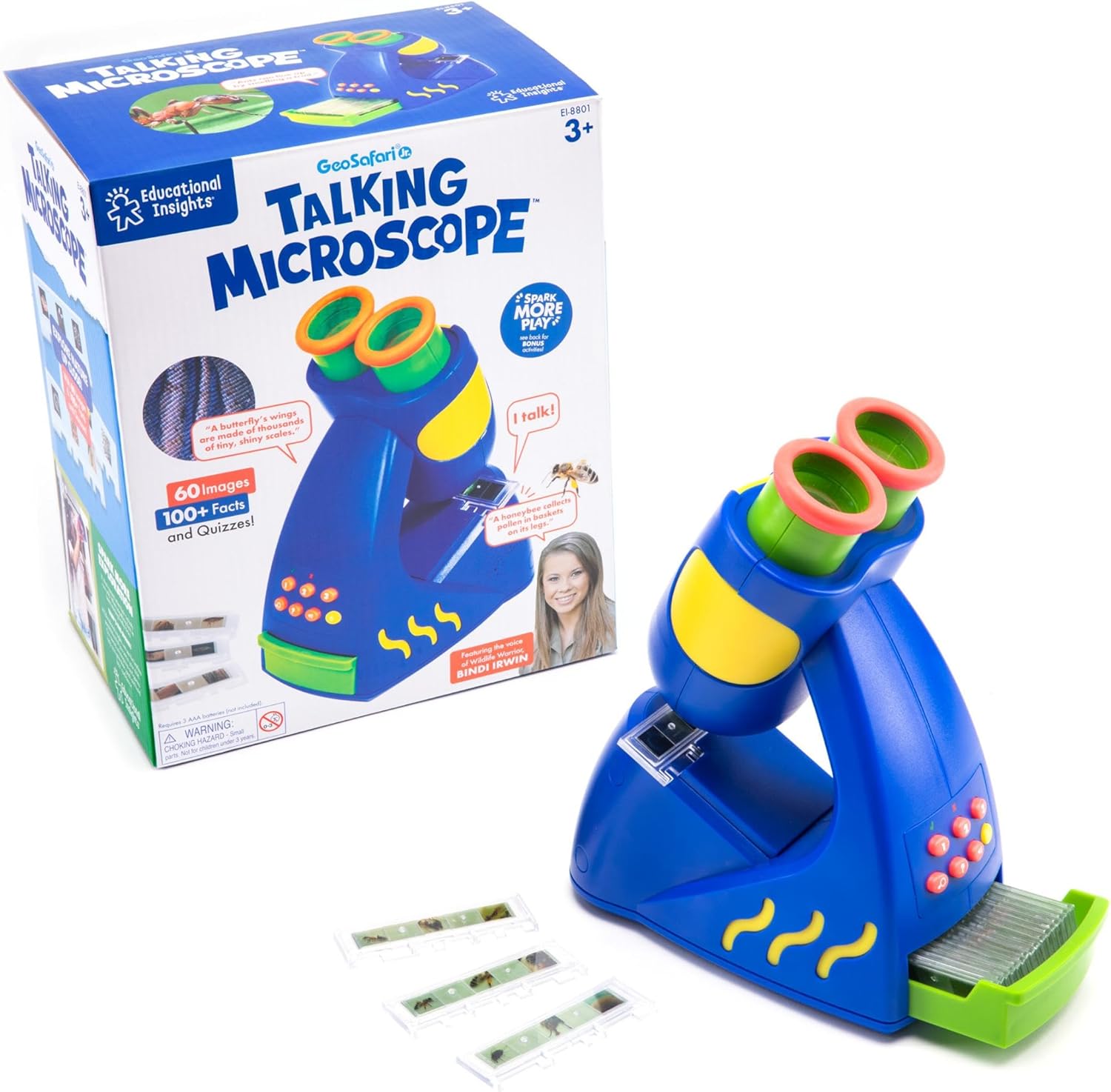
Spec sheet
GeoSafari Jr. Talking Microscope
- Brand Name
- Educational Insights
- Manufacturer
- Learning Resources
- Model Number / MPN
- 8801
- Global Trade Identification Number (GTIN)
- 00086002088017
- Target Age Designation
- Ages 3+ (Preschool) / 4 to 8 years (Manufacturer recommended age)
- Visual Content Library
- 20 pre-prepared slides with 60 full-color images (3 images per slide)
- Audio Programming
- Voiced by Bindi Irwin (over 100 facts and quiz questions)
- Language Support
- English, Spanish, French, German
- Power Requirements
- 3 AAA batteries (not included)
- Manufacturer Warranty
- 1 Year Warranty Against Manufacturer Defects
Figures as published by the manufacturer on the Amazon listing.
Optical Interface and Dual Eyepiece Ergonomics
Evaluating the hardware framework of early childhood educational tools requires a close look at accessibility, and the optical interface is where the geosafari jr talking microscope specs diverge sharply from traditional hobbyist microscopes. Instead of a single monocular ocular tube that forces a young child to close one eye—a motor skill that many three-year-olds have not yet mastered—the unit incorporates two wide, soft-rimmed eyepieces. This binocular viewing hood allows children to keep both eyes wide open while viewing the illuminated slide deck, eliminating the squinting, facial strain, and spatial disorientation that routinely cause young children to abandon standard lab microscopes.
The internal optical path is completely fixed, operating without focusing wheels, rack-and-pinion elevation gears, or sensitive objective lenses. When examining the geosafari jr talking microscope for toddlers, this fixed-focus design is an intentional engineering choice that guarantees the specimen image remains crisp and centered every single time a slide is inserted. For caregivers who have attempted to guide a toddler through the micro-focusing process of an entry-level biological tool like a my first microscope station, the complete absence of manual optical calibration on this unit prevents blurred optics and eliminates user error entirely.
The viewing stage features an intuitive slide recess where young operators slide the broad visual cartridges into place horizontally. Because the viewer relies on pre-aligned internal lenses rather than variable optical magnification, children experience none of the frustrating dark rings, spherical aberration, or optical misalignment typical of low-cost biological lenses. The physical interface instead acts as a structured image frame, providing immediate visual reinforcement the moment the child peers into the comfort-molded goggles.
Slide Library Architecture and Visual Assets
The core visual curriculum of the unit depends entirely on the proprietary geosafari jr talking microscope slides included in the package. The system ships with 20 pre-prepared plastic slide strips, with each individual slide containing three distinct full-color photographic images, producing a total archive of 60 scientific visuals. These images cover a wide spectrum of natural science categories, incorporating high-resolution images of living plants, wild animals, insects, and recognizable household objects that provide real-world context for young observers.
Operating the educational insights geosafari talking microscope involves a tactile indexing process that aids fine motor development. To inspect a slide, the child slots the plastic strip into the front receiver tray and advances it manually through three distinct detent stops. Each stop aligns one of the three photo cells directly beneath the internal optical pathway while simultaneously registering the slide position with the internal tracking hardware, ensuring the visual subject directly matches the accompanying audio narration.
Because the slides are manufactured from rigid, durable plastic rather than fragile glass or delicate acrylic slips, they withstand dropping, forceful insertion, and sticky toddler fingers without cracking or scratching. The major functional constraint of this architecture is its closed-loop nature. Because the system relies exclusively on these proprietary formatted visual cards, young learners cannot place real leaves, insect wings, or fabric swatches onto the stage. The viewer functions purely as a curated photographic slide station rather than an open-ended scientific magnification stage.
Audio System, Language Modes, and Quiz Mechanics
The auditory learning engine sets this hardware apart from silent optical viewfinders. Voiced by Wildlife Warrior Bindi Irwin, the system comes loaded with more than 100 spoken facts and interactive quiz prompts stored on an internal audio chip. Sound output is driven through an integrated speaker grille on the chassis base, delivering clear, natural speech designed to keep early learners actively listening while their eyes remain focused on the slide image.
The console features two primary operation settings toggled via top-mounted physical buttons: Fact Mode and Quiz Mode. In Fact Mode, inserting and indexing a slide triggers descriptive biological facts outlining the animal or plant on display, explaining behaviors, habitats, and distinctive physical traits. In the geosafari talking microscope quiz mode, the device transforms into a responsive trivia console, posing targeted questions about the displayed image and asking the child to confirm observations or recall details by pressing the corresponding input buttons on the platform.
While older students might interact with high-tech input peripherals like quest pro controllers in secondary STEM classrooms, younger learners benefit from direct, tactile button presses that connect audio responses to static visual scenes. Furthermore, the standard model includes four built-in language settings—English, Spanish, French, and German—accessible via a switch mechanism. This multilingual firmware expands the utility of the hardware beyond introductory biology into early second-language acquisition, allowing bilingual households and immersion classrooms to toggle spoken content seamlessly.
Chassis Engineering, Power Demands, and Storage Integration
The physical body of the geosafari jr talking microscope model 8801 is molded from high-impact thermoplastic with a wide, flared pedestal base designed to resist tipping during aggressive table play. The low center of gravity prevents the unit from falling over when children lean their full upper-body weight against the dual eyepieces. Every transition edge is smoothed to prevent pinches, and the tactile buttons are oversized to accommodate developing hand-eye coordination and limited grip strength.
Regarding power delivery, the geosafari jr talking microscope battery requirements call for 3 AAA alkaline batteries, which are not included in the standard retail box. The battery compartment is recessed beneath the base platform and secured behind a threaded screw terminal, preventing young children from accessing the battery cells. Power management is optimized around short, sporadic play sessions; the device shuts off audio and illumination after periods of inactivity to prevent premature drain of the three cells.
One of the most practical engineering touches on the model 8801 chassis is the integrated slide storage bay. Because loose educational components are prone to disappearing in home and classroom environments, the rear base of the microscope houses an onboard storage rack designed to hold all 20 slide cartridges securely. When addressing the wide geosafari jr talking microscope age range—which officially lists children ages 3+ on packaging but spans a manufacturer recommended age of 4 to 8 years—this self-contained footprint ensures that young users can independently set up, cycle through, and clean up their observation station without adult intervention.
GeoSafari Jr. Talking Microscope Pros and Cons
What works
- Dual-eyepiece setup eliminates squinting and eye fatigue
- Sixty full-color images across twenty durable slides
- Over one hundred audio facts voiced by Bindi Irwin
- Four built-in language settings for multilingual learning
- Integrated rear storage compartment keeps all slides organized
What to weigh up
- Proprietary slide format cannot view custom specimens
- Requires three AAA batteries that are not included
- No variable optical magnification adjustment knobs
Check GeoSafari Jr. Talking Microscope on Amazon
Who Should Buy the GeoSafari Jr. Talking Microscope
The model 8801 serves a very specific niche in early childhood educational hardware. Identifying whether it fits your home or classroom depends on whether you value structured, self-guided audio lessons or open-ended physical magnification.
Buy It If
- You need a frustration-free introductory science station for toddlers or preschoolers who struggle with closing one eye on standard monocular eyepieces.
- You want a completely self-contained STEM toy with integrated onboard storage that keeps all twenty slide cartridges organized in one footprint.
- You value multilingual audio support, allowing children to hear science facts and quiz challenges in English, Spanish, French, or German.
- You prefer durable, drop-resistant plastic slide cartridges over fragile glass or delicate specimen collection tools for everyday play.
Skip It If
- Your child wants to collect real-world physical specimens like flower petals, hair strands, or water drops to inspect under true adjustable magnification.
- You are seeking a silent, battery-free optical viewer that does not require 3 AAA cells to power audio playback and stage lighting.
- Your student is already beyond the foundational animal identification stage and requires advanced biological terminology or field microscope capabilities.
Final Verdict
9.2/10Our score
When asking if the geosafari jr talking microscope is worth it, the answer depends entirely on aligning parental expectations with the unit’s technical strengths. The GeoSafari Jr. Talking Microscope is not a laboratory magnification tool; it is an interactive audio slide viewer engineered to eliminate the physical barriers that make standard microscopes inaccessible to three-, four-, and five-year-olds. By pairing a comfortable dual-eyepiece viewing hood with high-resolution animal and plant imagery, Educational Insights has built a bridge between toy-based tactile play and introductory biological observation.
The inclusion of Bindi Irwin’s clear narration, two interactive gameplay modes, four international languages, and onboard slide storage makes model 8801 a robust, low-maintenance STEM investment for preschool playrooms. As long as buyers understand that it functions as a curated photographic slide station rather than an adjustable field magnifier, this talking microscope delivers an engaging, durable, and highly educational learning experience that nurtures early scientific curiosity.
FAQ
What are the exact battery requirements for the GeoSafari Jr. Talking Microscope?
The microscope requires 3 AAA alkaline batteries, which are not included in the packaging. The battery bay is located on the underside of the base platform and is secured with a safety screw to ensure young children cannot open the power compartment during use.
Can children examine their own slides or real-world objects with this viewer?
No, the unit is engineered exclusively to read the 20 proprietary slide cartridges included in the box. Because there is no adjustable optical stage or variable focusing barrel, the internal lens configuration cannot focus on custom glass slides, physical bugs, leaves, or liquids.
What age group is the GeoSafari Jr. Talking Microscope best suited for?
The product packaging indicates ages 3+, while the manufacturer recommended age specification spans 4 to 8 years. Due to the fixed-focus binocular goggles and foundational trivia content, the viewer is ideal for children aged 3 to 5 years, while children over age 6 may outgrow the fixed slide collection quickly.
How do the Quiz Mode and Fact Mode differ during play?
In Fact Mode, the child inserts a slide to hear descriptive biological information and fun facts about the displayed subject voiced by Bindi Irwin. In Quiz Mode, the device turns into an active listening game, asking the child questions about what they see on the slide and prompting them to press buttons on the console to answer.
Which languages are supported on the model 8801 microscope?
The standard model 8801 firmware includes four selectable audio languages: English, Spanish, French, and German. Caregivers can toggle the language switch on the unit to expose young children to science vocabulary in multiple spoken dialects.
See this listing on Amazon We may earn a commission if you buy through this link.
More in Optics & Outdoors


The weekly shortlist
Specs worth reading, once a week
New teardowns, spec sheets and buying notes from across the desk.
This demo form is not connected to a mailing service.