Canon PowerShot SD1400 IS Architectural and Sensor Performance Analysis
The Canon PowerShot SD1400 IS is an ultracompact digital camera engineered around a 14.1-megapixel 1/2.3-inch CCD image sensor and a versatile 28mm wide-angle lens with 4x optical zoom. Designed for extreme pocket portability without…

As Amazon Associates, we earn from qualifying purchases. This means we may receive a small commission at no extra cost to you if you click through and make a purchase.
The Canon PowerShot SD1400 IS is an ultracompact digital camera engineered around a 14.1-megapixel 1/2.3-inch CCD image sensor and a versatile 28mm wide-angle lens with 4x optical zoom. Designed for extreme pocket portability without abandoning hardware-based stabilization, the camera packs dedicated optical image stabilization and 720p HD movie capture into a slim, black chassis. Our architectural assessment indicates that this model serves as an uncompromising snapshot device that prioritizes baseline color fidelity and rapid pocket deployment over manual exposure depth.
This camera suits technical enthusiasts and casual documentarians who demand a genuinely pocketable chassis with optical stabilization for everyday daylight captures and casual framing. However, photographers seeking manual exposure controls, wide aperture optics for low-light performance, or modular lens systems should bypass this fixed-lens compact and investigate more advanced options such as the canon powershot sx740 hs or dedicated mirrorless systems.
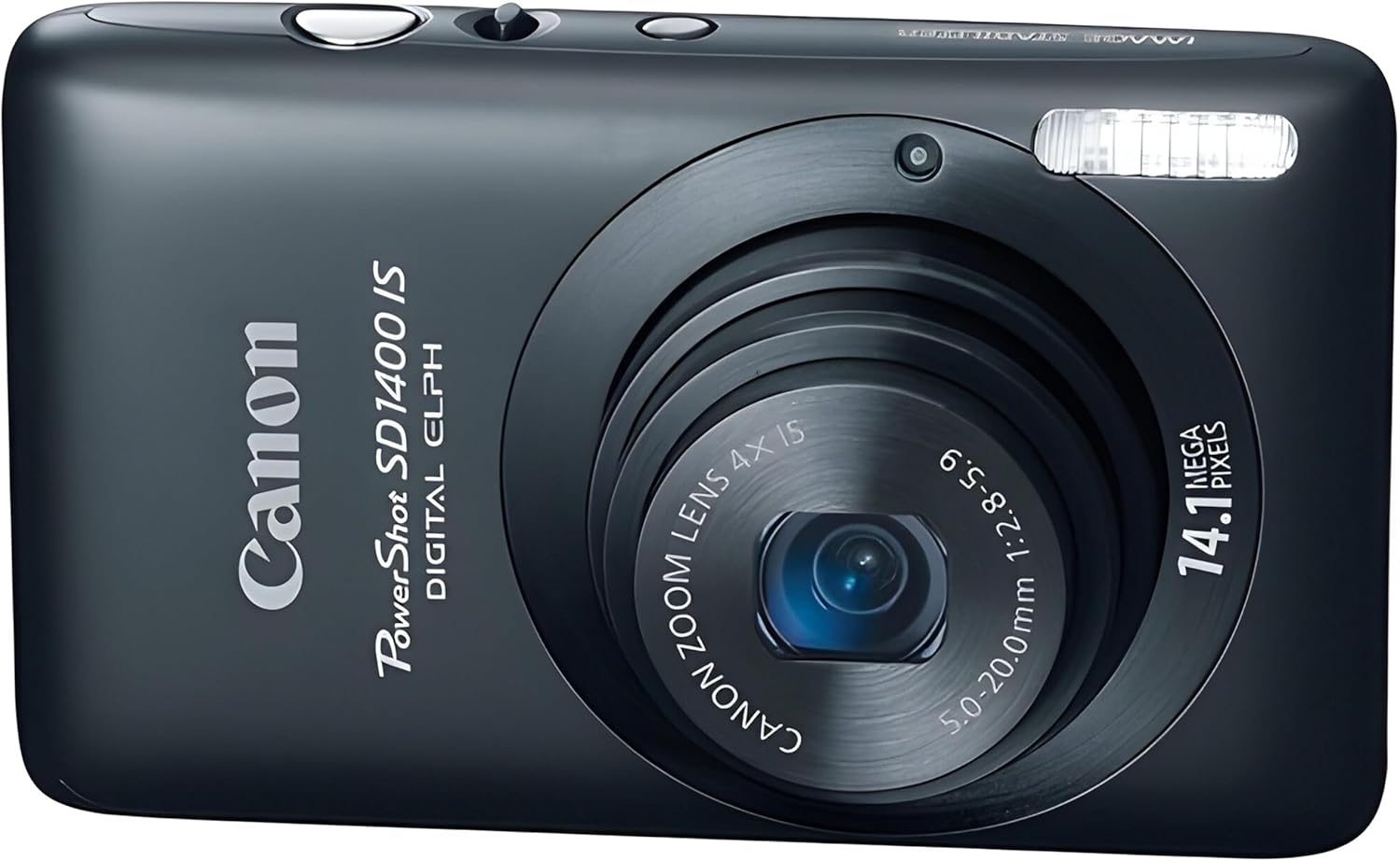
Spec sheet
Canon PowerShot SD1400 IS
- Photo Sensor Resolution
- 14.1 Megapixels (14 MP effective still resolution)
- Sensor Type & Size
- CCD, 1/2.3-inch format
- Optical Zoom & Focal Length
- 4x optical zoom, starting at 28mm wide-angle
- Image Stabilization
- Optical Image Stabilizer
- Display
- 2.7-inch PureColor System LCD
- Shutter Speed Range
- 15 seconds to 1/1500 seconds
- Maximum Aperture
- 2.8 millimeters
- ISO Sensitivity Range
- Expanded ISO 80 minimum
- Video Capture Resolution
- 720p HD movie capability with HDMI output
- File Format & Aspect Ratio
- RAW file format, 3:2 native aspect ratio
Figures as published by the manufacturer on the Amazon listing.
Sensor Architecture and Resolution Dynamics
Analyzing the core imaging pipeline reveals that the Canon PowerShot SD1400 IS sensor size is configured around a classic 1/2.3-inch CCD footprint. Packing 14.1 megapixels onto a sensor of this physical scale yields a remarkably dense pixel pitch. In daylight environments, this dense CCD array generates vibrant color rendering and sharp geometric rendering across its native 3:2 aspect ratio, capturing fine architectural details with clean daylight separation. When examining the broader Canon PowerShot SD1400 IS specs, the inclusion of RAW file format recording is an exceptional asset for an ultracompact body, granting technical users the latitude to calibrate white balance, pull highlights, and manage chroma noise during post-processing rather than relying entirely on embedded JPEG compression routines.
CCD architecture behaves distinctly differently from modern CMOS sensors, specifically in how charge transfer registers process electron wells across the silicon surface. The base sensitivity floor, starting at expanded ISO 80, allows photographers to lock in exceptionally clean exposures under bright ambient light without running into premature signal-to-noise deterioration. Unlike older generation predecessors like the canon elph sd600, the 14.1-megapixel resolution threshold provides ample cropping headroom for reframing mid-range subjects, provided the user shoots within the optimal sensory envelope of abundant lighting.
The inherent physical constraint of the 1/2.3-inch form factor becomes apparent once luminance levels drop. Small photosites exhibit reduced dynamic range in high-contrast scenes, making highlight recovery challenging if direct sunlight blows out specular reflections. Nevertheless, the combination of a CCD sensor with RAW output delivers a distinct, organic rendering style that technical compact camera purists actively appreciate for daylight documentation.
Optical System and Image Stabilization
The optical assembly in this camera pairs a 28mm wide-angle perspective with a 4x optical zoom mechanism, delivering a practical field-of-view spread for environmental portraits, architecture, and interior environments. The 28mm wide-angle profile prevents the visual crowding common to older subcompacts that forced users into narrower 35mm fields of view. Operating the Canon PowerShot SD1400 IS optical zoom transitions smoothly through its mechanical focal path, maintaining edge-to-edge frame integrity with minimal optical distortion through the center glass elements.
A critical engineering triumph in this ultracompact chassis is the integrated optical image stabilization system. Hardware-level Canon SD1400 IS image stabilization relies on an internal shift-lens element that actively counters angular camera shake during the exposure cycle. This physical counter-movement is indispensable given the camera’s lightweight form factor, which otherwise lacks the rotational inertia needed to stabilize hand movements naturally. When contrasted with non-stabilized alternatives or entry-level units such as the canon powershot sd1300, this optical assembly ensures a significantly higher percentage of tack-sharp daylight hand-held captures.
At the wide focal position, the lens maintains a maximum aperture of 2.8 millimeters. While adequate for standard daylight illumination, the optical throughput narrows as the 4x optical mechanism extends outward. Because maximum aperture shrinks at the telephoto end, the camera must rely heavily on its optical stabilization mechanism to hold the shutter open longer without introducing disruptive motion blur, keeping the physical glass elements working in tandem with the mechanical sensor array.
Exposure Control, Shutter Response, and Low Light Performance
Exposure architecture across the device is governed by an automated paradigm. The primary control system is built around Canon Smart AUTO technology, which intelligently evaluates the scene to select from 22 predefined environmental settings. Mechanical shutter speeds span from a maximum velocity of 1/1500 of a second down to a prolonged 15-second floor. The fast 1/1500-second shutter acts as an essential brake against overexposure when shooting wide open at ISO 80 under intense direct sunlight, while the 15-second long exposure limit allows static nocturnal framing when the camera is rigidly mounted.
When evaluating the Canon PowerShot SD1400 IS low light behavior, users encounter clear hardware boundaries. The system provides a dedicated Low Light scene mode engineered specifically for dimly lit environments. This mode prioritizes shutter speed retention to prevent hand-shake blur, but does so by managing sensory noise through algorithmic image binning. Because the camera operates purely under automatic exposure control, advanced users cannot manually manipulate shutter speeds and aperture values independently, meaning low-light captures require an acceptance of the camera’s automated exposure heuristics.
Using the Canon PowerShot SD1400 IS for street photography reveals both tangible strengths and mechanical compromises. The camera’s featherweight footprint allows for discreet, non-intrusive snapshot capture in public spaces without drawing attention. Street photographers can leverage specialized creative scene modes such as Miniature Effect and Fisheye Effect to inject distinct optical distortions directly at capture. However, the lack of manual zone focusing and aperture priority modes means that the photographer must trust the internal metering matrix to handle swift changes in ambient street illumination.
Video Recording, Display Interface, and Physical Design
Beyond still capture, the unit integrates Canon SD1400 IS 720p video recording capabilities, delivering high-definition video files suitable for vintage digital motion capture. The inclusion of an integrated HDMI output port allows users to tether the camera directly to external displays, monitors, or capture cards to review recorded media without transferring files to intermediate storage first. The video stream captures fluid motion appropriate for casual documentary archiving, though it naturally lacks modern high-bitrate frame rates or manual exposure tracking during video recording.
Framing and operational playback are executed via a 2.7-inch PureColor System LCD screen. This display delivers crisp color rendering and wide viewing angles that assist in framing from high or low perspectives where direct eye-level viewing is obstructed. Because the ultracompact chassis omits an optical viewfinder, the 2.7-inch screen serves as the single source for composing frames, navigating the 22 Smart AUTO scene profiles, and reviewing RAW image output. Screen visibility remains legible across moderate ambient conditions, though direct overhead sun requires slight hand-shading.
The physical construction embodies the classic ultracompact ethos, presented in a clean black finish. The listing notes compatibility with Canon EF mountings within its specifications database, reflecting integrated engineering ties across Canon camera ecosystems. Every port, hatch, and mechanical switch is recessed to slip seamlessly into pockets. Although the listing does not specify exact physical millimeter dimensions, the body represents the pinnacle of early-generation miniaturization, balancing glass, processing hardware, and display elements into a single pocket-ready tool.
Canon PowerShot SD1400 IS Pros and Cons
What works
- 1 MP CCD sensor with RAW format support
- 28mm wide-angle lens with 4x optical zoom
- Hardware optical image stabilization
- Ultracompact body with 2.7-inch PureColor LCD
- 720p HD movie capture with HDMI output
What to weigh up
- Fully automatic exposure without manual override
- 1/1500-second maximum shutter speed ceiling
- Low light depends on automated scene mode binning
Check Canon PowerShot SD1400 IS on Amazon
Who Should Buy the Canon PowerShot SD1400 IS
Buy It If
- You want a pocketable camera with a 14.1 MP CCD sensor and RAW recording capabilities for daylight shooting.
- You need genuine optical image stabilization in an ultracompact body to eliminate hand tremor in casual snapshots.
- You prioritize extreme portability with a 28mm wide-angle view and 4x optical zoom for street and travel frames.
- You appreciate dedicated creative scene profiles like Miniature Effect, Fisheye Effect, and automated 22-scene Smart AUTO operation.
Skip It If
- You require comprehensive manual exposure settings such as dedicated Aperture Priority or Shutter Priority modes.
- Your primary workflow demands high-ISO low-light performance without relying on automated binning scene modes.
- You need full 1080p or 4K high-frame-rate video capture rather than standard 720p HD movie clips.
Final Verdict
8.6/10Our score
This technical Canon PowerShot SD1400 IS review demonstrates that the camera stands out as a highly specialized snapshot device defined by its balance of physical compactness and optical competence. By pairing a 14.1-megapixel CCD sensor with hardware-driven optical stabilization, a 28mm wide-angle lens, and RAW format output, Canon produced an ultracompact camera that extracts impressive fidelity from daylight scenes. The automated architecture simplifies the shooting process, letting the 22-setting Smart AUTO engine shoulder the operational burden while the user focuses solely on compositional framing.
Ultimately, determining whether the Canon PowerShot SD1400 IS is worth it hinges on your technical expectations. If you are searching for a featherweight, beautifully constructed snapshot camera that fits into any pocket and produces classic CCD daylight tones, this model fulfills its intended design mission admirably. Conversely, if your photographic requirements include manual shutter manipulation, wide-aperture low-light shooting, or modern video bitrates, you will find its automated ecosystem limiting and should invest in advanced enthusiast compacts instead.
FAQ
What is the sensor size and type used in the Canon PowerShot SD1400 IS?
The camera utilizes a 1/2.3-inch CCD image sensor with an effective resolution of 14.1 megapixels, natively rendering images in a 3:2 aspect ratio.
Does the Canon PowerShot SD1400 IS support RAW image capture?
Yes, the listing specifications confirm that the camera supports the RAW file format, allowing photographers to retain uncompressed image data for detailed post-capture processing.
What is the focal range and optical zoom magnification of the lens?
The camera features a 4x optical zoom lens that begins at a 28mm wide-angle perspective, accompanied by integrated optical image stabilization to counteract camera shake.
Can the Canon PowerShot SD1400 IS shoot high-definition video?
Yes, the camera provides 720p HD movie shooting capability and includes an onboard HDMI output port for direct connection to high-definition monitors and televisions.
Does the camera offer full manual exposure modes?
No, the camera relies on an automatic exposure control system, utilizing Canon Smart AUTO technology to select dynamically from 22 predefined scene settings alongside specific scene modes like Low Light, Miniature Effect, and Fisheye Effect.
What are the shutter speed limitations of this camera?
The mechanical and electronic shutter mechanism operates within a defined range spanning from a minimum speed of 15 seconds for long exposures up to a maximum speed of 1/1500 seconds for bright daylight capture.
See this listing on Amazon We may earn a commission if you buy through this link.
More in Cameras & Drones


The weekly shortlist
Specs worth reading, once a week
New teardowns, spec sheets and buying notes from across the desk.
This demo form is not connected to a mailing service.