AYANEO Pocket Micro In-Depth Spec & Hardware Breakdown
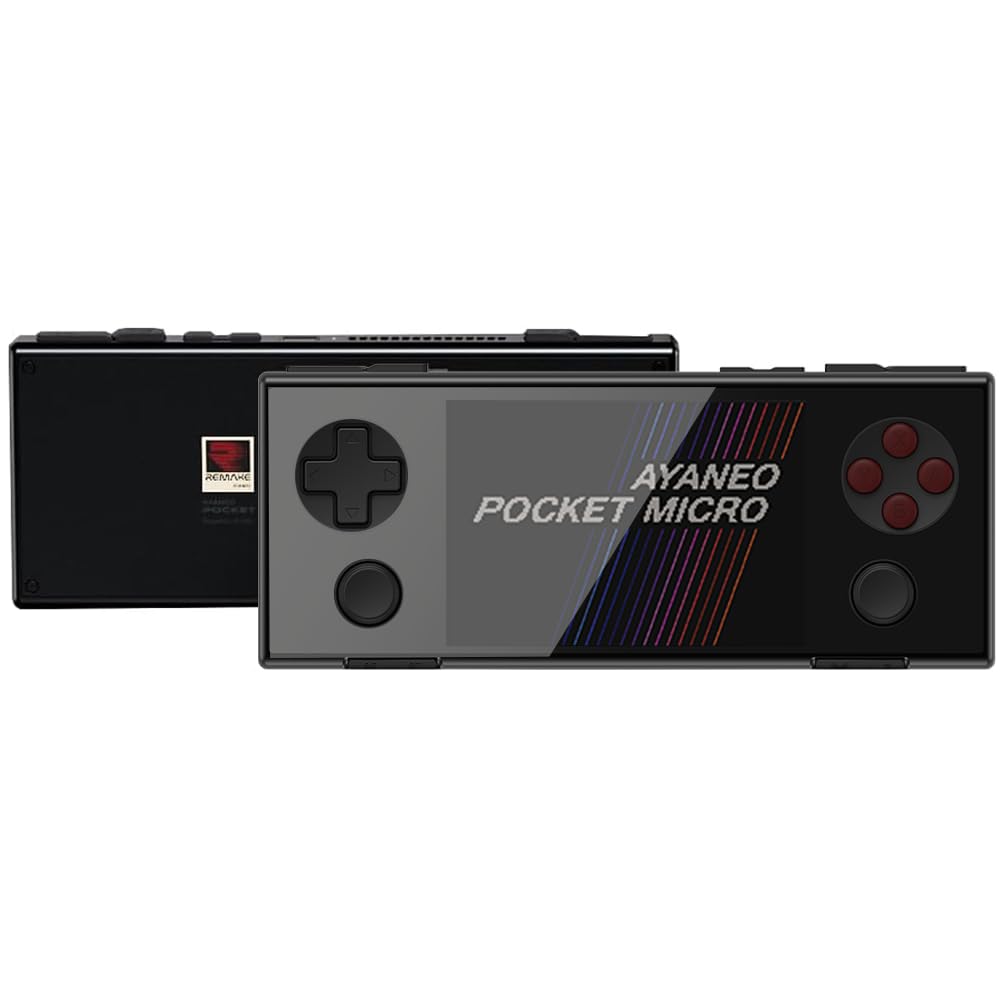
The AYANEO Pocket Micro is a compact Android-powered gaming handheld built around a dedicated 3.5-inch display, a CNC-machined aluminum alloy chassis, and tactile physical controls. Designed to emulate classic handheld titles with exact pixel…
By Maria Carver
As Amazon Associates, we earn from qualifying purchases. This means we may receive a small commission at no extra cost to you if you click through and make a purchase.
The AYANEO Pocket Micro is a compact Android-powered gaming handheld built around a dedicated 3.5-inch display, a CNC-machined aluminum alloy chassis, and tactile physical controls. Designed to emulate classic handheld titles with exact pixel accuracy while maintaining modern operating system flexibility, this device bridges the gap between boutique retro hardware and everyday mobile utility. Our hardware evaluation shows that the Pocket Micro is a masterfully constructed device that delivers the definitive display experience for legacy handheld gaming within an ultra-portable pocket footprint.
This handheld is ideal for retro gaming enthusiasts, collectors, and everyday carry minimalists who value flawless integer scaling for 3:2 titles alongside premium metal craftsmanship. If you want a pocketable console for Game Boy Advance, Super Nintendo, and PlayStation gaming that easily slips into a pocket, this hardware setup is purpose-built for you. However, mobile players wanting a wide 16:9 screen for cloud gaming or demanding emulation of complex sixth-generation consoles should look toward larger horizontal handhelds instead.
Spec sheet
AYANEO Pocket Micro
- Processor
- MediaTek Helio G99
- Memory
- 8GB LPDDR4X RAM
- Internal Storage
- 256GB UFS 2.2
- Display
- 3.5-inch IPS touchscreen
- Resolution and Density
- 960 × 640 pixels, 330 PPI
- Aspect Ratio and Color
- 3:2 aspect ratio, 100% sRGB coverage
- Brightness
- 400 nits peak brightness
- Chassis Material
- CNC-machined aluminum alloy with glass front panel
- Dimensions and Weight
- 156 × 63 × 18 mm, 227 g
Figures as published by the manufacturer on the Amazon listing.
Display Architecture and Integer Scaling Precision
The primary attraction of the handheld centers on its custom panel geometry. The AYANEO Pocket Micro screen resolution is set at 960 × 640 pixels across a 3.5-inch IPS touchscreen, establishing an authentic 3:2 aspect ratio rather than the standard 16:9 or 4:3 configurations found on most modern devices. With a pixel density of 330 PPI and full 100% sRGB color gamut coverage, this panel produces saturated colors, clean font reproduction, and sharp sprites. Outdoor visibility remains dependable across moderate daylight environments courtesy of the 400-nit rated screen brightness.
For emulation enthusiasts, the mathematical relationship behind this resolution provides the ultimate justification for the hardware. The original Game Boy Advance ran at a native resolution of 240 × 160 pixels. Dividing 960 by 240 yields an exact integer factor of four, while dividing 640 by 160 yields the exact same four-times factor. This perfect four-times pixel multiplication allows the AYANEO Pocket Micro GBA integer scaling to render classic handheld games without bilinear interpolation blur, pixel shimmering, or uneven scaling artifacts. Every native pixel becomes a crisp four-by-four grid of physical display pixels, filling the panel seamlessly without black borders.
While the 3:2 geometry excels at legacy handheld titles, it introduces minor black borders when running other retro media. Standard 4:3 console systems such as the Super Nintendo and PlayStation display thin vertical pillarboxing on the sides, though the visual compromise remains subtle because 3:2 is close to 1.33:1. Widescreen 16:9 content displays more noticeable letterboxing along the top and bottom. However, thanks to the 330 PPI pixel density, non-native scaling modes remain sharp and legible across diverse software libraries.
MediaTek Helio G99 Emulation Performance and Hardware Limits
At the center of the internal hardware is an octa-core MediaTek Helio G99 processor paired with 8GB of LPDDR4X RAM and 256GB of UFS 2.2 storage. This hardware balance prioritizes thermal efficiency and consistent clock speeds over excessive battery draw. The AYANEO Pocket Micro Helio G99 arrangement processes background emulation shaders and multi-threaded retro cores smoothly, offering quick access times for expansive digital collections. The 256GB storage tier provides generous onboard capacity for system files and classic titles without demanding immediate storage management.
When analyzing real-world AYANEO Pocket Micro emulation performance, the hardware proves exceptionally capable throughout the 8-bit, 16-bit, and 32-bit generations. Consoles including the NES, SNES, Genesis, Game Boy lineup, and original PlayStation run at full execution speeds with fast-forward capability and visual filters enabled. Nintendo 64 and Sega Dreamcast also perform smoothly, while PlayStation Portable games run well with resolution upscaling, albeit with 16:9 letterboxing on the 3:2 display. Touchscreen response ensures that dual-screen handheld emulators function reliably across touch-heavy interfaces.
Hardware boundaries become apparent when attempting demanding sixth-generation 3D systems. Emulating titles on the PlayStation 2 or GameCube pushes the integrated Mali-G57 graphics processor to its ceiling. While lightweight games achieve playable speeds with underclocking or resolution adjustments, complex 3D titles frequently exhibit frame drops. In discussions comparing the AYANEO Pocket Micro vs Pocket S, the higher-end Pocket S utilizes flagship Snapdragon processing designed for advanced 3D platforms and widescreen play, whereas the Pocket Micro focuses strictly on compact, power-efficient retro handling. As a focused system, the AYANEO Pocket Micro for retro gaming remains tailored to vintage console libraries rather than heavy 3D rendering.
Chassis Construction, Ergonomics, and Physical Controls
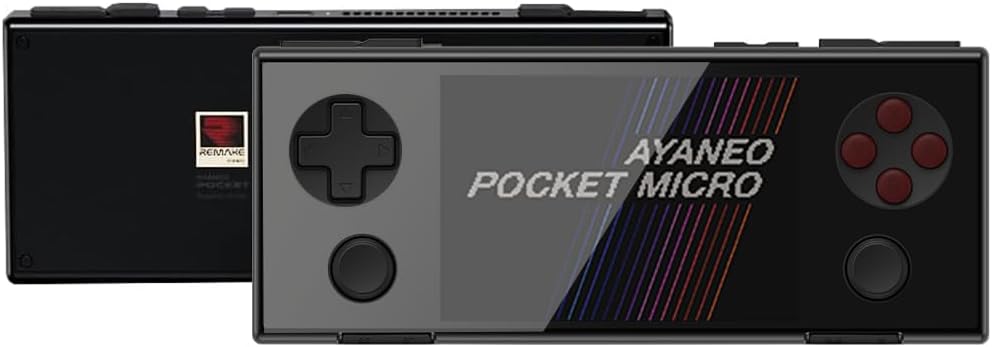
AYANEO constructed this console with premium exterior materials rarely found in pocketable gaming hardware. Measuring 156 × 63 × 18 mm and weighing 227 grams, the unit features a CNC-machined aluminum alloy shell paired with a borderless glass front panel. The anodized metal body eliminates chassis creaking and frame flex entirely. The unibody feel and structural rigidity rival premium consumer electronics such as the DJI Camera Pocket 4, ensuring that the device withstands daily transit inside a bag or jacket pocket without flex.
Control inputs include dual low-profile joysticks, a responsive directional pad, standard action buttons, L1/R1 bumpers, L2/R2 shoulder triggers, and a power button with an integrated fingerprint sensor for fast biometric security. Placing dual joysticks on a 156-millimeter face gives the console versatility for dual-stick arcade classics and custom emulator shortcuts. The shoulder buttons fit neatly into the top perimeter, maintaining an 18-millimeter profile that slides easily into pockets without catching on seams. An internal X-axis linear motor provides crisp haptic feedback, while a 6-axis gyroscope enables tilt controls in compatible software.
Users who prioritize pocketable everyday carry devices—such as creators balancing ultra-compact tools like the Kodak 1987 keychain camera alongside their gaming gear—will appreciate the strict 156-millimeter footprint. However, the flat pocket-friendly shape requires some ergonomic compromise. Without sculpted rear palm grips, extended gaming sessions that rely heavily on the shoulder triggers can cause hand fatigue for players with larger hands. Nevertheless, the 227-gram weight provides a solid, premium hand feel that inspires confidence during daily use.
Android 13 Software Integration and AYASpace Functionality
The system operates on AYANEO Pocket Micro Android 13, supplying modern operating system architecture, broad application access, and comprehensive controller compatibility. Android 13 provides an updated runtime environment for retro emulators, frontend organization tools, and cloud storage utilities. The 3.5-inch touchscreen enables straightforward navigation across menus, making it simple to alter core configurations, transfer save files, and update standalone applications directly on the device.
To streamline the handheld experience, AYANEO includes its custom AYASpace management software as an integrated frontend. AYASpace facilitates button remapping, screen mapping overlays for touch-only mobile games, and adjustable power profiles. Players can reduce power consumption to maximize battery runtime during lightweight 8-bit gaming or increase system performance when tackling higher-load emulation. This built-in software suite reduces the need for awkward touchscreen navigation, giving the handheld a console-like interface.
Wireless peripherals pair via Bluetooth 5.2 alongside onboard wireless connectivity for network syncing and multiplayer features. Low-latency Bluetooth ensures dependable audio sync with wireless earbuds and external game controllers. Just as specialized portable gadgets like the DJI X3 camera prioritize purposeful hardware configurations over generic multi-use compromises, the Pocket Micro tailors every component to pocketable retro handling. Shoppers reviewing the AYANEO Pocket Micro specs should note that the listing does not specify battery capacity in milliampere-hours, nor does it explicitly state the inclusion of an external MicroSD slot or analog audio jack, meaning users must manage their local file libraries across the internal 256GB UFS 2.2 storage.
AYANEO Pocket Micro Pros and Cons
What works
- Native 3:2 screen with 4x GBA integer scaling
- CNC-machined aluminum alloy and glass unibody chassis
- Sharp 960 by 640 IPS panel at 330 PPI
- MediaTek Helio G99 processor with 8GB RAM
- Fingerprint power button and 6-axis gyroscope
- Integrated AYASpace key mapping and performance modes
What to weigh up
- Listing does not specify battery capacity
- 3:2 aspect ratio letterboxes 16:9 widescreen content
- Helio G99 processor limits demanding 3D emulation
- Flat compact shape lacks contoured rear palm grips
Check AYANEO Pocket Micro on Amazon
Who Should Buy the AYANEO Pocket Micro
Selecting this handheld requires balancing its specific 3:2 screen ratio, pocket dimensions, and processing ceilings against your personal gaming preferences. The device fills a unique niche for players who value build quality and screen precision above broad 3D emulation headroom.
Buy It If
- You want exact 4x integer scaling for Game Boy Advance games without display stretching or blur.
- You appreciate CNC-machined aluminum alloy and glass construction over hollow plastic casings.
- You need an ultra-compact Android 13 gaming console measuring just 156 mm for everyday pocket carry.
- You focus primarily on 8-bit, 16-bit, and 32-bit retro gaming platforms and classic arcade titles.
Skip It If
- You want to play high-end PlayStation 2 or GameCube titles at upscaled resolutions.
- You primarily stream widescreen 16:9 media or prefer large displays for modern Android gaming.
- You require deep contoured palm grips for multi-hour sessions without hand fatigue.
Final Verdict
6.6/10Our score
When asking is AYANEO Pocket Micro worth it, the answer depends entirely on your gaming preferences and your appreciation for precise hardware design. As an ultra-portable retro gaming handheld, the Pocket Micro achieves what few competitors attempt: pairing a bespoke 960 × 640 3:2 display with an immaculate CNC aluminum unibody frame. For enthusiasts whose gaming nostalgia centers on classic handheld consoles, the four-times native integer scaling delivers an unrivaled visual experience that makes vintage sprites appear sharper and more authentic than ever before.
While the Helio G99 silicon limits upper-tier sixth-generation emulation and the 3.5-inch flat profile favors portable commutes over marathon couch gaming, the device fulfills its intended design mission with precision. By combining 8GB of LPDDR4X RAM, 256GB of fast UFS 2.2 storage, Android 13 software flexibility, and AYASpace management inside a rigid 227-gram aluminum body, the AYANEO Pocket Micro stands as a masterclass in boutique hardware engineering for dedicated retro gaming purists.
FAQ
What makes the AYANEO Pocket Micro display unique for retro gaming?
The AYANEO Pocket Micro features a 3.5-inch IPS touchscreen with a 960 × 640 resolution and a 3:2 aspect ratio. This pixel count provides an exact 4x integer scale for Game Boy Advance titles, allowing every native pixel to map directly into a 4×4 pixel grid without scaling blur, distortion, or black letterboxing.
Can the AYANEO Pocket Micro run PlayStation 2 games?
The MediaTek Helio G99 processor and Mali-G57 GPU can run lighter PlayStation 2 and GameCube games with emulator adjustments, but demanding 3D titles will suffer frame drops and stuttering. The console is optimized for 8-bit, 16-bit, 32-bit, and select 64-bit systems.
How does the AYANEO Pocket Micro compare to the AYANEO Pocket S?
The AYANEO Pocket Micro features a 3.5-inch 3:2 screen and a MediaTek Helio G99 processor built for pocket-sized retro gaming. The AYANEO Pocket S is a higher-tier flagship handheld equipped with a larger 16:9 widescreen display and a Qualcomm Snapdragon processor designed for demanding 3D games and advanced console emulation.
Does the listing specify battery capacity or expandable storage?
The manufacturer listing confirms that the device features 256GB of internal UFS 2.2 storage and 8GB of LPDDR4X RAM, but the listing does not specify battery capacity or whether an external MicroSD card slot is included.
What operating system runs on the AYANEO Pocket Micro?
The console runs on Android 13 paired with AYANEO’s proprietary AYASpace software suite. AYASpace delivers control customization, performance mode adjustments, and button mapping overlays for touch-based mobile games.
See this listing on Amazon We may earn a commission if you buy through this link.
More in Gaming


The weekly shortlist
Specs worth reading, once a week
New teardowns, spec sheets and buying notes from across the desk.
This demo form is not connected to a mailing service.