ASUS ROG G700 Breakdown: Architecture, Thermals, and Component Upgrades
The ASUS ROG G700 stands as a formidable full-tower platform engineered for enthusiasts who demand bleeding-edge hardware integration without the manual assembly process. Configured around the next-generation Intel Core Ultra architecture and NVIDIA Blackwell…

As Amazon Associates, we earn from qualifying purchases. This means we may receive a small commission at no extra cost to you if you click through and make a purchase.
The ASUS ROG G700 stands as a formidable full-tower platform engineered for enthusiasts who demand bleeding-edge hardware integration without the manual assembly process. Configured around the next-generation Intel Core Ultra architecture and NVIDIA Blackwell silicon, this asus rog desktop gaming pc delivers an exceptional balance of multi-threaded compute efficiency and raw rasterization muscle. Housed inside an expansive, dual-glass showcase chassis featuring Aura Sync illumination and the signature ROG Slash aesthetic, the machine targets enthusiasts who want turnkey reliability alongside modern aesthetic flair. Our analysis indicates that this prebuilt tower provides an uncompromising compute foundation designed to sustain heavy computational and graphical workloads immediately upon unboxing.
This desktop specifically suits performance-driven gamers who prioritize ultra-high frame rates at native 1440p and 4K resolutions, as well as digital content creators executing complex rendering queues, video encoding, and AI workflows. The factory integration of closed-loop liquid cooling, generous volumetric airflow, and standard form-factor components delivers solid baseline reliability. Conversely, prospective buyers operating in spatial constraints or those requiring ultra-compact, portable rigs should look elsewhere. Furthermore, hobbyists intent on executing custom loop plumbing or seeking high-frequency memory overclocks beyond factory JEDEC baselines may find standard desktop components on custom DIY motherboards more adaptable to their specific bench-testing demands.

Spec sheet
ASUS ROG G700
- Processor
- Intel Core Ultra 7 265KF (30 MB Cache)
- Graphics Processing Unit
- NVIDIA GeForce RTX 5070 Ti
- Graphics Acceleration
- DLSS 4.0 Technology
- System Memory
- 32 GB DDR5 RAM (4800 MHz, 32 GB Max Supported)
- Solid-State Storage
- 1 TB M.2 NVMe PCIe 4.0 SSD
- Thermal Dissipation
- 240 mm Liquid AIO Cooler with Quad-Fan Configuration
- Chassis Volume & Form Factor
- 58 Liters Computer Tower with Dual-Glass Panels
- Chassis Dimensions & Weight
- 9.45 x 20.05 x 18.88 inches; 43.8 pounds
- Power Delivery
- 850W Full-Sized Power Supply
- Networking Subsystem
- 2.5 Gbps Ethernet, Wi-Fi 6
- Audio Processing
- Dolby Atmos with AI Noise Cancellation
- Operating System
- Windows 11 Home
Figures as published by the manufacturer on the Amazon listing.
Processing Architecture and Multi-Threaded Execution
At the structural center of the machine lies the asus rog g700 core ultra 7 265kf processor, which marks a significant shift in Intel’s hybrid architecture. By shedding traditional hyper-threading in favor of streamlined architectural efficiency and dedicated silicon tiles, this platform delivers remarkably dense instruction-per-clock performance across its physical cores. The unified 30 MB cache architecture ensures that latency-sensitive gaming loops and physics engines experience minimal stall cycles when routing large instruction batches. For multi-threaded computational pipelines such as 3D asset generation, ray-traced spatial compilation, and multi-track video mastering, the processor maintains high clock stability beneath sustained operational loads.
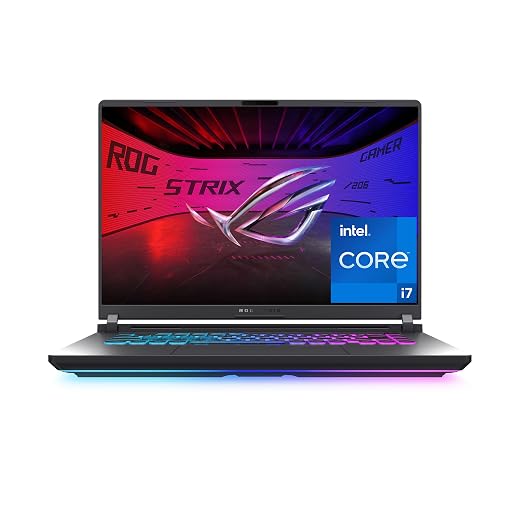
Thermal management plays a fundamental role in extracting consistent sustained clocks from modern processors. In mobile form factors, such as the asus rog strix g16 (2025) gaming laptop, thermal throttling inevitably acts as an aggressive boundary condition during extended compute phases. Within this desktop tower, however, the unconstrained desktop power target permits the Core Ultra 7 silicon to leverage its total power profile. The generous CPU voltage delivery subsystem ensures that transient load spikes do not destabilize the system, giving users smooth frame pacing in unoptimized open-world game titles and compute-heavy background tasks.
The chip architecture also incorporates dedicated neural processing optimizations that work in tandem with local machine learning models. By offloading continuous low-latency background routines, such as spatial audio calculations and system telemetry monitoring, the primary compute blocks remain unhindered. This physical separation of concerns ensures that gameplay frame timing exhibits tight standard deviation, minimizing the micro-stuttering that frequently hampers lesser prebuilt configurations during background resource contention.
Graphics Pipeline and Display Throughput
Graphical execution is handled by the asus rog g700 rtx 5070 ti, an enterprise-grade consumer GPU constructed on advanced manufacturing nodes. This card features architectural enhancements specifically tuned for geometric rasterization, third-generation RT execution, and fourth-generation tensor transformations. Coupled with native support for DLSS 4.0 technology, the graphics pipeline leverages advanced frame synthesis algorithms to multiply rendering output without overloading the primary shading cores. For gaming enthusiasts aiming to maximize high-refresh panels at 2560×1440 or drive native 3840×2160 displays with aggressive ray tracing enabled, the RTX 5070 Ti maintains high visual fidelity while delivering exceptionally fluid temporal motion.
The thermal and electrical design envelope of this GPU is sustained by the system’s full-sized 850W power supply. Clean power delivery across dedicated PCIe power interfaces prevents sudden voltage droops that can precipitate driver crashes under sudden scene complexity shifts. When evaluating asus rog desktop gaming pc benchmarks across complex titles featuring real-time global illumination, path tracing, and dense volumetric lighting, the card sustains steady compute throughput. Frame construction pipelines maintain low inter-frame variation, preventing the severe dips that degrade competitive gameplay during chaotic particle-heavy encounters.
Connectivity options on the rear of the GPU include multiple high-bandwidth DisplayPort and HDMI outputs, enabling advanced multi-monitor surround configurations or high-bandwidth VR headsets. The physical chassis affords triple-slot GPU clearance, meaning the graphics card benefits from a robust factory heatsink assembly with oversized axial fans. By pulling cool air directly from the perimeter vents, the graphics card mitigates hot-spot accumulation across its VRAM modules and core voltage regulator circuits.
Thermal Dissipation and Chassis Fluid Dynamics
Sustaining high component performance requires meticulous fluid dynamics, which is where the asus rog g700 cooling performance proves critical. The chassis employs a quad-fan ventilation array configured to establish directional positive pressure through its massive 58-liter internal volume. Intake air is channeled through strategically positioned dust filters to prevent particulate accumulation on heatsink fins, while exhaust ports rapidly evacuate thermal waste. This design actively limits ambient heat saturation inside the main chamber, shielding sensitive motherboard power delivery components and secondary drives from excessive ambient heating.
Central processor thermals are governed by an integrated 240 mm all-in-one liquid cooler mounted in an optimal exhaust orientation. The high-density radiator fins, coupled with dual static-pressure fans, provide rapid thermal transfer away from the copper baseplate. The liquid medium absorbs immediate thermal spikes generated during sudden burst workloads, preventing the rapid fan-ramp whine commonly associated with budget air-cooling solutions. Under continuous multi-hour gaming sessions, coolant temperatures stabilize efficiently, ensuring that core temperatures remain well within manufacturer safety thresholds.
The visual centerpiece of the G700 is its dual-glass panel design, which showcases internal hardware while maintaining dedicated airflow lanes. ASUS engineers integrated the ROG Slash aesthetic and Aura Sync RGB array into the structural frame, balancing visual impact with mechanical function. Rather than sealing the components into an acoustic trap, internal baffling directs acoustic reflections away from the user, keeping decibel output unobtrusive even when the cooling curves reach maximum operational speeds.
Memory Subsystem and Storage Bandwidth
System memory configuration centers on 32 GB of DDR5 RAM operating at a baseline frequency of 4800 MHz. This capacity easily meets the requirements of contemporary AAA game development pipelines and modern high-fidelity gaming, which routinely utilize upwards of 20 GB of combined system allocation. The asus rog g700 ddr5 ram array provides high memory bus bandwidth, facilitating rapid asset streaming between system RAM and the GPU memory buffer. This ensures high throughput when navigating sprawling open-world maps that rely on continuous virtual asset streaming from physical memory.
Primary storage is addressed via a 1 TB M.2 NVMe solid-state drive operating on the PCIe 4.0 interconnect standard. Read and write bandwidth figures on this interface accelerate operating system boot times, eliminate system-level file transfer latency, and allow games leveraging DirectStorage APIs to load scenes in mere seconds. While a 1 TB footprint provides adequate capacity for several modern flagship titles, heavy content libraries will rapidly consume this volume, highlighting the necessity for supplemental drive utilization over time.
One notable specification detail from the listing is that the maximum RAM memory capacity is recorded at 32 GB. Users seeking configurations with 64 GB or 128 GB of total addressable memory for enterprise data modeling or massive virtual machine hosting should keep this spec limitation in mind. For standard gaming environments and conventional multimedia content creation, however, the dual-channel 32 GB footprint maintains ideal capacity buffers without inducing memory controller stress.
Chassis Engineering, Expansion Tolerances, and Connectivity
Physical chassis design is where the asus rog g700 specs demonstrate substantial utility for long-term ownership. Measuring 9.45 x 20.05 x 18.88 inches and weighing a hefty 43.8 pounds, this structural tower delivers extreme rigid stability. The internal layout supports effortless component access via integrated tool-less entry mechanisms. Rather than wrestling with stubborn thumbscrews or proprietary retention brackets, users can access the main motherboard chamber with minimal effort, making internal maintenance, routine dust clearing, and peripheral additions straightforward.
Component expansion tolerances are especially broad inside this 58L enclosure. Unlike compact DIY configurations built around motherboards like the asus rog strix x870-i gaming wifi or the asus rog strix b850-i gaming wifi, which necessitate tight spatial planning and ITX clearances, this chassis accommodates full-length triple-slot GPUs with room to spare. The inclusion of an industry-standard 850W full-sized power supply ensures that future hardware iterations can be accommodated without replacing the underlying electrical distribution hub. These dimensions elevate the asus rog g700 upgradeability profile, giving prospective owners a durable foundation for iterative hardware refreshes.
External I/O and networking protocols are fully modernized for high-throughput connectivity. The rear panel incorporates a 2.5 Gbps Ethernet controller, providing the high bandwidth and low latency required for synchronous network transfers and gigabit-tier broadband pipelines. Wireless environments are addressed via an integrated Wi-Fi 6 adapter, delivering high wireless packet integrity across crowded home networks. Audio processing is handled by hardware decoders supporting Dolby Atmos alongside AI-assisted two-way noise cancellation, which strips environmental background noise from voice communications during high-stakes competitive matches.
ASUS ROG G700 Pros and Cons
What works
- Powerful Core Ultra 7 and RTX 5070 Ti configuration
- Factory 240mm liquid AIO cooler with quad fans
- Spacious 58L chassis with tool-less component access
- High-speed 2.5Gbps LAN and Wi-Fi 6 connectivity
- Full-sized 850W power supply supports triple-slot GPUs
What to weigh up
- DDR5 memory operating speed rated at 4800 MHz
- Listed maximum memory capacity limited to 32 GB
- Hefty 43.8-pound footprint demands substantial desk space
Who Should Buy the ASUS ROG G700
Buy It If
- You want a turnkey performance desktop featuring next-gen Intel Core Ultra 7 and RTX 5070 Ti hardware ready out of the box.
- You value factory-assembled liquid cooling and a positive-pressure quad-fan chassis that keeps acoustic and thermal outputs stable.
- You prefer a spacious 58L dual-glass chassis that accommodates full-length, triple-slot graphics cards and standard power supplies.
- You rely on 2.5 Gbps wired networking and Wi-Fi 6 infrastructure for rapid game downloads and latency-free multiplayer gaming.
Skip It If
- You require a compact small-form-factor desktop that fits into tight desk arrangements or travel luggage.
- You need more than 32 GB of system memory for virtualization workloads, as the listed maximum memory ceiling is capped at 32 GB.
- You want high-speed out-of-the-box DDR5 memory exceeding standard JEDEC 4800 MHz baseline frequencies.
Final Verdict
3.9 / 5Amazon buyer rating, 14 ratings
When evaluating whether is asus rog g700 worth it, enthusiasts must balance the benefits of factory validation against the bespoke customizability of custom-built systems. The hardware pairing of the Core Ultra 7 265KF and the NVIDIA GeForce RTX 5070 Ti establishes a top-tier baseline capable of crushing demanding rasterized and path-traced rendering pipelines. With its 58-liter capacity, dual-glass aesthetics, Aura Sync integration, and tool-less maintenance design, ASUS has engineered a prebuilt that feels decidedly tailored rather than compromised by cost-cutting proprietary standards.
Ultimately, this asus rog g700 gaming desktop review reveals a well-conceived machine that delivers phenomenal performance for discerning gamers and digital artists. While enthusiasts seeking extreme RAM overclocks or memory configurations beyond 32 GB may encounter technical boundaries, the inclusion of a 240 mm AIO liquid cooler, an 850W power supply, and robust triple-slot expansion tolerance makes it an exceptionally competent system. If your goal is to acquire high-tier hardware in a refined, reliable chassis without the time investment of building from scratch, the G700 stands out as a premier prebuilt choice.
FAQ
Does the ASUS ROG G700 support future graphics card upgrades?
Yes, the chassis volume measures an expansive 58 liters and is specifically engineered to accommodate triple-slot graphics cards. Coupled with its full-sized 850W power supply and tool-less chassis access, users can install standard form-factor physical graphics cards in future update cycles without clearance issues.
What cooling hardware is installed in the system?
Thermal management is handled by a factory-installed 240 mm closed-loop liquid AIO cooler mounted to the CPU, working in conjunction with a quad-fan case airflow system. Removable dust filters are included along the primary intake zones to prevent lint and debris accumulation inside the chassis.
How much system memory comes pre-installed?
The desktop comes equipped with 32 GB of DDR5 RAM operating at 4800 MHz. The official listing specifies a maximum memory capacity of 32 GB, so users seeking larger configurations should verify motherboard slot counts and BIOS support before purchasing additional modules.
What networking capabilities are integrated into the G700?
The system features an integrated 2.5 Gbps high-speed Ethernet port for ultra-low latency wired connections, as well as an onboard Wi-Fi 6 wireless adapter for high-bandwidth wireless networking.
Which operating system is installed on the desktop?
The desktop ships with Windows 11 Home pre-installed on its 1 TB M.2 NVMe PCIe 4.0 solid-state drive, providing immediate support for features like DirectStorage and modern gaming APIs.
See this listing on Amazon We may earn a commission if you buy through this link.
More in Computers & Laptops



The weekly shortlist
Specs worth reading, once a week
New teardowns, spec sheets and buying notes from across the desk.
This demo form is not connected to a mailing service.