ASUS ROG Crosshair VIII Dark Hero Wi-Fi Spec Analysis
The ASUS ROG Crosshair VIII Dark Hero is an enthusiast-grade Socket AM4 motherboard engineered to extract peak performance from multi-core processors without acoustic compromise. Built on the mature AMD X570 chipset, this revised board…

As Amazon Associates, we earn from qualifying purchases. This means we may receive a small commission at no extra cost to you if you click through and make a purchase.
The ASUS ROG Crosshair VIII Dark Hero is an enthusiast-grade Socket AM4 motherboard engineered to extract peak performance from multi-core processors without acoustic compromise. Built on the mature AMD X570 chipset, this revised board replaces active fan cooling with a completely passive thermal design while deploying upgraded power stages capable of driving flagship silicon. For hardware enthusiasts and workstation users seeking rock-solid voltage regulation, expansive storage options, and premium peripheral support, it stands as one of the most refined high-end foundations ever produced for its generation.
This motherboard directly suits PC builders running high-end Zen 3 multi-threaded chips who require silent operation, high-bandwidth wired and wireless networking, and substantial memory headroom. Conversely, builders looking toward future-generation processor upgrades on modern platforms like the asus rog x870e or budget-focused mainstream builders should look elsewhere, as the Dark Hero represents an uncompromising, enthusiast-focused investment tied strictly to the DDR4 AM4 ecosystem.
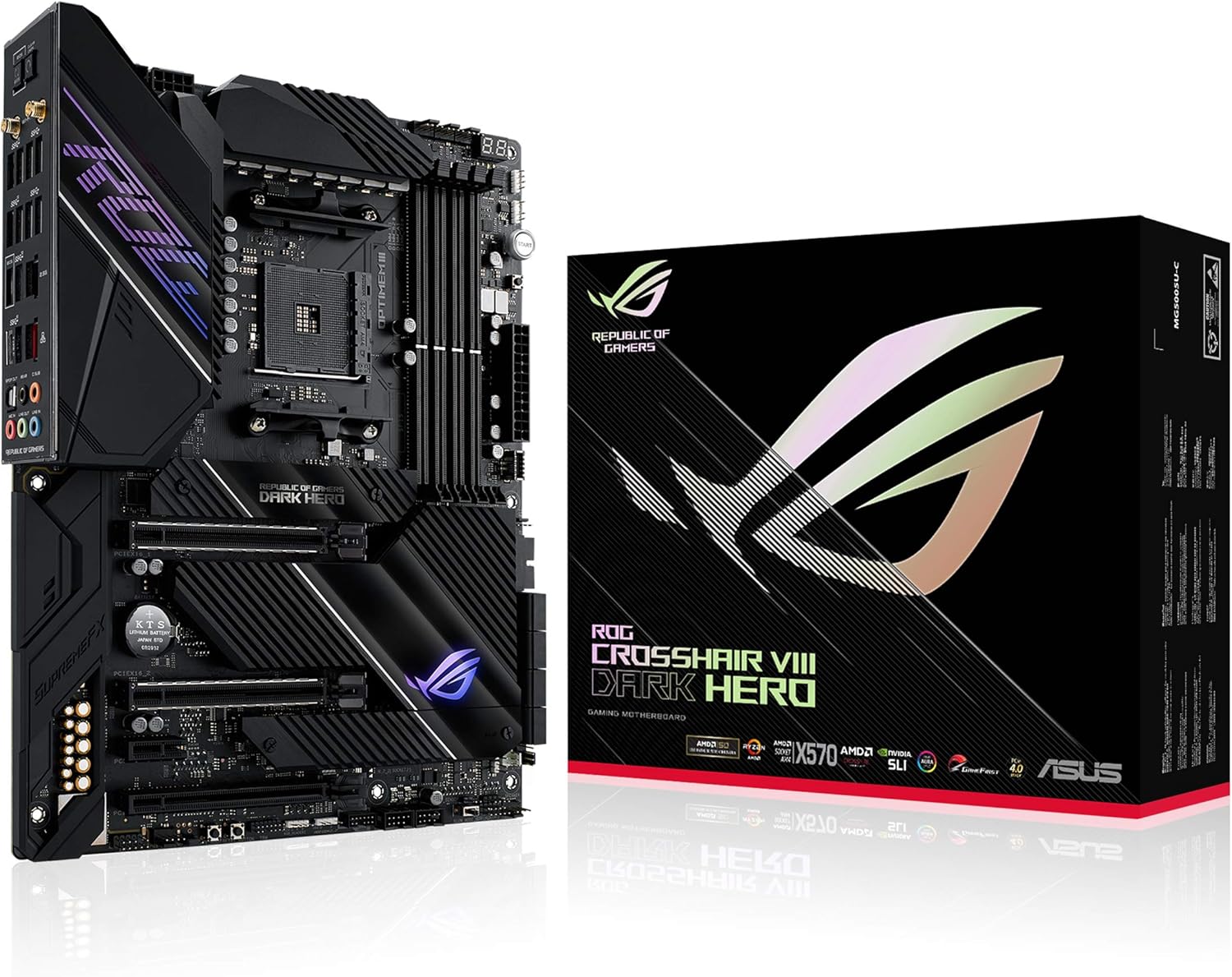
Spec sheet
ASUS ROG Crosshair VIII Dark Hero
- Processor Socket
- Socket AM4 (AMD 2nd, 3rd Gen Ryzen and Ryzen 5000 Series)
- Chipset Architecture
- AMD X570 with passive cooling solution
- VRM Power Delivery
- 14+2 TI power stages rated for 90A with ProCool II connectors
- Memory Architecture
- Dual-channel DDR4, 4 DIMM slots, up to 128 GB maximum capacity
- PCIe Support
- PCI Express 4.0 interface with ASUS SafeSlot reinforcement
- Wireless Connectivity
- Wi-Fi 6 (802.11ax) MU-MIMO and Bluetooth 5.1
- Wired Networking
- Dual LAN: 2.5 Gbps Ethernet port and 1 Gbps Ethernet port
- Storage Expansion
- 8 x SATA 3 ports plus aluminum heatsink-shielded M.2 slots
- USB Architecture
- 12 total USB ports (including 4 x USB 2.0, USB 3.2 Gen 2 Type-C)
- Audio Output
- High-fidelity onboard audio with Optical S/PDIF connector
Figures as published by the manufacturer on the Amazon listing.
VRM Architecture and Power Delivery Analysis
The core strength of the board lies in its upgraded power delivery framework. ASUS redesigned the power stage layout specifically to handle heavy sustained current loads, outfitting the board with 14+2 Texas Instruments power stages rated for 90A per stage. When evaluating the rog crosshair viii hero vrm compared to earlier platform revisions, such as the legacy asus crosshair vi hero atx, the step up in power handling and component resilience is immediately clear. The array feeds processor cores clean, unthrottled current even under punishing overclocking benchmarks.
Complementing the 90A stages are microfine alloy chokes, 10K Japanese-made black metallic capacitors, and dual ProCool II power connectors. These solid-pin auxiliary connectors ensure low-resistance contact with the power supply leads, preventing thermal bottlenecks at the socket boundary. The massive VRM heatsinks flanking the socket feature substantial surface area, allowing heat from aggressive voltage loads to dissipate rapidly into the chassis airflow without thermal throttling.
For builders wondering how the power delivery sustains an asus crosshair viii hero ryzen 5000 build, the electrical topology provides excessive headroom. Premium 12-core and 16-core chips draw substantial current when pushing peak clock frequencies across all compute threads. The 90A TI power stages absorb dynamic load spikes smoothly, resulting in reduced ripple, minimized heat accumulation, and stable supply rails during heavy 3D rendering or complex data compilation sessions.
Chipset Thermal Performance and Silent Operation
Early motherboard releases utilizing the asus rog crosshair viii hero x570 architecture frequently integrated small high-RPM fans directly over the platform controller hub to handle PCIe 4.0 data heat loads. The defining advancement of this model is the crosshair viii dark hero passive cooling design, which completely eliminates the mechanical chipset fan in favor of a large, high-mass passive aluminum heatsink. This structural change removes the primary mechanical point of failure common to standard X570 hardware.
Eliminating the active fan yields two distinct advantages: zero acoustic profile from the chipset zone and zero risk of fan bearing wear over years of operation. The passive heatsink extends beneath the primary graphics slot, utilizing carefully machined thermal fins that shed heat via normal internal chassis airflow. The listing does not specify precise thermal pad thermal conductivity ratings, but the heatsink mass successfully absorbs sustained southbridge workloads during heavy multi-drive write tasks.
Thermal management extends across the surface of the motherboard through dedicated M.2 aluminum heatsinks that clamp down on fast storage drives. Additionally, the motherboard integrates the ROG Water Cooling Zone, a cluster of dedicated headers that allow liquid cooling builders to track fluid temperature and flow rates directly through firmware. This holistic thermal system ensures that critical board components remain well below their thermal limits even when packed inside dense performance cases.
PCIe 4.0 Lane Routing and Storage Architecture
Platform bandwidth is built around native rog crosshair viii hero pcie 4.0 capability, unlocking double the theoretical transfer rates of the older PCIe 3.0 generation. High-end modern GPUs communicate directly across full PCIe 4.0 x16 lanes reinforced with ASUS SafeSlot technology. SafeSlot embeds a rigid metal bracket into the PCIe slot housing, preventing slot damage or sagging caused by the sheer mass of modern flagship graphics cards when outputting to displays like the asus rog swift oled pg32ucdp.
Storage flexibility on the platform is expansive. The motherboard features eight SATA 3 ports operating at 6 Gbps, making it exceptionally well-suited for builders assembling large local media archives, redundancy arrays, or expansive creative asset drives. Complementing the SATA infrastructure are high-speed M.2 connections protected beneath thick aluminum heatsinks to mitigate high-temperature drive throttling during sustained transfer cycles.
While newer platforms such as the Intel-based rog maximus z890 hero push forward into PCIe 5.0 lanes, the PCIe 4.0 backbone on this board provides complete saturation for top-tier Gen 4 NVMe solid-state drives. The lane allocation from the AM4 processor and X570 chipset operates without bottlenecking secondary peripherals, delivering consistent file transfer performance across storage drives, auxiliary cards, and primary expansion slots.
Networking and Connectivity Capabilities
Networking performance is engineered for low latency and high transfer speeds through a hybrid wired and wireless framework. The crosshair viii hero wi-fi 6 system utilizes 802.11ax wireless standards featuring multi-user multiple-input multiple-output (MU-MIMO) technology. This wireless system ensures resilient connections across congested home and studio networks, while integrated Bluetooth 5.1 provides low-latency connectivity for wireless peripherals, controllers, and audio equipment.
Wired connectivity is equally robust, offering a dual-LAN configuration comprised of a high-bandwidth 2.5 Gbps Ethernet port paired with a standard Gigabit Ethernet port. This dual-jack setup allows builders to dedicate the 2.5G port to ultra-fast local network-attached storage transfers while dedicating the secondary Gigabit connection to primary internet access, providing hardware redundancy and flexible routing.
The motherboard back panel accommodates comprehensive external equipment through an integrated I/O array boasting 12 total USB ports, as well as 16 overall connectivity ports across the board. The setup includes four legacy USB 2.0 ports for mouse and keyboard inputs, high-speed USB 3.2 Gen 2 Type-C, and an optical S/PDIF audio out port for clean digital sound transmission to external DACs and studio monitors.
Firmware Stability and DIY Installation Features
The ASUS ROG Crosshair VIII Dark Hero includes a suite of hardware-level DIY tools designed to streamline assembly and system recovery. The rear panel features an integrated pre-mounted I/O shield, eliminating alignment frustrations during chassis installation while shielding exterior ports against accidental electrostatic discharge. The board also incorporates the dedicated ASUS BIOS FlashBack feature, allowing users to update or recover motherboard firmware using a USB drive and power supply without needing a CPU or RAM installed.
For memory configuration, the board supports dual-channel DDR4 memory across four DIMM slots, accepting up to 128 GB of total capacity. While the listing baseline data notes a 2133 MHz standard base clock speed, the underlying trace architecture supports advanced memory kits through XMP and manual frequency tuning. Firmware support is deeply integrated with Windows 10, delivering stable driver packages for all onboard controllers.
Hardware diagnostic readouts and onboard micro-switches further ease the configuration process inside the case. Builders can monitor real-time boot status, isolate post-boot errors, and clear CMOS parameters directly without reaching for jumper pins. These physical conveniences turn what could be a complex enthusiast platform into a reliable, manageable workspace during system assembly and troubleshooting.
ASUS ROG Crosshair VIII Dark Hero Pros and Cons
What works
- 14+2 90A TI power stage delivery
- Silent passive chipset heatsink design
- Dual Ethernet with 2.5G and 1G
- Integrated Wi-Fi 6 and Bluetooth 5.1
- Robust 8-port SATA 3 storage array
What to weigh up
- Restricted to AM4 and DDR4 generation
- Full ATX form factor limits compact builds
Check ASUS ROG Crosshair VIII Dark Hero on Amazon
Who Should Buy the ASUS ROG Crosshair VIII Dark Hero
Buy It If
- You are running a 12-core or 16-core AMD Ryzen 5000 processor and want premium 90A power stages for rock-solid stability and overclocking headroom.
- You demand a dead-silent system and want an X570 motherboard that utilizes a passive chipset heatsink rather than an active high-RPM fan.
- You need dual LAN ports (2.5G and 1G) combined with integrated Wi-Fi 6 for advanced networking, NAS connectivity, and low-latency gaming.
- You manage massive local data arrays requiring eight native SATA 3 storage ports alongside high-speed PCIe 4.0 M.2 slots.
Skip It If
- You plan to build on next-generation platforms requiring DDR5 memory and PCIe 5.0 lane native architecture.
- You are assembling an entry-level or mid-range gaming rig where high-end 90A power stages and dual LAN connections exceed your performance requirements.
- You require an ultra-compact build, as this board uses a full-size ATX form factor that demands standard desktop chassis clearance.
Final Verdict
9.2/10Our score
When asking if the asus rog crosshair viii dark hero am4 board continues to stand out, the answer depends entirely on your platform loyalty. For users invested in the mature AM4 ecosystem, this motherboard represents the absolute apex of the platform. The combination of 14+2 90A power stages, a completely silent passive chipset cooler, and broad PCIe 4.0 routing corrects the thermal and acoustic compromises found on early X570 iterations, creating a powerhouse desktop foundation.
Ultimately, determining whether is asus rog crosshair viii hero wi-fi worth it comes down to your workload demands. If you already possess a top-tier Zen 3 processor and need a feature-dense, whisper-quiet platform with outstanding networking and massive storage capacity, this motherboard delivers an exceptional enthusiast experience. It extracts every drop of performance from DDR4 and AM4 silicon while maintaining pristine acoustic discipline.
FAQ
Does the ASUS ROG Crosshair VIII Dark Hero feature an active chipset fan?
No. Unlike earlier X570 motherboards, the Dark Hero features a completely passive chipset heatsink that relies on internal case airflow, eliminating fan noise and moving parts from the motherboard hub.
What processors are compatible with this motherboard?
The board features an AMD Socket AM4 and is designed to support 2nd Gen and 3rd Gen AMD Ryzen processors, including the high-performance Zen 3 Ryzen 5000 series desktop processors.
What are the primary networking capabilities on this board?
The board offers both wired and wireless high-speed networking, including an onboard Wi-Fi 6 (802.11ax) controller with MU-MIMO support, integrated Bluetooth 5.1, a 2.5 Gbps Ethernet port, and an auxiliary Gigabit Ethernet port.
How much system memory can be installed on the Dark Hero?
The motherboard includes four DDR4 DIMM slots supporting dual-channel memory configurations with a maximum system memory capacity of up to 128 GB.
Can the BIOS be updated without a processor installed?
Yes. The board includes ASUS BIOS FlashBack functionality, allowing builders to flash or restore the firmware using a USB flash drive and a connected power supply without having a processor or memory installed.
See this listing on Amazon We may earn a commission if you buy through this link.
More in PC Components & Storage


The weekly shortlist
Specs worth reading, once a week
New teardowns, spec sheets and buying notes from across the desk.
This demo form is not connected to a mailing service.