Apple iMac 27-Inch 5K Architecture & Hardware Analysis
The Apple iMac 27-inch 5K represents a peak milestone in all-in-one desktop engineering, combining a dedicated workstation-class visual interface with an established x86 compute pipeline. Powered by a 3.3GHz 6-core 10th-generation Intel Core i5…

As Amazon Associates, we earn from qualifying purchases. This means we may receive a small commission at no extra cost to you if you click through and make a purchase.
The Apple iMac 27-inch 5K represents a peak milestone in all-in-one desktop engineering, combining a dedicated workstation-class visual interface with an established x86 compute pipeline. Powered by a 3.3GHz 6-core 10th-generation Intel Core i5 processor, discrete AMD Radeon Pro 5300 graphics, and a factory 512GB solid-state drive, this desktop system targets home offices, digital studios, and analytical production desks. Anchored by its hallmark 5120-by-2880 panel with 500 nits of brightness, the machine delivers a pristine visual canvas and dependable sustained throughput across demanding desktop applications without demanding separate monitor enclosures or tangled peripheral clusters.
This desktop workstation primarily serves visual creators, photographers, data analysts, and multi-window power users who require massive native desktop real estate, predictable x86 legacy environment stability, and discrete GPU acceleration. The integrated chassis provides a complete production environment straight out of the package, eliminating the calibration complexities and cable clutter typical of modular tower setups. However, prospective buyers demanding battery-powered port mobility, compact footprints, or zero-fan thermal designs should evaluate portable workstations such as the apple macbook pro 14 inch rather than allocating desk space to a permanent twenty-pound aluminum unit.
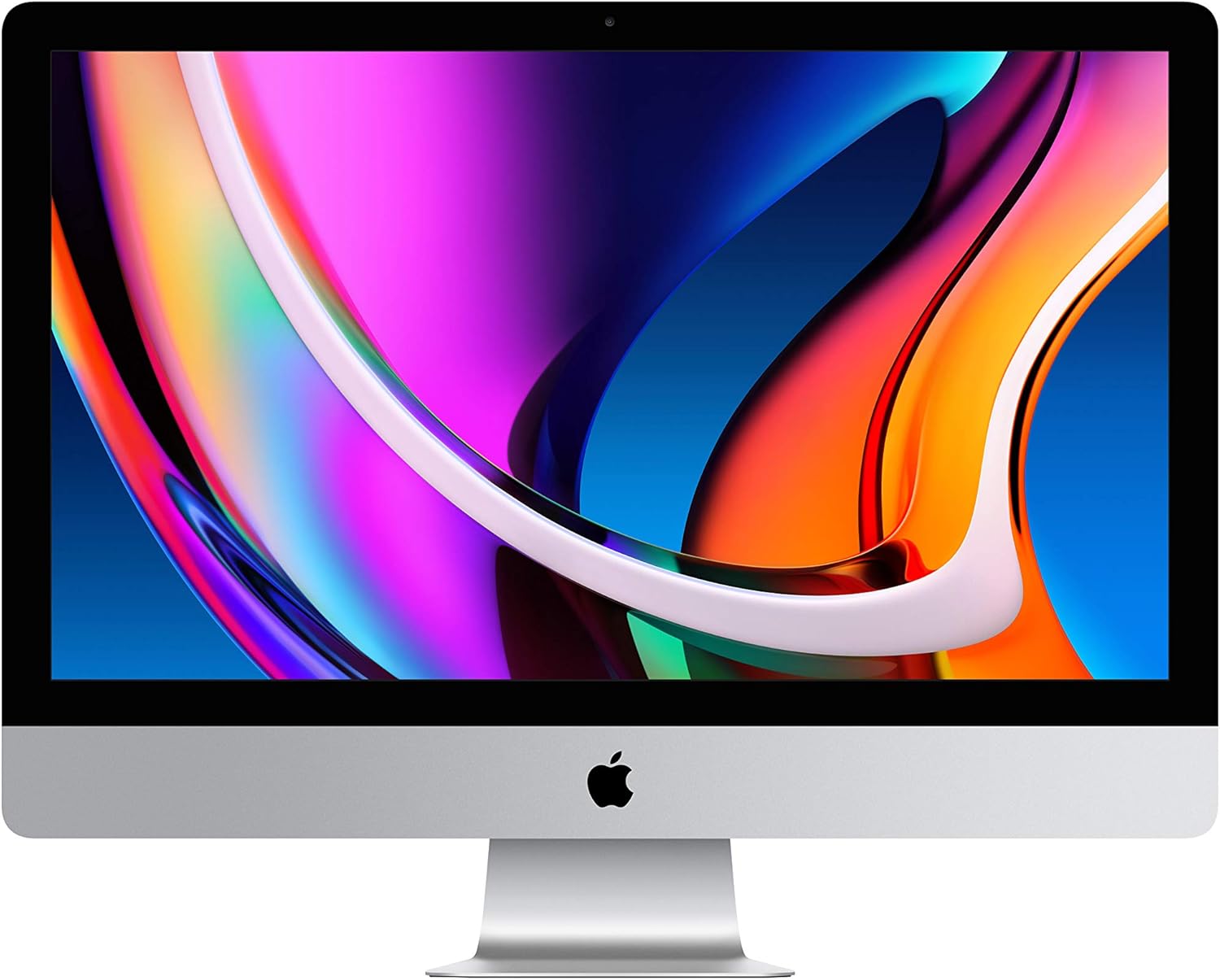
Spec sheet
Apple iMac 27-inch 5K
- Display Panel
- 27-inch Retina 5K (5120-by-2880 resolution, 500 nits brightness, one billion colors)
- Central Processing Unit
- 3.3GHz 6-core 10th-generation Intel Core i5
- Graphics Processing Unit
- AMD Radeon Pro 5300
- Installed System Memory
- 8 GB RAM
- Memory Expansion
- 2 expansion slots indicated
- Internal Storage Capacity
- 512 GB Solid State Drive (SSD)
- High-Speed Connectivity
- Two Thunderbolt 3 (USB-C) ports
- Legacy and Network I/O
- USB, Ethernet, Bluetooth
- Thermal Dissipation
- Internal air cooling system with active fan
- Physical Dimensions and Weight
- 7.99 x 25.59 x 20.31 inches; 19.7 pounds
Figures as published by the manufacturer on the Amazon listing.
Retina 5K Display Engineering and Visual Calibration
The centerpiece of the hardware package is unquestionably the integrated panel. Measuring 27 inches diagonally, the display outputs an ultra-sharp 5120-by-2880 resolution, delivering an exceptional pixel density that completely eliminates visible screen door effects and jagged rasterized type. With a factory luminance rated at 500 nits and native support for one billion colors, the screen produces deep tonal gradations, uniform highlights, and crisp visual separation. For users scrutinizing fine lines in engineering blueprints or inspecting raw photographic assets, the resolution ensures that a full 4K frame can be displayed natively at 100 percent scale while leaving ample room for user interface palettes, timelines, and application toolbars along the margins.
When deploying the Apple iMac 27-inch for photo editing and color-sensitive graphic tasks, the panel offers structural advantages that standard commercial monitors struggle to replicate. The high luminance profile counteracts ambient studio lighting, maintaining contrast balance across midday viewing conditions. Furthermore, rendering one billion colors eliminates banding artifacts along subtle photographic gradients, such as evening skies or delicate studio skin tones. While the listing does not specify whether this unit features the specialized nano-texture glass option or standard glossy glass, the optical clarity delivers razor-sharp text clarity and accurate visual depth that elevate high-resolution raster and vector design pipelines.
The panel balance makes the desktop especially valuable for multi-document research workflows. Viewing dense financial spreadsheets, dual-page layout documents, and detailed software development environments simultaneously becomes effortless due to the massive physical and pixel resolution. By integrating the display assembly directly into the all-in-one housing, the system eliminates the scaling incongruities, refresh mismatches, and color inconsistencies that often plague multi-vendor dual-monitor workstations.
Intel Core i5 Architecture and Processing Throughput
System computation is anchored by a 10th-generation Intel Core i5 processor featuring six independent physical processing cores operating at a 3.3GHz base frequency. This multi-core CPU architecture offers strong single-threaded clock performance alongside robust multi-threaded parallelism, enabling the machine to juggle complex office suites, virtualized containers, and creative digital media applications without stalling. In real-world computing contexts, evaluating the iMac 27-inch Core i5 benchmarks shows that the six dedicated x86 cores handle heavy compilation runs, raw file conversions, and multi-track audio arrangements with consistent deterministic speed.
Active thermal management plays a critical role in sustaining performance under prolonged operational stress. Unlike thin mobile notebooks that quickly throttle clock speeds due to tight chassis constraints, this desktop configuration incorporates a high-volume internal air cooling design driven by an internal fan. The 7.99-inch chassis depth allows heat pipes to draw thermal energy away from the Intel silicon toward the primary exhaust vent. This mechanical airflow design ensures the processor can maintain elevated Turbo frequencies across extended rendering tasks, heavy data transformations, and long audio mastering sessions without erratic throttling cliffs.
The standard x86 CPU architecture remains an essential consideration for technical workflows requiring dedicated hypervisor compatibility, legacy software drivers, or native dual-boot OS configurations. While high-performance mobile powerhouses like the macbook pro 16 inch have transitioned computing paradigms, the native Intel silicon on this platform retains direct architectural compatibility with enterprise x86 binaries, legacy virtualization stacks, and specialized Windows tools that may struggle under translation layers.
AMD Radeon Pro 5300 Graphics Acceleration
Visual computation and raster processing are managed by dedicated hardware in the form of the AMD Radeon Pro 5300 graphics processor. Unlike integrated graphics solutions that rob bandwidth from system RAM, this discrete graphics chip possesses dedicated compute units and independent video memory to handle complex pixel shaders, real-time interface rendering, and accelerated timeline playback. Equipping the system with the iMac 27-inch Radeon Pro 5300 GPU guarantees that the staggering 14.7 million pixels of the 5K display panel receive fluid 60Hz rendering without burdening the central processing unit.
For multimedia tasks and creative video timelines, the discrete GPU leverages specialized hardware pipelines to accelerate video encoding, preview rendering, and computational color grading. Video editors working within timelines containing multi-layer color correction or vector motion typography benefit from accelerated timeline scrubbing. The GPU operates in tandem with the operating system graphics framework, offloading mathematical rendering instructions from the CPU so general operating system responsiveness remains buttery smooth even when high-resolution visual processing is actively running in background applications.
Beyond creative applications, the discrete GPU supports professional analytical tools and external graphic requirements. When connected to high-resolution secondary displays via the rear expansion array, the Radeon Pro 5300 manages dual-frame output with stable frame pacing. The inclusion of dedicated visual silicon makes this all-in-one far more capable than typical integrated-graphics business desktops, ensuring that 3D modeling wireframes, CAD layouts, and graphical simulations compute cleanly.
Memory Architecture and Hardware Upgrade Viability
The standard factory configuration of this desktop arrives equipped with 8 GB of installed system memory. While 8 GB is sufficient for standard day-to-day administrative workloads, web browsing with moderate tab counts, and casual media playback, technical users and creative professionals will encounter memory bottlenecks when running heavy multitasking suites or handling massive raster files. Fortunately, the chassis physical architecture provides a distinct advantage: the hardware listing explicitly documents a total of two expansion slots, maintaining upgrade flexibility that is virtually nonexistent in modern compact computers.
Planning an Apple iMac 27-inch RAM upgrade is one of the most cost-effective methods to extend the operational longevity and computational ceiling of this machine. Adding matched memory modules into the available expansion slots allows the system to hold larger assets in active volatile memory, eliminating operating system paging to storage swap files. With expanded memory pools, digital artists can work with massive multi-layered Photoshop documents, data scientists can manipulate broad in-memory data frames, and developers can run local development servers alongside production web browsers without experiencing interface hesitation.
Understanding memory topology is essential for achieving optimal memory bandwidth. The architecture supports multi-channel access, meaning that pairing identical RAM modules in matching channels yields optimal read and write rates to feed the 10th-generation Intel processor. For users considering long-term production utility, the presence of physical memory access gives this desktop an operational shelf life that soldered-memory designs cannot match.
Thunderbolt 3 Connectivity and Solid-State Storage
Data persistence is anchored by an ultrafast 512 GB solid-state drive. Unlike mechanical hard drives or early hybrid drive designs, the integrated solid-state architecture delivers rapid boot cycles, near-instantaneous application launches, and minimal latency when loading massive asset libraries. Evaluating the Apple iMac 27-inch SSD performance reveals that read and write operations easily sustain simultaneous multi-track media playback, system indexing, and broad background cache creation without creating input/output bottlenecks during daily use.
Peripheral expandability is anchored by two high-speed Thunderbolt 3 ports utilizing the versatile USB-C form factor. The Apple iMac 27-inch Thunderbolt 3 interface provides massive peripheral bandwidth, allowing users to chain ultra-fast external NVMe RAID arrays, dedicated audio interfaces, capture cards, and high-resolution external displays from the rear panel. Alongside Thunderbolt 3, the rear input/output array houses standard USB ports, a dedicated Gigabit Ethernet jack for robust low-latency local networking, and integrated Bluetooth for wireless peripherals, forming a truly versatile desktop connectivity hub.
Users who handle intensive digital assets will appreciate the system ability to host external expansion without cluttering internal system busses. While newer workstation designs like the mac book pro m3 push architectural limits, the combination of two 40Gbps Thunderbolt channels, legacy USB-A compatibility, and wired Ethernet on this iMac provides a mature interface profile that connects effortlessly to legacy enterprise equipment and modern high-speed peripherals alike.
Apple iMac 27-inch 5K Pros and Cons
What works
- Stunning 27-inch 5120×2880 Retina 5K panel
- Dedicated AMD Radeon Pro 5300 graphics
- Dual high-bandwidth Thunderbolt 3 ports
- Physical expansion slots for memory upgrades
- Fast 512GB solid-state drive storage
What to weigh up
- Modest 8GB baseline factory memory
- Stationary 19.7-pound desktop footprint
- Active fan cooling under sustained loads
Check Apple iMac 27-inch 5K on Amazon
Who Should Buy the Apple iMac 27-inch 5K
Determining whether this desktop fits your workflow requires balancing its magnificent visual panel, dedicated graphics compute, and physical upgrade paths against its stationary, high-mass desktop footprint. The system delivers immense value in specific production roles but may prove limiting for mobile users.
Buy It If
- You demand a pristine 27-inch 5120-by-2880 Retina 5K display with 500 nits brightness and one billion colors for color-critical photo editing and visual design.
- You require an established x86 Intel computing environment to maintain native compatibility with specialized legacy business software, dual-boot setups, or hypervisors.
- You want the operational flexibility to expand your memory pool using physical expansion slots rather than being locked into permanent soldered RAM.
- You prioritize a unified all-in-one form factor that combines discrete Radeon graphics, internal SSD storage, and Thunderbolt 3 connectivity in a single enclosure.
Skip It If
- You require portable computing capability to take your production workflows on the road, between offices, or into field environments.
- You require a completely silent, fanless computing platform that never activates mechanical air cooling under heavy computational stress.
- Your production software relies strictly on non-x86 processor optimizations or demands high baseline memory configurations beyond the factory 8 GB without manual upgrades.
Final Verdict
9.2/10Our score
The Apple iMac 27-inch 5K remains one of the most visually impressive and balanced all-in-one desktop systems ever engineered. By pairing the extraordinary resolution and color depth of its 27-inch Retina 5K panel with the robust multi-core muscle of a 3.3GHz 10th-generation Intel Core i5 and AMD Radeon Pro 5300 graphics, it delivers a turnkey workstation that excels across office administration, graphic creation, and multi-window analytical workloads. The inclusion of two physical expansion slots for memory and two high-bandwidth Thunderbolt 3 ports ensures the machine can adapt to expanding operational demands over time.
When asking whether an Apple iMac Pro 27-inch alternative or this Core i5 desktop is worth it for modern setups, the answer rests firmly on visual fidelity, expansion utility, and desktop workflow integration. While newer portable architectures offer distinct efficiency gains, very few computing platforms provide a factory-calibrated 14.7-million-pixel 5K canvas, discrete GPU compute, and reliable x86 binary stability in a single elegant silver aluminum enclosure. For professionals and prosumers who want an expansive, clutter-free desktop workspace that handles daily computational demands with ease, this machine delivers proven architectural competence.
FAQ
How does the Apple iMac 27-inch 5K display perform for color-critical photo editing?
The display panel is exceptionally well-suited for color-critical photography and visual media. It features an ultra-sharp 5120-by-2880 resolution, a factory peak brightness of 500 nits, and support for one billion colors. This wide color output prevents tonal banding along subtle gradients, while the high pixel density allows creators to inspect raw photographic detail at 1:1 pixel ratios with room for application toolbars.
Can the system memory be upgraded on this model?
Yes. The listing indicates that the hardware configuration includes two total expansion slots. While the base machine arrives with 8 GB of RAM installed, users can populate the available memory slots with compatible RAM modules to increase overall system memory bandwidth and expand multitasking capacity for heavy creative applications.
What peripheral connectivity is supported by the rear ports?
The hardware interface includes two high-bandwidth Thunderbolt 3 (USB-C) ports alongside standard USB ports, a dedicated Ethernet jack, and Bluetooth. The Thunderbolt 3 connections support high-speed external storage drives, secondary monitor output, audio interfaces, and external data peripherals with transfer speeds up to 40Gbps per channel.
How does the thermal management system handle prolonged rendering?
The desktop utilizes an active air cooling architecture featuring an internal fan assembly. Unlike ultra-thin mobile laptops that must aggressively throttle clock speeds to manage heat, the desktop aluminum chassis provides generous internal volume to exhaust heat during prolonged multi-core computational tasks and continuous GPU rendering.
What internal storage configuration comes with this computer?
The desktop is equipped with a 512 GB solid-state drive (SSD). The integrated SSD architecture provides ultra-fast read and write performance, ensuring fast operating system boot times, rapid loading of large software suites, and minimal wait times when opening extensive multimedia project files.
See this listing on Amazon We may earn a commission if you buy through this link.
More in Computers & Laptops


The weekly shortlist
Specs worth reading, once a week
New teardowns, spec sheets and buying notes from across the desk.
This demo form is not connected to a mailing service.