AMD Ryzen 9 7900X3D Architecture Breakdown: Specs, Cache & Platform Limits
The AMD Ryzen 9 7900X3D represents one of the most technically nuanced desktop processors engineered for the modern Socket AM5 ecosystem. Enthusiasts frequently scan hardware databases under the mistaken query amd ryzen 7 7900x3d,…

As Amazon Associates, we earn from qualifying purchases. This means we may receive a small commission at no extra cost to you if you click through and make a purchase.
The AMD Ryzen 9 7900X3D represents one of the most technically nuanced desktop processors engineered for the modern Socket AM5 ecosystem. Enthusiasts frequently scan hardware databases under the mistaken query amd ryzen 7 7900x3d, but this unit sits firmly in the high-end Ryzen 9 series, delivering 12 physical cores and 24 concurrent threads built on AMD Zen 4 architecture. By marrying a massive 140MB cache footprint with a dedicated 2200 MHz integrated graphics engine, the silicon targets power users who refuse to partition their system between a dedicated workstation and a dedicated gaming rig. The one-line verdict on this processor is clear: it is an exceptionally power-efficient, hybrid multi-core processor that delivers stellar frame rates and reliable rendering muscle, provided the user understands how its split-die architecture allocates tasks.
This processor is ideally suited for digital creators, software developers, and video editors who require double-digit core counts for sustained productivity during work hours, yet prioritize fluid frame pacing during evening gaming sessions. The combination of dense multi-threading and stacked cache creates a balanced environment for high-resolution streaming, code compilation, and simulation. Conversely, pure gamers seeking maximum frame rates in low-resolution esports titles, as well as mainstream builders working within tight component budgets, should look toward simpler single-die chips. Without deliberate scheduling optimization, the architectural complexity of this 12-core part yields diminishing returns for straightforward, gaming-only rigs.
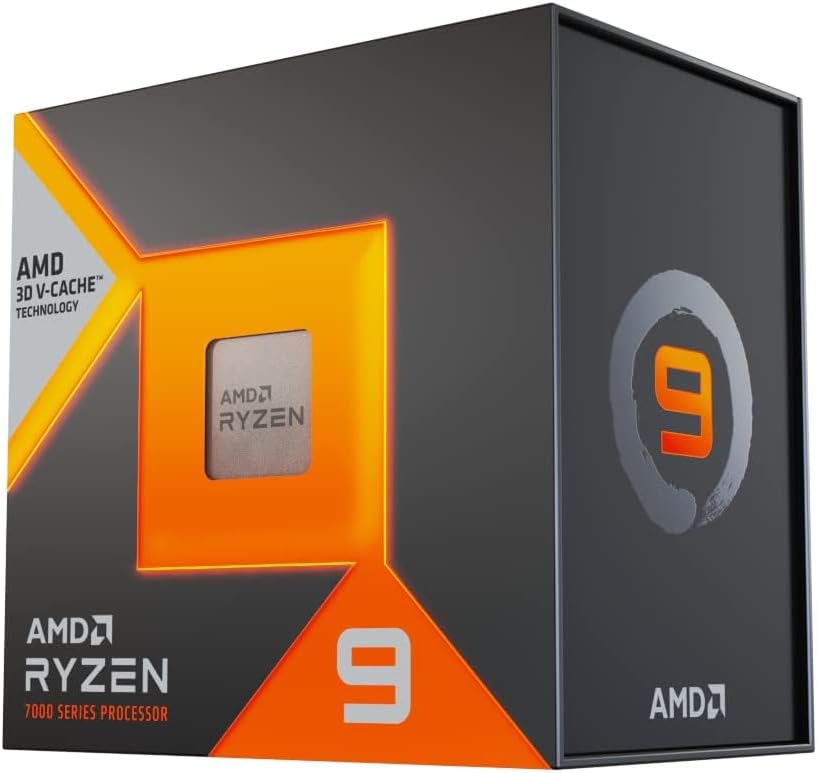
Spec sheet
AMD Ryzen 9 7900X3D
- Processor Series & Architecture
- AMD Ryzen 9, Zen 4 Architecture
- Physical Core & Thread Count
- 12 Cores, 24 Concurrent Threads
- Total Secondary Cache
- 140 MB Total Cache Memory Installed
- Base & Maximum Boost Clocks
- 5.5 GHz Max Boost (5.6 GHz Listed Processor Speed)
- Thermal Design Power (TDP)
- 105 Watts
- Integrated Graphics Frequency
- 2200 MHz
- Processor Socket & Platform
- Socket AM5, Windows 10 and Windows 11
- System Memory Support
- DDR5 Memory with Unlocked Overclocking
- Cooling Solution Requirement
- Cooler Not Included, Liquid Cooler Recommended
Figures as published by the manufacturer on the Amazon listing.
Dual-CCD Configuration and 3D V-Cache Topology
Understanding the internal silicon arrangement is essential when assessing the official amd ryzen 9 7900x3d specs. Unlike standard monolithic desktop CPUs or single-chiplet alternatives, this processor utilizes two physical Core Complex Dies (CCDs) connected via AMD’s high-speed interconnect to a centralized I/O die. Each CCD houses 6 physical cores rather than the standard 8 cores found in monolithic dies. This specific ryzen 9 7900x3d ccd configuration creates a total core pool of 12 cores and 24 threads, but the two compute dies are not architecturally identical.
The primary distinguishing feature of the processor is its asymmetric cache layout. AMD applies its ryzen 9 7900x3d 3d v-cache layer directly onto only one of the two 6-core chiplets. The cache-stacked die carries the supplemental 64MB 3D V-Cache slice, granting those six cores instant access to an enormous local cache buffer that drastically cuts down main memory latency. Meanwhile, the second 6-core chiplet remains standard Zen 4 silicon, devoid of stacked cache but capable of clocking closer to the listed 5.5 GHz to 5.6 GHz frequency ceiling. Together with the Layer 2 cache allocations across both dies, the processor reports an expansive 140MB of total installed secondary cache.
This physical disparity means that operating system scheduling plays an indispensable role in daily execution. In our detailed AMD Ryzen 9 7900X3D review materials, thread management is highlighted as the core determining factor of real-world responsiveness. When modern schedulers in Windows 10 and Windows 11 detect a gaming application, threads must be guided toward the six cache-dense cores to prevent latency penalties. When productivity applications initiate, all 24 threads across both dies fire simultaneously. For users who delve into BIOS settings and driver stacks, this asymmetrical design offers an intriguing blend of compute density and localized cache acceleration.
Gaming Performance and Thread Scheduling Dynamics
When analyzing the capabilities of the ryzen 9 7900x3d for gaming, the architectural reality of its six cache-equipped cores defines the user experience. Because the 3D V-Cache is mounted to just one CCD, gaming workloads that fit neatly within six physical cores thrive. Titles that rely heavily on rapid memory retrieval—such as open-world simulations, complex physics engines, and expansive strategy games—benefit immediately from the expanded cache, showing remarkable stability in 1% and 0.1% low frame times. By keeping game logic inside the massive 140MB cache pool, the CPU avoids repetitive trips to system RAM, smoothing out micro-stutter in dense rendering environments.
However, the limitation stems from the physical core distribution. Gamers looking at a Ryzen 7 7800X3D bundle often notice that an 8-core single-CCD chip can deploy all eight cores directly beneath a shared cache canopy without cross-die latency. On the 12-core part, if a game demands more than six physical cores and spills over to the second die, communication across the interconnect can introduce microsecond latency penalties. AMD manages this through specialized chipset drivers and Windows game mode integration, parking the frequency die during pure gaming sessions so execution remains anchored to the 6-core cache die.
This technical nuance means the processor functions effectively as a hyper-fast 6-core gaming chip when gaming takes center stage, and transforms into a broad 12-core productivity workhorse the moment multi-threaded rendering kicks in. For enthusiast gamers running high-resolution panels at 1440p or 4K, where GPU limits often take precedence over CPU bottlenecks, the frame rates generated by this chip remain exceptionally consistent, backed by the stability of its massive cache pool.
Workstation Performance and Multi-Threaded Processing
Where this processor pulls distinctly ahead of single-die gaming parts is in multi-core compute throughput. The ryzen 9 7900x3d workstation performance profile leverages all 12 cores and 24 concurrent threads to power through demanding professional workloads. Video production suites, 3D ray tracing, rasterization, and local code compiling fully populate both compute dies. In these scenarios, the presence of the frequency-boosted second CCD pays immediate dividends, driving sustained multi-threaded performance that easily outclasses 8-core alternatives.
Content creators handling high-bitrate video workflows will also appreciate the baseline hardware convenience provided by the Zen 4 architecture. AMD embeds an integrated graphics core with a graphics frequency of 2200 MHz into the platform. While not intended for high-end 3D gaming, this integrated GPU provides essential multi-monitor display capabilities and rapid system diagnostics, enabling creators to troubleshoot rendering rigs or maintain auxiliary displays without dedicating primary discrete GPU lanes.
The processing headroom afforded by 24 threads also supports complex background operations. A creator can broadcast an uncompressed video stream, encode local capture files, and run chat overlays simultaneously without starving the primary gaming thread. While users who require non-stop enterprise compute might evaluate the broader landscape against next-generation chips like the AMD Ryzen 9800X3D, the 12-core architecture of this Zen 4 model establishes a very capable bridge between everyday workstation demands and high-performance recreational gaming.
Platform Compatibility, DDR5 Memory, and PCIe 5.0
Motherboard selection and platform integration represent a key consideration for this processor. The processor operates strictly on the newer Socket AM5 platform, moving away from legacy PGA layouts to an LGA grid with physical dimensions measuring 1.57 inches long by 1.57 inches wide. Verifying ryzen 9 7900x3d am5 compatibility is straightforward: the processor requires an AM5 motherboard, natively supporting the platform across AMD 600-series chipsets. The listing confirms that the silicon supports high-bandwidth PCIe 5.0 lanes on select 600 Series motherboards, granting extensive data throughput for next-generation solid-state storage and future add-in cards.
Memory topology has also evolved with the transition to AM5. The ryzen 9 7900x3d ddr5 memory support is strictly tied to DDR5 SDRAM, omitting backward compatibility with older DDR4 memory kits entirely. AMD provides unlocked memory overclocking capabilities, allowing power users to configure high-speed memory profiles and tune sub-timings. Pairing this chip with stable, low-latency DDR5 kits ensures that the I/O die maintains rapid communication between the system memory and the dual compute chiplets.
The transition to AM5 also delivers long-term platform viability. System builders investing in an AM5 foundation gain native compatibility with modern operating systems, specifically Windows 10 and Windows 11. Given the dynamic thread parking requirements of the dual-CCD design, running an up-to-date installation of Windows 11 is highly recommended to leverage the latest scheduler routines, ensuring that background tasks and gaming threads route to their optimal dies automatically.
Thermal Characteristics and Cooling Requirements
Thermal management on stacked 3D V-Cache processors requires careful planning. According to official documentation, the ryzen 9 7900x3d tdp cooling requirements are defined by a 105-watt thermal design power rating. This 105W figure is notably lower than the 170W TDP found on standard non-X3D 12-core chips in the Zen 4 generation, showcasing the deliberate power tuning AMD applied to preserve the structural integrity of the stacked cache silicon.
Because the 3D V-Cache is bonded directly on top of the compute cores using TSV (through-silicon vias), heat dissipation through the integrated heat spreader faces greater thermal resistance than standard monolithic silicon. Consequently, AMD has set the maximum operating temperature (Tjmax) at 89°C. This 89°C threshold is lower than the 95°C ceiling typical of standard Zen 4 processors, meaning the CPU will begin throttling boost frequencies earlier if cooling capacity is insufficient.
Prospective buyers must note that AMD does not include a cooling solution inside the packaging. The official manufacturer specification explicitly advises that a liquid cooler is recommended. To maintain maximum boost clocks near 5.5 GHz across gaming sessions and sustained workstation workloads without bumping against the 89°C thermal boundary, deploying a high-quality liquid cooling loop or an expansive all-in-one cooler is virtually mandatory for keeping heat soak under control.
AMD Ryzen 9 7900X3D Pros and Cons
What works
- 12 physical cores and 24 concurrent threads
- Massive 140MB total installed secondary cache
- Conservative 105-watt TDP power profile
- Socket AM5 platform with PCIe 5.0 support
- Unlocked DDR5 memory overclocking capabilities
What to weigh up
- No cooling solution included in packaging
- Liquid cooling recommended by manufacturer
- Reduced 89°C maximum operating temperature limit
Check AMD Ryzen 9 7900X3D on Amazon
Who Should Buy the AMD Ryzen 9 7900X3D
Buy It If
- You manage hybrid workflows that balance heavy 3D rendering, video editing, or software compilation with intensive gaming.
- You want a power-efficient 12-core desktop processor capped at a modest 105-watt TDP profile.
- You are building a high-bandwidth Socket AM5 system utilizing DDR5 memory and PCIe 5.0 storage on select 600-series boards.
- You play cache-sensitive simulations, open-world titles, and strategy games that show marked stability gains from a 140MB cache pool.
Skip It If
- Your computing needs consist exclusively of high-framerate competitive gaming without any background productivity tasks.
- You do not want to invest in a dedicated liquid cooling solution, which AMD recommends for managing thermal limits.
- You are seeking an entry-level processor that includes a basic bundled air cooler in the retail box.
Final Verdict
9.6/10Our score
When deciding whether the is ryzen 9 7900x3d worth it proposition holds true for your next build, the outcome hinges on your workload balance. The processor is neither a single-purpose gaming component nor a slow, monolithic workstation unit. Instead, it serves as a specialized, highly capable hybrid processor. Its 12 cores and 24 threads provide substantial rendering muscle, while the 140MB secondary cache pool ensures exceptional frame stability in titles that demand immediate memory access.
By operating within a restrained 105W TDP limit, it delivers remarkable efficiency, though the 89°C Tjmax and requirement for an aftermarket liquid cooler demand appropriate hardware planning. If you are a digital creator who demands a balanced computing environment on the modern AM5 platform, the AMD Ryzen 9 7900X3D provides a compelling, architecturally sophisticated engine capable of handling multi-threaded production by day and smooth gaming by night.
FAQ
Does the AMD Ryzen 9 7900X3D come with a cooler in the box?
No, the processor is packaged as a bare processor unit without any bundled thermal solution. AMD explicitly recommends pairing this 105-watt chip with an aftermarket liquid cooler to manage heat density and adhere to the 89°C maximum operating temperature.
Why do some buyers search for the AMD Ryzen 7 7900X3D?
Shoppers often confuse AMD’s naming tiers because the 8-core 7800X3D belongs to the Ryzen 7 family, leading some to search for an amd ryzen 7 7900x3d. In reality, the 7900X3D is strictly a Ryzen 9 desktop processor featuring 12 cores and 24 threads.
What socket and motherboard chipsets are required for this processor?
The processor requires a motherboard equipped with Socket AM5. It supports PCIe 5.0 on select AMD 600-series motherboards and is fully compatible with both Windows 10 and Windows 11 operating systems.
Can I use DDR4 memory with the AMD Ryzen 9 7900X3D?
No, the Socket AM5 platform completely drops support for older DDR4 system memory. The processor natively supports DDR5 memory and features unlocked memory overclocking support for tuning system performance.
What is the integrated graphics capability on this processor?
The processor includes integrated AMD Radeon graphics running at an engine clock of 2200 MHz. While not engineered for intensive 3D gaming, this graphics engine provides essential video output for everyday computing, troubleshooting, and multi-monitor setups.
See this listing on Amazon We may earn a commission if you buy through this link.
More in PC Components & Storage


The weekly shortlist
Specs worth reading, once a week
New teardowns, spec sheets and buying notes from across the desk.
This demo form is not connected to a mailing service.